

Your Content Is Quietly Losing Ground (Here’s What Refreshing It Can Do)
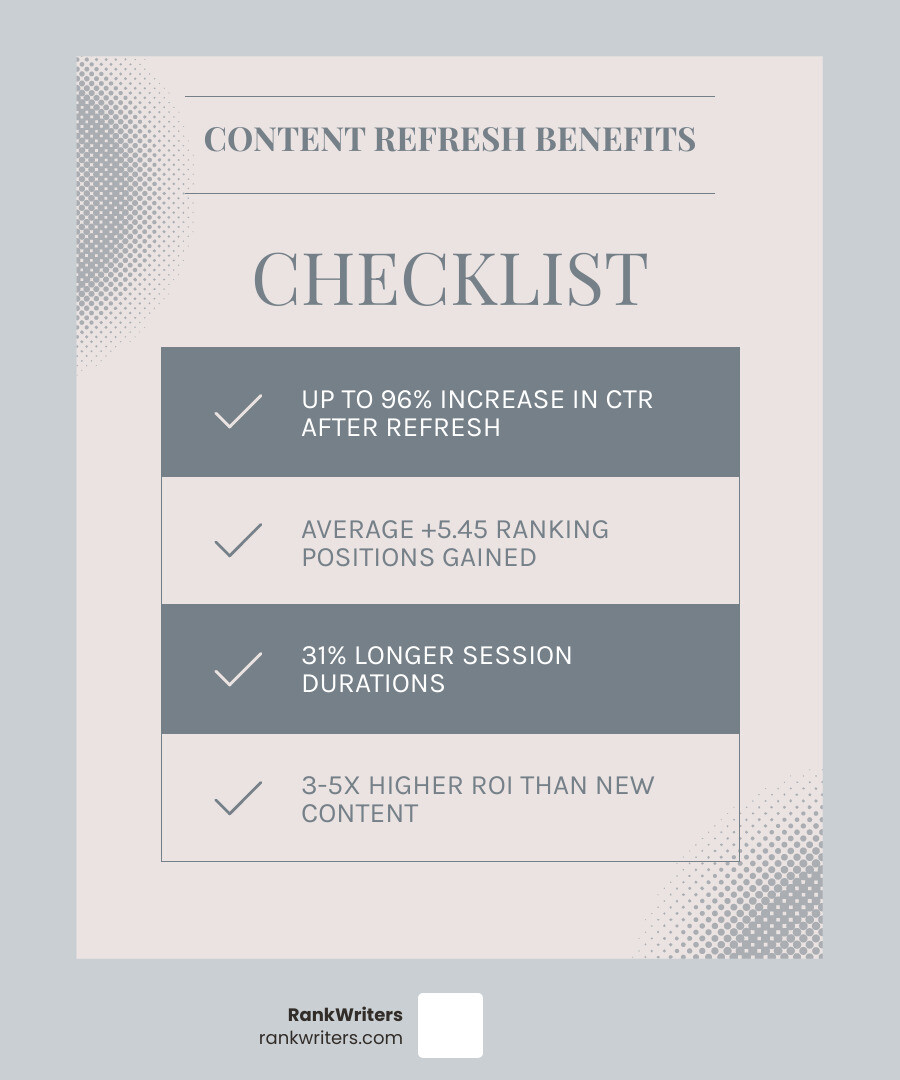
The impact of refreshing content is measurable, significant, and often faster than most marketers expect. If you want the short version:
What happens when you refresh content:
| Benefit | What the Data Shows |
|---|---|
| More clicks | Up to 96% increase in CTR after a refresh |
| Higher rankings | Pages gain an average of +5.45 positions with a 31-100% content expansion |
| Longer sessions | Refreshed, time-sensitive content drives 31% longer session durations |
| Better ROI | Refreshing existing content yields 3-5x more ROI than writing new posts |
| AI visibility | ChatGPT cites content that is 25.7% fresher than average search results |
| Slower decay | Content updates reduce natural ranking decay by 87% |
Here is the uncomfortable reality: content does not stay relevant on its own.
In competitive niches, pages that used to hold their rankings for 12-18 months are now decaying in as little as 3-6 months. Google’s freshness signals now account for roughly 6% of its ranking algorithm, up from less than 1% just a few years ago. And AI search tools like ChatGPT and Perplexity are drawing the majority of their citations from content updated within the last 30 days.
Meanwhile, most businesses are still pouring budget into creating new content while their existing pages quietly bleed traffic.
That is the gap this guide is designed to close.
Whether you run a blog, an e-commerce site, or a service business, your existing content is an asset. One that is either compounding in value or slowly eroding. Knowing how to identify which pages need attention, what to change, and how often to do it is one of the highest-ROI skills in modern SEO.
By Allie Leng-Barton
Defining the Impact of Refreshing Content on SEO
To understand the impact of refreshing content, we first have to look at how search engines perceive time. Google has long prioritized recency through various updates, most notably the Caffeine update, which allowed the search engine to index and surface fresh content much faster than before.
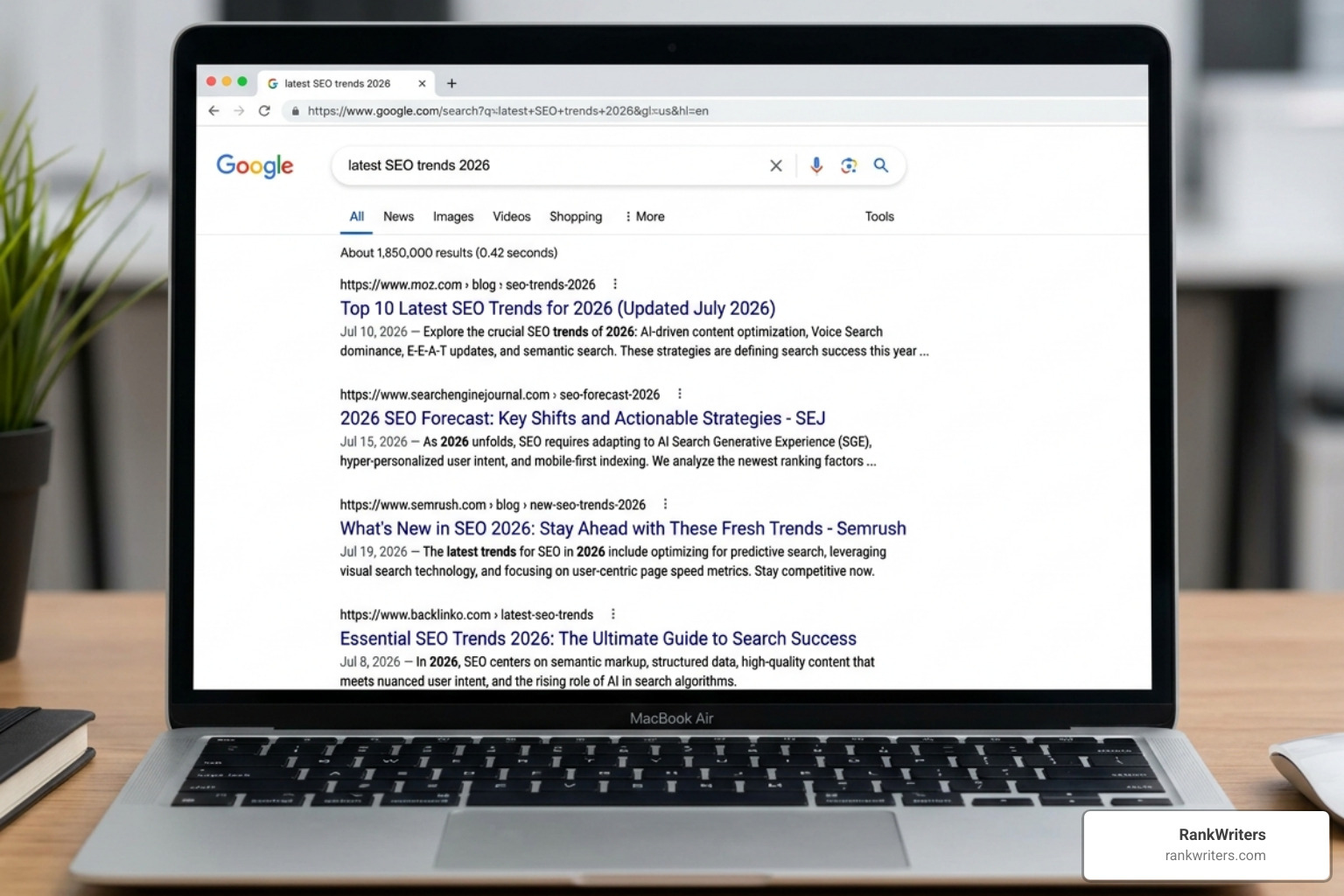
One of the most critical components of this is the “Query Deserves Freshness” (QDF) algorithm. This signal identifies when a user is looking for the latest information on a trending topic, such as “mortgage rates May 2026” or “latest SEO trends.” If your content was written in 2024, it simply won’t satisfy a 2026 search intent, regardless of how well it was originally written.
According to research by Profitero, Refreshing Content: The Impact of Keeping Content Optimized is a major factor in “digital shelf” success. Their data shows that more than half of the products on Amazon did not change their content in 2025, leading to significant performance gaps compared to brands that actively maintained their listings. On the search engine side, freshness now accounts for approximately 6% of the ranking algorithm. This is a massive jump from historical levels, highlighting that Google increasingly views outdated content as unhelpful content. For those looking for more context on these shifts, you can read More info on the latest Google Search Update.
Measuring the Impact of Refreshing Content on CTR
A content refresh is not just about rankings; it is about the “clickability” of your search result. When a user sees a date from two years ago in the SERP (Search Engine Results Page), they are statistically less likely to click. Studies show that sites regularly refreshing time-sensitive content see a 47% higher Click-Through Rate (CTR).
For example, a post titled “How to Get Over 1 Million YouTube Subscribers” saw a 38% increase in click performance simply by updating the metadata and internal data to reflect current platform trends. In another case, a post about “Shadow Banning” yielded a 96% boost in clicks after terminology was updated to match modern industry slang. This proves that aligning your content with current user intent is a prerequisite for Developing a winning Seo Content Strategy.
The Impact of Refreshing Content on AI Search Visibility
In 2026, we are no longer just optimizing for humans and traditional search bots. We are optimizing for Large Language Models (LLMs) and Answer Engines. This is known as AEO (Answer Engine Optimization) and GEO (Generative Engine Optimization).
The impact of freshness here is even more pronounced. AI platforms like ChatGPT, Gemini, and Perplexity have a heavy freshness bias. Research indicates that AI search citations are 25.7% fresher on average than traditional organic search results. Perplexity, for instance, sources roughly 50% of its citations from content published or updated in the current year. If your content is stale, you are effectively invisible to AI Overviews. To stay competitive, you must understand How To Optimize Content For Ai Dont Get Left Behind.
Why Content Freshness Drives User Engagement
Freshness is the fuel for positive user signals. Google’s Navboost system, which uses historical interaction data to evaluate the quality of a page, relies heavily on how users behave when they land on your site.
When content is updated with new data, better visuals, and more accurate answers, dwell time increases and bounce rates drop. If a borrower is looking for information from mortgage lenders and finds a guide with 2023 interest rates, they will immediately “pogo-stick” back to the search results. This sends a negative signal to Google that your page did not satisfy the query.
Conversely, a refresh that adds current statistics and actionable advice keeps users on the page longer. Refreshed content has been shown to drive 31% longer session durations. This engagement is a virtuous cycle: better signals lead to better rankings, which lead to more traffic. For a deeper dive into what specific elements to change, check out Content Refresh 101: What to Update (and Why It Works) and our Tips for Writing Seo Friendly Content.
Identifying and Prioritizing Content for a Refresh

You cannot refresh everything at once. Strategic prioritization is key to maximizing ROI. The best place to start is your own data in Google Search Console (GSC).
What to look for:
- Content Decay: Look for pages that have seen a sustained 3 month decline in clicks or rankings. This is the primary signal that your content is losing its “charm” to competitors.
- Low-Hanging Fruit: Identify pages ranking in positions 5 to 20. These pages already have “proven ranking ability” but are just missing the extra push needed to reach the top 3 spots, where the majority of clicks happen.
- High Impressions, Low CTR: If a page has thousands of impressions but a CTR under 1%, the topic is relevant, but your title or meta description is likely outdated or unappealing.
For mortgage lenders (IMBs), this might mean refreshing a guide for borrowers on “First-Time Homebuyer Programs” if the local Westmoreland County regulations have changed. Maintaining these Cornerstone Pages Support Seo ensures your most valuable assets continue to generate leads. As noted by Why a Content Refresh Matters – SBAM, keeping content updated is a technical necessity for staying relevant in a crowded digital space.
Step-by-Step Process for a Successful Content Refresh
A successful refresh is more than just changing the “published” date. In fact, cosmetic date changes without substantive updates can actually penalize your site. Follow this systematic process:
- Conduct a Content Audit: Use tools like Screaming Frog or GSC to export your URLs and identify the “decaying” pages mentioned above.
- Analyze the Competition: Look at the top 3 results for your target keyword. What do they have that you don’t? Are they using videos, infographics, or more recent data?
- Expand and Update: Research shows that adding 31-100% more content to an existing page produces a statistically significant ranking gain of +5.45 positions. Add new sections that answer “People Also Ask” questions.
- Optimize Metadata: Rewrite your title tags and meta descriptions to include the current year (2026) and more compelling hooks.
- Fix Technical Debt: Check for broken internal and external links. Ensure all images have descriptive alt text.
- Visual Enhancement: Add a new infographic or a video. Visuals can increase engagement by 650% compared to text-only posts.
- Republish and Promote: Change the “last modified” date and resubmit the URL in Google Search Console. Treat it like a new post by sharing it on social media and in your newsletter.
For those repurposing content for the AI era, use this Checklist For Optimizing Repurposed Content For Ai Search to ensure your updates align with LLM requirements. You can also find more strategies in this Content Refresh Strategy for Increasing Website Traffic – ContentStudio guide.
Frequently Asked Questions about Content Refreshing
How often should content be refreshed?
It depends on the topic’s “velocity.” High-evolution topics like technology or news should be reviewed every 3-6 months. Strategy guides and evergreen content should be audited every 12 months. A good rule of thumb is that if the data in the post is more than a year old, it’s time for a refresh.
Does refreshing content help with AI Overviews?
Yes, significantly. AI systems are trained to prioritize recent, structured, and authoritative information. By adding FAQ sections, updated statistics, and clear H2 headers, you make it easier for AI agents to crawl and cite your content in their answers.
What are the most common refresh mistakes to avoid?
The biggest mistake is changing the URL. Never change the URL of a ranking page, as you will lose all existing backlink equity and crawl history. Other mistakes include making only “thin” updates (less than 10% change) or deleting sections that are already driving traffic for secondary keywords.
Conclusion
The impact of refreshing content is one of the most powerful levers in a digital marketing strategy. By breathing new life into existing assets, businesses can see traffic lifts of 50-300% without the massive time investment required to create brand-new content from scratch.
At RankWriters, we specialize in this systematic, future-proof approach. Whether you are a local business in Westmoreland County or a national brand, our focus is on driving revenue through a combination of traditional SEO, AEO, and GEO. We understand that in 2026, staying still is the same as moving backward.
Programs like the Small communities are big winners in Revitalizing Westmoreland initiative show how important it is to keep local information current and accessible. By maintaining your “digital shelf,” you ensure your brand remains the go-to authority for your audience.
Ready to stop the decay and start growing? Learn more about our SEO Agency Services and let us help you turn your old content into a lead-generation machine.