

Why AI Optimized Content Is the New Competitive Edge
AI optimized content is content specifically structured and written so that AI models like ChatGPT, Perplexity, and Google’s AI Overviews can easily understand, extract, and cite your expertise. Here’s what makes it different:
- Structured for machine parsing – Clear headings, short paragraphs, bulleted lists, and tables
- Data-rich and specific – Concrete facts, verifiable statistics, and cited sources instead of vague claims
- Semantically clear – Simple language that defines terms and connects concepts logically
- Citation-ready – Self-contained answers that AI can quote directly
- Regularly updated – Fresh content signals credibility to AI systems
If you’ve Googled anything lately, you’ve noticed AI Overviews dominating the search results. According to recent data, AI referrals to top websites spiked 357% year-over-year, reaching 1.13 billion visits in June 2025. This isn’t a trend—it’s a fundamental shift in how people find information.
The harsh reality? Your content might rank on page one but never get mentioned when someone asks ChatGPT or Perplexity for recommendations in your industry. Traditional SEO focused on getting pages to rank. AI optimization focuses on getting your expertise cited in the answers users actually see.
Most business owners are stuck. They’re pouring money into content that Google understands but AI ignores. They’re watching competitors show up in AI-generated answers while their own brand stays invisible. The rules changed, but nobody sent a memo.
The gap between traditional SEO and what AI needs is costing you leads.
I’m Allie, a content strategist focused on how AI is reshaping search and discovery, and I’ve helped teams turn AI optimized content into clear, structured answers that AI systems can understand, trust, and cite. Let me show you exactly how to bridge that gap.
The New Search Paradigm: From Keywords to Conversations
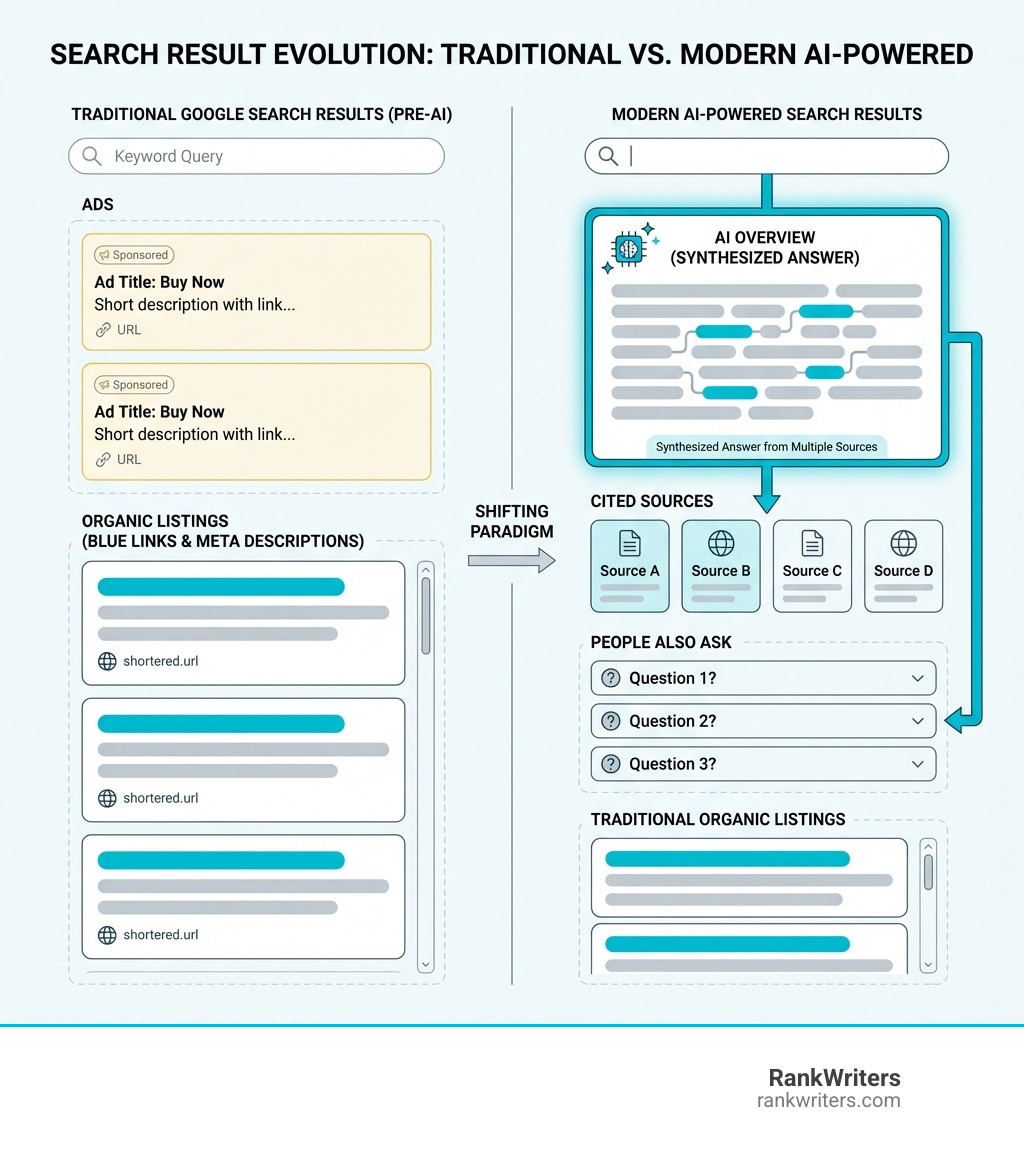
The internet is evolving, and with it, how we search for information. Gone are the days when a simple keyword match guaranteed visibility. Today, AI-powered search engines and large language models (LLMs) are reshaping the landscape. They don’t just match keywords; they understand intent, synthesize answers, and evaluate the trustworthiness of sources. This means our approach to content creation must also evolve.

This new paradigm introduces us to concepts like Generative Engine Optimization (GEO) and Answer Engine Optimization (AEO), which are crucial for success. While traditional SEO still matters, we can’t afford to ignore the rising tide of AI. In fact, many experts believe that SEO isn’t dead in 2025, but AI changes the game. Understanding the subtle yet significant differences between AI Overviews and Featured Snippets, for instance, is just one piece of this puzzle. You can learn more about these nuances in our article on AI Overviews vs. Featured Snippets: What’s the Difference?.
What is AI Content Optimization?
At its core, AI content optimization is the practice of using artificial intelligence technology to create and improve content, enhancing its visibility and performance. Our goal is to help content better satisfy search engines and meet the target audience’s needs, ultimately leading to better rankings and, more importantly, better answers from AI. It’s about designing content that AI systems can easily interpret, categorize, and present as a definitive answer. This discipline is often referred to as Generative Search Optimization, focusing on how AI models “see” and use our content.
We’re moving beyond just writing for algorithms. We’re writing for intelligent systems that read for meaning, interpret connections, and evaluate accuracy by comparing definitions across sources.
Why AI Optimization Is No Longer Optional
AI is rapidly becoming the first touchpoint for information findy. Users are increasingly turning to AI assistants like ChatGPT and Google’s AI Overviews for quick, synthesized answers. This shift means that if our content isn’t optimized for these systems, we risk losing visibility entirely. Pew’s research makes it clear: if your content doesn’t appear in the summary, users probably won’t see it. They’re skipping the blue links—even the top ones.
The benefits of optimizing for AI are compelling:
- Increased AI Citations: Content with specific data points is 30-40% more likely to appear in LLM responses.
- Higher Engagement: When AI systems cite our content, it often leads to increased brand visibility and direct traffic.
- Improved Trust: Authoritative content is up to 30% more likely to appear in AI-generated answers, building reader trust.
- Efficiency and Scalability: AI tools can help automate parts of the optimization process, making it more efficient and scalable.
Ignoring this shift can lead to a significant drop in website traffic, as discussed in our article, Why Is My Website Traffic Down? AI Search for Lenders. It’s no longer just about ranking; it’s about being selected.
SEO Content vs. AI-Optimized Content
To truly grasp the shift, let’s compare traditional SEO content with the demands of AI optimized content:
| Feature | Traditional SEO Content | AI-Optimized Content |
|---|---|---|
| Primary Goal | Rank pages for keywords; drive clicks | Be cited by AI models; provide direct answers |
| Focus | Keywords, backlinks, page authority, crawlability | Clarity, structure, data, trustworthiness, semantic meaning |
| Evaluation by | Search engine algorithms (ranking signals) | LLMs (semantic analysis, information extraction, trustworthiness) |
| Content Structure | Often long-form, keyword-rich | Hierarchical, scannable, Q&A formats, lists, tables |
| Language | Keyword-centric, often verbose | Entity-centric, precise, unambiguous, natural language |
| Data Usage | General statements, opinions | Specific numerical data, verifiable facts, cited sources |
| Trust Signals | Domain authority, backlinks | E-E-A-T (Experience, Expertise, Authoritativeness, Trustworthiness), citations, freshness |
| Outcome | Page appears on SERP, user clicks link | Content excerpt appears in AI summary, user gets direct answer |
The Anatomy of AI-Friendly Content
Creating AI optimized content isn’t just about tweaking a few keywords; it’s about fundamentally rethinking how we structure and present information. AI models don’t “read” like humans do. They parse, extract, and synthesize. This means our content needs to be designed as a set of building blocks that AI can easily understand and reassemble.

We need to focus on a clear hierarchical structure, high information density, semantic clarity, and strong E-E-A-T (Experience, Expertise, Authoritativeness, Trustworthiness) signals. Our guide on Format Content for AI Search digs deeper into these aspects.
Structure for Scannability and Extraction
AI systems thrive on structure. Articles with clear hierarchical structure are processed by language models with 67% higher information extraction accuracy. This isn’t just for AI; it also makes our content more user-friendly.
Here’s how we structure for optimal scannability and extraction:
- Hierarchical Headings (H1, H2, H3): Use one H1 for the main title, H2s for primary sections, and H3s (or H4s) for supporting points. This acts like a table of contents for AI, guiding it through our content.
- Short Paragraphs: Break down long blocks of text into concise, digestible paragraphs, ideally 2-4 sentences each. Long walls of text blur ideas and make parsing difficult for AI.
- Bulleted and Numbered Lists: These are fantastic for breaking down complex details into clean, reusable segments. Content using structural formatting elements (tables, lists, highlights) has 89% higher data extraction accuracy by AI systems.
- Tables for Data: When presenting comparative data or detailed information, tables are invaluable. They allow AI to easily extract and understand relationships between different data points.
- Semantic HTML: Using appropriate HTML tags (like
Our approach to how to do SEO content writing now heavily incorporates these structural best practices.
Write with Semantic Clarity and Specificity
AI systems prefer precise and unambiguous communication. They don’t want fluff; they want facts.
- Simple Language: Peer-reviewed studies show that clarity wins. Stick to short sentences (15–20 words) and write in simple, natural language. Avoid jargon where possible, or define it clearly.
- Specific Data Points: Content with specific data points is 30-40% more likely to appear in LLM responses. The presence of specific numerical data in content increases the probability of citation by AI systems by 210%. Instead of saying “Our company offers the best CRM solutions,” say “Our CRM solution reduced customer ticket response time by 43% in a company with 200 employees.”
- Verifiable Facts: Anchor claims in measurable facts and provide data sources for at least 60% of main claims. Articles with data sources for at least 60% of main claims are cited by AI five times more frequently than articles based primarily on opinions.
- Avoiding Vague Marketing Claims: AI systems instantly distinguish concrete, verifiable information from marketing generalities. Vague language like “next-gen” or “cutting-edge” without context is worthless to AI.
This focus on precise, factual language is key to writing content for AI queries.
Build Authority with E-E-A-T and Freshness
AI systems, much like human readers, seek out authoritative and trustworthy information. This is where E-E-A-T comes into play.
- Author Authority: Articles written by authors with clearly defined and verifiable qualifications are cited by AI systems 176% more frequently than anonymous or poorly documented content. We ensure our authors have clear bios showcasing their expertise. This includes their professional background, certifications (e.g., Google Analytics Certified Expert), and publication history. Expertise, Authoritativeness, and Trustworthiness (E-A-T) determines whether AI systems trust your content enough to quote it.
- Citing Credible Sources: Supporting every point with real data, examples, or credible third-party sources is crucial. This not only builds trust with readers but also helps AI models verify claims.
- Regular Content Updates: Content updated at least quarterly has a 234% higher citation rate by AI systems than static content. AI systems prefer actively maintained sources, signaling current and credible information. We make sure our evergreen content is reviewed and refreshed regularly. Marking update dates is also crucial, as AI systems treat this as a signal of active content maintenance.
Maintaining high AI content quality means continuously demonstrating our expertise and keeping our information current.
Your Action Plan for Creating AI Optimized Content
Now that we understand the “why” and “what” of AI optimized content, let’s dive into the “how.” This section provides actionable steps to integrate AI optimization into our content strategy, ensuring our brand appears in those coveted AI-generated answers.
Our checklist for optimizing repurposed content for AI search offers a great starting point for leveraging existing assets.
Using AI for On-Page SEO and Keyword Strategy
AI tools are changing how we approach keyword research and on-page optimization. They go beyond simple keyword suggestions to identify deeper semantic relationships and content gaps.
- AI Tools for Content Gaps: AI can reveal content gaps and improve clarity and comprehensiveness by identifying missing topics or areas where more detail is needed. We can use AI tools to analyze our existing content and suggest areas for expansion.
- Secondary Keywords and Keyword Clustering: AI can help us identify secondary keywords that complement our primary keywords, broadening our search visibility. Then, we can use AI to cluster these keywords into logical groups, ensuring our content covers topics exhaustively. This shifts our focus from individual keywords to comprehensive topic relevance.
- Topic Relevance Over Density: AI systems understand content by context and relationships between terms, not by counting keywords. Overloading content with keywords (keyword stuffing) is an outdated practice that hurts readability and AI interpretation. Instead, we focus on covering topics completely and naturally, using related terms and synonyms.
Tools like an AI SEO Agent: SEO Strategy Generator can help us automate parts of this process, generating initial strategies that we then refine with human expertise.
How to create AI optimized content for titles, metas, and snippets
Titles, meta descriptions, and featured snippets are our content’s first impression, both for users and AI. Optimizing these elements for AI means being concise, clear, and directly answering potential questions.
- Concise Answers and Q&A Format: AI models love direct, concise answers. Using a Q&A format, especially for common questions, makes it easy for AI to extract and present our content. We aim for one- to two-sentence answers that can stand alone.
- Self-Contained Phrasing: Each piece of information should be self-contained and make sense when pulled out of context. This is crucial for featured snippets and AI-generated summaries.
- Optimizing for Featured Snippets: Featured snippets often come from structured content like lists, tables, and Q&A sections. By answering specific questions clearly and concisely within our content, we increase our chances of appearing in these prominent positions.
- Voice Search Optimization: Voice search queries are typically longer and more conversational, often phrased as questions. By structuring our content with clear headings that ask questions and providing direct answers, we naturally optimize for voice search.
Our guide on how to get your brand mentioned in AI tools like ChatGPT and Perplexity provides more strategies for this.
Implementing Schema Markup: Your Direct Line to AI
Schema markup is perhaps the most advanced element of AI optimized content. It’s metadata invisible to human readers but extremely readable to AI systems, providing context and semantic meaning to individual content elements.
- What is Schema?: Schema.org is a collaborative effort to create structured data markups that search engines and AI systems can understand. It’s like giving AI a map to our content.
- JSON-LD Format: We typically implement schema in JSON-LD format, which is a JavaScript notation embedded in the
orof our HTML. It’s the recommended format by Google. - FAQ, HowTo, Product Schema: We use specific schema types where they make sense:
- FAQ Schema: For frequently asked questions sections, this explicitly tells AI that we’re providing answers to common queries. Articles containing an FAQ section with at least 5 questions have a 280% higher citation rate by AI systems.
- HowTo Schema: For step-by-step guides, this helps AI understand the sequence of actions.
- Product Schema: For product pages, this provides details like price, availability, and reviews directly to AI.
- 340% Higher Citation Rate: Articles with comprehensive structured data are cited by AI systems 340% more frequently than identical content without this markup. This is one of the highest-impact changes we can make for AI visibility. You can find more details on structured data and schema markup from Google.
Common Pitfalls and How to Avoid Them
Even with the best intentions, it’s easy to stumble when venturing into AI optimized content. We’ve learned from our experiences and the broader industry how crucial human oversight and continuous testing are.
The ‘Don’ts’: Mistakes That Hurt AI Visibility
Many traditional SEO tactics, or even misapplications of AI, can backfire in the age of AI search.
- Long Walls of Text: These blur ideas and make parsing difficult for AI. AI extracts chunks of information.
- Hiding Content in Tabs or Expandable Menus: AI may not render or fully process content that is hidden behind interactive elements. Key information should be directly visible in the main content.
- Relying Solely on AI for Creation: While AI can assist, relying entirely on it for net-new content can lead to generic, unoriginal, or even inaccurate information. AI systems often generate formulations that are low-value for other AI systems. This can be a “recipe for disaster,” leading to a loss of strategic direction. Our article, ChatGPT Fails You Shouldn’t Stake Your Job On: AI, digs into these risks.
- Keyword Stuffing: This outdated practice prioritizes keywords over human experience, leading to over-optimized content that is not engaging. AI looks for semantic clarity, not keyword density.
- Ignoring Content Updates: Static content signals less credibility. AI systems prefer actively maintained sources.
- Unverifiable Claims: Making claims without supporting data or credible sources (e.g., “we are the best” without proof) is quickly dismissed by AI.
The ‘Dos’: Best Practices for Sustainable Success
To truly succeed with AI optimized content, we need to accept a collaborative approach and prioritize genuine value.
- Focus on User Intent: Understand what questions our audience is asking and structure content to provide clear, direct answers. Write for the user first, and AI will follow.
- Human Review and Editing: AI is a powerful assistant, but human expertise is irreplaceable. We use AI to support research, organize structure, or generate first versions, but final content requires significant human curation for accuracy, brand voice, and unique insights.
- Make Content ‘Citation-Ready’: This means writing self-contained answers, using clear definitions, and backing claims with data. The goal is for AI to confidently extract and quote our content.
- Use AI as a Collaborator: AI content operations is the discipline of producing people-first content at scale using personas, our sources, and citations as guardrails. It converts noisy inputs into verifiable pages optimized for SEO and AI Overviews. Learn more here.
- Test Visibility in AI Engines: We regularly test our content’s visibility in major AI systems (ChatGPT, Claude, Perplexity, Gemini) by running relevant queries and checking if our articles are cited. This iterative testing helps us refine our strategy. Our article on tactics to get mentioned in AI (Perplexity, ChatGPT) offers practical advice.
Frequently Asked Questions about AI Optimized Content
How is AI-optimized content different from standard SEO content?
AI-optimized content prioritizes structural clarity, data-rich specificity, and semantic meaning for machine interpretation, not just keyword targeting for ranking. It’s designed to be parsed, understood, and cited by AI models. While traditional SEO content aims to rank on a search results page, AI-optimized content aims to have its information extracted and included directly in an AI-generated answer or summary.
Can I use AI to write AI-optimized content?
Yes, but with caution. AI can generate drafts and ideas, but human oversight is crucial for fact-checking, adding unique insights, ensuring brand voice, and verifying data. The best approach is a human-AI collaboration where AI handles repetitive tasks and initial content generation, and humans provide the critical thinking, expertise, and nuanced refinement needed for truly effective AI optimized content.
How do I measure the success of my AI optimization efforts?
We measure success by tracking metrics like appearances in AI Overviews, brand mentions in chatbot responses (often referred to as Share of Voice), and referral traffic from AI search features. Regularly test prompts in generative AI systems like ChatGPT, Claude, and Perplexity, checking whether your articles are cited. Tools like ChatHub can help monitor your visibility across different AI platforms. We also track branded search growth as a secondary signal of AI citations and monitor direct traffic patterns to specific articles.
Conclusion: Future-Proof Your Content Strategy
The shift to AI-driven search is not just another update; it’s a structural change in how information is finded and consumed. To thrive in this new era, we must move beyond traditional SEO and accept the principles of AI optimized content.
The key takeaways are clear:
- Structure for machines: Use clear headings, lists, tables, and semantic HTML.
- Be specific and factual: Support claims with data and verifiable sources.
- Build undeniable authority: Showcase expertise and keep content fresh.
- Leverage AI wisely: Use it as a powerful assistant, not a replacement for human intellect.
- Optimize for citation, not just clicks: Aim to be the source AI trusts and quotes.
The future of search is conversational, intelligent, and deeply integrated with AI. Our content needs to be ready. At RankWriters, we specialize in helping businesses like yours steer this evolving landscape. We combine deep keyword research with AI-centric content structure to deliver a systematic, future-proof approach that drives revenue.
To gain a competitive edge, you need a systematic approach that combines deep keyword research with AI-centric content structure. Start analyzing your content’s potential with our keyword analysis tool.