

The AI Search Revolution Is Already Here
AI based search engines are tools that use artificial intelligence to understand what you actually mean, not just the words you type, and return direct answers instead of a list of links.
Here are the top AI search engines worth knowing in 2026:
| AI Search Engine | Best For |
|---|---|
| Perplexity | General research with cited sources |
| Andi | Privacy-focused, ad-free search |
| Exa | Developer APIs and RAG applications |
| You.com | Enterprise AI agents and pipelines |
| Consensus | Academic and peer-reviewed research |
| Felo | Multilingual queries |
| Phind | Coding and technical research |
Search is changing fast. And if you run a business, this shift affects how customers find you.
Google still handles the majority of search queries. But since mid-2024, AI Overviews and competing AI search tools have shaken up the landscape. Organic click-through rates dropped 61% in that period. Paid CTRs fell 68%.
That’s not a minor update. That’s a structural change.
At the same time, visitors arriving from AI search platforms convert at a rate 23 times higher than visitors from traditional search results. So while volume may be down, intent is way up.
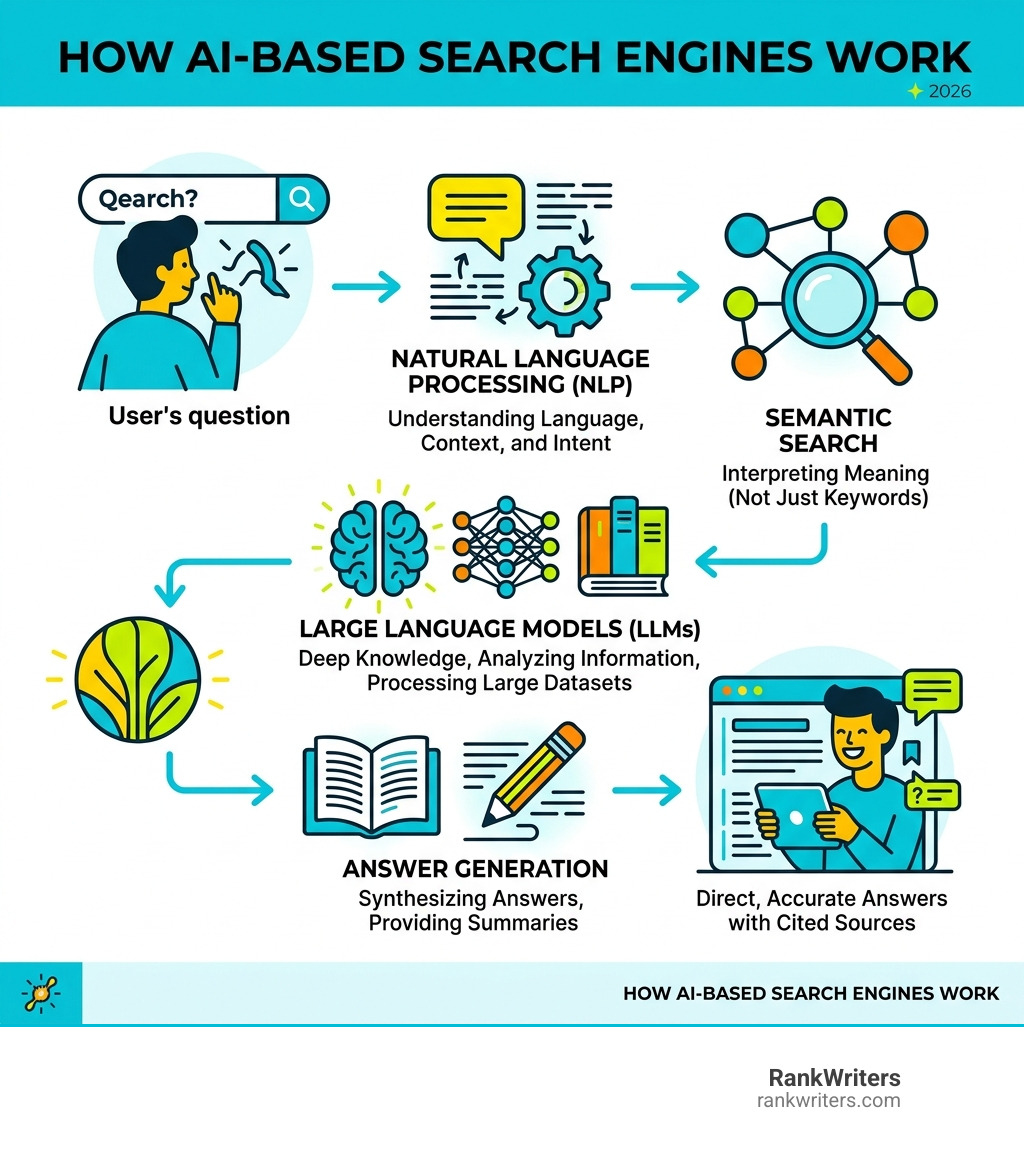
The tools driving this shift, from Perplexity to Exa to You.com, work differently from Google. They use technologies like Natural Language Processing (NLP), Large Language Models (LLMs), and semantic search to understand context, intent, and meaning.
This guide breaks down every major AI search engine you should know, how they compare, and what it means for your content strategy.
What is an AI Based Search Engine?
An ai based search engine is a tool powered by artificial intelligence technologies like Natural Language Processing (NLP) and Large Language Models (LLMs). Unlike a traditional search engine that matches keywords to a database of indexed pages, an AI engine analyzes the context and intent behind a query. It doesn’t just give you a list of links; it synthesizes information from across the web to provide a conversational, comprehensive answer.
For mortgage lenders and IMBs, an AI Search Engine can be a game changer when researching borrower trends. Instead of sifting through dozens of articles on “current mortgage rates in Pennsylvania,” a lender can ask, “How are rising interest rates affecting first-time homebuyer behavior in Westmoreland County?” The AI engine scans real-time data, news reports, and market analyses to provide a structured summary of those specific trends.

The “magic” happens through a process called Retrieval-Augmented Generation (RAG). This technology allows the AI to retrieve relevant, up-to-date information from the live web and then use an LLM to “write” a response based on those facts. This minimizes the risk of the AI making things up while ensuring the information is as fresh as possible. This is supported by scientific research on AI search infrastructure, which emphasizes the importance of grounding LLMs in real-world data.
Core Technologies Powering AI Based Search Engine Results
The engine under the hood of these tools is significantly more complex than a standard crawler. Several key technologies make this possible:
- Transformer Models: These are the neural networks that allow the AI to understand the relationship between words in a sentence, grasping nuance and complex phrasing.
- Vector Embeddings: This technology converts text into mathematical vectors in a high-dimensional space. By doing this, the search engine can find results based on conceptual similarity rather than just matching characters.
- Distributed Indexing: To handle the massive scale of the internet, AI engines use distributed systems that merge traditional inverted indexing with vector-based search for high-speed retrieval.
- Real-time Data Ingestion: Modern tools ensure that if a news story breaks five minutes ago, it is already part of the search results.
For IMBs looking to understand these mechanics deeper, A Comprehensive Guide to AI Search Tools explains how these technologies integrate into daily workflows to improve efficiency.
Key Benefits of Using an AI Based Search Engine
The shift toward AI search isn’t just a trend; it’s a response to the “information overload” of the modern web. Here are the primary benefits:
- Accuracy: By using RAG and citing sources, these tools help verify facts more quickly than manual browsing.
- Speed: You get a direct answer in seconds rather than spending minutes clicking through multiple tabs.
- Personalization: AI engines remember the context of a conversation, allowing for follow-up questions that refine the search.
| Feature | Traditional Keyword Search | AI Semantic Search |
|---|---|---|
| Input | Short, specific keywords | Natural language, long-form questions |
| Output | List of blue links | Synthesized text, tables, and summaries |
| Context | Treats each search as a new event | Understands follow-up questions and intent |
| Speed to Answer | Requires manual reading/clicking | Provides the answer directly |
| Source Verification | User must check each link | AI provides citations and links |
Top AI Search Tools for 2026
By April 2026, the market for an ai based search engine has matured into several distinct players, each carving out a specific niche. While Google remains the giant, these tools offer specialized capabilities that general search engines often lack.

- Perplexity AI: Often considered the gold standard for general research. It is known for its “Pro Search” mode, which asks clarifying questions to narrow down what you are looking for.
- Andi AI: A privacy-first search engine that delivers answers in a clean, ad-free interface. It uses an ensemble of language models to ensure high accuracy.
- Exa (formerly Metaphor): Built specifically for developers and RAG applications. It uses a neural search approach that finds links based on how humans actually describe things online.
- You.com: A platform that emphasizes “agentic” search. It allows users to build custom AI agents and offers a powerful suite of web search APIs for enterprise teams.
- Consensus: A specialized tool that only searches through peer-reviewed scientific research.
- Felo: A multilingual powerhouse that can search the web in one language and provide the answer in another, perfectly formatted.
Accuracy and Speed Benchmarks
When it comes to performance, not all AI engines are created equal. Independent evaluations like SearchBench and benchmarks like FRAMES provide a clear picture of who is leading the pack.
- Andi AI currently holds the #1 spot on the SearchBench AI evaluation with a staggering 87% accuracy rate. For comparison, traditional Google search scored 71%, while ChatGPT scored 62%.
- Exa leads the industry in speed. Its “Instant” search returns results in under 180ms, which is faster than almost any other provider on the market.
- You.com offers a Search API with a 300 ms p99 latency, making it twice as fast as many of its competitors. It currently serves over 10 million daily queries with 99.99% uptime.
- FRAMES Benchmark: In terms of accuracy on complex, multi-step queries, Exa leads with 54.4% accuracy, outperforming Perplexity (44.5%) and Brave Search (21.6%).
Specialized Features for Professional Research
For professionals in Pennsylvania and beyond, the value of an ai based search engine often lies in its ability to handle specialized data types.
- Academic Research: Consensus searches over 200 million academic papers across scientific domains, providing summaries grounded in peer-reviewed evidence.
- Coding & Tech: Phind is designed specifically for developers, allowing them to choose between different LLMs to solve complex debugging or architecture questions.
- Trend Intelligence: Idea Search tracks over 189,000 products on platforms like Product Hunt to provide real-time category trend intelligence.
- Developer Experience: Meilisearch provides a “search-as-you-type” experience that returns answers in less than 50 milliseconds, making it ideal for integration into custom apps.
Specialized Search Verticals to Watch:
- Real-time news and financial data (You.com)
- Company structured data for due diligence (Exa’s database of 70M+ companies)
- Scientific and medical literature (Consensus)
- Code documentation and GitHub repositories (Phind)
Specialized Use Cases for AI Search Technology
The versatility of an ai based search engine means it can be applied to almost any professional field. In the mortgage industry, for instance, borrowers often come to lenders with complex, multi-part questions they’ve “researched” online. Lenders can use these tools to quickly verify the latest regulatory changes or local housing market shifts.
- Software Research: Instead of reading through “Top 10” lists that are often just paid advertisements, AI engines like Perplexity can create objective comparison tables of software features, pricing, and user sentiment from Reddit or specialized forums.
- Enterprise Knowledge Management: Large organizations use AI search to index their own internal documents, allowing employees to find “the needle in the haystack” across millions of pages of decentralized data.
- Multilingual Queries: Tools like Felo allow a researcher in Pennsylvania to query Japanese or German technical journals and receive a perfectly translated summary in English, complete with citations.
For mortgage lenders looking to stay ahead of the curve, it is vital to understand How to Optimize Content for AI: Don’t Get Left Behind. As more borrowers move away from Google and toward AI assistants, your content needs to be “discoverable” by these new engines.
Optimizing for the AI Search Era
As the search landscape shifts, the strategies used to gain visibility must also evolve. Traditional SEO (Search Engine Optimization) is no longer enough on its own. We are entering the era of GEO (Generative Engine Optimization) and AEO (Answer Engine Optimization).
RankWriters specializes in this “future-proof” approach. By combining traditional SEO with strategies designed for AI discovery, businesses can ensure they appear not just in the list of links, but in the AI-generated answer itself.
- GEO (Generative Engine Optimization): This focuses on making content authoritative and “citable” for LLMs. This involves using clear, structured data and ensuring the content is high-quality and human-generated.
- AEO (Answer Engine Optimization): This strategy prioritizes scannability and directness. Using Q&A formats and H2 headers that mirror common questions helps AI engines identify your content as the best answer.
- E-E-A-T Guidelines: Google and AI engines alike are prioritizing Experience, Expertise, Authoritativeness, and Trustworthiness. Content that shows real-world expertise (like a mortgage lender discussing specific Pennsylvania loan programs) is more likely to be cited.
Understanding the SEO vs GEO vs AEO Difference is essential for IMBs and mortgage lenders who want to maintain their inbound lead flow as search behavior changes.
Frequently Asked Questions about AI Search
How do AI search engines ensure accuracy?
Most modern AI search engines use Retrieval-Augmented Generation (RAG). Instead of relying solely on what the AI “learned” during training, the engine searches the live web for the most current information and then summarizes those specific results. This process includes citations, allowing the user to click through and verify the source.
Can AI search engines replace Google?
While Google still handles over 90% of global search traffic, AI engines are rapidly taking market share for “deep research” and complex informational queries. Google has responded by integrating its own AI Overviews (powered by Gemini), effectively turning Google into an AI search engine itself. For many users, the choice is no longer between “AI or Google,” but rather which AI interface they prefer.
Are AI search engines free to use?
Most follow a “freemium” model. Basic searches are usually free, but “Pro” tiers (typically around $20/month) offer more powerful models (like GPT-4o or Claude 3.5 Sonnet), higher usage limits, and more advanced research features.
Conclusion
The rise of the ai based search engine represents the most significant shift in how we access information since the invention of the web browser. For businesses, this is both a challenge and an incredible opportunity. While traditional click-through rates may be fluctuating, the quality of traffic coming from AI platforms is unprecedented.
RankWriters offers a systematic, future-proof approach to navigating this new world. By integrating traditional SEO with cutting-edge GEO and AEO strategies, RankWriters helps businesses in Pennsylvania and beyond stay visible where it matters most: in the answers.
If you are ready to adapt your content strategy for the AI era, you can find more info about SEO services to help your business drive consistent, high-intent inbound leads. Don’t let your brand get left behind in the “blue link” era while the rest of the world moves toward the answer.