

Let’s cut straight to it. You’ve probably Googled this question, skimmed a few articles that all said the same thing, and still didn’t have a real answer. That’s because most of what’s written about SEO agencies is either written by SEO agencies trying to sell you something, or it’s generic enough to apply to absolutely nobody. So you’re left wondering “is hiring an SEO agency worth the money?”
This is different. What follows comes from more than a decade of working inside regulated industries, building content programs from scratch, and watching businesses grow or stagnate based almost entirely on whether they had a real SEO strategy behind them.
So. Is it worth it? Here’s the honest answer: it depends. But not on the things most people think.
Why Most SEO Efforts Fail Before They Start
When a business owner tells me SEO didn’t work for them, my first question is always: what did you actually do?
Did you use an AI tool to draft content randomly? Did you add competitors and keywords and look at trends? Did you consider local versus national strategy? Did you have a sense of strategy at all?
Because “SEO didn’t work” is almost never a complete sentence. In order to understand why something didn’t work, you need to look at the actual asset. What was the content? What was the intent behind it? Who was it written for?
The two most common failure patterns I see are:
Trying to do too many things for too many people. When your focus is muddied, your content is muddied, and search engines can’t figure out what you’re actually about. Neither can your customers.
Random AI-generated content dumps. This one is everywhere right now. People think SEO is just putting words on a screen. But the words need to be meaningful. They need to be conversational. If someone asked me a question about their business, I wouldn’t give them a preamble full of platitudes. I’d give them a direct, useful answer. That’s what content needs to do.
The Missing Technical Layer Nobody Warns You About
Beyond strategy and content, there’s a technical layer that most DIY SEO efforts miss entirely: schema markup, site architecture, page speed, crawlability. These aren’t optional extras. They’re foundational. Without them, even great content can underperform because search engines don’t have the signals they need to rank it properly.
This is one of the biggest reasons businesses who try to go it alone hit a ceiling quickly. They’re playing the visible game while ignoring the infrastructure underneath it.
The Part Nobody Talks About: Positioning Comes First
Here’s something that might surprise you. At RankWriters, one hundred percent of clients need help tightening their messaging before any real SEO work can begin. Not some clients. All of them.
Because here’s the thing: SEO and positioning aren’t separate disciplines. If your messaging is unclear, your SEO strategy has nothing solid to stand on. The businesses that see the strongest results are the ones with a very clear, specific offering. Something that can’t be confused with someone else.
That clarity is what lets us build a content strategy with real teeth. It’s also what lets search engines and AI platforms understand exactly what you do and who you serve.
In our model, positioning work is SEO work. They’re the same effort.
What the Numbers Actually Look Like
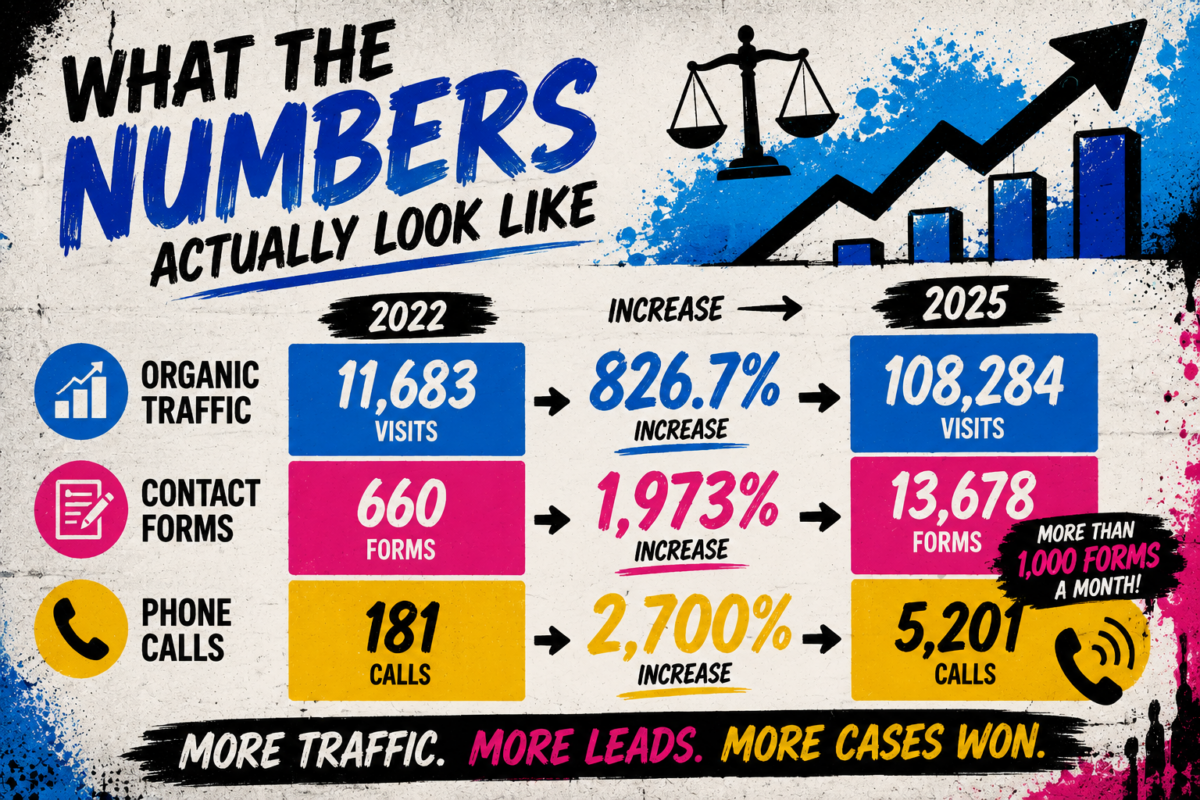
Let me give you a real example.
In 2022, we took over SEO for an attorney whose organic traffic for the entire year was 11,683 visits. By 2025, that number had grown to 108,284 organic visits. That’s an 826.7% increase.
But traffic isn’t the point. Lead generation is.
In 2022, that same attorney had 660 contact forms submitted through his website. In 2025, that number was 13,678. More than 1,000 forms a month.
Phone calls, which are the lifeblood of a legal practice, went from 181 in 2022 to 5,201 in 2025. That’s a 2,700% increase.
That’s not a rounding error. That’s a business transformation. And it happened because the strategy was clear, the execution was consistent, and we never treated it as something you could set up and walk away from.
This Is Not Set-It-and-Forget-It Work
That last point matters more than most people realize.
SEO is an ongoing strategic and tactical effort. Every month, we’re reviewing numbers, tracking keyword trends, watching what competitors are ranking for and why, and identifying opportunities to redirect that traffic. When pages slip in ranking, we go back and refresh the content. We stay current because the market doesn’t stop moving.
There’s no hard-baked number that triggers a major pivot. Sometimes the market shifts. Sometimes something happens in the world and the entire conversation in your industry changes overnight. You have to be ready to move. The agencies that win for their clients are the ones that stay agile.
Monthly reviews aren’t optional. They’re the work.
So How Do You Know If You Should Hire an Agency?
Here’s the litmus test.
Look at your competitors. Where are they? What are they doing? Are they growing? Are they showing up in places you’re not? If the answer to any of those questions makes you uncomfortable, that’s your answer.
Then ask yourself one more thing: how much do you want to invest in growing your business and your profits?
SEO done right is not cheap. And SEO done wrong is even more expensive, because you’re paying for results you’re not getting and losing ground to competitors who are. The cost of not doing it properly isn’t just a line item. It’s the difference between a business that grows and one that doesn’t.
The Bottom Line
Hiring an SEO agency is worth it when you find one that treats positioning and strategy as the same conversation, that does real ongoing work instead of setting up a campaign and disappearing, and that can show you concrete results, not vanity metrics.
It’s not worth it if you hire an agency that churns out generic AI content, never revisits what they’ve built, or can’t tell you clearly what they’re doing and why.
The question isn’t really whether SEO is worth the money. The question is whether you can afford to let your competitors answer that question for you.