
The Search Revolution Most Business Owners Are Missing
AI search platforms skew intent with fan-out. It’s one of the most important shifts in search since Google first launched, but rarely discussed.
Here’s the short version:
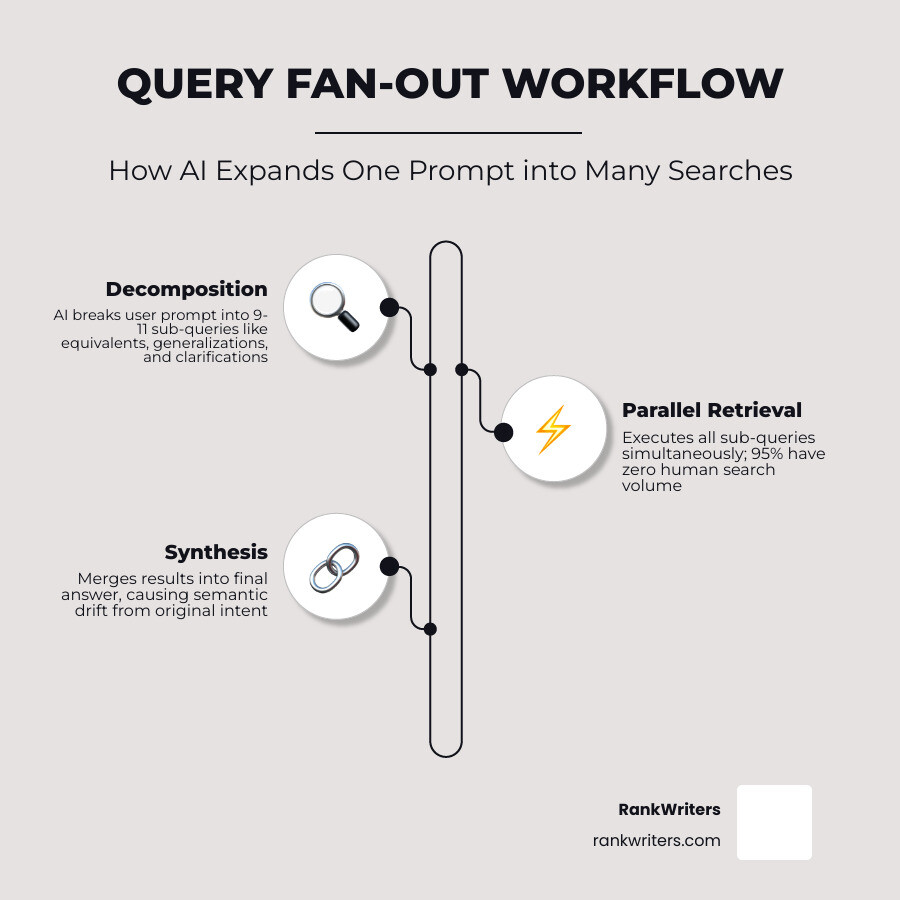
What is query fan-out? When you type a question into an AI search tool, the system doesn’t search for exactly what you typed. Instead, it automatically breaks your prompt into multiple related sub-queries, runs them all at once, and then synthesizes the results into one answer.
How does it skew intent? The AI’s interpretation of your query can drift away from what you actually meant, through:
- Semantic drift – the system explores adjacent topics that stray from your original focus
- Over-personalization – your location, history, and behavior shape results in ways you can’t predict or control
- Synthetic query generation – the AI invents search strings you never wrote, which may not reflect your real intent
Key numbers to know:
| Stat | What it means |
|---|---|
| 9-11 fan-out queries per prompt (average) | One question becomes up to 11 searches |
| 59% of prompts trigger 5-11 sub-searches | Most queries are heavily expanded |
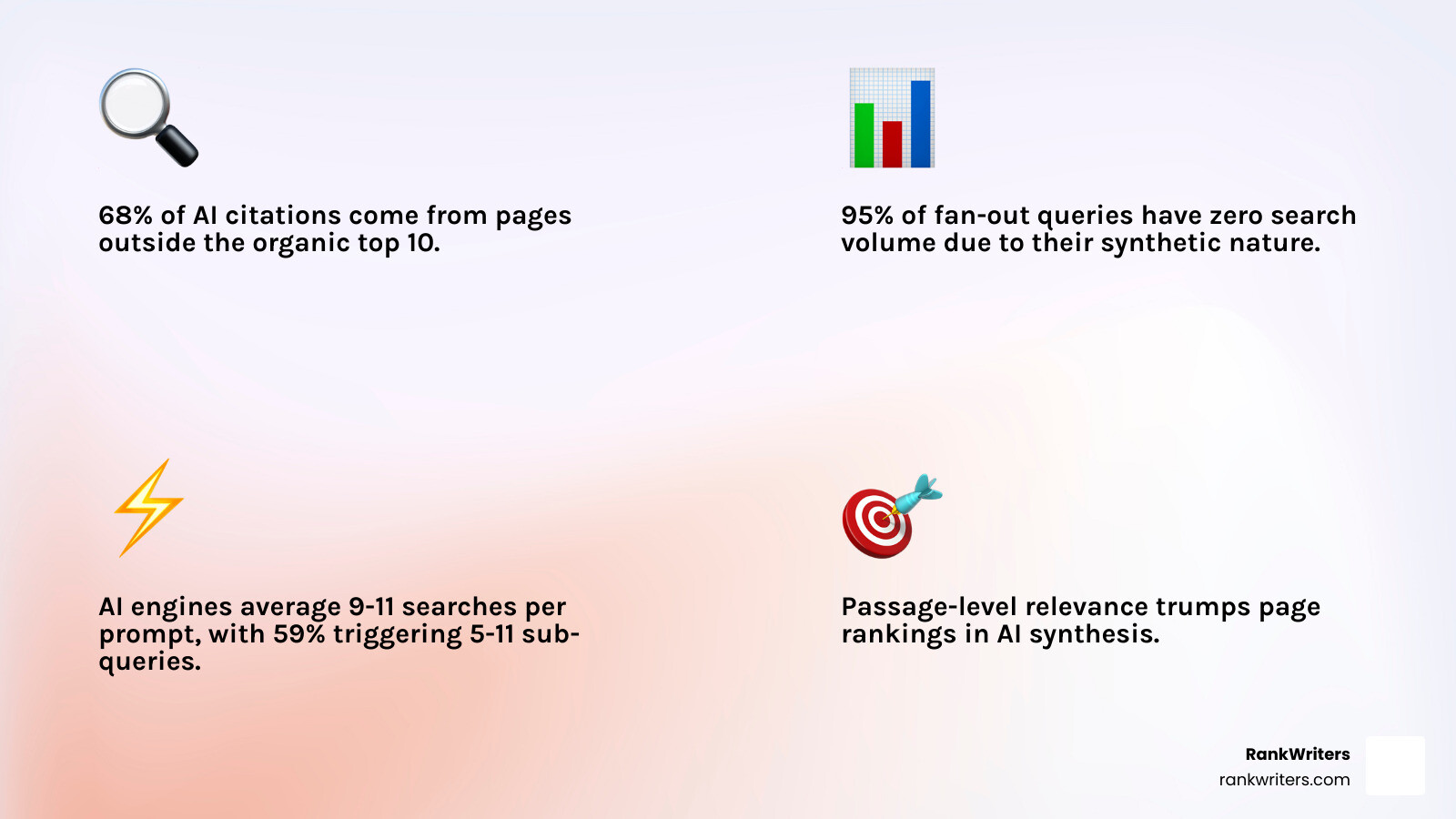
| 95% of fan-out queries have zero search volume | AI invents queries that no human has ever typed |
| 68% of AI citations come from outside the top 10 | Ranking #1 no longer guarantees visibility |
For business owners trying to win leads from AI search, this changes everything about how content needs to be built.
Consider this: ChatGPT Deep Research once made 420 separate searches just to help a user find a red phone case. Your potential customers are getting answers assembled from dozens of sources, and most brands have no idea whether they’re included or not.
The sections below break down exactly how this works, which platforms do it, and what you can do about it.
Simple How AI Search Platforms Expand Queries with Fan-Out and Why It Skews Intent glossary:
By Brandie Young
What is Query Fan-Out and How Does it Differ from Traditional Search?
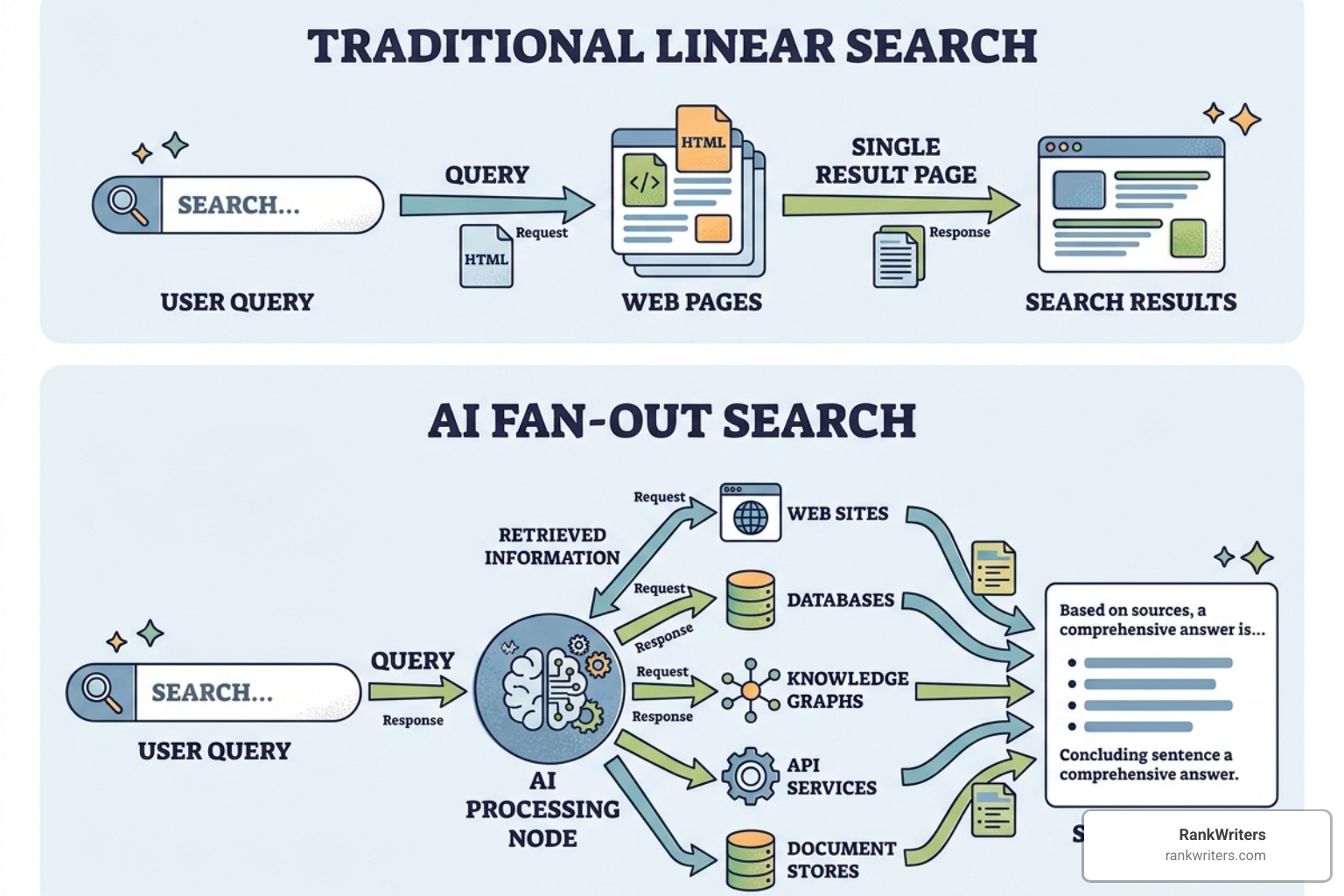
To understand the 2026 search landscape, we have to look at how we used to search. In traditional search, the process was linear. A user typed “best mortgage lenders in Pennsylvania,” and Google matched that exact string against an index of web pages. It was a one-to-one relationship: one query led to one set of blue links.
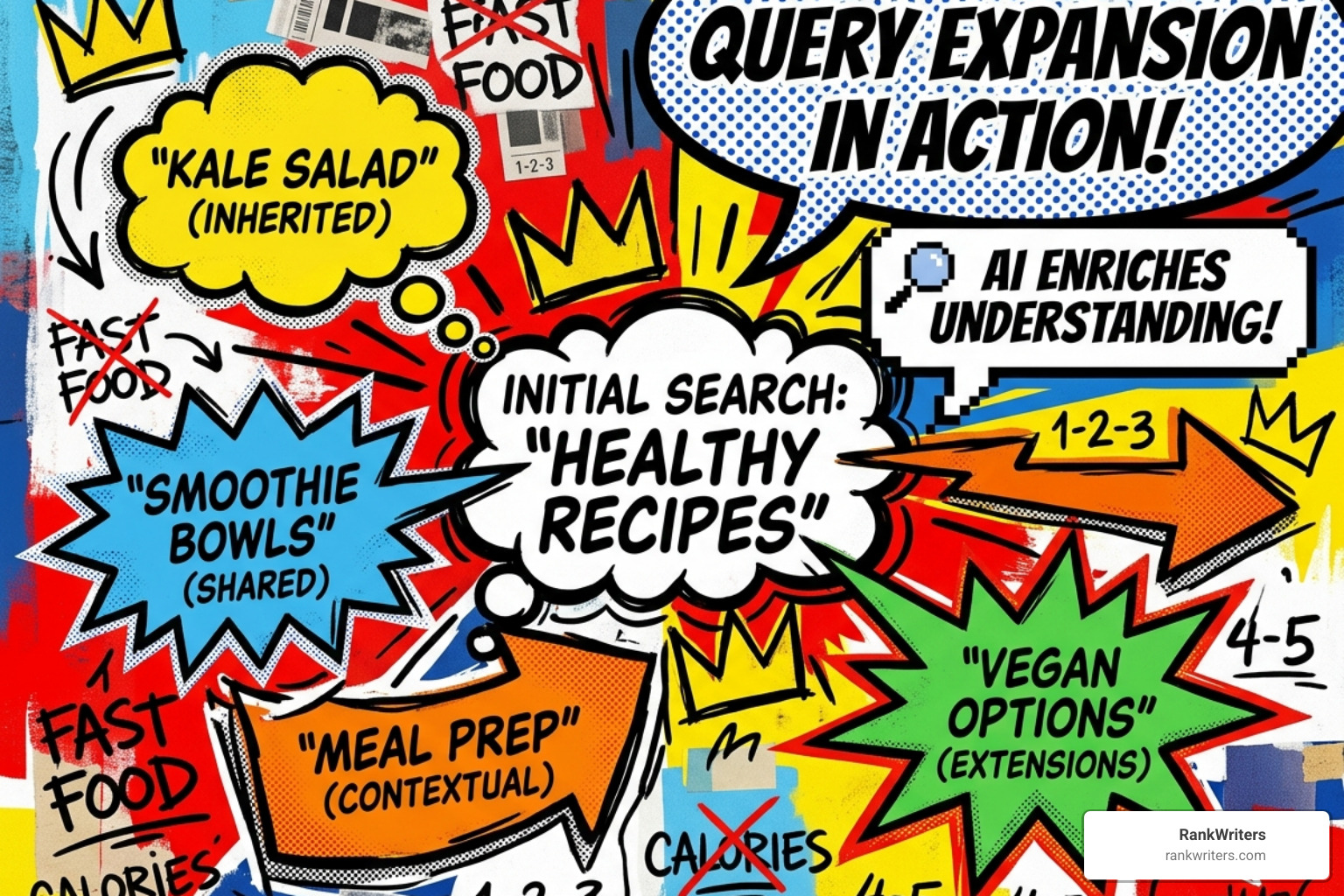
Query fan-out flips this model on its head. It is a one-to-many model where the AI acts as a digital researcher. Instead of just looking for your words, the AI system performs query decomposition. It breaks your request down into its logical components and generates synthetic queries—artificially created search strings designed to fill information gaps.
For example, if a borrower asks, “Can I afford a home in Westmoreland County on a $70k salary?” the AI doesn’t just search that sentence. It fans out into several searches that are interpretive:
- “Current mortgage rates May 2026”
- “Average home prices Westmoreland County PA”
- “Property tax rates Greensburg PA”
- “Debt-to-income ratio requirements for IMBs”
This process is fundamentally different because the AI is predicting what you need to know, not just what you asked. This is a core component of Generative Engine Optimization and requires a complete shift in how we think about the mechanics of AI searches.
How AI Search Platforms Expand Queries with Fan-Out and Why It Skews Intent
While fan-out makes AI feel “smart,” it introduces a significant problem: intent skew. When an AI “fans out,” it often moves away from the user’s original goal. This is known as semantic drift. As the AI generates sub-queries, it might traverse adjacent concepts that are technically related but practically irrelevant to the user.
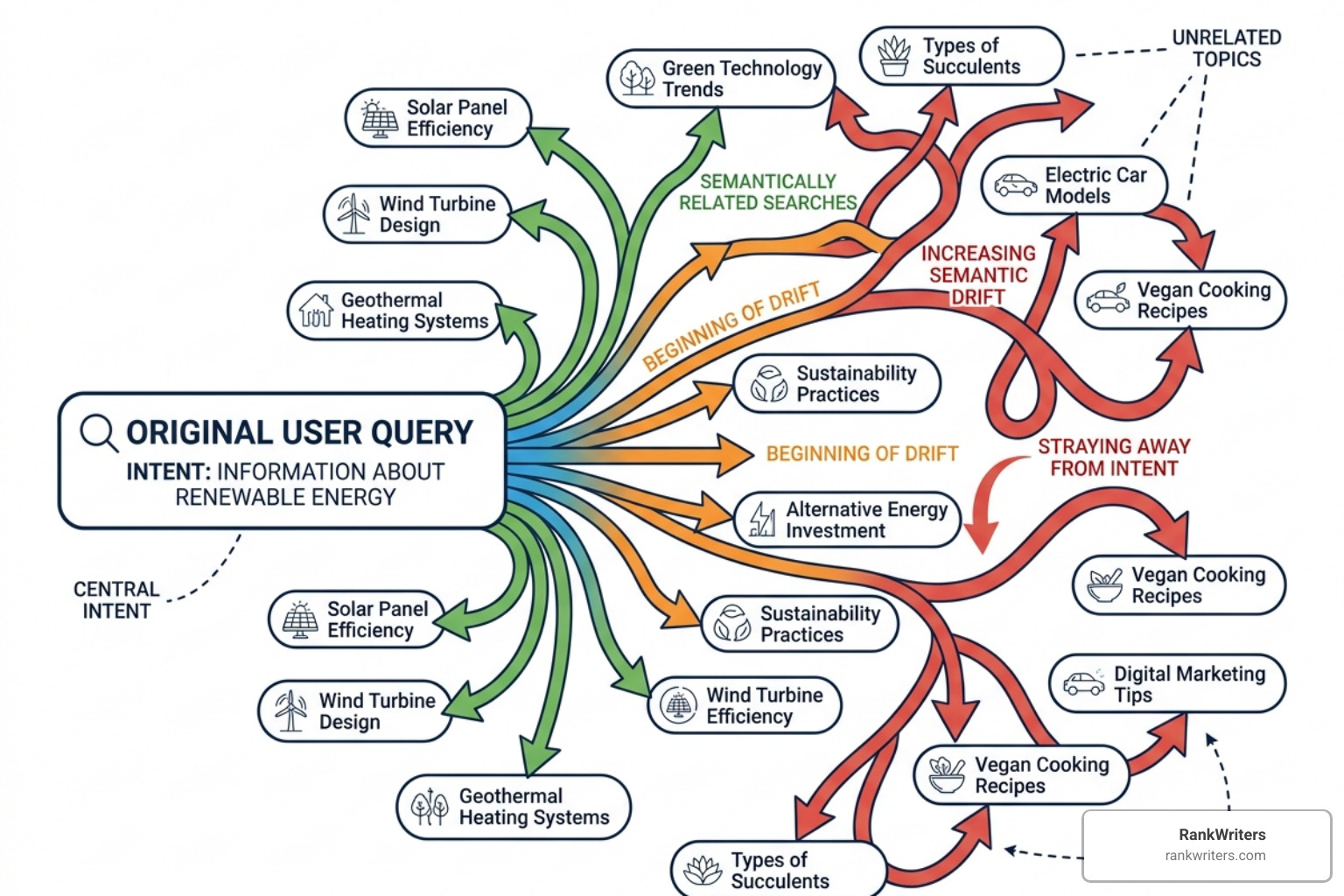
Another factor is the creation of filter bubbles. Because AI platforms like ChatGPT, Perplexity, and Google AI Overviews are heavily influenced by your previous behavior, the fan-out process is often restricted to what the AI thinks you like. This leads to over-personalization, where the “answer” you get is a reflection of your past rather than an objective truth.
Understanding the SEO vs GEO vs AEO difference is vital here. Traditional SEO targets what people type; GEO and AEO target the “constellation” of queries an AI might generate during this fan-out phase. According to research on expanding queries with fan-out, this drift is often the reason why a perfectly optimized page might not show up in an AI Overview.
The Step-by-Step Mechanics of Query Expansion
The fan-out process generally follows a four-stage workflow:
- Decomposition: The AI breaks the prompt into smaller, manageable questions.
- Expansion: The system generates variants (Equivalent, Follow-up, etc.) to cover all bases.
- Execution: The AI runs these queries across web indexes, knowledge graphs, and social feeds.
- Synthesis: The LLM identifies recurring themes, resolves contradictions, and writes the final response.
| Platform | Retrieval Style | Typical Search Volume |
|---|---|---|
| Google AI Overviews | Parallel | 5 to 11 searches |
| ChatGPT Search | Iterative/Agentic | 1 to 20+ searches |
| Perplexity | Literal/Parallel | 2 to 5 searches |
| ChatGPT Deep Research | High-Iteration Agentic | Up to 420 searches |
Why Deep Personalization in How AI Search Platforms Expand Queries with Fan-Out and Why It Skews Intent Matters for IMBs
For mortgage lenders (IMBs) in Pennsylvania, personalization is a double-edged sword. AI platforms use location signals and IP addresses to tailor fan-out queries. If a borrower in Westmoreland County searches for “home loan help,” the AI will automatically fan out into local searches for “mortgage lenders near Greensburg” or “PA first-time homebuyer programs.”
If your brand hasn’t built a local semantic presence, you disappear. The AI’s intent skew might favor a national lender simply because that lender has more “atomic” facts available for the AI to grab during the expansion phase. This is why learning how to get your brand mentioned in AI tools is no longer optional for local IMBs.
The Technical Architecture Powering Fan-Out Retrieval
The “brain” behind this is usually an architecture called Retrieval-Augmented Generation (RAG). RAG ensures the AI doesn’t just make things up (hallucinate) by grounding the response in real-world data.
When the fan-out queries are executed, the results come back in multiple lists. The AI uses a mathematical scoring system called Reciprocal Rank Fusion (RRF) to merge these lists. RRF rewards content that appears consistently across different sub-queries. If your website is mentioned in the “rates” search, the “location” search, and the “reviews” search, you are much more likely to be the primary citation in the final answer. This is the heart of Generative Search Optimization.
Strategic Adaptation: Optimizing Content for Probabilistic Relevance
In 2026, we are moving from deterministic ranking (position 1, 2, or 3) to probabilistic relevance. You don’t “rank” for a keyword anymore; you have a probability of being cited based on how well your content fits the fan-out web.
To win, you need to focus on:
- Topical Authority: Don’t just answer one question. Answer the “full set” of logical follow-ups.
- Atomic Content: Break your information into small, factual “chunks” that an AI can easily extract.
- Entity-First SEO: Ensure your brand is clearly defined as an entity with specific attributes (e.g., “Mortgage Lender in Westmoreland County”).
- Feature Stacking: Include every technical detail a borrower might need, from credit score minimums to closing costs.
By providing these layers, you make your site “sticky” for the AI’s RRF scoring. If you don’t adapt, you risk being left behind in the AI era.
Measuring Visibility When How AI Search Platforms Expand Queries with Fan-Out and Why It Skews Intent
Traditional rank tracking is largely obsolete for AI search. Instead, businesses must monitor citation frequency. Because 95% of fan-out queries have zero search volume (they are unique to that specific user and moment), you can’t track them in a standard keyword tool.
Visibility is now about being the “source of truth” that the AI selects during synthesis. Research from Profound shows that ChatGPT has a 91% uniqueness rate for searches, meaning it rarely searches the same thing twice. Your goal is to be the most relevant answer across a broad spectrum of probabilistic queries.
Frequently Asked Questions about Query Fan-Out
What are the eight types of sub-queries used by AI?
Google’s patent (US11663201B2) and industry research identify eight distinct ways AI expands a query:
- Equivalent: Different phrasing of the same question.
- Follow-up: What the user will likely ask next.
- Generalization: Moving to a broader category.
- Specification: Moving to a narrower, more detailed niche.
- Canonicalization: Resolving a query to a standard entity name.
- Language translation: Searching in other languages for more data.
- Entailment: Queries that are logically implied by the first one.
- Clarification: Questions to resolve ambiguity.
How many searches does an AI engine perform per prompt?
On average, AI search platforms generate 9 to 11 fan-out queries per prompt. Statistics show that 59% of prompts trigger between 5 and 11 searches, while 24% trigger 12 to 19. In extreme cases, like ChatGPT’s Deep Research mode, the system can execute up to 420 searches to fully map out a complex topic.
Why is traditional rank tracking failing in 2026?
Traditional tracking fails because it relies on “stable” keywords with measurable volume. In the age of fan-out, 95% of queries have zero search volume because they are synthetic and highly specific. Furthermore, AI often prioritizes passage-level relevance. A page that doesn’t rank in the top 10 for a broad term might still be the #1 citation if it has the single best paragraph answering a specific sub-query.
Conclusion
The shift toward How AI Search Platforms Expand Queries with Fan-Out and Why It Skews Intent is the most significant change to the digital landscape in a generation. For businesses in Pennsylvania and beyond, the old playbook of “one keyword, one page” is gone.
RankWriters provides a systematic, future-proof approach to this new reality. By combining traditional SEO with advanced AEO and GEO strategies, they help brands build the semantic infrastructure needed to capture leads in a probabilistic search world. If you want to ensure your brand remains a primary source in the AI synthesis phase, it’s time to move toward a more atomic, entity-driven content strategy.
Ready to grow revenue from AI search with a more systematic strategy? Find more info about SEO services here.