
SEO, GEO, and AEO are three distinct strategies that determine how content is found in traditional search results, AI answers, and voice or zero-click features.
- SEO (Search Engine Optimization): Focuses on improving website visibility on search engines like Google by ranking in organic search results. It uses strategies like keyword optimization, backlinks, and technical improvements.
- GEO (Generative Engine Optimization): Ensures your brand is cited in AI-generated answers on platforms like ChatGPT or Google AI Overviews. It prioritizes mentions and citations over clicks.
- AEO (Answer Engine Optimization): Structures content to become the direct answer for voice assistants (like Siri or Alexa) and benefits of featured snippets and other zero-click features.
Why It Matters:
- 60% of U.S. adults use generative AI tools for research or decisions.
- Zero-click searches account for nearly 60% of Google searches, reducing traditional website traffic.
- Voice searches now make up 50% of all searches, emphasizing the need for direct answers.
Quick Overview:
- SEO: Drives website traffic via search engines.
- GEO: Builds visibility in AI-generated responses.
- AEO: Secures direct answers in voice search and snippets.
To succeed, combine these strategies to ensure your brand is visible across traditional search, AI platforms, and voice assistants.
What’s the Difference Between SEO, GEO, and AEO? A Side-by-Side Comparison
What is SEO?
Search Engine Optimization (SEO) is all about making your website more visible in organic search results, helping more people find and visit your site. Think about it: when someone searches for “personal injury lawyer near me” or “best rhinoplasty surgeon in Miami”, SEO is what determines whether your business shows up on the first page – or gets buried several pages deep.
The main objective is simple: bring in the right kind of traffic. Search engines use automated crawlers to scan and rank pages based on factors like relevance, value, and trustworthiness. And ranking matters – a lot. Organic search drives 53% of all website traffic, while paid ads account for just 15% [6]. To succeed, you need to understand the three key components of SEO.
Core Components of SEO
SEO isn’t just one thing; it’s built on three essential parts that work together to improve your site’s rankings.
Technical SEO focuses on making your site accessible and easy for search engines to understand. This includes improving site speed (keep it under 3 seconds), ensuring mobile compatibility, creating XML sitemaps, and fixing crawl issues. Search engines evaluate over 200 factors when ranking pages, so if Google’s bots can’t navigate your site smoothly, even the best content won’t rank [1][9].
On-Page SEO deals with optimizing individual pages. This starts with understanding the keywords your audience is using. Then, you’ll refine elements like title tags, headers (H1, H2, H3), and the overall content structure to align with their search intent. For instance, someone searching for “how to file a personal injury claim” is looking for educational content, whereas “personal injury lawyer consultation” indicates they’re ready to hire [1][9].
Off-Page SEO is all about building authority through external signals. High-quality backlinks from reputable sites act like votes of confidence. For example, if a respected legal publication links to your law firm’s article, it tells Google your content is reliable and worth ranking higher [1][9].
All three components are tied together by E-E-A-T – Experience, Expertise, Authoritativeness, and Trustworthiness. Google places a high priority on content that reflects real-world knowledge and credentials, especially for topics related to health, finances, or legal matters [6][1].
How SEO Benefits Service Providers
For law firms and medical practices, SEO brings in high-intent leads – people who are actively searching for your services. When someone types “divorce attorney in Austin” or “breast augmentation consultation”, they’re not just browsing. They’re ready to act, and being at the top of search results positions your practice as the obvious choice [2].
SEO also builds lasting credibility. Unlike paid ads, which disappear as soon as you stop funding them, organic rankings grow over time. A well-optimized website keeps attracting qualified leads month after month, solidifying your reputation as an expert in your field. With Google processing around 8.5 billion searches daily [5], every search is a chance to connect with potential clients.
What is GEO?
Generative Engine Optimization (GEO) is all about making sure your content gets mentioned in AI-generated answers on AI search engines like ChatGPT, Google AI Overviews, and Perplexity [7][12]. Instead of aiming to rank a clickable link, the focus shifts to becoming the answer – the go-to recommendation these AI tools provide when users ask questions.
While traditional SEO is centered around driving clicks to your website, GEO operates on a different principle: visibility economics. It’s about being part of the AI’s response, even if the user never visits your site [7][12]. Here’s an eye-catching stat: as of March 2025, 13.14% of all search queries triggered Google AI Overviews – double the percentage from just three months earlier [12]. On top of that, 80% of users reportedly resolve 40% of their queries using AI tools without ever clicking a link [12].
For service providers like law firms or medical practices, this is a game-changer. AI-driven traffic behaves differently. In 2025, Ahrefs analyzed how visible it was in AI search models. The results? AI referrals made up just 0.5% of total visitors, but those visitors converted at a rate 23 times higher than traditional organic traffic, accounting for over 12% of total signups [7].
“Traditional SEO gets your content or offerings listed. GEO gets your content or offerings recommended.” – Zach Paruch, SEO Strategist at Semrush [12]
The challenge? When AI summaries appear, users click on search results only 8% of the time, compared to 15% for traditional search – a nearly 50% drop in click-through rates [7]. That’s why being mentioned in AI responses is now as valuable as earning a click. Let’s explore how GEO’s approach stands apart from SEO.
How GEO Differs from SEO
SEO is all about ranking “blue links” to drive website traffic. GEO, on the other hand, prioritizes brand mentions and citations in AI-generated responses [7][12]. This shift means user engagement focuses less on clicks and more on immediate answers.
The metrics for success also change. SEO tracks keyword rankings and organic traffic, but GEO measures AI share of voice – how often your brand appears in AI responses – and citation frequency [7][12]. AI platforms often pull data from sources like Google Business Profiles and trusted directories, bypassing individual websites entirely.
Interestingly, service-based local keywords such as “personal injury lawyer near me” or “rhinoplasty surgeon in Miami” are often AI-resistant – they’re less likely to trigger generative summaries and still rely on traditional local pack visibility [13]. However, informational queries like “what to expect after rhinoplasty” or “how long does a personal injury case take” are prime GEO opportunities. These queries prompt AI to provide direct answers, citing reliable sources. Adapting to these shifts is crucial, as we’ll outline next.
How to Use GEO
To excel in GEO, start with these strategies:
- Optimize your Google Business Profile: Ensure your NAP (Name, Address, Phone) data is consistent and up-to-date across all platforms. AI tools often pull local information from these profiles [11][13]. Regularly update your profile with fresh posts, correct hours, and recent photos to signal relevance.
- Focus on third-party mentions: AI often cites “best of” lists, review platforms, and industry rankings over individual websites [7][12]. Encourage happy clients to leave reviews on platforms like Avvo, Healthgrades, or Google. Also, look for features in local news articles, legal directories, or medical association listings.
- Write AI-friendly content: Begin each section with a clear, concise answer (40–60 words) that AI models can easily extract and cite [5][9]. For instance, if you’re explaining “how to choose a divorce attorney”, start with a straightforward summary before expanding on the details. AI favors fresh content too – 90% of AI bot hits are for articles published within the last three years [9]. Keeping your content updated with current stats and facts is key.
- Use structured data: Implement Schema markup for LocalBusiness, FAQ, Organization, and Service types. This ensures your content is machine-readable for AI crawlers, increasing the chances of being featured in AI-generated summaries [11][12].
What is AEO?
Answer Engine Optimization (AEO) is all about structuring your content so that AI and voice assistants – like ChatGPT, Gemini, Siri, and Alexa – can easily pull and present clear answers. Unlike traditional SEO, which focuses on driving clicks to your site, AEO aims to make your content the go-to quoted response [15][8][10].
The main objective? Answerability. For example, when someone asks Alexa, “How long does a medical malpractice suit take?” or types “What is the recovery time for rhinoplasty?” into Google, AEO ensures your content becomes the cited answer. This is especially important as voice searches now make up about 50% of all searches, zero-click searches account for nearly 60% of Google queries, and featured snippets appear in over 12% of searches [5]. Below, we’ll cover practical steps to tailor your content for AEO.
The difference between AEO and SEO is key. AEO prioritizes clear, well-structured content designed to meet conversational queries and secure zero-click visibility [15][16]. This shift is particularly important for service providers like law firms or plastic surgeons. Being the cited answer for high-intent questions helps establish trust and authority before users even land on your website [8][11][5].
How to Optimize for AEO
Optimizing for AEO calls for a different strategy than traditional SEO. Here’s how you can align your content to meet AEO standards:
- Format for snippets: Use numbered lists for step-by-step instructions and bullet points for tips or benefits [15]. For instance, if you’re explaining how to file a personal injury claim, present the process as a clear, numbered list.
- Leverage FAQ schema markup: Implement FAQPage structured data to highlight questions and answers in your content [11][5]. This helps AI engines identify and extract relevant information for voice replies or featured snippets.
- Use an “answer capsule”: Place a concise, 40–60 word summary in plain English at the start of your content to directly address high-intent queries [15][5]. This approach satisfies AI’s preference for quick, clear answers.
- Optimize for entities: Clearly define and consistently name brands, products, and people throughout your content. Use question-based headings that align with natural search behavior, like “How much does a rhinoplasty cost in Miami?” instead of vague titles like “Pricing Information” [15][11].
These techniques can deliver measurable results. For example, after implementing first-paragraph definitions, bulleted summaries, and FAQ schema, a B2B software company saw an 18% increase in branded search demand and a noticeable boost in demo requests over three months [11]. This demonstrates how AEO can drive conversions, not just visibility.
Why AEO Matters for Service Providers
For service providers, AEO isn’t just an optimization tactic – it’s a game-changer. Whether you’re a law firm or a plastic surgeon, AEO ensures you capture users at critical stages of their search journey. When potential clients ask detailed questions about costs, timelines, or processes, being the direct answer builds trust before they even visit your site [8][11][5].
The data backs this up. Google Generative AI Overviews now appear in about 16% of U.S. searches, and when they do, the top organic search result often sees a 34.5% drop in clicks [14]. But here’s the twist: even with fewer clicks, businesses can thrive. Take NerdWallet, for example – they reported a 35% revenue increase in 2024 despite a 20% drop in monthly website traffic. This shows how meaningful AI-driven interactions can outperform raw traffic numbers [17].
Looking ahead, Gartner estimates that by 2026, 25% of organic search traffic will shift to AI chatbots and virtual assistants [17]. For service providers, this means adapting now to stay visible. When someone asks, “How do I choose a medical malpractice lawyer?” or “What is the recovery time for rhinoplasty?” your optimized content could be the answer that turns a searcher into a client – without them ever needing to click through to your site. That’s the power of being the answer, not just an option.
sbb-itb-16c0a3c
SEO, GEO, and AEO each serve distinct purposes, shaping how content is discovered, who interacts with it, and what actions follow. SEO (Search Engine Optimization) is all about ranking higher on Google and other traditional search engines, aiming to secure those coveted “10 blue links” that drive traffic to your website. GEO (Generative Engine Optimization) focuses on AI-driven platforms like ChatGPT, Gemini, and Perplexity, where the goal shifts to earning brand mentions and citations within AI-generated responses. On the other hand, AEO (Answer Engine Optimization) is about becoming the definitive, single best answer for voice assistants like Siri and Alexa or zero-click features like featured snippets.
These strategies represent a broader shift in how success is measured. Traditional SEO prioritizes traffic and rankings, gauging how effectively users are directed to your website. GEO and AEO, however, emphasize visibility and presence in what’s now referred to as the “discovery layer.” While SEO drives clicks, GEO and AEO focus on ensuring your brand is included in AI-generated answers or voice responses. It’s the difference between being listed as an option and being the recommended choice.
This shift aligns with evolving user behaviors. For instance, zero-click searches now make up nearly 60% of all Google queries, while voice searches account for roughly 50% of all searches [5]. These trends highlight why optimizing for AI citations and direct answers is no longer optional – it’s critical to maintaining visibility in today’s search landscape.
Comparison Table
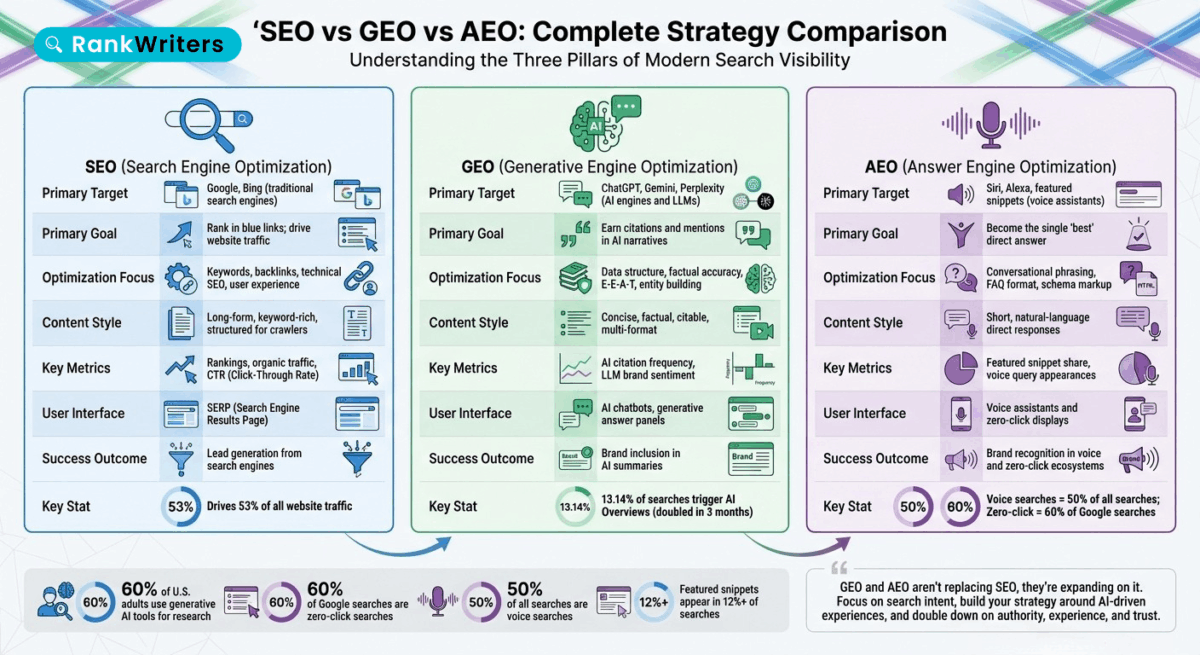
Here’s a quick breakdown of how SEO, GEO, and AEO differ across their core focus areas, tactics, goals, and metrics:
| Aspect | SEO | GEO | AEO |
|---|---|---|---|
| Primary Target | Traditional search engines (Google, Bing) | AI engines and LLMs (ChatGPT, Gemini, Perplexity) | Voice assistants and answer boxes (Siri, Alexa, featured snippets) |
| Primary Goal | Rank in blue links; drive website traffic | Earn citations and mentions in AI narratives | Become the single “best” direct answer |
| Optimization Focus | Keywords, backlinks, technical SEO, user experience | Data structure, factual accuracy, EEAT, entity building | Conversational phrasing, FAQ format, schema markup |
| Content Style | Long-form, keyword-rich, structured for crawlers | Concise, factual, citable, multi-format | Short, natural-language direct responses |
| Key Metrics | Rankings, organic traffic, click-through rate (CTR) | AI citation frequency, LLM brand sentiment | Featured snippet share, voice query appearances |
| User Interface | SERP (Search Engine Results Page) | AI chatbots, generative answer panels | Voice assistants and zero-click displays |
| Success Outcome | Lead generation from search engines | Brand inclusion in AI summaries | Brand recognition in voice and zero-click ecosystems |
“GEO and AEO aren’t replacing SEO, they’re expanding on it. Focus on search intent, build your strategy around AI-driven experiences, and double down on authority, experience, and trust” [2].
This comparison helps you assess which strategy aligns best with your business goals, whether it’s driving website traffic, increasing brand mentions in AI outputs, or becoming the go-to answer in voice searches.
When to Use SEO, GEO, or AEO
Choosing between SEO, GEO, and AEO depends on your immediate goals and the broader strategy you’re aiming to build. SEO is the go-to approach for businesses focused on driving traffic and generating leads through traditional search results. For instance, if you’re a plumber, contractor, or local consultant, SEO should be at the top of your list. Keywords like “plumber near me” are still highly effective for traditional SEO because they often bypass AI-generated overviews and continue to attract clicks [2]. These types of searches often lead directly to conversions, making SEO an excellent choice for generating immediate leads.
GEO comes into play when your business needs to stand out in AI-generated responses. If potential customers are using tools like ChatGPT, Gemini, or Perplexity for recommendations, you’ll want your business to be mentioned in those responses. This is especially important for brands trying to establish authority in competitive industries, as mentions in AI-generated content can enhance credibility. With about 60% of U.S. adults using generative AI for research [3], GEO has become a key strategy for building brand awareness in today’s digital landscape.
AEO, on the other hand, is crucial for situations where users rely on voice assistants for quick, direct answers. This approach is ideal for informational queries, like “how to fix a leaky faucet” or “what is the best CRM for small businesses.” To decide which tactic fits your business goals, start by analyzing the types of queries your audience is making.
Which Strategy to Prioritize
Start by auditing your keywords through keyword research. Separate local, service-based terms for SEO and focus on informational queries for GEO and AEO. For example, a local HVAC company should prioritize SEO for searches like “emergency AC repair in Dallas.” At the same time, they can optimize for AEO by creating FAQ content such as “how often should I replace my air filter” and build GEO authority with detailed guides that AI platforms can cite.
Blending these strategies creates a well-rounded online presence. SEO lays the groundwork for long-term domain authority, AEO ensures your content is formatted for quick answers, and GEO provides the depth and credibility that AI systems prefer to reference [4][18]. Once you’ve identified your priorities, work on integrating these tactics into a cohesive content strategy.
Combining Strategies with RankWriters
RankWriters helps bring these strategies together by creating smart content pillars that work for both users and AI. Through detailed keyword research, you can pinpoint which terms need traditional SEO optimization, which require AEO-style FAQ formatting, and which demand GEO-focused content depth. The platform’s AI-driven tools ensure your content is both machine-readable for search engines and conversational enough for AI chatbots and voice assistants.
For example, a comprehensive guide on “commercial HVAC maintenance” can rank for traditional search terms (SEO), deliver concise answers for featured snippets (AEO), and establish authority for AI platforms to cite (GEO). RankWriters also provides automated content delivery and monthly performance reports, allowing you to track rankings, snippet appearances, and brand mentions across platforms. This integrated approach – sometimes referred to as “Search Everywhere Optimization” – ensures your brand is present on Google, Reddit, TikTok, and AI chatbots [1].
To make your content stand out, implement schema markup and include concise answers upfront so it’s easy for machines to process. Build trust through E-E-A-T signals by using credible authors and verifiable data. When all these elements come together, your content doesn’t just rank – it becomes the go-to resource for AI platforms and voice assistants alike.
Conclusion
Achieving digital visibility today goes beyond simply climbing the search rankings. While SEO remains the backbone for attracting traffic and establishing domain authority – especially for service-oriented and local keywords that drive clicks and conversions – it’s no longer the sole player in the game. AEO helps shape your content for voice searches and snippet-ready answers, while GEO positions your brand as a trusted source that AI systems turn to when users seek recommendations or synthesized insights.
With nearly 60% of Google searches resulting in “zero-click” outcomes [5], it’s clear that relying on just one strategy won’t cut it anymore. Instead, a unified approach is key. Combining SEO, GEO, and AEO creates a powerful synergy: SEO ensures technical optimization and crawlability, AEO structures your content for machine-readability, and GEO establishes the depth and trustworthiness that AI prefers. To make this work, focus on robust schema markup, prioritize E-E-A-T principles, and craft content that serves both human readers and AI systems. Together, these tactics create a cohesive online presence that ensures your brand is visible across all platforms where your audience is searching.
Start by auditing your existing content to pinpoint areas of improvement. Determine which keywords need a traditional SEO boost, which can benefit from AEO’s structured formatting, and which require GEO-level authority. Then, integrate these approaches into a single, cohesive strategy. This way, you can capture traffic, answer user questions, and earn citations across platforms – from classic search results to AI tools like voice assistants and chatbots. Success in this evolving landscape isn’t just about ranking high – it’s about being present, trusted, and genuinely helpful wherever your audience looks.
FAQs
What’s the best way for businesses to combine SEO, GEO, and AEO strategies?
To bring SEO, AEO, and GEO together effectively, think of them as interconnected strategies that strengthen each other. Begin with a strong SEO foundation – this means crafting optimized content, maintaining a well-structured site, ensuring technical performance, and building quality backlinks to perform well in traditional search rankings.
Once your SEO is solid, focus on AEO (Answer Engine Optimization). This involves creating clear, fact-based snippets that directly address user questions. Incorporate structured data, such as FAQ, How-To, or Q&A schema, to increase the chances of your content being featured in snippets or pulled into AI-driven answers from tools like voice assistants.
Then, take it a step further with GEO (Generative Entity Optimization). Ensure your brand, products, and locations are accurately represented in the knowledge graph. Use schema.org markup to enrich your data and maintain consistency across all references. This helps generative AI tools reliably include your business in chat-based and multimodal results.
By layering these approaches – starting with SEO, building on it with AEO, and refining with GEO – you can broaden your reach from traditional search results to AI-driven answers and generative platforms.
What’s the difference between optimizing for SEO and AEO?
Optimizing for SEO is all about enhancing a website’s presence in traditional search engine results. This means crafting content rich with relevant keywords, fine-tuning on-page elements like title tags and meta descriptions, ensuring the site runs smoothly with fast load times and mobile compatibility, and building a strong network of backlinks to establish authority.
In contrast, AEO (Answer Engine Optimization) focuses on making content suitable for AI-driven tools like voice assistants or answer boxes. This involves creating concise, fact-based content, using structured data formats like FAQ or Q&A schema, and ensuring the information is reliable and easy for AI to extract. While SEO leans on in-depth content and link-building, AEO emphasizes brevity and structured design to align with the needs of modern AI technologies.
Why is Generative Engine Optimization (GEO) critical for brand visibility in AI-driven content?
Generative Engine Optimization (GEO) is becoming increasingly important as AI tools like chatbots, AI-generated summaries, and generative search results transform the way people find information. Unlike traditional SEO, which focuses on boosting search engine rankings, GEO is all about structuring your brand’s data in a way that works for large language models (LLMs). These models rely on clear, trustworthy, and reusable information to confidently reference your brand in AI-driven content. Without GEO, your brand risks being overlooked in these critical AI-powered platforms.
It’s worth noting that GEO doesn’t replace SEO or AEO – it works alongside them. SEO ensures your content is accessible for search engines to crawl, AEO focuses on delivering concise answers for voice search and AI snippets, and GEO fine-tunes your data for seamless inclusion in AI-generated outputs. As AI continues to reshape how users interact with content, GEO plays a key role in keeping your brand visible and relevant in this ever-changing digital environment.