

Why Most SEO Traffic Doesn’t Make You Money (And What Does)
Bottom-of-funnel keywords are search terms used by people who are ready to buy, sign up, or hire right now. They signal high purchase intent and consistently drive the highest conversion rates of any keyword type.
Quick answer: Here’s what you need to know:
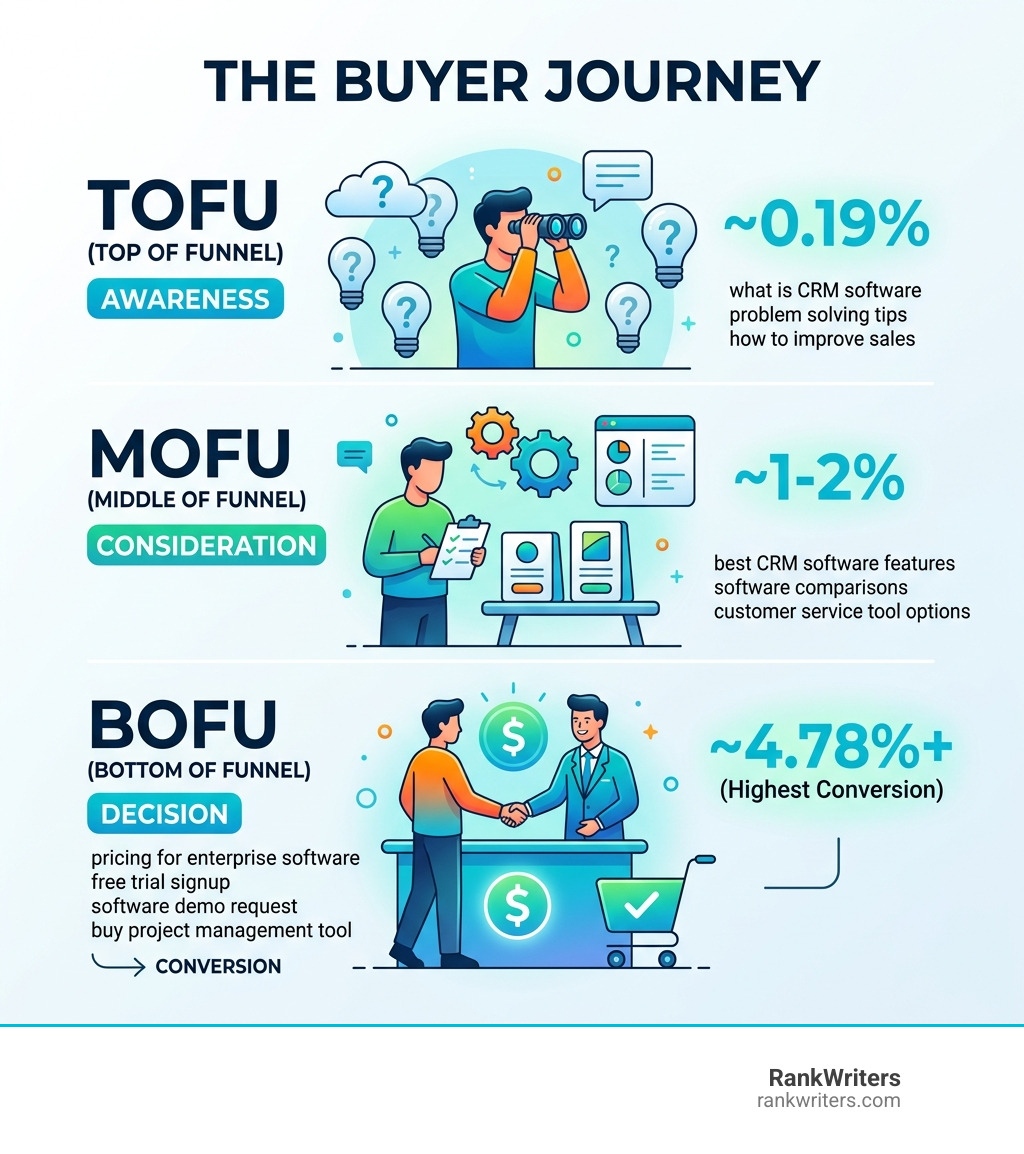
| Keyword Type | Funnel Stage | Example | Avg. Conversion Rate |
|---|---|---|---|
| TOFU | Awareness | “what is CRM software” | ~0.19% |
| MOFU | Consideration | “best CRM software features” | ~1-2% |
| BOFU | Decision | “HubSpot vs Salesforce pricing” | ~4.78%+ |
The difference is dramatic. Research across dozens of clients shows BOFU content converts leads at 25 times the rate of top-of-funnel content. In one documented case, just 20 BOFU content pieces generated over 3x more total conversions than 40 top-of-funnel pieces combined.
Yet most businesses keep pouring budget into high-volume informational keywords that rarely close deals.
If your content gets traffic but not revenue, this guide is for you. You’ll learn exactly what BOFU keywords are, how to find them, and how to build content around them that actually converts.
By Allie Leng-Barton
Defining Bottom-of-Funnel Keywords and Their Strategic Value
In search engine optimization, not all traffic is created equal. Imagine a physical store: a person walking by and asking, “What do you sell?” is vastly different from someone standing at the register with a credit card in hand asking, “Do you have this in blue?” Bottom-of-funnel keywords (BOFU) represent that person at the register.
These terms are defined by their commercial intent. While Top-of-Funnel (TOFU) keywords are educational and Middle-of-Funnel (MOFU) keywords are investigative, BOFU keywords are transactional. According to research from Keyword Funnels: Lower, Middle & Upper Stages Explained, these stages represent the psychological evolution of a buyer.
The strategic value of BOFU terms lies in their efficiency. Data shows that BOFU keywords can convert 2400% better than TOFU keywords. When you understand why is keyword research important, you realize that focusing on these high-intent terms allows you to generate more revenue with significantly less traffic.
Distinguishing Intent from Informational Queries
The primary difference between a “browser” and a “buyer” is searcher psychology. An informational query like “how does a mortgage work” suggests the user is in the early awareness stage. They aren’t ready to sign a contract; they are just learning the vocabulary.
Conversely, a solution-aware user at the decision stage might search for “best mortgage lenders in Pennsylvania.” This searcher already knows they need a loan and is actively vetting providers. Failing to recognize this shift is one of the most common B2B SEO mistakes why high intent keywords dont convert, as brands often try to “educate” someone who is already educated and simply needs a reason to choose them over a competitor.
The ROI of Prioritizing High-Intent Traffic
Prioritizing bottom-of-funnel keywords is the fastest way to lower your Customer Acquisition Cost (CAC). Because these users are already at the finish line, you spend less time and money nurturing them through long email sequences or expensive retargeting ads.
Real-world data is staggering: BOFU content has been shown to convert leads at a 25x higher rate than TOFU content (4.78% vs 0.19%). If you are a business owner in Westmoreland County looking to grow, would you rather have 10,000 visitors who want to read a blog post or 100 visitors who want to book a consultation? The latter drives the bank account, while the former only drives the ego.
Core Categories of High-Intent Search Terms
To dominate the search results in 2026, you must categorize your keywords based on how a buyer thinks. Most BOFU searches fall into four distinct buckets: category, comparison, alternatives, and “jobs-to-be-done.”
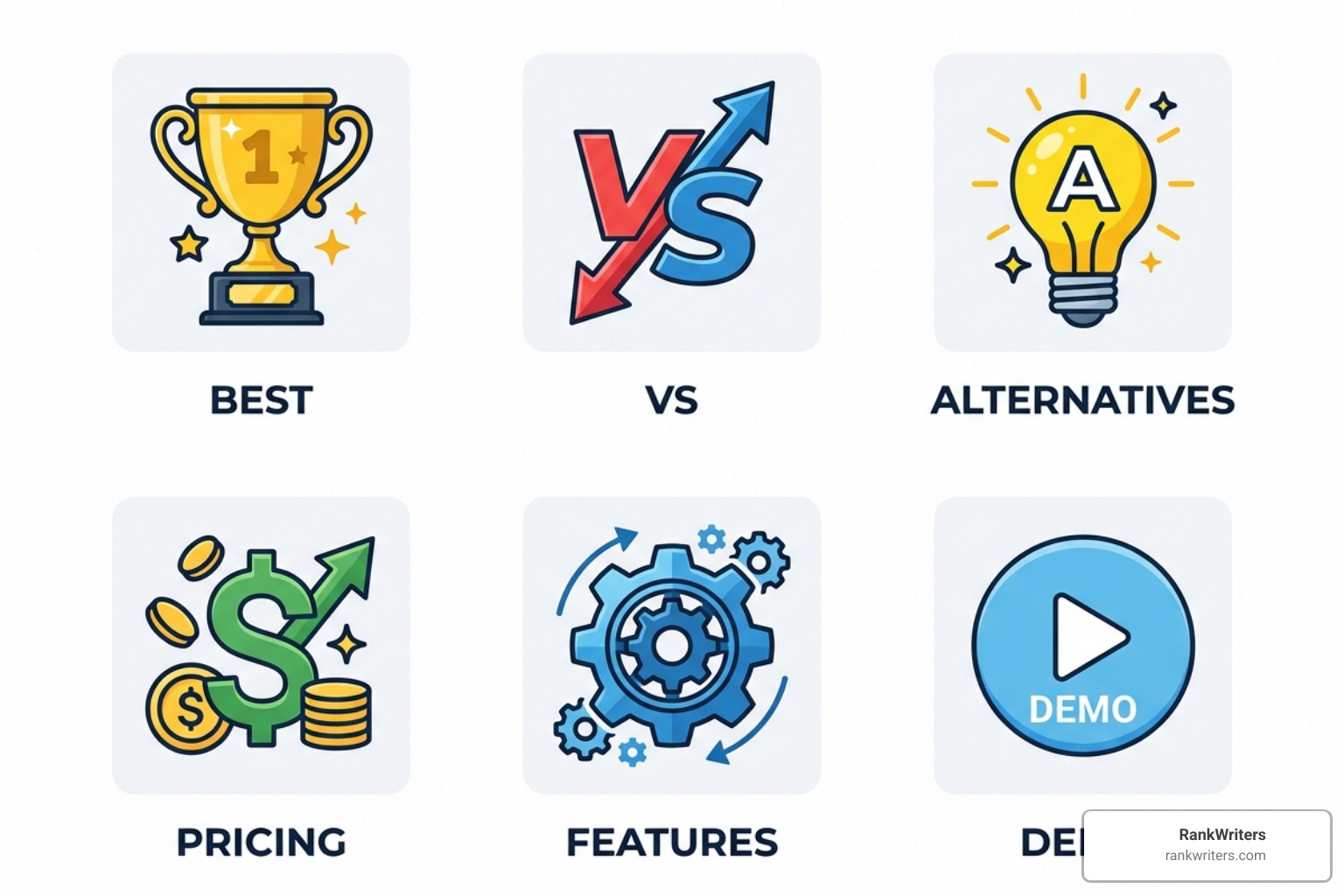
According to Get the Most Out of Your Bottom-of-Funnel Keywords | Twibi, understanding these categories is the first step in how to get keywords for SEO that actually pay the bills.
Using Comparison and Alternative bottom-of-funnel keywords
One of the most effective ways to capture ready-to-buy traffic is the “piggyback” tactic. This involves creating content around “Brand A vs. Brand B” or “[Competitor] Alternatives.”
For example, mortgage lenders often target borrowers who are unhappy with a major national bank by ranking for keywords like “Alternatives to [Big Bank Name] for first-time buyers.” These searchers are already solution-aware but are looking for a better fit. By positioning your service as the superior alternative, you insert yourself into a decision that was already being made. This is a core part of law firm keyword prioritization frameworks step by step guide, where firms target specific legal needs against larger, less personal competitors.
Transactional Modifiers for bottom-of-funnel keywords
Modifiers are the “secret sauce” of high-intent keywords. By adding a single word to a broad term, you can transform it from an informational query into a money-maker.
Common BOFU modifiers include:
- Pricing: “Mortgage lender interest rates Westmoreland County”
- Reviews: “Best rated IMBs in Pennsylvania”
- Best for: “Best mortgage lenders for veterans”
- Demo/Trial: “Software demo for real estate agents”
- Near me: “Mortgage lenders near me”
Independent Mortgage Lenders (IMBs) can use these modifiers to compete with larger institutions by focusing on niche expertise. Tools like these top 10 keyword generator tools including free versions can help you find hundreds of these long-tail variations in minutes.
How to Find High-Intent Keywords Using Free and Paid Methods
You don’t always need an enterprise-level budget to find gold-mine keywords. In fact, some of the best bottom-of-funnel keywords come from “free” sources where real humans are talking about their problems.

Mining Forums and Social Proof for Real User Intent
Forums like Reddit and Quora are underutilized gold mines. When a user is frustrated with a product, they don’t go to a keyword tool; they go to Reddit. Searching for “[Competitor Name] sucks” or “[Competitor Name] help” on Reddit will reveal the exact “pains” your potential customers are feeling.
This “Pain Point SEO” approach focuses on objection handling. If you see people complaining that a competitor’s customer support is slow, you can create a BOFU page titled “Why our [Service] offers 24/7 live support.” As noted in this Reddit discussion on finding BOFU keywords, sales team insights are often more valuable than any tool. Your sales team knows the exact questions prospects ask before they sign a check—use those questions as your keywords!
Leveraging Professional SEO Tools for Prioritization
While free methods are great for brainstorming, paid tools like Ahrefs and SEMrush are essential for prioritization. These tools allow you to filter for “commercial” or “transactional” intent and see exactly what your competitors are ranking for.
When using a keyword analysis tool, don’t be scared off by low search volume. A keyword with only 50 searches a month might seem small, but if those 50 people are all ready to buy a $500,000 home, that keyword is worth more than a “how-to” guide with 50,000 visitors. The goal is to find how to find and rank for bottom of the funnel keywords that have high “business value,” regardless of their total volume.
A Step-by-Step Process to Rank for Competitive bottom-of-funnel keywords
Ranking for BOFU terms is different from ranking for a standard blog post. Because the intent is commercial, Google often displays “transactional” search results, such as product pages, comparison tables, or local maps.
To rank here, your keyword content writing must be hyper-focused on the user’s final decision. You need to provide:
- Direct Answers: If they search for pricing, show them the price.
- Social Proof: Include testimonials and case studies right on the page.
- Authority: Demonstrate E-E-A-T (Experience, Expertise, Authoritativeness, and Trustworthiness) by showing real results you’ve achieved for others.
Creating Conversion-Focused Landing Pages
A common mistake is ranking a BOFU keyword and then sending the user to a generic homepage. You must create a dedicated landing page that matches the search intent. If you are a mortgage lender in Pennsylvania, and someone searches for “FHA loan requirements in Westmoreland County,” they should land on a page specifically about FHA loans in that county.
Key elements for these pages include:
- Friction Reduction: Minimize form fields. Don’t ask for a blood sample if you only need an email address.
- Mobile Optimization: Most BOFU searches happen on the go. If your page takes 10 seconds to load, the user is gone.
- Trust Badges: Show that you are a legitimate, licensed business.
- Clear CTAs: Tell them exactly what to do next (e.g., “Get a Quote,” “Book a Demo”).
Learning how to analyze competitive attorney keywords can provide a great template for this, as legal landing pages are some of the most conversion-optimized in the world.
Measuring Success Beyond Raw Traffic
If you only look at “total visitors” in Google Analytics, you are missing the point of BOFU SEO. Success should be measured by:
- Conversion Rate: What percentage of visitors actually took an action?
- Assisted Conversions: Did this BOFU page help a user make a decision even if they didn’t convert on the first visit?
- Pipeline Value: What is the potential dollar value of the leads generated?
- Customer Lifetime Value (CLV): Are the leads from these keywords sticking around longer?
Frequently Asked Questions about BOFU SEO
Why do BOFU keywords have lower search volume?
Search volume follows the “long tail” principle. Millions of people want to know “what is a mortgage,” but only a few hundred are ready to “apply for a mortgage in Greensburg, PA” this week. While the volume is lower, the lead quality is infinitely higher. You are trading quantity for quality.
How do you measure the success of a BOFU strategy?
Stop looking at your traffic graph and start looking at your CRM. Track how many Sales Qualified Leads (SQLs) or direct purchases are coming from specific pages. Use UTM parameters to trace a customer’s journey from their first search to their final purchase.
What are common mistakes when targeting BOFU terms?
The biggest mistake is “keyword stuffing” or writing content that feels like a sales pitch without providing value. Another error is having a weak Call-to-Action (CTA). If a user is ready to buy, don’t just ask them to “read more”—ask them to “buy now.” Finally, many brands ignore search intent by trying to rank a generic blog post for a keyword that clearly requires a product comparison table.
Conclusion
In 2026, the brands that win aren’t the ones with the most traffic—they are the ones with the most profitable traffic. By shifting your focus toward bottom-of-funnel keywords, you stop “lighting cash on fire” with vanity metrics and start building a sustainable engine for revenue.
At RankWriters, we specialize in this exact systematic approach. We don’t just write content for the sake of filling a blog; we produce content optimized for Google, AI Search (AEO, GEO), and traditional SEO to generate consistent inbound leads. Our future-proof strategy ensures that your brand captures high-intent users whether they are searching via a keyboard or an AI assistant.
Ready to turn your website into a lead-generation machine? Explore our SEO agency services and let’s start ranking for the keywords that actually grow your business.