

What Are the Four Types of SEO (And Why They All Matter)?
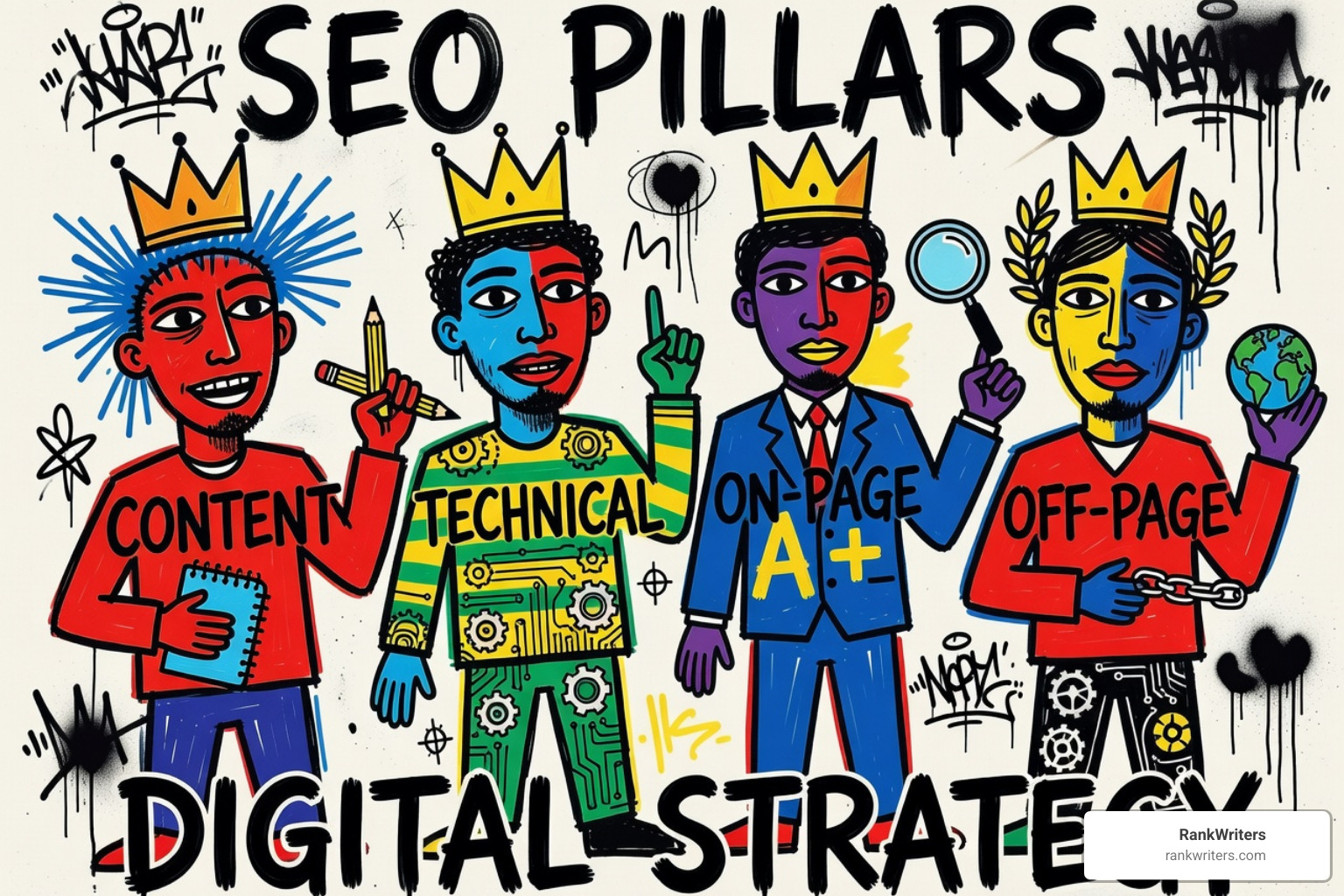
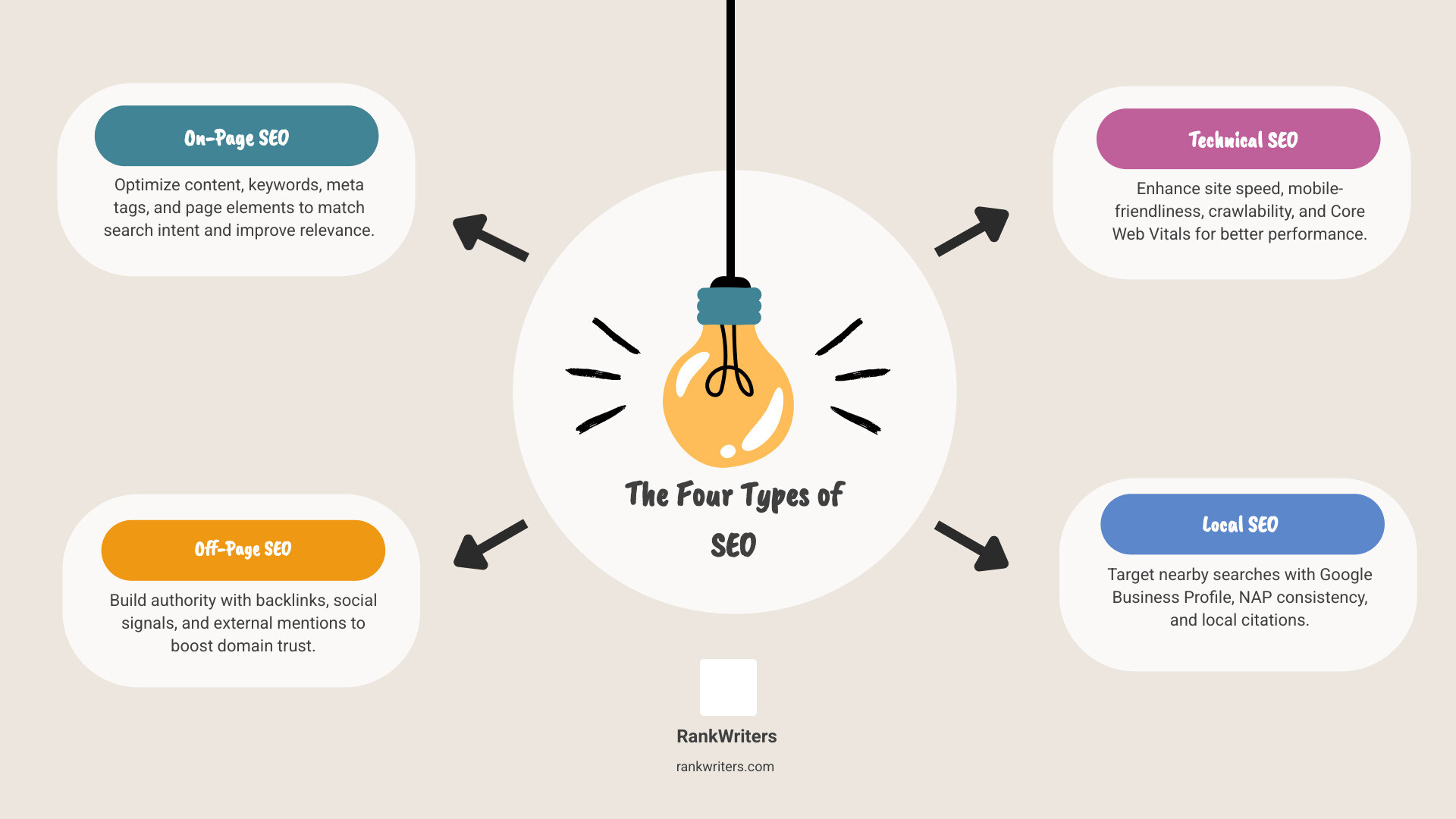
The four types of SEO are On-Page SEO, Off-Page SEO, Technical SEO, and Local SEO. Each one plays a different role in helping your website rank higher in search results.
Here’s a quick breakdown:
| SEO Type | What It Does |
|---|---|
| On-Page SEO | Optimizes your content, keywords, and page elements |
| Off-Page SEO | Builds authority through backlinks and external signals |
| Technical SEO | Improves site speed, crawlability, and mobile performance |
| Local SEO | Helps nearby customers find your business in local searches |
Most business owners focus on one or two of these and wonder why results are slow. The truth is, all four work together. Ignoring any one of them leaves gaps that your competitors are happy to fill.
Think of it this way: your website could have brilliant content, but if it loads slowly, isn’t mobile-friendly, or has no backlinks pointing to it, search engines won’t rank it. All four types of SEO need to be firing at once.
This guide breaks down each type clearly, so you know exactly what to focus on and where to start.
By Lisha Fabris
The Four Types of SEO: A Strategic Overview
When a mortgage lender wants to reach new borrowers, they cannot simply put up a website and hope for the best. Search Engine Optimization (SEO) is the process of making a website more visible on search engines like Google. For mortgage lenders, this means appearing when a borrower searches for “best mortgage rates in Pennsylvania” or “how to apply for a home loan.”
Understanding What is SEO? is the first step toward digital dominance. While there are hundreds of individual ranking factors, they generally fall into four main buckets. These buckets represent different ways search engines evaluate a site. Google wants to provide users with the most relevant, trustworthy, and easy-to-use information possible.
To achieve this, search engines look at:
- The content on the page (On-Page).
- The technical health of the site (Technical).
- The reputation of the site across the web (Off-Page).
- The physical proximity and local relevance of the business (Local).
Mortgage lenders often ask how mortgage lenders rank higher on Google. The answer lies in search intent. Search intent is the “why” behind a user’s query. Is the borrower looking for information (informational), a specific website (navigational), comparing loan products (commercial), or ready to start an application (transactional)?
According to Semrush, identifying these intents allows a lender to create content that matches exactly what the borrower needs. For example, a blog post about “FHA vs. Conventional Loans” satisfies informational intent, while a “Start Your Application” button targets transactional intent.
Comparing the Four SEO Pillars
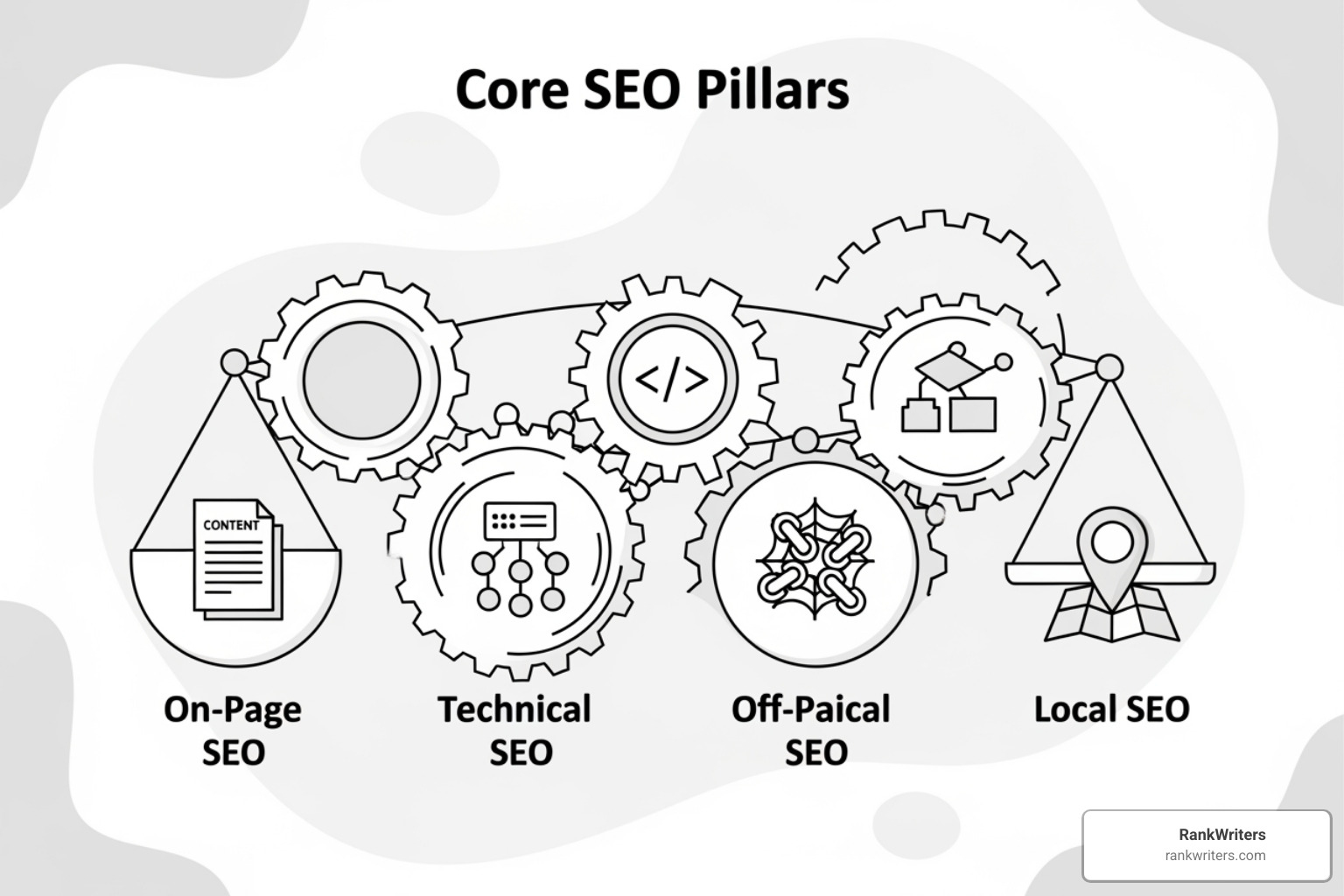
| Pillar | Focus Area | Key Goal |
|---|---|---|
| On-Page | Content, Keywords, HTML Tags | Relevance and User Value |
| Technical | Site Speed, Mobile-Friendliness, Code | Crawlability and Performance |
| Off-Page | Backlinks, Social Shares, Reviews | Authority and Trust |
| Local | Google Business Profile, NAP, Local Citations | Local Visibility |
On-Page SEO: Optimizing Content and Search Intent
On-page SEO is often considered the most accessible of the four types of SEO. It involves everything you do directly on your website to tell search engines what your pages are about. For a mortgage lender, this means ensuring that every page on the site is optimized for both search engines and human borrowers.
A major component of this is managing On-Page SEO Meta Tags for mortgage sites. Meta tags include title tags and meta descriptions. These are the snippets of text that appear in search results. A well-written title tag should be under 60 characters and include the primary keyword near the beginning. Meta descriptions, while not a direct ranking factor, should be around 155 to 160 characters to encourage borrowers to click through to the site.
Content quality is another pillar of on-page success. Google prioritizes content that demonstrates E-E-A-T: Experience, Expertise, Authoritativeness, and Trustworthiness. In the mortgage industry, where financial advice can significantly impact a borrower’s life, E-E-A-T is non-negotiable. Lenders should produce deep, helpful content that answers common borrower questions.
Image optimization is a frequently overlooked part of on-page SEO. According to Google’s image recommendations, lenders should use descriptive filenames, titles, and alt text. Alt text helps search engines understand the context of an image and improves accessibility for borrowers using screen readers.
Keyword density is another factor to watch. While keyword stuffing (cramming keywords into text unnaturally) can lead to penalties, maintaining a density of 1% to 3% is generally considered a best practice. Tools like the Ahrefs toolkit can help lenders identify the right keywords to target and analyze how difficult it will be to rank for them.
Integrating The Four Types of SEO for Maximum Reach
A successful content strategy does not exist in a vacuum. It must be integrated across all types of SEO to ensure maximum reach. For instance, while you are writing a blog post (On-Page), you should also consider how fast that page loads (Technical) and how you will get other sites to link to it (Off-Page).
To find the best long-tail search terms that borrowers are actually using, lenders can use tools like Keyword.io. These long-tail keywords often have lower search volume but much higher conversion rates because they are highly specific.
Once the content is live, analyzing its performance is vital. SEOquake is a helpful browser extension that provides a quick on-page analysis of any URL, including keyword density and internal link counts. Furthermore, understanding the user experience (UX) is crucial. If borrowers land on a page but leave immediately because the layout is confusing, your rankings will eventually suffer. Monitoring tools like Seline can help lenders understand customer journeys and where they might be dropping off.
Technical SEO: Enhancing Site Performance and Crawlability
Technical SEO is the foundation of your digital house. If the plumbing and wiring are broken, it doesn’t matter how pretty the wallpaper is. For mortgage lenders, Technical SEO for mortgage lenders ensures that Google’s “spiders” can easily crawl and index the site.
One of the most critical aspects of technical performance is site speed. Google has explicitly stated that site speed is a ranking factor. A delay of even a few seconds can lead to a significant loss in potential borrowers. Lenders can use Google’s PageSpeed Insights to see exactly where their site is lagging and get actionable tips for improvement, such as compressing images or minimizing code.
Mobile performance is equally vital. Social Media Today reports that more than 70% of total Internet time is spent on mobile devices. If a borrower cannot easily navigate a mortgage calculator on their smartphone, they will likely move to a competitor’s site. Google uses mobile-first indexing, meaning it primarily uses the mobile version of a site for ranking and indexing. Lenders should regularly run Google’s Mobile-Friendly Test to ensure their site provides a seamless experience across all devices.
Core Web Vitals are a set of specific factors that Google considers important in a webpage’s overall user experience. These include:
- Largest Contentful Paint (LCP): How fast the main content loads.
- First Input Delay (FID): How quickly the site responds to a user’s first interaction.
- Cumulative Layout Shift (CLS): How stable the page layout is as it loads.
Addressing these technical elements prevents “crawl errors” where search engines get stuck and cannot find your content. It also involves securing the site with HTTPS, which is a confirmed ranking signal. Google Chrome now labels non-HTTPS sites as “not secure,” which can instantly destroy a borrower’s trust.
Off-Page SEO: Building Authority and Digital Reputation
Off-page SEO involves actions taken outside of your own website to impact your rankings within search engine results pages (SERPs). Think of it as the digital version of word-of-mouth. For mortgage lenders, Off-Page SEO for mortgage lenders is about building authority and showing Google that other reputable sites trust you.
The most important part of off-page SEO is link building. When a high-authority website links to your site, it acts as a “vote of confidence.” However, not all links are created equal. A single link from a well-known financial publication is worth far more than dozens of links from obscure, low-quality directories. In fact, buying backlinks is a “black hat” tactic that can lead to severe penalties from Google.
Lenders can earn high-quality backlinks through digital PR and expert outreach. Platforms like Help a B2B Writer and Qwoted allow lenders to act as expert sources for journalists. When a lender provides a helpful quote for an article about interest rates or home buying tips, they often receive a backlink to their website in return.
Social signals also play a role in off-page SEO. While social media likes and shares are not direct ranking factors, they drive traffic to your content. This increased visibility can lead to more natural backlinks as people discover and share your expertise.
Building a digital reputation also includes managing online reviews. Positive reviews on third-party sites signal to search engines that your business is legitimate and provides a good service to borrowers. Responding to these reviews, both positive and negative, shows that the lender is engaged and cares about client satisfaction.
Local SEO: Capturing Nearby Borrowers and Clients
For mortgage lenders with physical offices in Westmoreland County or other parts of Pennsylvania, local SEO is paramount. This type of SEO focuses on appearing in search results for specific geographic locations. When a borrower searches for “mortgage lender near me,” local SEO determines who shows up in the “Map Pack” at the top of the page.
Local SEO Services for mortgage lenders often start with the Google My Business profile (now officially called Google Business Profile). This is a free tool that allows businesses to manage how they appear on Google Search and Maps. Lenders should ensure their profile is 100% complete, including their business name, address, phone number (NAP), hours of operation, and high-quality photos of their office and team.
NAP consistency is a major local ranking factor. Your business information must be identical across every corner of the web. If your address is listed as “Street” on your website but “St.” on a directory, it can confuse search engines and hurt your local rankings.
Lenders can track their local performance using tools like Local Falcon. This tool provides a “grid” view of how a business ranks in different parts of a city or county, which is incredibly useful for seeing exactly where your local visibility drops off.
In addition to Google, lenders should get listed in prominent local directories. This includes:
- Yelp: A major source for local business discovery and reviews.
- Angi: Useful for reaching homeowners who may be looking to refinance.
- Local Chambers of Commerce: These provide high-authority, locally relevant backlinks.
Encouraging borrowers to leave reviews on your Google Business Profile is one of the most effective ways to boost local rankings. Google prioritizes businesses with a high volume of positive, recent reviews.
Measuring Success and Avoiding Common SEO Mistakes
SEO is not a “set it and forget it” strategy. It requires constant monitoring and adjustment. Measuring success helps lenders understand which of the four types of SEO are providing the best return on investment.
Common metrics to track include:
- Organic Traffic: The number of visitors coming from non-paid search results.
- Keyword Rankings: Where your site ranks for specific terms like “mortgage rates.”
- Conversion Rate: The percentage of visitors who fill out a loan application or contact form.
- Backlink Growth: The number of new, high-quality sites linking to you.
It is also important to stay ahead of new trends. For example, Search Engine Land reports that AI Overviews now appear for roughly 13% of all searches. This means lenders need to optimize for AI-driven search (AEO) by providing clear, concise answers to complex questions.
While looking for success, lenders must also avoid common pitfalls. SEO for Law Firms and lenders often faces similar challenges, such as high competition and strict compliance rules. One of the biggest mistakes is ignoring site speed. As noted earlier, a delay of just a few seconds can cause a borrower to bounce.
Common Pitfalls Across The Four Types of SEO
Even experienced marketers make mistakes. Here are the most common ones to avoid across the four types of SEO:
- Keyword Stuffing: Overusing keywords in a way that makes content hard to read.
- Buying Backlinks: This is a shortcut that often leads to manual penalties from Google.
- Ignoring Mobile Optimization: With most traffic coming from phones, a desktop-only focus is a recipe for failure.
- Duplicate Content: Copying content from other sites or repeating the same text across multiple pages on your own site.
- Inconsistent NAP: Having different contact details on different websites confuses both borrowers and search engines.
- Slow Load Times: Failing to compress images or clean up code can kill your rankings.
Frequently Asked Questions about SEO Types
What are the four main types of SEO?
The four main types are On-Page SEO (content and keywords), Off-Page SEO (backlinks and authority), Technical SEO (site performance and code), and Local SEO (geographic relevance and Google Business Profile).
How do you measure success for each SEO type?
- On-Page: Track keyword rankings and time spent on page.
- Technical: Monitor site speed via PageSpeed Insights and check for crawl errors in Google Search Console.
- Off-Page: Measure the quantity and quality of new backlinks and social media engagement.
- Local: Track “Map Pack” rankings and the number of phone calls or direction requests from your Google Business Profile.
Why is a balanced approach essential for small businesses?
A balanced approach is essential because the four types are interconnected. For instance, you can have the best content (On-Page), but if your site is slow (Technical), no one will stay to read it. If you have great content and a fast site, but no one links to you (Off-Page), Google may not find you authoritative enough to rank on the first page. For small businesses, Local SEO is often the fastest way to see results and compete with larger national brands.
Conclusion
Mastering the four types of SEO is the key to building a sustainable, lead-generating machine for any mortgage lender. By focusing on high-quality content, a solid technical foundation, a strong digital reputation, and local visibility, lenders can ensure they are found by borrowers at the exact moment they are ready to make a move.
RankWriters understands that SEO is no longer just about keywords. It is about a systematic, future-proof approach that combines traditional SEO with modern AI search optimization (AEO and GEO). For lenders looking to grow their business and generate consistent inbound leads, professional content is the most valuable asset.
If you are ready to take your digital presence to the next level, More info about SEO content writing services is available to help you outrank the competition and reach more borrowers in your community. Let the experts handle the complexity of search algorithms so you can focus on what you do best: helping people achieve the dream of homeownership.