

When users ask AI tools like ChatGPT or Google’s Generative AI a question, they expect a clear, concise, and accurate answer. To ensure your content gets cited in these AI responses, you need to write content for AI in a way that’s easy to extract and understand. Here’s how:
- Write answers with direct answers to questions: Provide responses in 40–60 words that fully answer questions without the need for additional context.
- Structure page format: Include H1 and other headings phrased as questions, bullet points, and concise FAQ sections to make your content easier for AI to parse.
- Be clear: Avoid vague language or phrases like “as mentioned above.” Use specific terms and define concepts clearly within the same section.
- Incorporate schema markup: Add structured data like FAQPage or HowTo schema to help AI systems identify and extract your content accurately.
- Track performance: Monitor how often your content is cited in AI-generated answers and refine it based on gaps or inaccuracies. This process is a core part of generative search optimization.
How AI Processes and Surfaces Content
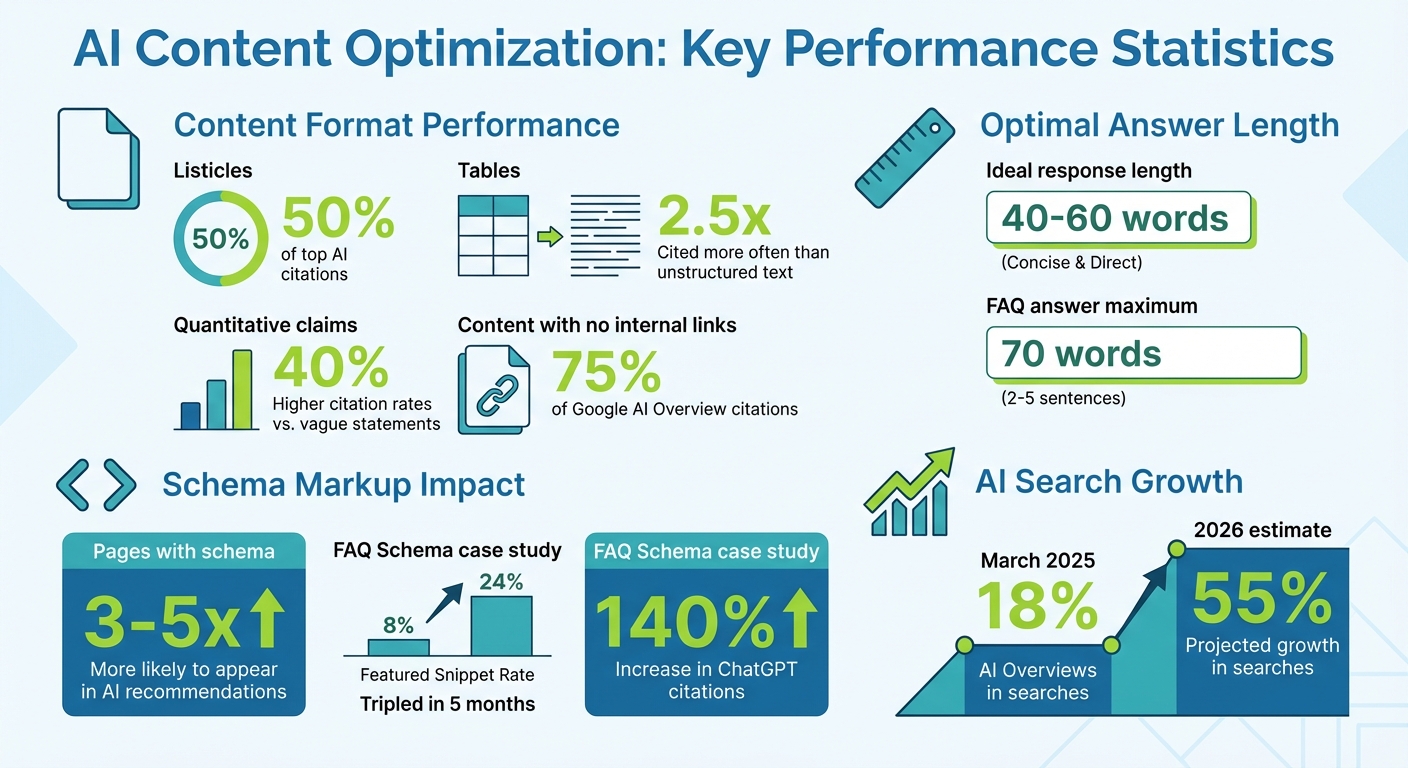
AI Content Optimization Statistics: Citation Rates and Performance Data
How AI Matches Questions to Content
AI doesn’t read content from start to finish like a person might. Instead, it breaks your pages into smaller, modular sections that it evaluates independently [2][3][9]. Picture a book split into individual paragraphs, each labeled with its main topic. This allows the AI to quickly locate and retrieve the specific piece of information it needs.
When a user asks a question, AI focuses on understanding the intent and context behind the query rather than just looking for matching keywords. It scans its indexed content chunks for relevant sections while performing an entity-level analysis. This means it identifies and connects people, places, organizations, and concepts to understand how they relate [8][3][9][10]. The system then evaluates whether your content is detailed and accurate enough to be cited. This modular approach ensures AI can find and match precise answers to user queries.
AI also cross-references multiple sources to verify information [8][3]. If your content aligns with widely accepted facts and presents them clearly, it earns higher confidence signals. From there, the AI synthesizes data by pulling snippets from authoritative sources to create a single, cohesive response [3][1][10]. This process often results in a “winner-takes-all” scenario, where only a few top sources are cited for each query [1].
Why Clear Answers Beat Narrative Explanations
AI systems favor structured answers over lengthy narratives because they’re easier to extract and validate. Using Retrieval-Augmented Generation (RAG), these systems prioritize content that can stand alone without needing extra context [2][6]. The ideal response is concise – typically 40 to 60 words – and fits neatly within the AI’s extraction framework [1][7].
For example, research shows that listicles make up 50% of top AI citations, while tables are cited 2.5 times more often than unstructured text [7]. Quantitative claims are also 40% more likely to receive citations compared to vague, qualitative statements [7]. Structured formats signal reliability by minimizing the effort AI needs to interpret relationships between data points [3][7].
Narrative content, on the other hand, often requires additional context to make sense. Phrases like “This approach works well because it addresses the core issue” can leave readers – and AI – wondering what “this approach” or “the core issue” actually refers to. In contrast, clear and self-contained answers can be understood and used immediately, even when taken out of context. Direct, unambiguous sentences help AI classify your content as a reliable source [8][7]. By focusing on clarity and structured data, you increase the chances of your content being cited and recognized as authoritative.
How to Write Content That AI Can Use
Finding the Right Questions to Answer
To create content that resonates with users and is easily understood by AI, start by mapping questions into three key stages: problem understanding, solution exploration, and implementation details. This approach ensures you’re addressing users at every stage of their journey, not just targeting broad, high-traffic keywords[10].
Dig into your internal data for insights. Sales calls, support tickets, customer feedback, and demo recordings often reveal the exact questions and pain points your audience has. Additionally, you can use AI tools like ChatGPT or Perplexity to uncover frequently asked questions in your niche[11][3].
Tools such as Ahrefs‘ Brand Radar or AnswerThePublic can help you identify the precise language users are typing into search engines. Look for reports that highlight gaps where your brand isn’t currently addressing user needs. From there, focus on 10 high-value questions that directly impact your business or correct common misunderstandings about your offerings[11].
Prioritize conversational, long-tail questions. For example, instead of targeting a generic phrase like “best CRM”, aim for detailed queries like “Which CRM is best for a small marketing agency without a developer?” These types of questions are more specific and actionable for both users and AI[11][10]. Once you’ve identified the right questions, the next step is formatting your answers for AI clarity.
Formatting Answers for AI Systems
After identifying the most impactful questions, focus on structuring your content so AI systems can easily extract it. Start your response with a direct answer in the first 40–60 words to ensure quick AI recognition[1][7]. Follow it up with a brief bulleted list summarizing key points – this is often referred to as an “answer block”[2].
Use H2 and H3 headings phrased as natural language questions, like “How do I reduce cart abandonment?” These clear, question-based headers help AI systems identify where one topic ends and another begins[3][6][2].
Be precise with your language. Instead of vague pronouns like “it” or “this”, use specific terms. For example, write “Email marketing generates higher ROI” rather than “It generates higher ROI.” This ensures your content remains clear even when pulled out of context. If you use industry-specific terms, define them within the same paragraph to avoid confusion, even if you’ve explained them elsewhere on your site[6][10][12].
Keep FAQ answers concise – stick to two to five sentences or a maximum of 70 words. Use active voice for clarity. For instance, say “Our team performs an audit” instead of “An audit will be performed”[12]. Avoid excessive internal linking within paragraphs you want AI to extract; research shows that 75% of content cited by Google’s AI Overviews has no internal links in the cited section[6]. Lastly, use standard punctuation like periods and commas, avoiding decorative symbols like arrows or stars, which can disrupt AI parsing[3].
Answer Patterns That Don’t Work
Certain answer styles can hinder AI systems from accurately extracting your content. For example, responses that rely on surrounding context – like “as mentioned above” or “in the previous section” – can confuse AI, as it extracts individual chunks rather than entire pages[6][12]. Similarly, starting with vague phrases like “This approach works well” leaves both readers and AI unsure of what “this approach” refers to.
Long-winded explanations can also be problematic. If your main point is buried in sentence seven of a 200-word paragraph, AI will likely overlook it. Quantitative claims with specific numbers are far more effective than generic statements like “many experts agree” or “this method is effective.” In fact, content with precise data receives 40% higher citation rates than vague assertions[7].
Avoid hiding critical information in expandable tabs, PDFs, or behind decorative formatting. AI systems prefer clean HTML and straightforward text structures. Long, unbroken blocks of text also reduce extractability – AI relies on clear visual and semantic cues to determine where one answer ends and the next begins[3][6]. For even better results, consider using structured FAQ sections and schema markup.
sbb-itb-16c0a3c
Using Structured Data and FAQ Sections
How FAQ Sections Help Answer Common Questions
FAQ sections are designed to reflect the way users naturally phrase their questions. For example, when someone searches for “What is technical SEO?“, AI systems prioritize well-structured Q&A content to deliver a quick, direct response [2][7]. This makes it essential to format FAQ sections with clear, concise answers. Aim for 3–7 focused Q&A pairs per page, keeping each answer under 70 words. Use H3 headings for the questions to create clear divisions that AI parsers can easily understand [7].
The benefits of this approach are measurable. One study found that using FAQ Schema resulted in a jump in Featured Snippet appearances from 8% to 24% over five months – tripling the rate – and led to a 140% increase in ChatGPT citations [7]. Adding structured Q&A content with proper schema markup not only improves AI recognition but also enhances the likelihood of being featured in search results.
Adding Schema Markup for Better AI Recognition
Schema markup acts as a translator, turning your content into explicit signals that AI systems can easily interpret. Kelly Kranz from AI Marketing Labs highlights its importance:
“In the age of AI-driven search, structure isn’t cosmetic – it’s the foundation of AIO success” [13].
Pages equipped with schema markup are 3–5 times more likely to appear in AI-driven recommendations compared to those without [7].
Focus on key schema types like FAQPage, HowTo, Product, and Article to clearly define your content’s structure [7]. The best way to implement schema is by using JSON-LD in your page header, as it’s the format Google prefers and AI systems process most efficiently. However, it’s critical that the marked-up content matches exactly what users see on the page, as Google’s guidelines strictly require this alignment [7].
“Schema provides explicit entity relationships AI systems can confidently extract. Without it, AI must interpret your content.” – Onely [7]
To ensure everything is working as intended, regularly validate your schema using Google’s Rich Results Test. This helps catch errors early, preventing issues that could hurt your visibility. Additionally, keeping your HTML clean – avoiding excessive divs or inline styles – can improve how accurately AI systems extract your content. Structured content, like tables and data-rich formats, is cited 2.5 times more often than unstructured text [7]. By combining schema markup with clean coding practices, you set the stage for better performance in both AI-driven and traditional search results.
Making AI Query Optimization Part of Your Content Strategy
Writing for Both AI Systems and Human Readers
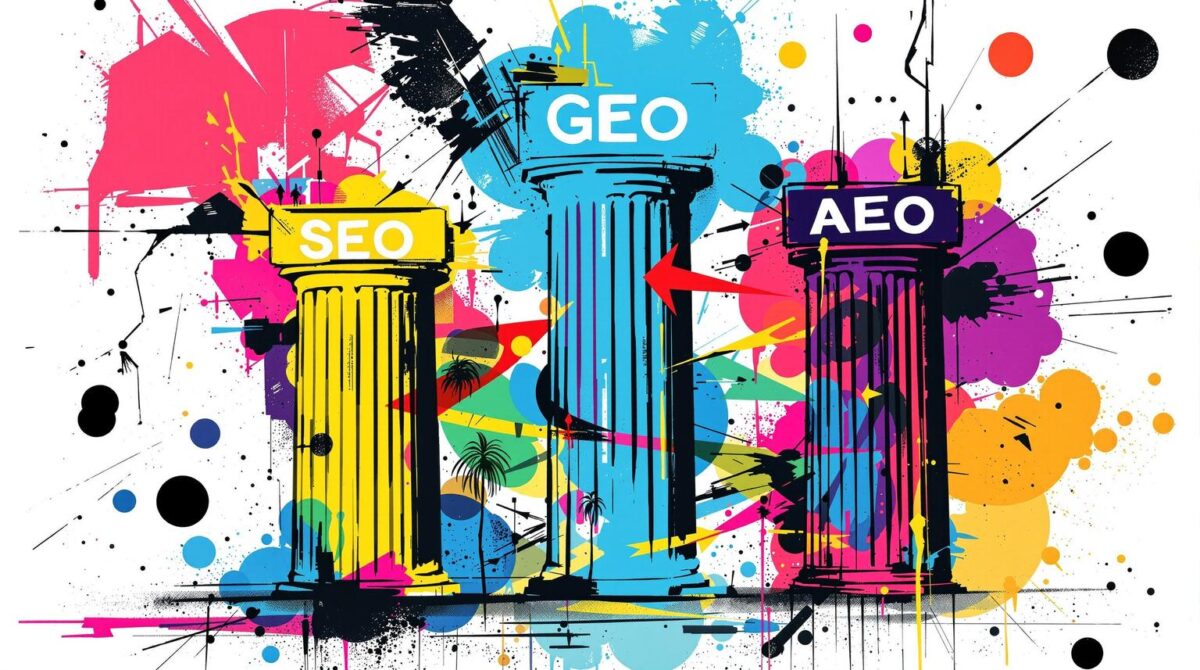
Crafting content that works for both AI systems and people requires a focus on clarity, structure, and utility. AI query optimization – also known as Answer Engine Optimization (AEO) – relies on the same principles that make content effective for human readers. As Despina Gavoyannis from Ahrefs explains:
“AEO doesn’t replace SEO; it complements it.” [4]
One of the most effective techniques is the “answer block” approach. This involves starting each section with a concise 2–4 sentence summary immediately following the heading. Afterward, you can expand with additional details and context. This method ensures AI systems can extract clear, direct answers while giving human readers a quick overview they can easily scan.
The key difference when writing for AI lies in avoiding ambiguity. For example, instead of saying, “This helps improve results”, an AI-optimized version would specify, “Schema markup helps improve AI citation rates.” Repeating the subject in your content ensures clarity, especially when individual pieces of information are pulled out by AI systems [6][9].
Tracking and Improving AI Performance
Once your content is structured effectively, it’s essential to measure its impact using AI-specific metrics. While traditional SEO metrics provide some insights, they don’t capture the full picture. One critical metric to monitor is AI Share of Voice – this measures how often your brand appears in AI-generated answers compared to competitors [4][15]. With AI referrals growing significantly over the past year, this channel is becoming increasingly important [3].
Start by tracking brand mentions across AI platforms such as ChatGPT, Perplexity, Google AI Overviews, and Gemini. Pay attention to both linked citations and unlinked mentions, and analyze the sentiment and accuracy of what these systems say about your brand [4][15]. If you notice inaccurate mentions, update your FAQ or About pages with clear, precise corrections to give AI systems better source material to work with [4].
For established brands, results often appear within weeks or months. However, newer brands with less online authority may need 12–18 months to achieve consistent AI citations [4]. To identify opportunities, track URLs referenced by AI and analyze high-volume industry queries where your brand is absent [15]. A simple way to test your content’s AI readiness is to paste it into ChatGPT and ask it to “quote the answer.” If the AI struggles or requires surrounding context, it’s a sign your formatting could be improved [14].
Conclusion
Search habits are shifting, with users increasingly relying on instant, AI-generated answers instead of clicking links. As of March 2025, AI Overviews appeared in about 18% of all searches [5]. Fast forward to 2026, and estimates suggest that number has surged to 55% [5]. This shift highlights the growing importance of creating content that delivers precise, self-contained answers.
AI-driven search optimization (AEO) complements traditional SEO by focusing on clear, structured responses that enhance brand credibility – even when users don’t click through. By using strategies like concise answer blocks, question-based headings, and schema markup, your content can do more than just rank; it can be directly cited by AI systems. Early adopters who implement these techniques gain a competitive edge while the playing field is still relatively uncrowded [5]. AI citations not only increase visibility but also transfer trust from the AI system to your brand, strengthening your authority over time.
“Visibility in AI search isn’t about luck. Structure, clarity, and snippability work together to make your content easier for AI to process and surface.” [3]
The takeaway? Now is the time to optimize your content. Brands that prioritize writing clear, direct answers and use structured data will stay ahead as search evolves. Start by auditing your most valuable pages, adding FAQ schema, and testing how easily AI can extract your answers. These steps will help secure your position in this rapidly changing landscape.
FAQs
How does schema markup help AI understand and feature your content?
Schema markup is a way to structure your data so that AI systems can understand your content more easily. By specifying entities, formats (like FAQs or How-To guides), and their relationships, schema makes it simpler for AI to extract and display your information accurately.
When your pages include properly implemented schema markup, they’re more likely to show up in AI-generated responses. Why? Because schema provides clear, machine-readable context that aligns with how AI processes information. Research even shows it can greatly improve your chances of being featured in AI-driven recommendations.
Why is structured content better for AI to extract and use?
Structured content works well with AI because it presents information in a clear, organized manner that’s easy to digest and extract. Using question-based headings, concise answer-first paragraphs, and tools like bullet points or tables helps create self-contained snippets that AI can quickly process. Adding schema markup takes it a step further by giving extra context, making it simpler for AI to find and reference the right details.
This method increases the likelihood of your content appearing in AI-generated responses since direct, well-structured answers are far more effective than lengthy or overly detailed narratives.
Why do AI systems prefer concise answers?
AI systems are built to process and retrieve information at lightning speed, which is why short, self-contained answers work best. Clear and straightforward responses are more likely to align with user queries, making them easier for AI to match accurately. Direct answers tend to outperform long-winded explanations because they cut through confusion and don’t rely on extra context to make sense.