

A topic authority hub involves creating a central pillar page connected to detailed subtopic pages through internal links. It helps search engines and AI systems grasp the depth of your content while driving more traffic and boosting credibility.
Here’s how to get started:
- Identify Core Topics: Focus on topics closely tied to your products or services, with potential for 10–20 subtopics.
- Create a Pillar Page: Build a central hub covering the main topic broadly, linking to detailed cluster pages.
- Develop Cluster Content: Write in-depth articles on subtopics, linking back to the pillar page and other cluster pages.
- Optimize and Update: Use tools like Google Search Console to track performance, and refresh content regularly with new research or data.
This structured approach not only improves rankings but also aligns with modern AI systems, increasing the chances of your content being cited in AI-generated responses. For example, companies like Land of Rugs and Kineon saw significant traffic and revenue boosts by adopting this method.
Quick Tip: Focus on solving customer problems at every stage of their journey – from awareness to decision-making – and use internal links to create a seamless content experience.
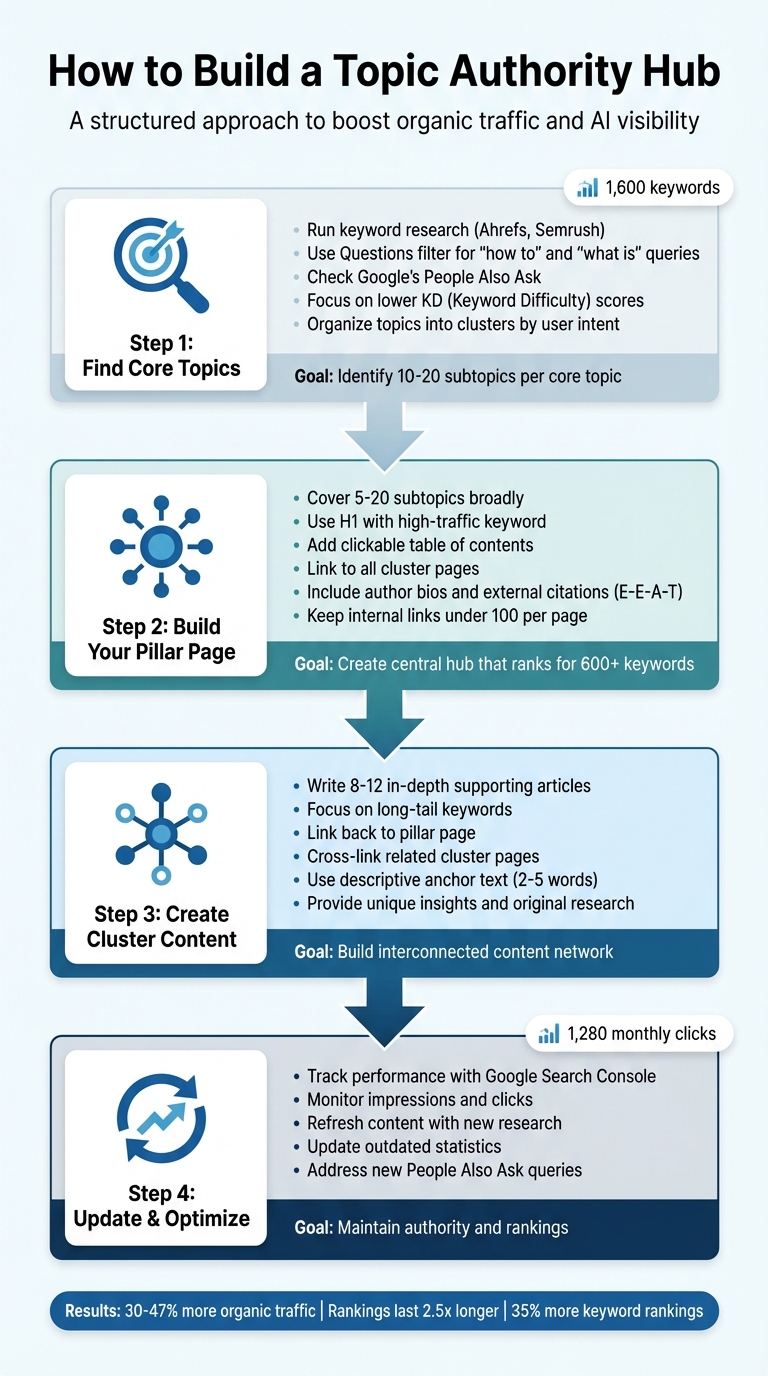
4-Step Process to Build a Topic Authority Hub for SEO
Step 1: Find Core Topics That Match Your Offers
Start by identifying topics that align closely with your services or products as part of a content-driven SEO strategy. These topics should address informational search intent, have measurable traffic potential, and allow for the creation of 10–20 related subtopics [10][5][12]. For instance, a personal injury law firm might use seed keywords like “personal injury” or “tort law” to uncover questions such as “what is a tort” or “how to file a personal injury claim” [10][9]. This step lays the groundwork for focused keyword research and well-structured content clusters.
Run Keyword Research for Your Services
Use keyword research tools like Ahrefs or Semrush to explore broad seed keywords tied to your core offerings. Apply the Questions filter to find queries starting with phrases like “how to” or “what is”, which can serve as the basis for your cluster content [10][4]. For example, a skincare brand might use “anti-aging skincare” as a seed keyword to discover questions like “what causes wrinkles” or “how does retinol work.”
Leverage Google’s People Also Ask section and featured snippets to identify common customer questions [2][7]. A great example comes from the red light therapy brand Kineon. In July 2023, they used Google Search Console to identify their authority on “knee pain” queries. By expanding their research to include questions from Quora, Reddit, and People Also Ask, they built a linked content cluster that boosted their blog to 1,280 monthly clicks within six months. That single cluster accounted for 7% of their total revenue [2].
When prioritizing subtopics, focus on those with lower KD (Keyword Difficulty) scores to gain traction before tackling more competitive pillar pages [3]. Wikipedia can also serve as a helpful guide – its internal links and table of contents often highlight logical subtopics for your chosen subject [10][5].
Organize Topics into Clusters
Group related keywords into clusters based on user intent rather than treating each keyword as its own page. A simple way to check this is by comparing Google search results for different keywords. If the results overlap significantly, those keywords should be part of the same cluster page [10][8]. For example, “best CRM for small business” and “top CRM tools for startups” likely share the same intent and can be addressed on one page.
Align your clusters with the buyer’s journey:
- Create informational content for the awareness stage (e.g., “what is CRM”).
- Develop commercial content for the consideration stage (e.g., “CRM software comparison”).
- Provide transactional content for the decision stage (e.g., “CRM pricing plans”) [3][8].
Aim to create 4 to 8 cluster pages per pillar page to provide enough depth to establish authority [4].
Before building new pages, audit your existing content using Google Search Console. Look for pages already ranking for related terms and map them to your new pillar structure to avoid keyword cannibalization [3][7]. This approach helps you build on your existing authority and prevents competing with your own content. By structuring your topics into clear, focused clusters, you strengthen your site’s topical authority – an essential factor for gaining credibility and citations from AI systems.
Step 2: Build Your Main Pillar Page
The pillar page is the foundation of your topic authority strategy. It acts as a central hub, providing a broad overview of your main subject while linking to detailed cluster pages that dive into specific subtopics. Think of it as a gateway – introducing the overall concept without overwhelming readers by going too deep into any single area [5].
When creating your pillar page, aim to cover 5 to 20 subtopics that tie back to your core offering [5]. For instance, Shopify’s pillar page, “What Is Dropshipping and How Does It Work”, outlines the basics of the dropshipping model, its advantages, and common questions. As of June 2024, this single page ranks for 1,600 keywords and draws approximately 58,000 organic visits monthly [13]. This structure not only educates readers but also sets the stage for effective SEO and content marketing optimization.
Set Up the Pillar Page for SEO
Start with a clear and logical heading structure. Use an H1 tag featuring a broad, high-traffic keyword for your main topic, and break down subtopics under H2 and H3 headings. These subheadings can be inspired by common questions from Google’s “People Also Ask” section [7]. Make sure your primary keyword appears in critical elements like the title, meta description, subheadings, image alt tags, and the URL [4].
Add a clickable table of contents at the top of the page. This not only helps users navigate easily but also improves how search engines understand your page structure [6]. A great example is Hunter’s “Cold Email Guide”, which uses this strategy effectively. The table of contents enhances usability and contributes to the page ranking for over 600 keywords [13].
Every cluster page in your hub should link back to the pillar page, and vice versa, using optimized anchor text [3]. Google suggests keeping internal links under 100 per page to maintain SEO value [6]. A well-organized page doesn’t just help users – it also signals your authority on the topic to search engines, which is crucial for improving visibility in AI-driven search results. Additionally, include author bios and cite reputable external sources to demonstrate E-E-A-T (Experience, Expertise, Authoritativeness, and Trustworthiness) [2].
Address Customer Problems and Solutions
Once the technical setup is in place, focus on solving specific customer challenges. Structure your content to guide readers through the buyer’s journey. Start with top-of-funnel content addressing “what is” questions to define the problem and introduce the topic. Then, move to mid-funnel content, such as “benefits of” sections, to explain how your solution meets their needs. Finally, include bottom-of-funnel content, like “best of” comparisons, to position your offering as the ideal choice [7]. This approach strengthens your pillar page’s role as a central resource.
For industries like law or healthcare, create pillar pages that naturally branch into multiple subtopics. For example, a personal injury law firm could develop a pillar page on “Personal Injury Law” with cluster pages on torts, negligence, damages, and statutes of limitations [10]. Each section should directly address a specific issue your service resolves.
Incorporate lead magnets strategically throughout the page. Offer valuable resources – such as free guides, certifications, or consultations – at both the top and bottom of the page to provide clear next steps for visitors [3]. Drift’s “Chatbot Learning Center” is a great example of this strategy. By offering valuable resources, the page has earned over 500 backlinks and attracts an estimated 6,400 organic visits per month [1].
To stand out, avoid rehashing information readily available elsewhere. Instead, focus on offering unique insights, original research, or expert commentary to create “information gain.” Pages with strong topical authority tend to attract traffic 57% faster than those without, and sites with robust authority are three times more likely to appear in AI Overviews [14].
Step 3: Create Connected Cluster Content
Once your pillar page is set up, the next step is to build connected cluster content. These clusters act like spokes radiating from the central hub (your pillar page), showcasing your expertise in greater detail. Each cluster article should focus on a specific long-tail keyword or delve into a question your pillar page introduces but doesn’t fully address. This setup not only strengthens your site’s authority but also lays the groundwork for a solid internal linking strategy, which we’ll discuss shortly.
Write In-Depth Supporting Content
Start by brainstorming 8 to 12 subtopics that naturally stem from your pillar page’s theme [16]. To find these subtopics, tools like Google’s “People Also Ask” boxes or “Related Searches” can be invaluable [7][11]. Wikipedia’s table of contents for your main topic is another great resource to see how experts organize related information [5][1]. For example, if your pillar page is about “Effective Communication in the Workplace”, potential cluster topics could include “How to Give Constructive Feedback”, “Managing Conflict Between Team Members”, or “Communication Tools for Remote Teams.”
Each cluster article should stand on its own while being linked back to the pillar page. To make your content stand out, focus on providing unique insights – whether through original research, expert opinions, or case studies – rather than simply rehashing what’s already available online [14]. For example, UK retailer Land of Rugs saw a 119% increase in blog page views in the first half of 2022 compared to the same period in 2021 by shifting from product-focused content to broader topic clusters using Keyword Insights. This approach has generated over £100,000 in revenue since January 2021 [8].
Avoid trying to cover every possible angle. Instead, prioritize subtopics based on their potential business impact rather than just search volume. You can rank possible cluster topics on a scale of 1 to 5, considering their potential to drive revenue or contribute to your sales pipeline [8]. If you’re unsure about a subtopic’s potential, consider publishing a short expert opinion piece first and use Google Search Console to track early performance signals [8].
Use Internal Links to Connect Everything
Once your cluster content is ready, the next step is to tie everything together with internal links. A well-structured internal linking system turns individual articles into a unified hub of authority. Every cluster page should link back to the pillar page, and the pillar page should connect to each cluster article. This reciprocal linking creates an organized hierarchy that search engines can easily navigate [8][12][4].
Anchor text is key here. Use natural, descriptive phrases for your links instead of generic terms like “click here.” For example, phrases like “our guide to email marketing metrics” or “learn more about A/B testing strategies” provide clarity and context [8][4][15]. Keep anchor text short – ideally between 2 and 5 words – and ensure it’s specific. Additionally, cluster pages should link to other related cluster pages within the same hub, encouraging users to explore more content and stay engaged longer [8][15].
Take Backlinko’s YouTube Marketing hub as an example. It covers six main themes, each with multiple articles, and now ranks for over 17,000 keywords while earning nearly 7,000 backlinks [15]. This demonstrates how a strategic internal linking structure not only boosts SEO performance but also establishes topical authority. This approach signals to AI systems like ChatGPT that your site is a credible source, increasing the chances of your content being referenced in AI-generated responses while showcasing your expertise in the field.
Step 4: Keep Your Hub Updated and Optimized
Keeping your topic authority hub fresh and relevant is key to maintaining its performance. Google’s June 2025 core update emphasized this by favoring sites that provide thorough, credible coverage of topics while penalizing those with outdated content [8]. Letting your content go stale can hurt both your authority and rankings. Plus, tools like ChatGPT tend to prioritize well-maintained, reliable sources when determining what content to reference.
Track Performance with Analytics
Once your hub is live, it’s essential to monitor its performance regularly. Google Search Console is a great place to start. Keep an eye on impressions – they’re often the first sign that your strategy is working, even before you notice changes in clicks or conversions [2]. Export data spanning six months to identify pages losing visibility, as these are prime candidates for updates [3]. Additionally, Google Analytics 4 offers segment overlap reports, which can reveal how many users who interacted with your hub eventually converted, giving you a clear picture of its effectiveness. For example, in 2023, the red light therapy brand Kineon created a topical cluster focused on “knee health”, going from zero clicks to 1,280 in just six months [2].
Update Content Based on New Research
To maintain your hub’s authority, regular updates are non-negotiable. Refresh your content whenever new industry data comes out, when fresh “People Also Ask” queries appear, or when competitor gaps are uncovered on platforms like Reddit or Quora [2,8]. Replace outdated stats and references with current insights [2]. When deciding what to update, score topics based on factors like search volume, difficulty, alignment with your products, and the likelihood of success [8]. This ensures your hub remains a go-to resource, both for search engines and users. Consistent updates not only help rank higher on Google but also fit seamlessly into your larger strategy for AI visibility.
Comparison: Topic Authority Hub vs. Scattered Content
| Structure Type | SEO Impact | Traffic Potential |
|---|---|---|
| Topic Authority Hub | Builds semantic relationships, signals E-E-A-T, and ranks for 35% more keywords within the niche [17] | Generates 30%-47% more organic traffic and sustains rankings 2.5x longer [8] |
| Scattered Content | Dilutes authority and risks keyword cannibalization | Typically results in lower traffic that fades quickly without solid internal linking [8] |
Content organized into clusters consistently outperforms scattered content, driving 30%-47% more traffic and holding rankings significantly longer [8].
Conclusion
Creating a topic authority hub around your core offerings means organizing your content into a system that showcases expertise to both search engines and AI tools. The process revolves around four key steps: identifying core topics that align with your services, building a detailed pillar page, developing supporting cluster content that links back to the hub, and keeping everything current with the latest research. This structured approach is part of a larger AI visibility framework, designed to align with Google’s E-E-A-T guidelines and boost the chances of AI tools like ChatGPT referencing your content.
For businesses aiming to attract high-value clients, the rewards are tangible. Hub-and-spoke strategies have a proven track record of driving traffic growth and increasing revenue. Content organized into clusters tends to generate about 30% more organic traffic than standalone posts and maintains its rankings 2.5 times longer [8].
But the benefits go beyond just traffic. Topic hubs enhance your credibility as a trusted authority. High-value clients need confidence before they commit, and a well-structured hub answers their questions throughout the buyer journey – from initial awareness to the final decision. This not only builds trust but also encourages conversions. By connecting individual posts into a cohesive system, topic clusters improve how search engines and users perceive your content, boosting rankings and supporting your business goals.
To make this strategy work, consistent keyword research, smart internal linking, and regular updates are essential. Tools like RankWriters simplify tasks like competitive research, keyword mapping, and content optimization, helping your hub meet the high standards of search engines and AI platforms. This model not only solidifies your digital authority but also makes your content more appealing to AI-driven tools.
FAQs
How can I select the best core topics to build a topic authority hub?
A topic authority hub is essentially a well-organized collection of content that revolves around a central topic. At its core is a pillar page, supported by several in-depth subtopic pages. Together, they demonstrate expertise on a specific subject tied to your main offerings. This setup not only builds trust with your audience but also positions your site as a go-to resource for users and AI tools alike.
To pinpoint the right core topics, start by identifying the key challenges your audience is trying to address – those that align closely with your product or service. Use keyword research to validate your ideas, focusing on terms with clear user intent, manageable competition, and enough depth to allow for multiple subtopics. Aim for topics where you can create at least 3–5 detailed supporting pages, each addressing a unique but related query. Don’t forget to analyze your competitors’ content to spot gaps where your hub can shine.
After selecting your topic, design a robust pillar page that links to all supporting pages. At the same time, ensure each subtopic page links back to the pillar and connects with other related pages. Use clear, descriptive anchor text to emphasize these connections – this helps AI systems better understand the depth and structure of your content. Avoid common pitfalls like choosing topics that are too broad, skipping internal links, or relying on vague anchor text like “click here.” By following these steps, you’ll create a content hub that boosts your authority and visibility for both users and AI-driven tools like ChatGPT.
What are the advantages of using a pillar page and content cluster strategy?
Using a pillar page and content cluster strategy helps you create a well-structured hub that covers every key aspect of your main topic. Think of the pillar page as the central resource – a comprehensive overview of your subject – while the supporting subtopic pages dive into more specific details. This setup not only highlights your expertise but also signals to search engines and AI systems that your site offers interconnected, in-depth content. This can boost your site’s authority on the topic.
When you link subtopic pages back to the pillar page using consistent, descriptive anchor text, it helps search engines and AI models better understand how your pages are connected. This improves internal linking, speeds up indexing, and strengthens the relevance of your content across the cluster. The payoff? A better chance of your content being included in AI-generated answers from platforms like ChatGPT or Perplexity – making your site more visible in AI-driven searches.
How often should I update my topic authority hub to keep it effective?
To keep your topic authority hub running smoothly, make it a habit to update it regularly. While there’s no set timeline, consider revisiting your content whenever there are major shifts in your industry, fresh insights on the subject, or updates to your key offerings. Staying current helps your hub remain relevant and aligned with the latest trends.
A good rule of thumb is to review your hub every quarter. During these reviews, check for outdated details, broken links, or sections that could use more depth. Routine updates not only improve the experience for your visitors but also boost your chances of being recognized by AI tools as a trustworthy and up-to-date resource.