

SEO writing in 2026 means writing for two audiences at once: humans and AI-driven search experiences. This guide shows how to structure content, build topical authority, and improve on-page fundamentals so your pages rank and get cited. In this guide, we provide SEO writing tips that help you how to:
-
Structure content so it ranks in traditional search and is extractable by AI engines
-
Choose topics and keywords based on search intent, not volume alone
-
Build topical authority using hub-and-spoke content models
-
Write pages that earn featured snippets and AI citations
-
Apply practical E-E-A-T signals directly in your writing
-
Optimize on-page elements writers control, including headings, links, and page structure
-
Refresh and maintain content so it stays competitive over time
SEO in 2026 isn’t just about ranking high – it’s about becoming a trusted source for AI systems. Focus on creating user-friendly, data-backed content that aligns with AI’s evaluation criteria.
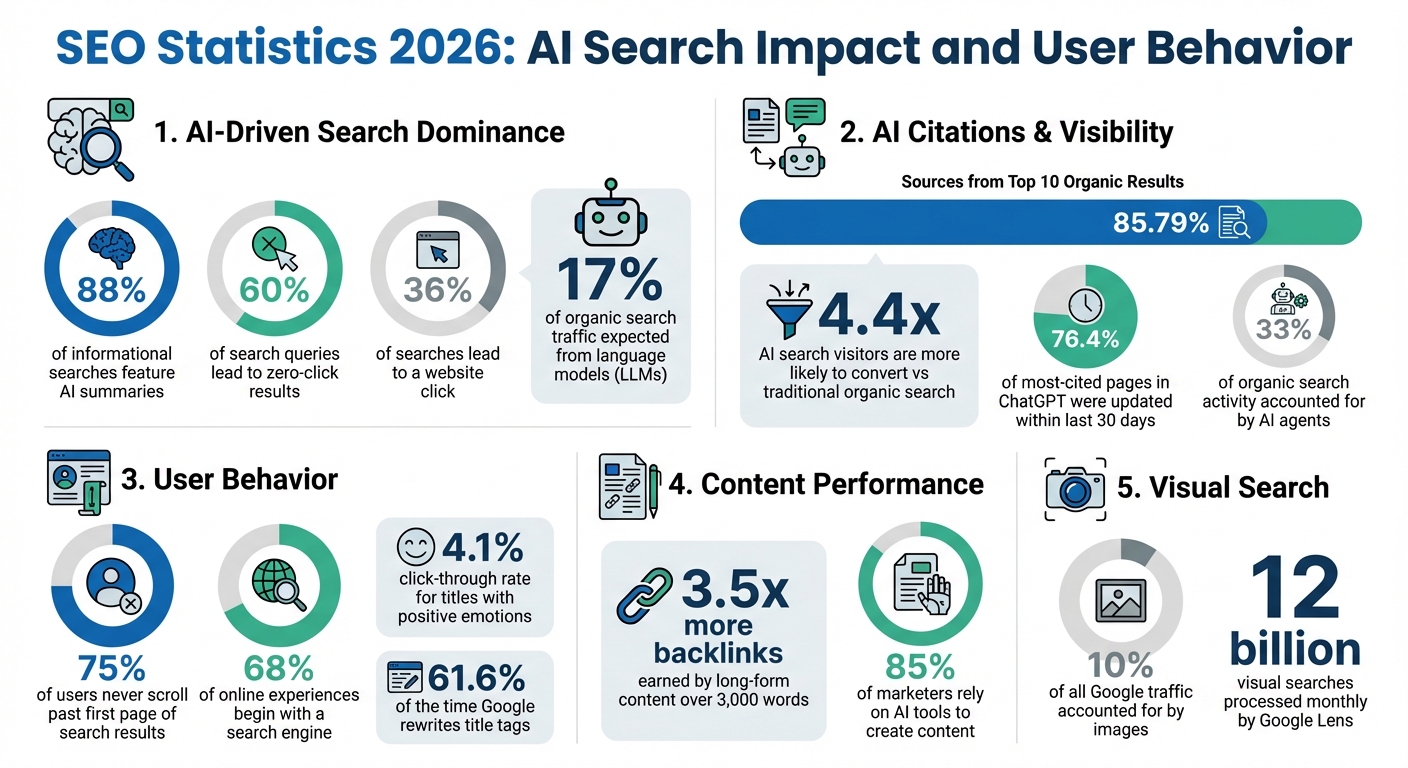
RankWriter SEO Statistics 2026: AI Search Impact and User Behavior
What Is SEO Writing in 2026?
SEO writing in 2026 is the practice of creating content that is easy for search engines and AI systems to understand, extract, and trust while still being useful to human readers. It focuses on clear structure, intent-driven topics, and explicit answers rather than keyword density or long-form narratives designed only to rank.
How to Build a Content Strategy for SEO
To succeed in SEO in 2026, you need to start by analyzing your sales funnel before diving into content creation. Are you ranking high but not converting? Are you driving traffic to the wrong pages? With only 36% of searches leading to a website click[8], focusing on content that captures high-intent traffic and drives revenue is more important than ever.
The backbone of a modern SEO strategy is topical authority – showing search engines and AI tools that you’re an expert on an entire subject, not just a few scattered keywords. This means organizing your content in a way that’s logical and easy to navigate for both humans and algorithms. When you consistently cover related topics in depth, AI-powered search engines are more likely to recognize and recommend you as a credible source. To stay relevant, your strategy needs to balance data insights with a strong focus on user needs.
By 2026, language models (LLMs) are expected to account for 17% of organic search traffic[7]. Your content needs to rank traditionally while also being structured for AI extraction.
How to Use the Hub & Spoke Model
To build topical authority, the hub-and-spoke model is a proven approach. Here’s how it works: you create a central hub page that offers a broad overview of a topic, then add spoke pages that dive into specific subtopics. Each spoke links back to the hub, and the hub links to all its spokes, forming a clear and crawlable hierarchy[9].
For example, your hub might be a comprehensive service page like “Personal Injury Law” or “Estate Planning Services.” The spokes would then cover narrower, related topics such as “personal injury settlement timeline” or “how to create a living trust.” This structure avoids keyword cannibalization by grouping related terms into a single, cohesive ecosystem[9].
Consider Salesforce’s strategy in 2025: their “CRM” hub page connected to spoke articles like “CRM systems”, “CRM software”, and “best CRM tools”, solidifying their dominance in the topic cluster[9]. Similarly, Backlinko saw a 626% increase in clicks – totaling 164,000 over 12 months – by merging two pages into a single, in-depth hub[5].
Start small with 3–4 hubs, each supported by at least 8 spoke pages. This ensures enough depth to rank effectively[6]. Map your spoke topics to different stages of the buyer journey: awareness-stage content answers basic questions, consideration-stage content compares options, and decision-stage content addresses final objections. When researching spoke topics, prioritize high-intent keywords like “best”, “vs”, “how to”, and “pricing” to attract users ready to convert[9].
How to Find High-Intent Keywords for Your Audience
Not all keywords are created equal. High-intent keywords indicate that someone is actively searching for a solution and ready to take action. For industries like law or services with high-value clients, this means focusing on transactional and commercial queries rather than purely informational ones.
Start by understanding five types of search intent: Informational (learning), Commercial (comparing options), Transactional (ready to buy), Navigational (specific brand searches), and Local (nearby services). Then, match these intents to your audience’s awareness levels. For instance, a “Most Aware” prospect might need pricing guides or ROI calculators to make a decision, while someone “Problem Aware” might respond better to educational blog posts or how-to guides[14].
Use tools like Google Keyword Planner to get accurate search volume data and RankWriters’ insights to uncover industry-specific high-intent keywords. Dig into your sales calls, support tickets, and customer inquiries to find out exactly what problems your audience is trying to solve[14]. Don’t overlook sources like “People Also Ask” sections on Google or forums like Reddit for real-world questions and concerns[14].
When evaluating keywords, consider factors like search traffic (using autocomplete), competition (Domain Rating), current ranking, and commercial value[6]. Long-tail keywords – phrases with three or more words – are a goldmine. They might have lower search volumes, but they attract more qualified, high-intent traffic with less competition[13]. Keep in mind, 75% of users never scroll past the first page of search results[12], so ranking high for these targeted terms can make all the difference.
On-Page Optimization Techniques for 2026
In 2026, crafting on-page elements requires a dual focus: engaging human readers while catering to AI systems that extract, summarize, and cite your content. While title tags, headings, and keyword placement remain staples, their purpose has shifted toward ensuring your content is easy to understand, trustworthy, and machine-readable.
How to Write Title Tags and Meta Descriptions
Title tags remain one of the most critical relevance signals for both search engines and AI crawlers.[15] To avoid truncation, keep your title tags between 50–60 characters (or 600 pixels). Google often replaces poorly optimized titles with the page’s H1 tag if they fall outside this range.[16] To maximize effectiveness, place your primary keyword at the beginning of the title. For instance, “SEO Writing Tips 2026: Complete Guide” is more effective than “A Complete Guide to SEO Writing Tips for 2026.” Adding modifiers like “best”, “guide”, or the current year can also help capture long-tail keyword variations. Research shows that titles evoking positive emotions enjoy a 4.1% higher click-through rate compared to negative ones.[15]
Meta descriptions, while not direct ranking factors, play a significant role in click-through rates and serve as concise summaries for AI systems.[15] Think of them as a snapshot of your page’s main purpose. For desktop, keep meta descriptions under 160 characters, and for mobile, aim for fewer than 120 characters. Include your main keyword to ensure search engines highlight relevant terms in search results. A good meta description answers the search query directly, such as: “Discover 12 actionable SEO strategies to rank higher and earn AI citations in 2026.”
| Element | Recommended Length | Primary Purpose in 2026 |
|---|---|---|
| Title Tag | 50–60 characters (600px) | High-level relevance signal; primary SERP headline |
| Meta Description | 120 (Mobile) – 160 (Desktop) chars | Boosts CTR; concise summary for AI systems |
A well-structured title and meta description lay the foundation for an organized hierarchy in your headings.
How to Use Heading Tags Correctly
Heading tags are essential for structuring content, helping both users and search engines navigate your page. Use a single H1 for your main topic, followed by H2s for major sections and H3–H6 for supporting details.[17][19] Avoid skipping heading levels (e.g., jumping from H2 to H4), as this can confuse both crawlers and screen readers.[18][19]
Google’s John Mueller has emphasized that header elements send a “really strong signal” about a page’s content.[17] Notably, Google rewrites title tags 61.6% of the time, often pulling from the H1 tag when titles are poorly optimized.[20] This makes your H1 tag especially important – it should include your primary keyword and clearly reflect the page’s content.
For subheadings, opt for descriptive and intent-driven language rather than vague labels like “Introduction” or “Step 1.” For example, instead of “Optimization Tips”, use “How to Optimize Images for Faster Page Speed.” Descriptive headings not only enhance user experience but also allow search engines to rank specific sections for niche queries. To improve your chances of being featured in AI-generated answers, start each section with a clear and authoritative statement immediately following the heading.
Beyond headings, precise keyword placement is another key element for signaling your content’s focus to both readers and AI systems.
Where to Place Keywords in Your Content
Strategic keyword placement helps search engines quickly understand your content’s context. Place your primary keyword within the first 100–150 words to establish the topic early.[15] Beyond the introduction, incorporate keywords naturally into your URL slug, image filenames, alt text, and internal link anchor text. These placements not only act as lightweight ranking signals but also improve accessibility and user experience.
For images, use descriptive filenames like “seo-writing-tips-2026.jpg” instead of generic names. Write alt text that naturally includes your keyword, such as “Infographic showing SEO writing tips for 2026.” Additionally, use semantic variations and secondary keywords in subheadings to reinforce your topic’s depth.[4][5] This mirrors how users often search with longer, conversational queries, helping AI systems better interpret your content.
Avoid keyword stuffing. As Martech Zone explains:
Keywords no longer drive rankings directly. Instead, they serve as signposts that help search engines understand your content’s purpose.[22]
The goal is to write content that feels natural for readers while providing clear signals to machines about your topic and its relevance. When combined with a strong content strategy, these techniques ensure your content remains clear and authoritative in an AI-driven world.
How to Optimize Content for Featured Snippets and AI Search
Featured snippets have become a key entry point for AI-powered search tools like Google AI Overviews and ChatGPT[1]. With 60% of search queries in 2026 being answered directly on the search results page without requiring a click[3], optimizing for these snippets is no longer optional – it’s crucial. Google AI Overviews now appear in 88% of informational search intent queries[1], and they pull sources from the top 10 organic results 85.79% of the time[1]. This means your content needs to be structured for both human readers and AI systems, aligning with the growing emphasis on E-E-A-T principles. AI systems prioritize content that’s clear, concise, and easy to scan.
To meet these new standards, you need to focus on two main strategies: making your content easy to scan and crafting summaries that AI can extract and use effectively.
How to Structure Content for Easy Scanning
Both AI systems and human readers value content that’s quick and simple to digest. Start by providing a clear, concise answer (40–60 words) immediately after any question-based heading[23]. Keep paragraphs short – just one to three sentences – to make your content less overwhelming. Use bulleted lists for related points and numbered lists for step-by-step instructions to break up text and improve readability.
For data-heavy content, tables are incredibly effective. Use clean HTML tables with clear rows and columns to present comparisons, prices, or measurements. These are easier for AI to extract and for readers to understand at a glance. Additionally, structure your H2 and H3 subheadings as specific questions, like “What is keyword density?” or “How do I optimize images for SEO?” This approach increases the chances of your content appearing in “People Also Ask” boxes and AI Overviews.
Don’t forget schema markup – using types like FAQPage, HowTo, and Article can help search engines better understand your content. Displaying “Last Updated” dates with the dateModified property signals that your content is current, which is especially important since AI platforms like ChatGPT often prioritize the most recent information.
Once your content is scannable, the next step is creating summaries that are optimized for AI systems.
How to Write Content Summaries for AI Search
AI search visitors are 4.4 times more likely to convert compared to traditional organic search visitors[42,43]. This makes crafting AI-optimized summaries a crucial part of your strategy. Each section of your content should function as a self-contained summary that provides enough detail to stand alone. Avoid vague pronouns like “it” or “this” by ensuring every sentence is specific and clear.
Embed your brand name directly into key insights. For example, instead of saying, “This approach helps you rank higher on Google“, say, “RankWriters’ hub-and-spoke model improves rankings by organizing content into topic clusters.” This ensures your brand remains associated with the information when AI systems extract it.
Use a conversational tone and replace general statements with specific statistics and sourced data. For instance, instead of saying “most searches”, specify “60% of search queries.” This not only makes your content easier for AI to reference but also increases its credibility. Include citation hooks – like distinct statistics, definitions, or lists – every 150–200 words to provide AI with clear, extractable data points.
Another advanced step is implementing an llms.txt file at your site’s root directory. Similar to robots.txt, this emerging standard helps Large Language Models (LLMs) identify and prioritize your most important content, improving the chances of your material being used in AI-generated answers.
In 2026, success is no longer just about driving clicks to your website. It’s about citation share – how often your brand is mentioned as a source in AI-generated responses. By focusing on scannable content and AI-ready summaries, you position your work to be both discovered and cited in this rapidly evolving search landscape.
sbb-itb-16c0a3c
Technical SEO Elements That Support Content Performance
Even the most compelling content can fall short if it’s built on a shaky technical foundation. As of 2026, search engines and AI systems don’t just analyze what you write but also how efficiently your pages deliver that content to users. Google’s Core Web Vitals – Largest Contentful Paint (LCP), Interaction to Next Paint (INP), and Cumulative Layout Shift (CLS) – are now direct ranking factors that reflect real-world user experience [29]. With mobile-first indexing fully rolled out on July 5, 2024, the performance of your mobile site directly impacts how well your content is crawled and indexed [30]. Pat Ahern, Managing Partner at Intergrowth, emphasizes:
Site load speeds and user experience can have a massive impact on your conversion rate, so treat this as a revenue maximization opportunity as you scale your site visitors. [30]
Elements like optimized images, internal links, and page speed are essential for a seamless user experience, improving load times, rankings, and visibility. Let’s dive into how these technical aspects can enhance your site’s performance.
How to Optimize Images and Alt Text
A strong technical foundation isn’t complete without optimized images, which play a key role in both user experience and AI-driven discovery. Images account for about 10% of all Google traffic via images.google.com, while Google Lens processes an astounding 12 billion visual searches every month [24]. Alt text and schema markup are crucial for providing the context that AI systems need to interpret and cite your visual content [15][21].
To optimize images effectively:
- Use descriptive, hyphenated filenames (e.g.,
aspen-tree-leaf-closeup.jpg) instead of vague ones. Hyphens act as spaces for search engines, helping them understand the image’s content [24]. - Write concise alt text (under 125 characters) that accurately describes the image in context. Skip redundant phrases like “image of” or “photo of”; just describe what’s visible [24].
- Choose the right file formats. WebP and AVIF offer better compression than JPEG or PNG, keeping file sizes below 100KB without losing quality [24][21]. For logos and graphics, SVG files are ideal for scalability and minimal size.
- Use
loading="lazy"for images below the fold to improve initial load times, but avoid this for above-the-fold images, as it can hurt your LCP score [24][25]. - Implement responsive images with the
srcsetandsizesattributes to serve appropriately sized images for different devices [24]. Always define explicit width and height in your HTML to prevent layout shifts (CLS) during loading [24][28].
Lastly, enhance discoverability by adding ImageObject schema markup to provide metadata like creator names and licenses. Submitting an image XML sitemap to Google Search Console ensures all visual assets are indexed [24][21].
How to Use Internal Links for Better Navigation
Internal linking has evolved into a vital tool for guiding both users and AI systems. With AI agents now accounting for roughly 33% of organic search activity, a well-structured internal link architecture ensures these systems can quickly retrieve and interpret your content [26]. Lemuel Park, Co-founder and CTO at BrightEdge, explains:
Core signals like intent-mapped content, E-E-A-T, internal linking, and performance guide AI systems in choosing trusted sources. [26]
Here’s how to make the most of internal links:
- Use keyword-rich anchor text that incorporates the primary keyword of the target page. Avoid generic phrases like “click here” or “read more,” as they offer little value to search engines [4][25].
- Link from high-authority pages to newer content to distribute link equity and boost rankings for fresh material [25].
- Place internal links early in your content, especially when introducing new concepts, to improve clarity for readers and AI systems alike [4].
- Build content hubs by connecting a main pillar page to related subtopic articles. This structure not only establishes topical authority but also signals in-depth expertise on a subject [4][27]. When you publish a new subtopic article, link it to its parent pillar page – and vice versa – to strengthen the association [4].
- Include your most important pillar pages in your top navigation, signaling their significance to search engines [4].
Keep internal links relevant to the topic at hand. Too many unrelated links can confuse both users and search engines, diminishing their effectiveness [4].
How to Improve Page Speed and Mobile Responsiveness
Fast load times are critical for both rankings and user satisfaction. Google’s Core Web Vitals set the benchmarks: LCP should occur within 2.5 seconds, INP should stay under 200 milliseconds, and CLS should remain below 0.1 [29][31]. These metrics directly affect how your site performs in search rankings, and they matter because 68% of online experiences begin with a search engine [31].
Here’s how to enhance page speed and mobile responsiveness:
- Optimize your LCP element, typically an image on 73% of mobile pages [28]. Use standard
<img>tags withsrcorsrcsetattributes to ensure the browser’s preload scanner can locate images quickly [28]. Applyfetchpriority="high"to your LCP image and avoidloading="lazy"for images in the initial viewport [28]. - Compress images and convert them to WebP or AVIF formats to reduce file sizes without losing quality [30][31].
- Use a Content Delivery Network (CDN) to serve content from servers closer to your users, reducing Time to First Byte (TTFB) [28].
- Split JavaScript tasks into chunks under 50 milliseconds to keep the main thread responsive, improving INP scores [28].
- For animations, rely on CSS
transformproperties rather thantop,left, ormarginvalues, which can trigger layout recalculations and negatively impact CLS [28]. - Ensure your pages are eligible for the back/forward cache (bfcache) by avoiding
no-storecache directives andunloadevent listeners, which can delay page restoration [28].
How to Create Original, Data-Driven Content
By 2026, the digital landscape is saturated with recycled content, with 85% of marketers relying on AI tools to create material[32]. To truly stand out, you need to focus on producing content that offers unique data, original research, and exclusive frameworks. This approach not only engages readers but also aligns with AI evaluation standards, making your content more impactful.
Publishing original, data-driven content strengthens Google’s E-E-A-T (Experience, Expertise, Authoritativeness, and Trustworthiness), positioning your site as a credible source for AI citations[1][21]. Sharing unique research and firsthand insights can act as “link bait”, encouraging journalists and industry professionals to reference your site as a primary source[21][5]. Ryan Law, Director of Content Marketing at Ahrefs, explains the value of this effort:
Great writing should feel hard. But interview someone, read a book, find an esoteric research paper, or collect some data… and your willingness to do something difficult gives you an edge.[34]
The payoff for this effort is clear. In April 2025, Backlinko updated its “SEO Trends” article with fresh research, leading to a 70.43% increase in organic traffic[5]. Similarly, Bankrate achieved an AI Visibility score of 87/100 by integrating niche-specific stats and insights from verified financial experts, making it one of the most-cited finance sources in ChatGPT and Google AI Mode[32].
This kind of content not only boosts your authority but also opens doors to creative and engaging formats.
How to Use Industry Trends and Original Research
Creating original research doesn’t have to break the bank or require a full-fledged data science team. Start by exploring your own internal resources – things like product reviews, customer support tickets, sales calls, and inquiries often reveal patterns and insights that competitors can’t easily replicate[5]. You can also run surveys or polls within your niche to generate unique statistics. If proprietary data isn’t available, try recombining public data in ways that uncover fresh perspectives[5].
Presentation is just as important as the data itself. Use custom charts, infographics, and annotated screenshots to make your findings visually engaging and easy to understand for both readers and AI models[1][21]. Descriptive filenames (e.g., 2026-seo-survey-results.jpg) and keyword-rich alt text ensure these visuals are discoverable by multimodal AI systems[1]. A clear methodology section is also essential – this transparency builds trust with both human readers and AI systems evaluating your content’s credibility[5].
Tools like Google Trends can help you identify emerging topics and seasonal patterns, but the real value lies in adding your own analysis and expert commentary. Include quotes from subject matter experts, whether internal or external, to deepen the content and create “citable moments” for AI[1][32]. Always attribute data-driven content to named authors with relevant credentials in your author bios – this enhances your E-E-A-T standing. When citing external sources, link back to the original, primary sources to demonstrate transparency and accuracy[10][35].
To make your content even more practical and shareable, consider adding actionable templates or downloadable checklists alongside your research[5]. Combining original data with useful tools increases the likelihood of your content being bookmarked, shared, and referenced. Keep in mind that long-form content over 3,000 words earns 3.5x more backlinks than shorter pieces, as it often covers topics in greater depth and includes unique data[33].
How to Create Content That Gets Shared
The format of your content plays a significant role in how shareable it is. While traditional blog posts remain effective, diversifying into case studies, infographics, and videos can significantly boost engagement and social shares. Case studies, in particular, demonstrate real-world E-E-A-T by showcasing actual results from campaigns, including both successes and failures, which adds credibility[32]. Be sure to include clear metrics, timelines, and actionable insights when presenting case studies.
Infographics are another powerful tool for turning complex data into digestible visuals. They act as “link magnets”, making it easy for journalists and bloggers to reference your findings in their own content[5]. Focus on a single, compelling insight or dataset per infographic to avoid overwhelming your audience. Use professional design elements with subtle branding, and provide an embed code to make sharing effortless.
Video content continues to gain traction, especially as AI becomes better at processing multimodal content. Short explainer videos that highlight your research findings or demonstrate your unique frameworks can be highly effective. Always include transcripts and closed captions to improve accessibility and provide additional text for search engines. Hosting videos on platforms like YouTube while embedding them on your site ensures greater visibility across search ecosystems.
Make your data easy to cite by presenting it in clean, well-labeled tables that others can screenshot or embed. Create summary statistics that fit naturally into social media posts – think “tweetable” insights designed to grab attention. Establish a consistent schedule for publishing original research, like quarterly reports or annual analyses, so your audience knows when to expect fresh data[10][35].
Finally, actively promote your data-driven content. Reach out to journalists, bloggers, and industry publications to ensure your work gets noticed. As Brian Dean, Founder of Backlinko, experienced:
Because that link comes from an authority site, Google puts lots of weight on it. In fact, I noticed a boost in my organic search engine traffic right after TechCrunch linked to me.[1]
Conclusion
SEO in 2026 is all about earning trust – not just from human readers but from AI systems as well. The strategies outlined here highlight a major shift in focus: moving away from chasing clicks and stuffing keywords to delivering real value through answering specific questions, building connections between content, and earning citations. As Lemuel Park, Co-founder & CTO of BrightEdge, explains:
SEO foundations are the prerequisite for AI visibility: without clean technicals, strong information architecture, and quality content… generative and answer-based efforts lack reliable data for AI systems to ingest, understand, or cite.[26]
With AI agents now driving about 33% of organic search activity[26] and most searches no longer ending in traditional clicks[36], your content needs to work harder to prove its worth. These trends point to the urgency of adapting your strategy. Focus on creating topical authority with pillar-cluster models, optimizing for featured snippets, and keeping your content fresh – 76.4% of the most-cited pages in ChatGPT were updated within the last 30 days[36].
To stay ahead, start by auditing your existing content for trust-building elements. Add author bios that showcase real credentials, include original data and custom visuals, and ensure your technical setup makes it easy for AI crawlers to find and understand your best content. Address “The Big 5” buyer questions – cost, problems, comparisons, reviews, and best-in-class options – and structure your responses in a way that AI can easily extract and use[4]. While AI tools can speed up your workflow, your content should always reflect human expertise and genuine insights.
Brands that succeed in 2026 will dominate the search ecosystem – whether on ChatGPT, YouTube, or TikTok – by creating content that stands out. What sets them apart? Original research, firsthand experience, and true expertise.
These strategies aren’t just theoretical – they deliver results. Now it’s up to you to put them into action, test what resonates with your audience, and craft content that rises above the noise in an increasingly competitive digital space.
FAQs
How can I make my content optimized for AI while building trust with readers?
To make your content stand out for AI while maintaining trust, focus on providing clear, concise, and well-organized information that demonstrates genuine knowledge and reliability. Apply the E-E-A-T principles – Experience, Expertise, Authoritativeness, and Trustworthiness – by referencing dependable sources and supporting your points with solid facts or relevant examples.
Help AI understand your content better by incorporating structured data, using clear headings, and following logical formatting. While AI tools can be helpful for refining grammar or suggesting keywords, always ensure a human touch in the final review. This keeps the content authentic and builds trust with your audience.
What is the hub-and-spoke model, and how does it improve SEO?
The hub-and-spoke model, often called a topic cluster, is a smart way to organize website content. At its core, there’s a central “hub” page that dives into a broad topic. Surrounding it are “spoke” pages, each covering related subtopics in more detail. These pages are all interconnected – the hub links to the spokes, and the spokes link back to the hub – forming a structure that helps both users and search engines make sense of your site’s content.
This setup plays a big role in boosting SEO. It signals to search engines that the hub page is a go-to resource for the main topic, which can help it rank higher for broad search terms. At the same time, the spoke pages focus on narrower keywords and specific user needs, expanding your site’s keyword reach. Plus, the organized layout makes it easier for visitors to navigate your site, keeping them engaged longer and reducing bounce rates – both of which can positively impact your rankings.
Why are high-intent keywords important for SEO in 2026?
High-intent keywords are a game-changer for SEO in 2026 because they match exactly what users are trying to accomplish – whether that’s buying a product, signing up for a service, or finding a solution to their problem. With AI-powered search engines becoming sharper at reading user intent, content that targets these keywords has a better shot at ranking higher and pulling in highly qualified traffic.
When you prioritize high-intent keywords, you’re not just aiming for better rankings; you’re also creating content that resonates with people who are ready to act. This strategy boosts engagement, drives higher conversion rates, and helps you achieve your business goals more effectively.