

A B2B SEO agency specializes in helping businesses improve their online presence to attract decision-makers from other companies. Unlike agencies focused on consumer SEO, these firms target long, research-driven buying cycles involving multiple stakeholders. Their goal is to generate leads, nurture prospects, and drive revenue by optimizing for niche, high-intent keywords, creating in-depth content, and addressing the unique needs of professional buyers.
Key Takeaways:
- Target Audience: Business decision-makers and buying committees, not individual consumers.
- Approach: Focus on long-tail keywords with commercial intent, thought leadership content, and multi-stage buyer journeys.
- Services: Includes technical SEO, content creation, on-page and off-page optimization, and data-driven insights.
- Why It Matters: 71% of B2B buyers start their journey with a Google search, and organic SEO offers a cost-effective alternative to rising ad costs.
- Results: SEO leads convert at 15% compared to 2% for outbound leads, with long-term ROI often exceeding 800%.
B2B SEO agencies understand the complexities of B2B sales cycles, where decisions take months, involve multiple stakeholders, and hinge on trust and authority. By partnering with these experts, businesses can reduce ad spend, improve visibility, and build sustainable growth.
What Is a B2B SEO Agency?
A B2B SEO agency focuses on optimizing your online presence to attract decision-makers from other businesses. These agencies recognize that business buyers don’t make decisions lightly. In fact, purchasing decisions often involve 6 to 10 individuals, each with their own priorities and search habits [6]. This deep understanding of professional buyer behavior helps shape strategies designed for long-term success.
The main goal? Generating leads and nurturing prospects through complex, multi-stage buyer journeys that can take months – or even years – to complete [1][7]. Instead of chasing high-volume keywords for quick traffic spikes, these agencies target niche, long-tail keywords with strong commercial intent. For example, terms like “enterprise SaaS integration” may not have massive search volumes, but their higher cost-per-click reflects their value in driving qualified leads [1][4].
Their services cover all aspects of SEO:
- Technical SEO: Improving site infrastructure, page speed, and mobile usability.
- Content SEO: Crafting materials that align with user intent at every stage of the buyer journey.
- On-page SEO: Refining metadata, internal linking, and site structure.
- Off-page SEO: Securing high-quality backlinks from respected industry sources [3].
By integrating these approaches, B2B SEO agencies address the unique challenges of longer purchase cycles, building a digital presence that fosters trust, authority, and relevance.
These agencies also establish credibility through data-driven insights, technical audits, and thought leadership content like whitepapers and case studies [1][7]. Given that 71% of B2B decision-makers start their buying process with a Google search [8], partnering with a specialized agency that understands this research-driven process becomes a smart move for sustainable growth. Up next, we’ll explore how B2B SEO differs from more traditional SEO strategies.
B2B SEO Agency vs. Traditional SEO Agency: What’s Different
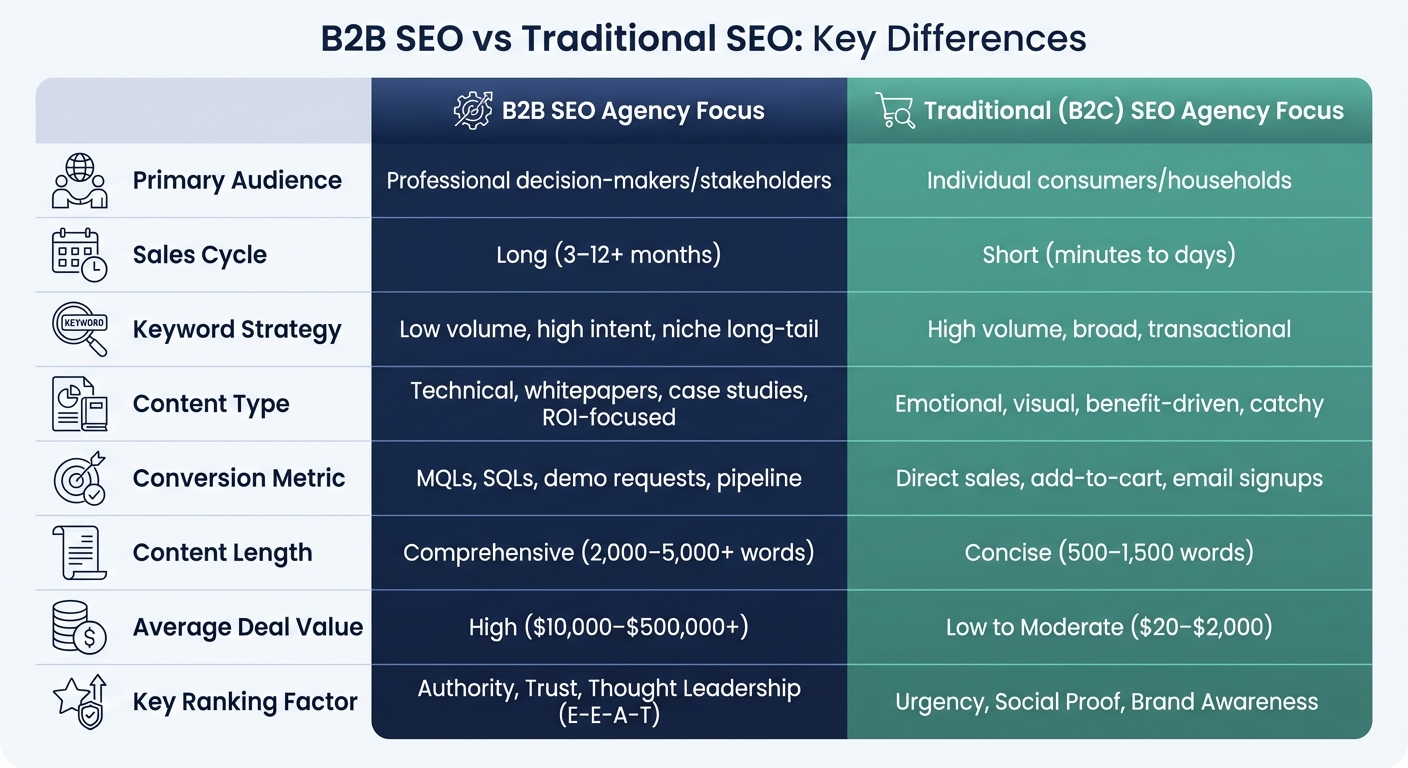
B2B SEO vs Traditional SEO: Key Differences Comparison
The differences between B2B and traditional (B2C) SEO go far beyond just targeting different audiences. They extend into how decisions are made, what the priorities are, and how long it takes to close deals. Traditional SEO is all about connecting with consumers who often make quick, emotion-driven decisions. On the other hand, B2B SEO focuses on professionals who take their time, conduct thorough research, consult with multiple stakeholders, and demand clear evidence of ROI. In fact, B2B sales cycles can stretch over several months, involving numerous decision-makers along the way [1].
One of the biggest distinctions lies in keyword strategy. Traditional SEO often goes after high-volume keywords like “best running shoes”, aiming to attract large amounts of traffic. In contrast, B2B SEO zeroes in on niche, low-volume keywords that carry significant commercial intent. For example, a keyword like “enterprise workflow automation pricing” might only attract about 50 searches per month. But those 50 searches could lead to deals worth anywhere from $10,000 to $500,000 or more [4][9]. While traditional SEO is traffic-driven, B2B SEO is laser-focused on targeting niche markets that can generate serious revenue.
Content is another area where the two approaches diverge. B2C content often leans on emotional appeals and eye-catching visuals to grab attention. B2B content, on the other hand, is all about depth and detail. It typically includes long-form materials like whitepapers, case studies, and guides, ranging from 2,000 to over 5,000 words. These resources provide technical insights and educational value. Research shows that B2B buyers usually review 3 to 7 pieces of content before they even consider speaking to a sales rep [8].
Here’s a quick breakdown of how B2B SEO and traditional SEO stack up:
Comparison Table: B2B SEO vs. Traditional SEO
| Feature | B2B SEO Agency Focus | Traditional (B2C) SEO Agency Focus |
|---|---|---|
| Primary Audience | Professional decision-makers/stakeholders | Individual consumers/households |
| Sales Cycle | Long (3–12+ months) | Short (minutes to days) |
| Keyword Strategy | Low volume, high intent, niche long-tail | High volume, broad, transactional |
| Content Type | Technical, whitepapers, case studies, ROI-focused | Emotional, visual, benefit-driven, catchy |
| Conversion Metric | MQLs, SQLs, demo requests, pipeline | Direct sales, add-to-cart, email signups |
| Content Length | Comprehensive (2,000–5,000+ words) | Concise (500–1,500 words) |
| Average Deal Value | High ($10,000–$500,000+) | Low to Moderate ($20–$2,000) |
| Key Ranking Factor | Authority, Trust, Thought Leadership (E-E-A-T) | Urgency, Social Proof, Brand Awareness |
This comparison underscores the critical differences in strategy, content, and goals between B2B and traditional SEO approaches. Each demands a tailored method to effectively meet the needs of its audience.
Why B2B Companies Need a Specialized SEO Agency
B2B companies operate in a unique landscape where generic SEO strategies often fall short. The longer sales cycles and intricate decision-making processes in B2B demand a more tailored approach. A specialized B2B SEO agency understands these complexities and develops a B2B SEO content strategy that aligns with the high-value, multi-step buying journey.
Here’s the reality: 80% of the B2B buying process happens before a potential customer even reaches out to your business [10]. This means your company needs to establish visibility and credibility from the very beginning. A specialized agency ensures your content targets every stage of this journey – from creating awareness to influencing the final decision. Even a keyword with just 50 monthly searches could represent 50 companies, each with the potential to bring in $50,000 to $500,000 annually [9]. Instead of chasing vanity metrics like total traffic, these agencies focus on keywords that drive real revenue.
This approach not only sets the foundation for long-term growth but also helps address rising ad costs while building trust and authority.
High Ad Costs Make SEO a Smart Investment
Paid advertising for B2B companies has become increasingly expensive. Over the past eight years, customer acquisition costs have risen by a staggering 222% [10]. For businesses looking to grow without breaking the bank, SEO for lead generation offers a cost-effective alternative. On average, acquiring a customer through organic search costs $457.66, compared to $813.83 for paid ads [10]. That’s nearly half the cost for similar results.
Here’s another reason SEO is worth it: leads generated through organic search convert at 15%, compared to just 2% for outbound leads [10]. Not only do you spend less per lead, but those leads are also more likely to turn into high-value customers. Over three years, SEO delivers an average ROI of 825%, contributing to 53% of inbound leads and 44.6% of B2B revenue [10]. Unlike paid ads, which lose their impact once the budget runs out, SEO creates lasting momentum by consistently driving qualified traffic.
B2B keywords often come with high cost-per-click rates due to their commercial intent. Ranking organically for these terms allows you to attract premium traffic without the hefty price tag. A strong SEO strategy can reduce the cost of acquiring a marketing-qualified lead (MQL) to less than one-third of what you’d spend on paid ads [10].
Building Trust and Authority
B2B buyers don’t make decisions lightly. They conduct thorough research and expect clear evidence before committing to a purchase. In fact, 73% of decision-makers trust thought leadership content more than traditional marketing materials [10]. Specialized SEO agencies excel at creating authoritative content that showcases expertise and builds confidence among potential clients.
High-quality content doesn’t just establish authority – it also opens doors to lucrative opportunities. For instance, 86% of B2B buyers say they would invite a company with strong thought leadership to participate in RFPs, and 75% of executives have explored new products after engaging with such content [10]. Google’s emphasis on E-E-A-T (Experience, Expertise, Authoritativeness, and Trustworthiness) further highlights the importance of credibility in search rankings. Given that B2B buyers spend only 17% of their purchasing journey in direct contact with vendors [10], your organic presence must work overtime to build trust.
The rise of AI-powered search engines has made this even more critical. Specialized agencies ensure your content not only ranks well on traditional platforms but also meets the evolving criteria for AI-driven search. Visitors from these emerging platforms are reportedly 4.4 times more likely to convert, making this an opportunity you can’t afford to miss [10].
Navigating Complex Buyer Journeys
B2B sales are rarely straightforward. The process often spans several months and involves multiple decision-makers. On average, 74.6% of B2B deals take at least four months to close, with buying groups consisting of 10–11 stakeholders – and up to 15 for enterprise-level deals [10]. Each stakeholder has unique concerns that need to be addressed before they’ll sign off on a purchase.
While many agencies focus on top-of-funnel awareness, a specialized B2B SEO agency prioritizes high-intent, bottom-of-funnel keywords. These include terms related to pricing, competitor comparisons, or specific features – keywords that indicate buyers are ready to make a decision. Even if these terms have lower search volumes, they’re far more likely to drive conversions.
To navigate the intricate buyer journey, specialized agencies create a cohesive content ecosystem tailored to different stakeholders. For example:
- CFOs might need tools like ROI calculators or cost comparison guides.
- IT teams often look for detailed documentation and security certifications.
- End-users benefit from use case examples and training materials.
It’s worth noting that 44% of B2B buyers consume 3–5 pieces of content before engaging with a vendor [10]. With 71% of decision-makers starting their research with generic search queries [8], traditional last-click attribution doesn’t capture the full value of SEO. Specialized agencies use multi-touch attribution to track every organic interaction, demonstrating SEO’s true impact on closing deals.
How to Choose the Right B2B SEO Agency
When it comes to B2B SEO, choosing the right agency can make or break your pipeline. Unlike generic SEO providers, an agency that understands the intricacies of B2B marketing can deliver results that truly align with your business goals. Here’s what to focus on when evaluating potential partners.
What Experience Matters Most?
Look for an agency with hands-on experience in managing the B2B sales cycle. Since these sales cycles are often lengthy [10], you need a partner who understands that last-click attribution is just one piece of the puzzle. Ask how they use multi-touch attribution to track and measure the early stages of the buyer journey [10].
An effective agency should also excel at building SEO content ecosystems tailored to different stakeholders, from executives to technical evaluators [10]. Request examples of how they’ve addressed diverse concerns within a single buying process to ensure they can create targeted, impactful content.
Another critical checkpoint: Does the agency rank for its own target keywords? Their visibility in search results is a direct reflection of their expertise. Ask about their SEO performance and how they achieve it – this demonstrates their ability to execute strategies successfully [11].
Additionally, ensure they’re well-versed in AI-powered search optimization. With AI-driven search visitors converting at 4.4 times the rate of traditional organic visitors [10], expertise in Generative Engine Optimization (GEO) is now essential. Ask how they structure content for platforms like ChatGPT and Perplexity and whether they incorporate structured data and authoritative citations into their strategies.
This focus on experience naturally ties into the next critical factor: industry knowledge.
How Important Is Industry Knowledge?
Industry knowledge isn’t optional – it’s a must-have for crafting content that resonates with decision-makers. Without it, you risk ending up with generic, surface-level content that fails to engage both AI search engines and your target audience [10].
When evaluating agencies, ask for examples of how they’ve handled technical terminology in your niche. Can they use your industry’s jargon correctly? Do they understand the complexities of your product or service? For industries like SaaS, this expertise can mean the difference between driving results or wasting your budget [11][4].
Check whether the agency engages with your Subject Matter Experts (SMEs) to ensure content depth and accuracy [8]. This approach shows they prioritize real expertise over superficial content. You should also assess their thought leadership efforts – do they publish whitepapers, run an active blog, or speak at industry events? These activities highlight their commitment to staying informed and relevant [4][1][5].
Their keyword strategy is another indicator of industry knowledge. Agencies with deep expertise focus on low-volume, high-intent long-tail keywords, which convert at an average rate of 36% [10]. Ask them to identify specific keywords your competitors rank for but you don’t – this tests their ability to conduct thorough market research [2].
Once you’ve confirmed their expertise and industry insights, it’s time to evaluate how they measure success.
What KPIs Should You Track?
The right metrics can reveal whether your SEO efforts are making a real business impact or just inflating vanity numbers. Pipeline contribution and revenue attribution should take priority over keyword rankings. Since B2B sales cycles are long, your agency must track “influenced pipeline” – deals where organic search played a role, even if it wasn’t the final touchpoint [10].
To get a complete picture, organize your KPIs by funnel stage:
- Awareness: Track organic traffic, branded search volume, and keyword rankings to measure market reach and competitive positioning [10][12].
- Engagement: Monitor metrics like MQLs, content downloads, and return visitors to gauge content quality and demand generation [10][12].
- Conversion: Focus on SQLs, opportunities created, win rates, and influenced revenue to assess sales impact and pipeline contribution [10][12].
- Efficiency: Compare CAC, cost per lead, and ROI to evaluate the financial performance of your SEO efforts [10][12].
| KPI Category | Metrics to Track | Insight Provided |
|---|---|---|
| Awareness | Organic traffic, branded search volume, keyword rankings | Market reach and competitive position [10][12] |
| Engagement | MQLs, content downloads, engagement time, return visitors | Content quality and demand generation [10][12] |
| Conversion | SQLs, opportunities created, win rate, influenced revenue | Sales impact and pipeline contribution [10][12] |
| Efficiency | CAC, cost per lead, ROI | Channel performance and financial returns [10][12] |
Don’t forget to implement self-reported attribution by adding a “How did you hear about us?” field to your forms. This simple step can capture organic influence that analytics tools might overlook [10][12]. Also, set realistic expectations – while you might see traffic and ranking improvements within 3–6 months, full pipeline visibility and ROI often take 9–18 months [10][9].
Common B2B SEO Mistakes to Avoid
Many B2B companies put time and resources into SEO strategies that fail to make a real impact on their sales pipeline. A common misstep? Falling into the volume trap – focusing on high-traffic, generic keywords that attract the wrong audience. For instance, while a keyword with 10,000 monthly searches might look appealing, a more specific term with just 50 searches could translate to $2.5M–$25M in potential annual revenue if it reaches the right decision-makers [9]. Generic keywords like “project management software” often bring in students or job seekers – not the qualified buyers you need.
Another frequent mistake is overlooking the buying committee. In B2B sales, decisions often involve 10–11 stakeholders, and for enterprise deals, this number can climb to 15 [10]. Crafting content for just one persona leaves out key players in the decision-making process. For example, failing to address the CFO’s concerns about ROI, the IT director’s security requirements, or the end user’s usability needs can cause deals to stall – sometimes indefinitely. In fact, 86% of deals can grind to a halt when content doesn’t speak to all stakeholders [10]. Partnering with an experienced SEO content writing agency can help create content ecosystems that meet the needs of every decision-maker.
Broken attribution models are another stumbling block for B2B SEO. Relying on last-click attribution often ignores the role of content that sparks interest long before a conversion happens. Since 74.6% of B2B sales take more than four months to close [10], content published in March could be the starting point for a deal that closes months later. Yet, traditional attribution models often credit only the final interaction, overlooking the importance of top-of-funnel content. This blind spot can hide technical issues that are critical to SEO success.
Speaking of technical issues, neglecting technical SEO can undermine even the best strategies. No matter how engaging your content is, it won’t perform if your site has slow load times, misconfigured robots.txt files blocking search engines, or poor mobile usability [9]. On top of that, weak Core Web Vitals – metrics that gauge user experience – can hurt your rankings regardless of your content quality.
“Technical SEO is like flossing. Everyone knows they should do it, nobody wants to talk about it, and you only care when something breaks.” – Katlyn Edwards [9]
Lastly, one of the most damaging errors is creating thin product pages. When you outsource content creation. Pages with just 150 words of generic copy simply don’t cut it. To rank for high-intent keywords, product pages should have over 1,000 words of detailed, keyword-optimized content that addresses pain points, technical specs, and implementation [9]. Without this depth, these pages struggle to rank – and miss out on high-intent traffic, which typically converts at around 36%, compared to the single-digit rates of generic keywords [10].
Conclusion
B2B SEO serves as a long-term engine for growth, requiring a unique blend of technical precision, industry expertise, and a deep understanding of nuanced buyer journeys. With 71% of B2B decision-makers beginning their purchasing process with a Google search, and only 36% of companies having a documented SEO strategy [8], the potential for businesses ready to invest in SEO is enormous. The best agencies focus not just on increasing traffic but on driving qualified leads, pipeline growth, and revenue – metrics that directly impact your bottom line.
By partnering with a specialized B2B SEO agency, you gain access to a team of experts – technical SEOs, content strategists, and industry specialists – without the high costs of building an in-house team [11]. These professionals understand the deliberate nature of B2B buyers, who often review 3–7 pieces of content and visit 2–7 websites before even engaging with sales [8]. A well-crafted SEO strategy ensures you connect with buyers at every critical touchpoint along their journey.
This strategic focus delivers tangible results. Take, for instance, the success stories of companies like Jasper, which increased organic sessions by 810% and generated $4 million in ARR through their blog strategy [13]. Similarly, Interfolio achieved over $186,000 in direct revenue and $1.1 million in pipeline growth [13]. While meaningful results often take 6 to 9 months to materialize [11], the benefits compound over time as your content continues to rank and attract high-quality leads.
For businesses looking to move away from costly ads and build sustainable organic growth, choosing the right B2B SEO agency is critical. Look for agencies that truly understand your industry, measure the metrics that matter to your business, and recognize that trust and authority are the driving forces behind B2B decision-making.
FAQs
How do B2B SEO agencies optimize strategies for businesses with long sales cycles?
B2B SEO agencies specialize in crafting focused, informative content designed to meet the needs of various decision-makers at every stage of the buyer’s journey. Their approach often includes using long-tail keywords and producing detailed resources, which helps establish credibility and build trust over time.
These agencies integrate SEO strategies with lead-nurturing efforts, ensuring businesses remain relevant throughout the often lengthy sales cycle. By monitoring metrics tied to the sales pipeline, they ensure that SEO work contributes directly to revenue growth and sustained success.
What makes B2B SEO different from traditional SEO?
B2B SEO is all about tailoring search optimization to fit the business-to-business buying process, which is quite different from how consumers behave online. Unlike B2C, where purchases are often quicker and more impulsive, B2B buyers tend to take their time. They dive into lengthy research, involve multiple stakeholders, and look for high-value, specialized solutions. To match this, B2B SEO zeroes in on high-intent, industry-specific keywords and delivers detailed resources like white papers, case studies, and demo request pages. These types of content help guide potential clients through their multi-step decision-making process.
On the other hand, traditional SEO usually targets broader, consumer-focused keywords and leans on strategies designed to drive fast conversions, such as landing pages or content that encourages quick buys. While traditional SEO often measures success by traffic and immediate sales, B2B SEO is more about generating leads, building pipelines, and supporting decision-makers as they navigate complex purchasing journeys.
Why does a B2B SEO agency need strong industry knowledge?
Industry expertise plays a key role for a B2B SEO agency, as it allows them to grasp the specific challenges, terminology, and decision-making dynamics unique to your market. In the B2B space, buyers tend to dive deep into research and evaluate solutions based on precise business needs. Having an agency that understands your industry means they can craft strategies that genuinely connect with your audience.
With this knowledge, the agency can produce highly relevant content – think case studies, technical guides, and whitepapers – that not only earns the trust of potential clients but also demonstrates authority to search engines. This dual benefit helps improve rankings for high-intent keywords, ultimately bringing in more qualified leads for your business.