
Why AI Retrieval Agents Matter for Your Content Visibility
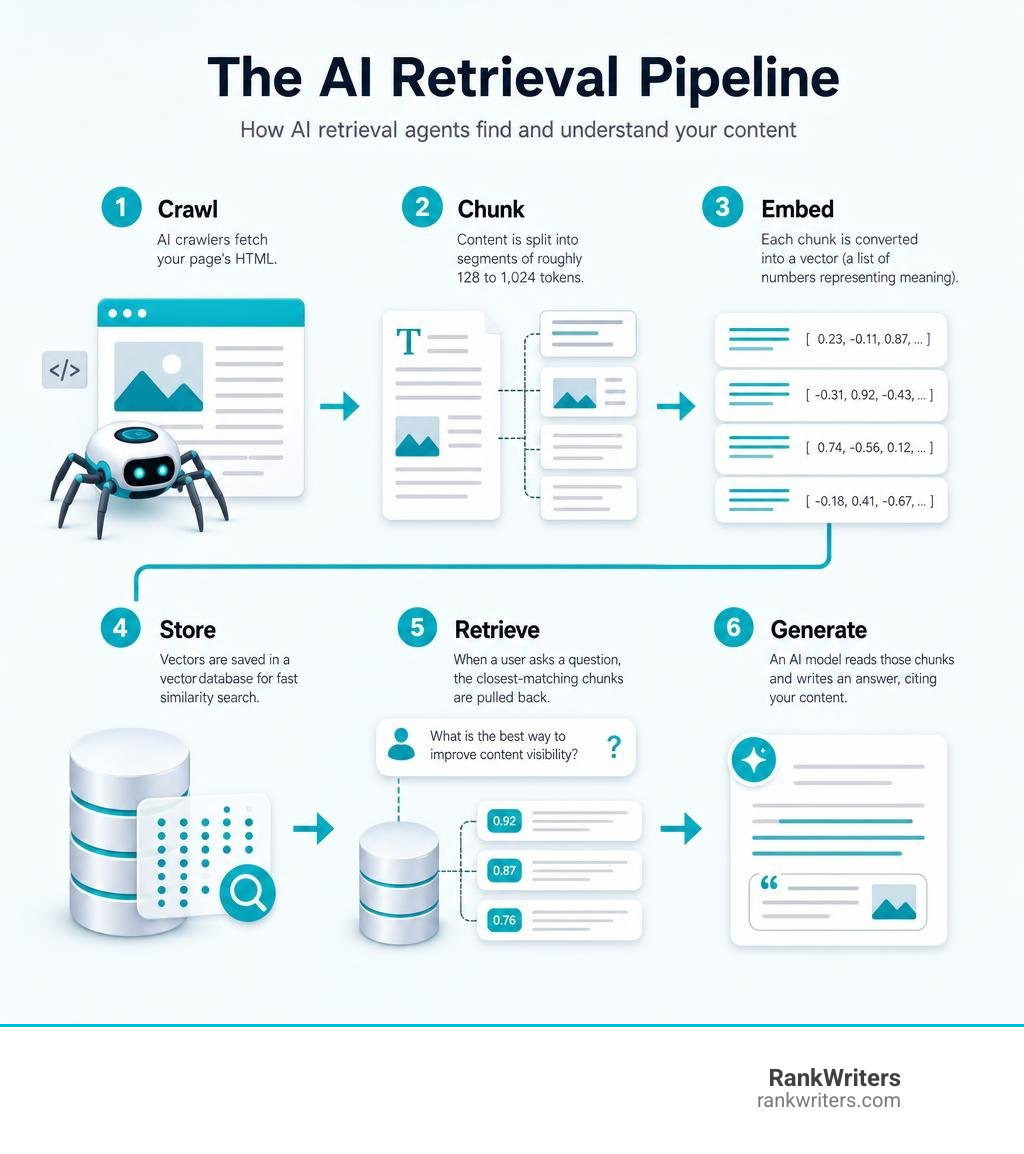
How do AI retrieval agents find and understand my content? Here’s the short answer:
- Crawl – AI crawlers fetch your page’s HTML (most don’t execute JavaScript)
- Chunk – Your content is split into segments of roughly 128 to 1,024 tokens
- Embed – Each chunk is converted into a vector (a list of numbers representing meaning)
- Store – Vectors are saved in a vector database for fast similarity search
- Retrieve – When a user asks a question, the closest-matching chunks are pulled back
- Generate – An AI model reads those chunks and writes an answer, citing your content
That’s the core loop. Everything else is built on top of it.
Search is changing fast. Over 34% of Gen Z now use AI chatbots instead of search engines, and AI Overviews appear in 47% of desktop searches. If your content isn’t being retrieved and cited by these systems, you’re invisible to a growing share of your audience, no matter how well you rank on a traditional results page.
The old rules were simple: rank the page, get the click. The new rules are different. AI agents don’t read your page the way a person does. They break it into fragments, match fragments to questions, and synthesize answers from the best-matching pieces. The page is no longer the unit of competition. The passage is.
For business owners and marketers already overwhelmed by SEO changes, this adds another layer of complexity. But the good news is that the principles that make content retrievable by AI agents are the same ones that make content useful to real people: clear structure, direct answers, and genuine authority.
Related content about How do AI retrieval agents find and understand my content?:
Understanding RAG and Agentic Retrieval Architectures
To grasp how AI retrieval agents interact with digital content, one must understand Retrieval-Augmented Generation (RAG). Traditional Large Language Models (LLMs) are frozen in time, limited strictly to the data they were trained on. RAG solves this limitation by acting as an open-book exam. Instead of guessing or hallucinating answers, the system retrieves relevant documents from an external database or the live web and feeds them directly to the LLM to generate an accurate, grounded response.
As search engines have evolved in 2026, simple RAG has given way to more sophisticated frameworks: Agentic RAG and Multimodal RAG. While traditional RAG relies on a basic linear pipeline (user query leads to a single database search, which leads to generation), Agentic RAG introduces autonomous decision-making. These agentic systems use planning and reasoning loops to determine if they need to search multiple sources, reformulate queries, or double-check their own work before presenting an answer.
Multimodal RAG expands this capability further by processing and retrieving multiple formats of information, including text, images, videos, and structured tables. This development is crucial because modern web pages are rarely text-only. If a product manual contains vital troubleshooting information inside a diagram, Multimodal RAG ensures the agent can retrieve and interpret that image.
To better understand how these systems differ, it is helpful to look at their technical execution:
| Feature | Traditional RAG | Agentic RAG |
|---|---|---|
| Workflow | Linear (Retrieve -> Generate) | Iterative (Plan -> Route -> Retrieve -> Critique -> Synthesize) |
| Query Handling | Single-shot keyword or vector search | Query decomposition into multiple parallel sub-queries |
| Tool Use | Limited to a single pre-defined database | Can call external APIs, code interpreters, and multiple search indexes |
| Self-Correction | None; accepts the first set of retrieved documents | Evaluates retrieval quality and executes follow-up searches if needed |
| Latency | Lower (millisecond response times) | Higher (requires multiple model calls and reasoning steps) |
For developers and platforms looking to implement these complex loops, resources like the Agentic Retrieval Overview – Azure AI Search | Microsoft Learn provide deep technical blueprints on how to orchestrate multi-query pipelines over massive data indexes.
The Evolution from Naive RAG to Agentic Systems
Early implementations of RAG, often called “naive RAG,” frequently broke down when faced with complex, real-world queries. If a user asked a multi-part question, a naive system would perform a single vector search, pull back a few semi-relevant paragraphs, and hope for the best. This often resulted in missing context, incomplete answers, or hallucinations.
According to research from major AI labs, naive RAG systems suffer from severe token constraints and latency issues. In fact, retrieval can constitute up to 41% of end-to-end latency in standard RAG setups. This latency becomes a major bottleneck when users expect answers within three to five seconds.
The transition to agentic systems solves these problems by focusing on precision. Studies show that RAG improves accuracy by 50% on knowledge-intensive tasks compared to standard AI agents, and it reduces hallucinations by 70% to 90% because responses are strictly grounded in retrieved documents. By shifting to an agentic approach, platforms can use smaller, more cost-effective models (such as 7B or 8B parameter models) to match or exceed the performance of massive 13B+ parameter models.
To explore how these agentic frameworks are reshaping modern information systems, researchers point to foundational analyses like Advancing the Search Frontier with AI Agents, which outlines how autonomous search loops are replacing traditional keyword matching.
The Role of Planners, Routers, Critics, and Synthesizers
At the heart of an agentic RAG pipeline is a specialized team of digital personas, each handling a specific phase of the search process:
- The Planner: When a user submits a complex query, the Planner breaks it down into a logical sequence of steps. If a user asks, “What is the difference between a 1031 exchange and a SEP IRA, and which one is better for a business owner in Pennsylvania?”, the Planner recognizes that this requires multiple distinct searches.
- The Router: The Router decides which tool is best suited for each sub-query. It might send a legal question to a structured database of tax codes, route a calculation to a code interpreter, and send a general opinion query to a web search index.
- The Critic: Once information is retrieved, the Critic evaluates its quality, relevance, and truthfulness. If the retrieved passages contain biased sales pitches or lack clear metrics, the Critic rejects them and instructs the Planner to try a different search angle.
- The Synthesizer: Finally, the Synthesizer compiles the validated pieces of information into a cohesive, natural-language response. It ensures that the final output directly answers the user’s original query while maintaining proper citation formatting.
This multi-stage gatekeeping process means your content must survive several layers of evaluation before it ever reaches the user. For a breakdown of how these agentic components communicate under the hood, Christopher S. Penn offers an excellent conceptual guide in Mind Readings: How to Explain AI Agents | Christopher S. Penn.
How Do AI Retrieval Agents Find and Understand My Content?
To optimize your digital presence for 2026, you must understand the exact path an AI agent takes to discover your web pages. When a user asks a question, the agent does not browse your website like a human, clicking through menus and reading articles from top to bottom. Instead, it relies on vector databases and semantic search.
Traditional search engines look for exact keyword matches. If you search for “automobile repair,” a traditional index looks for pages containing those exact words. Semantic search, however, matches the meaning of the query with the meaning of your content. It does this by converting text into vector embeddings, which are long strings of numbers that plot the concepts of your writing in a multidimensional mathematical space.
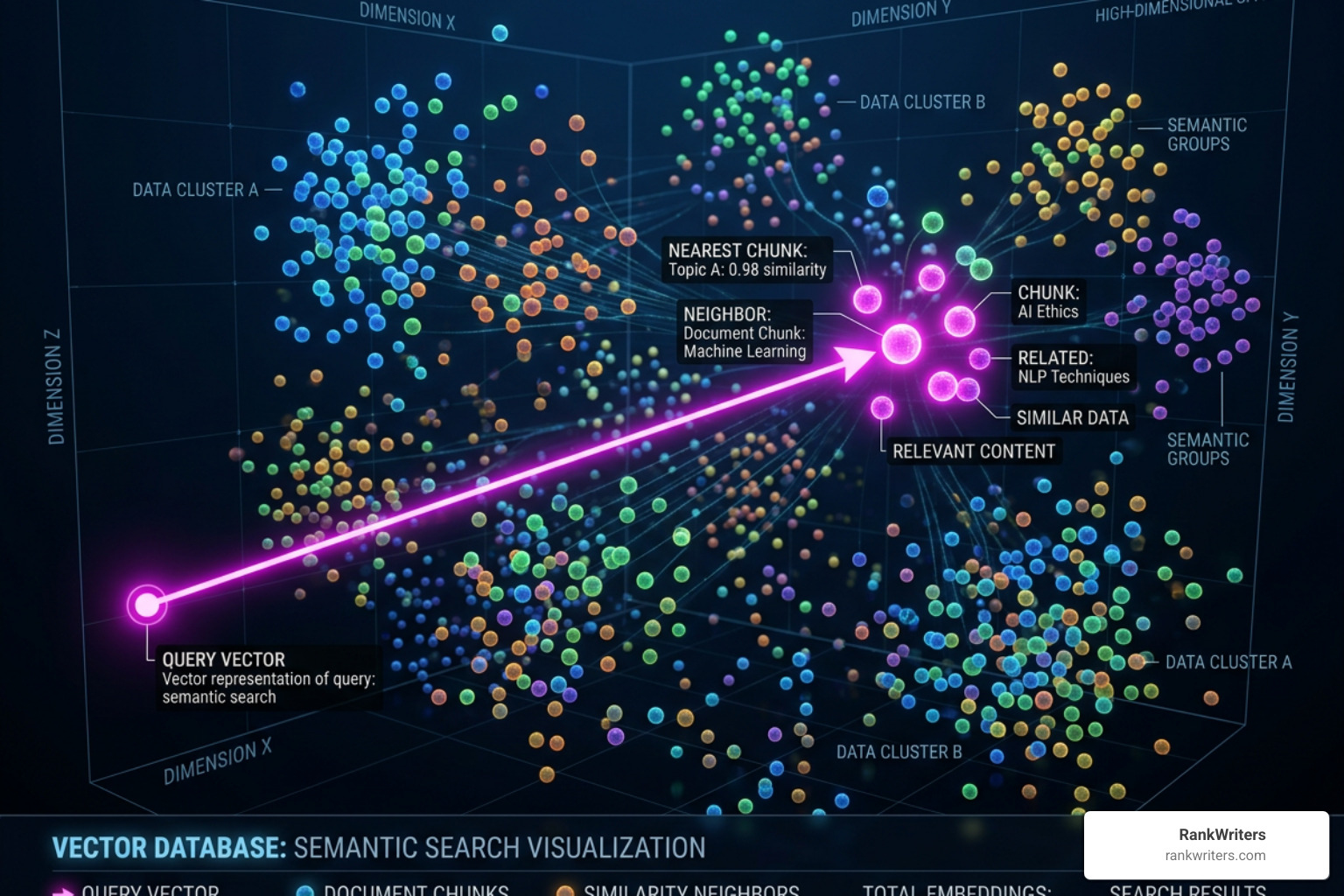
When a query is entered, the retrieval agent converts the query into a vector and uses similarity algorithms to find the content chunks that sit closest to it in that mathematical space. This means an agent can find and retrieve your content even if the user uses completely different words than those on your page.
To see how advanced local memory architectures process, index, and recall these semantic files in real-time, developers can review technical implementations such as How HEBBS Works: From Markdown to Memory Palace | HEBBS Blog, which details how markdown files are transformed into multi-dimensional memory networks.
How Do AI Retrieval Agents Find and Understand My Content Using Vector Embeddings?
The journey from a published web page to a vector database involves a process called chunking. Because embedding models have strict token limits (typically 512 or 1,024 tokens per input), they cannot process a 4,000-word article all at once. The retrieval system must break your page down into smaller, digestible fragments.
There are three main chunking strategies:
- Fixed-size chunking: Splitting text into exact character or token counts (e.g., every 200 words), regardless of sentence or paragraph boundaries. This is fast but often cuts sentences in half, ruining the context.
- Structural chunking: Splitting content based on HTML tags, such as H2 or H3 headers, paragraphs, or list items. This keeps logical sections together.
- Semantic chunking: Using AI models to detect shifts in meaning and drawing boundaries only when the topic changes.
Once the content is chunked, an embedding model (like Google’s EmbeddingGemma) processes each chunk and generates its vector representation. When a user searches for information, a vector similarity search (often using Hierarchical Navigable Small World, or HNSW, graphs) identifies the top matching chunks in milliseconds.
If your content is structured poorly, the chunks will lack context. A paragraph that relies heavily on backward-pointing pronouns (like “this,” “it,” or “as mentioned above”) will perform poorly in a vector search because, when isolated as a chunk, it loses its meaning. To avoid this, creators must design their pages with retrieval in mind. For a comprehensive strategy on aligning your site architecture with these systems, read The Complete Guide to LLM SEO.
Multi-Hop Retrieval and Query Decomposition
For simple questions, a single vector search is sufficient. But real users often ask complex, multi-layered questions that require connecting multiple pieces of information. This process is known as multi-hop retrieval.
Consider a query like: “Should a Pennsylvania business owner use a 1031 exchange or a SEP IRA to minimize their tax burden this year?”
An AI agent cannot answer this in one step. It must decompose the query into several sub-queries:
- What are the tax benefits of a 1031 exchange in 2026?
- What are the tax benefits of a SEP IRA in 2026?
- How do Pennsylvania state tax laws treat 1031 exchanges and SEP IRAs?
The agent executes these searches in parallel, gathers the results, and performs “query rewriting” to bridge the gap between different concepts. If your website only discusses SEP IRAs in isolation without referencing broader business tax strategies or regional compliance, you miss the opportunity to serve as a “bridge entity.”
To understand how agents navigate these complex reasoning paths and whether they truly comprehend the intent behind their searches, read the analysis by Daniel Tunkelang in Do AI Agents Know What They’re Searching For? – Daniel Tunkelang.
Optimizing Content for Agentic AI Search Engines
To ensure your brand is cited in this agentic landscape, you must transition from traditional Search Engine Optimization (SEO) to Generative Engine Optimization (GEO). GEO focuses on making your content easily discoverable, extractable, and authoritative for AI models rather than just ranking on a blue-link results page. To learn more about this shift, check out our guide on What is GEO? and see how it compares to traditional search strategies in GEO vs SEO.
Technical optimization is the foundation of GEO. If AI crawlers cannot access or parse your site cleanly, your content will never make it into their vector databases. Most AI crawlers do not execute JavaScript. If your website relies heavily on client-side rendering or complex interactive scripts to display text, AI bots will see a blank page.
Furthermore, you must ensure that your robots.txt file is configured to allow access to major AI search crawlers, such as GPTBot, ClaudeBot, and PerplexityBot. Blocking these crawlers to protect your content might seem appealing, but it ultimately renders your brand invisible to the millions of users searching via AI assistants.
For a step-by-step framework on making your site highly digestible for LLMs, refer to our playbook on How to Optimize Content for AI Don’t Get Left Behind.
Optimizing Your Site: How Do AI Retrieval Agents Find and Understand My Content?
To make your website a preferred source for AI retrieval agents, you should implement three key technical assets:
- The llms.txt File: Positioned at the root directory of your website (e.g.,
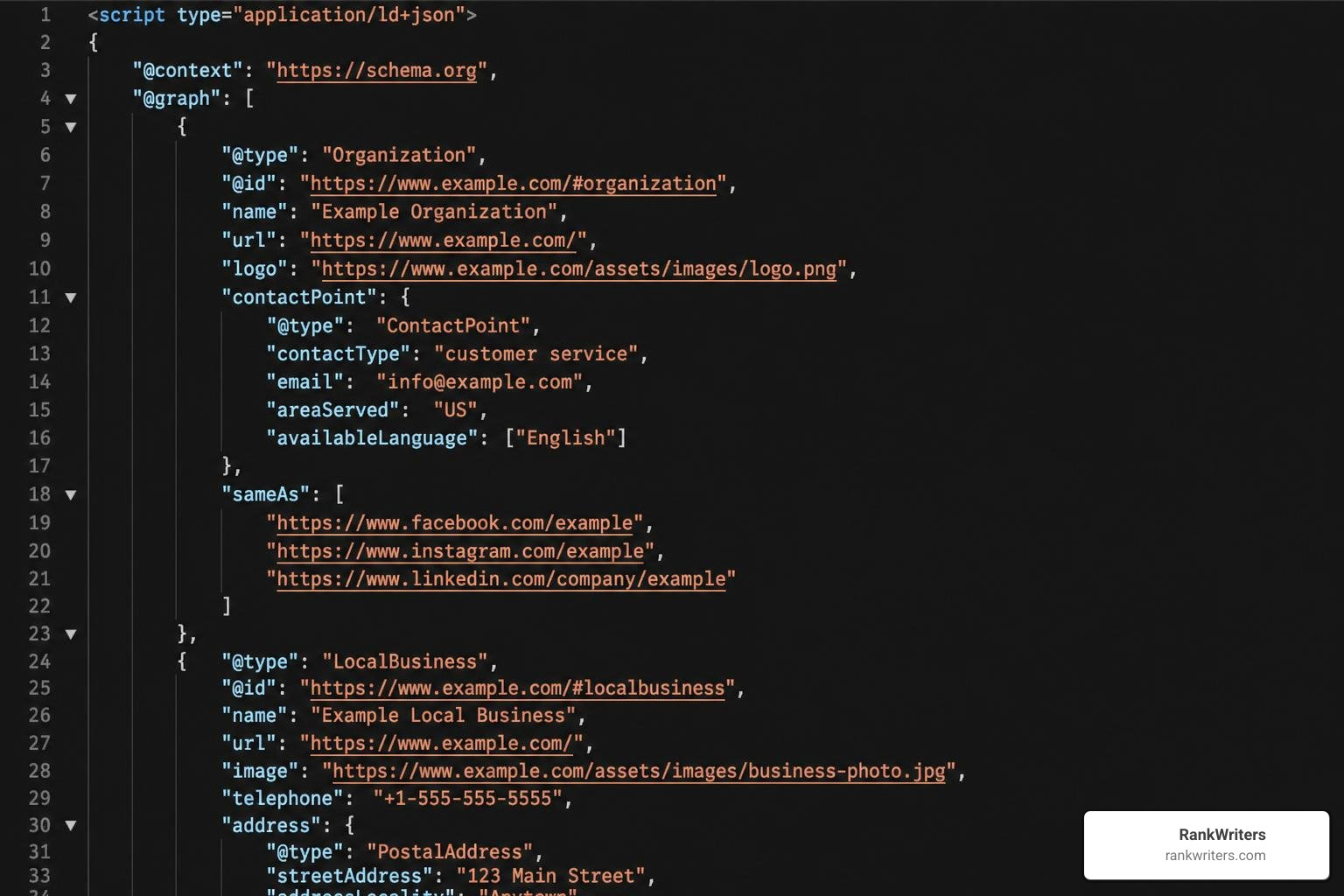
yourdomain.com/llms.txt), this markdown file serves as a direct roadmap for AI crawlers. It should contain clean, concise summaries of your site’s main pages, key offerings, and structured data, allowing crawlers to prioritize your most important content without wasting crawl budget. - Robust Schema Markup: Use JSON-LD schema markup to explicitly define your business, products, services, and authors. Nesting Organization, LocalBusiness, and FAQ schemas directly into your HTML helps AI agents identify entities and their relationships instantly.
- Clean, Semantic HTML: Avoid deeply nested, messy div structures. Use standard semantic tags like
,,. AI crawlers rely on these structural cues to perform rule-based chunking.
For industries facing rapid digital transformation, such as mortgage lending, these technical optimizations are vital. Independent Mortgage Banks (IMBs) must adapt their digital presence to capture borrowers who are using AI tools to compare interest rates and loan programs. To see how these optimization strategies apply directly to the financial sector, explore SEO AI Search and SEO for Mortgage Lenders 2026.
Content Structuring and Topical Authority for IMBs
For mortgage lenders and IMBs, winning the AI search game in 2026 requires building deep topical authority. When borrowers ask AI agents complex questions like, “What are the upfront costs of an FHA loan versus a conventional loan in Pennsylvania?”, the agent looks for sources that demonstrate extensive expertise and clear, structured answers.
To optimize your content for these queries, structure your pages around the Bottom Line Up Front (BLUF) framework. Lead each section with a direct, 40 to 50-word answer that explicitly defines terms using phrases like “is defined as” or “means.” Research shows that AI engines are twice as likely to cite passages that use definitive, authoritative language.
Additionally, structure comparative data into clean markdown tables rather than dense paragraphs. AI retrieval agents prefer tables because they are highly structured and easy to convert into clean, accurate chunks.
By building comprehensive topic clusters that cover every aspect of the borrowing journey, local lenders can outpace national competitors. To learn how to position your mortgage business against massive financial portals, read SEO AI Search How IMBs Can Outsmart the Mortgage Giants in 2025.
Frequently Asked Questions about AI Retrieval
What is the difference between traditional RAG and agentic RAG?
Traditional RAG is a simple, one-way pipeline. It takes a user’s question, performs a single database search, and feeds the retrieved passages to the LLM to generate an answer. Agentic RAG, on the other hand, introduces an autonomous loop. It uses an LLM to plan a search strategy, break complex questions into multiple sub-queries, route searches to different databases or APIs, critique the quality of the retrieved information, and run follow-up searches if the initial results are incomplete or contradictory.
How does chunking strategy affect AI search performance?
Chunking strategy has a massive impact on retrieval accuracy, often creating up to a 9% performance gap in RAG systems. If chunks are too small, they lose vital context and fail to match relevant queries. If they are too large, they dilute the specific answer with irrelevant information, exceeding the model’s token limits and increasing latency. Utilizing structural or semantic chunking ensures that paragraphs, lists, and tables remain intact as cohesive, meaningful units.
Why is my website not being cited by AI search engines?
There are several common reasons why a high-ranking website might fail to earn AI citations:
- JavaScript dependency: If your content is rendered dynamically using JavaScript, AI crawlers (which typically read raw HTML) may see your pages as empty.
- Context-dependent writing: If your paragraphs rely on vague pronouns or require reading the entire page to make sense, they will perform poorly during passage-level vector searches.
- Crawler blocks: Your robots.txt file may be accidentally blocking essential AI bots like GPTBot or ClaudeBot.
- Lack of direct answers: AI agents prioritize clear, factual, and direct answers over long, promotional, or fluffy introductions.
Conclusion
The shift from classic search engines to agentic retrieval systems has fundamentally rewritten the rules of digital marketing. AI agents do not read your website to admire its design; they crawl, chunk, and embed your content to turn it into a direct answer for their users. If your business is still relying solely on traditional keyword optimization, you risk becoming invisible in a world dominated by AI Overviews, ChatGPT Search, and Perplexity.
To capture consistent inbound leads in 2026, brands must adopt a future-proof strategy that blends SEO, AEO, and GEO. By structuring your content for clean chunking, implementing essential technical assets like
llms.txt, and building deep topical authority, you can ensure your business remains a highly cited, authoritative source across all generative search engines.Ready to optimize your content for the age of AI search? Partner with the experts at RankWriters. They specialize in systematic, future-proof SEO, AEO, and GEO content creation designed to drive revenue and keep your brand ahead of the curve. Explore their custom content solutions today at RankWriters SEO Services.
Case Study
2022 • 660 Leads
2025 • 13,678 LeadsYear over Year Lead Growth!
SEO compounds over time. After 3 years, the leads for this law firm grew to >1,000 per month.
Wonder how people search?
Here's the breakdown between traditional & AI Search
Traditional Search
Queries contain few words. This is often for local SEO or used early in discovery efforts.


 88%
88%At 88% Market Share Google Still Rules Search²
- 1/2 of U.S. Google searches trigger AI overviews
- ChatGPT: ~77M active U.S. users
- Google: ~260M active U.S. users
AI Chat SEO
Brand mentions are part of a AI chat conversations, often during research.
Services such as attorneys/law firms, plastic surgeons, and mortgage lenders, typically see strong growth in AI chat channels.



Our Search Everywhere Optimization addresses the nuances of traditional & AI search tools.
Review our Menu of Services
More great SEO information.
✕Join the Waitlist!
Please select a valid form
 This website uses cookies to improve your experience. By using this website you agree to our Data Protection Policy.Read Privacy Policy