


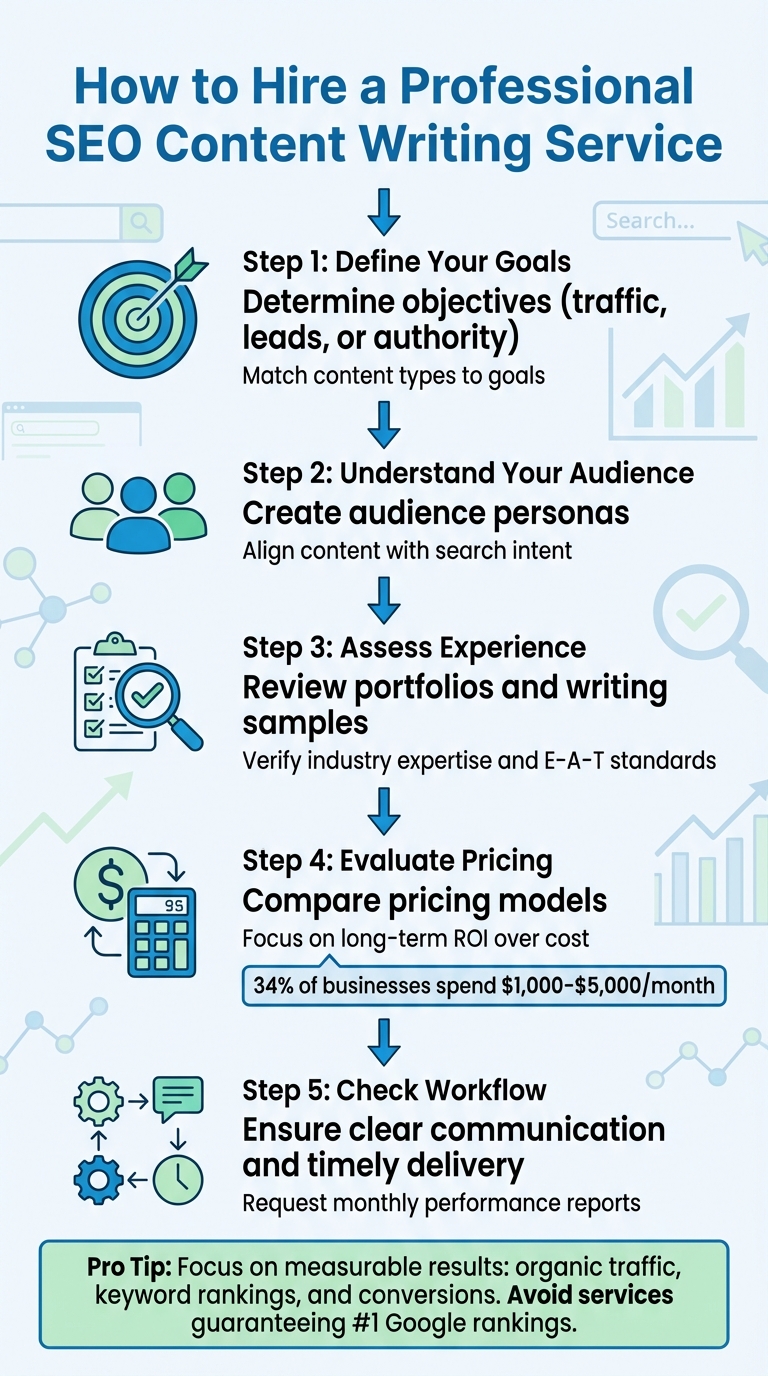
Hiring a professional SEO content writing service is essential for improving search rankings, attracting the right audience, and driving conversions. Here’s a quick guide to streamline the process:
- Define Your Goals: Determine if you want to boost traffic, generate leads, or build authority. Tailor content types (e.g., blog posts, white papers) to match your objectives. Following SEO writing best practices ensures these assets perform effectively.
- Understand Your Audience: Create audience personas to align content with their needs and search intent.
- Assess Experience: Choose writers with expertise in your industry. Review portfolios, writing samples, and past results.
- Evaluate Pricing: Compare pricing models like per-word rates, flat fees, or retainers. Focus on long-term ROI instead of cost-cutting.
- Check Workflow: Ensure clear communication, timely delivery, and regular performance reporting.
Pro Tip: Focus on providers who deliver measurable results like improved organic traffic, keyword rankings, and conversions. Avoid services that overpromise, like guaranteeing a #1 Google ranking.
Hiring the right service can save time, improve content quality, and drive sustainable growth for your business.
5-Step Process to Hire Professional SEO Content Writing Services
Tips for Hiring an SEO Content Writing Service
Identify Your Content Requirements
Before diving into an SEO content writing service, take the time to define your content needs. While 90% of companies use content marketing as part of their broader strategy [4], many rush into outsourcing without clear objectives. This often leads to mismatched expectations and wasted resources.
Set Clear Goals and Understand Your Audience
Start by outlining what you want your content to achieve. Are you aiming to drive more organic traffic? Generate quality leads? Establish authority in your field? Each goal calls for a tailored approach. For instance:
- If your focus is boosting organic search visibility, you’ll need SEO-optimized blog posts and evergreen content targeting specific keywords by getting keywords for SEO.
- If you’re prioritizing lead generation, white papers, case studies, and product-specific content are essential for guiding prospects through the sales funnel.
Next, get to know your audience. Develop detailed audience personas that describe your ideal customer’s demographics, pain points, and content preferences [4]. For example, a B2B software company targeting IT directors will need a professional, in-depth tone. On the other hand, an e-commerce brand catering to busy parents should prioritize simplicity and relatability.
Understanding search intent is just as important. Think about whether your audience is looking for information, comparing products, ready to make a purchase, or simply exploring your website [4]. Categorizing your content needs based on these behaviors ensures you’re meeting users where they are in their journey.
| Business Goal | Recommended Content Types | Primary KPIs |
|---|---|---|
| Boost Organic Traffic | SEO blog posts, evergreen content, guest posts | Keyword rankings, organic sessions, backlinks |
| Generate Leads | Ebooks, white papers, case studies, product blogs | Conversion rate, lead volume, demo requests |
| Brand Awareness | Social media posts, email newsletters, thought leadership | Page views, social shares, impressions |
| Customer Education | Technical guides, how-to manuals, FAQ pages | Time on page, bounce rate, support ticket reduction |
Once you’ve identified your goals and audience, plan a content schedule that aligns with these objectives.
Plan Your Content Schedule
Decide on a realistic publishing cadence. While 34% of businesses spend $1,000 to $5,000 monthly on outsourced content [8], your budget should match a sustainable output. If you’re just starting, aim for four high-quality blog posts per month rather than setting unachievable goals.
A defined schedule also helps determine the right type of provider. For short-term needs, like product descriptions for a launch, a freelancer might be sufficient. However, ongoing projects – such as weekly blog posts – often require partnerships with agencies or subscription services. Don’t forget to account for internal reviews. If multiple stakeholders need to approve content, allow 48–72 hours of lead time before your planned publishing date [8].
Find an SEO Content Writing Service with Industry Expertise
Once your goals and schedule are clear, focus on finding writers with experience in your industry. Generic content often falls flat. Writers who understand your field can deliver impactful content without a steep learning curve. This is especially critical in industries like healthcare, finance, or legal services, where Google emphasizes expertise, authority, and trustworthiness (E-A-T) [8].
For example, a healthcare company benefits from hiring a writer with medical knowledge who can create content that resonates with both patients and search engines – avoiding overly technical language that alienates readers [1][7]. Similarly, a SaaS company needs writers familiar with software terminology who can simplify complex features for a wider audience. Always ask potential providers about their niche experience and review samples that showcase both industry knowledge and writing skill.
Review Experience and Past Work
Once you’ve narrowed down your list of potential providers, take a close look at their case studies – the data often tell you more than any sales pitch ever could. Ask for samples that align with your industry and business model. For example, if you’re in the B2B software space, request tech-focused samples to ensure their expertise fits your needs [2]. Carefully examine these samples and case studies to assess both their technical skills and creative abilities.
Examine Writing Samples and Case Studies
Start by evaluating the technical elements. Check if keywords are appropriately placed in title tags, H1 headers, meta descriptions, URLs, and image alt-text [2]. These basics are crucial for SEO success.
Next, focus on readability. Great content should flow naturally without feeling forced or overloaded with keywords. Avoid samples that rely on keyword stuffing or excessive jargon. As TheFreeAudit.com puts it:
“A talented SEO content writing service balances keyword optimization with readability” [2].
The best samples grab your attention right away and often include visuals that support the content. Pay attention to their linking strategy, too. Quality samples will feature contextual internal links with clear anchor text and credible external citations. Also, ensure that any statistics or references in the content are from reputable sources – this adds authority and trustworthiness.
Don’t hesitate to ask the SEO content writing service provider for insight into their process. Have them explain how they chose focus keywords, structured the content, and achieved competitive rankings for those keywords. This will give you a better sense of their strategic approach.
Look for Client Reviews and Measurable Outcomes
After reviewing samples, shift your focus to the results they’ve delivered for past clients. It’s important to see that their technical expertise translates into tangible business growth. Look for measurable outcomes like increased organic traffic, better keyword rankings, improved conversion rates, or a higher number of indexed pages [7]. A reliable provider should demonstrate how their content drives meaningful conversions, such as signups or purchases, rather than just boosting raw traffic numbers [9].
Ask for “Search Impressions” data from Google Search Console. This metric often shows early SEO progress before rankings or clicks improve significantly [12]. Additionally, request reports on “Referring Domains” – the number of unique websites linking back to the client’s site. Search engines value diversity in link sources more than just the total number of backlinks [10]. If the provider uses tools like Semrush or Ahrefs, ask for “Traffic Cost” data. This metric estimates how much the client would have paid in Google Ads for the organic traffic received, offering a clear picture of ROI [10].
| Metric | What It Measures | Why It Matters |
|---|---|---|
| Organic Traffic | Total non-paid visits | Indicates overall reach and effectiveness [9][11] |
| Keyword Rankings | Position on search results | Positions 1–10 capture the majority of clicks [12] |
| Click-Through Rate (CTR) | Clicks divided by impressions | Reflects how appealing titles and descriptions are [9][12] |
| Organic Revenue | Income from search traffic | Directly connects SEO efforts to business ROI [9] |
Be cautious of providers that promise a #1 ranking on Google – such guarantees are often misleading [6]. Instead, work with those who offer detailed monthly reports covering metrics like indexed pages, impressions, clicks, and other meaningful actions [7]. Look for proven success stories with clear numbers, timelines, and strategies rather than vague claims about “boosting visibility.”
Understand Pricing Options
Once you’ve assessed a provider’s experience, the next step is aligning the cost structure with your needs. This ensures your investment supports sustainable growth. After confirming the provider’s ability to deliver results, it’s time to nail down the exact cost. SEO content writing prices vary significantly based on the pricing model and the expertise required. The challenge is finding a structure that fits your content needs, budget, and goals.
Learn the Different Pricing Structures
Most providers use one of four main pricing models. Here’s a breakdown:
- Per-word pricing: This is a common approach where you pay a set rate for each word. Rates typically range from $0.10 to $ 1.00 or more per word. While this model works well for occasional projects, it can sometimes encourage unnecessary wordiness to inflate the word count.
- Flat-rate pricing: With this model, you pay a fixed fee per article, regardless of its length. A standard 1,500-word article usually costs between $300 and $500, though specialized or technical content can range from $500 to $2,500 per piece. This structure focuses on quality rather than quantity. As Nate Matherson, Co-founder & CEO of Positional, explains:
“A big mistake companies make is that they’ll optimize for cost too early and then wind up needing to go back to all of their previously published articles and rework or replace them altogether.”
- Monthly retainers: Popular with agencies and managed services, retainers typically start at $1,000 and can go beyond $5,000 per month. This often includes strategy development, keyword research, writing, editing, and account management. In fact, 34% of businesses spend between $1,000 and $5,000 monthly on outsourced content [8].
- In-house hiring: This involves employing a full-time writer with an annual salary ranging from $40,000 to $85,000 [3]. When factoring in benefits and overhead, the cost per word for an in-house writer often falls between 20–30 cents. This option is best if you need daily content production and deep brand integration.
Here’s a quick summary of common pricing models and their typical costs:
| Pricing Structure | Estimated Cost | Content Volume | Included Services |
|---|---|---|---|
| One-Time Project | $50 – $500 per article | Single piece | Writing, basic research, 1-2 revisions |
| Monthly Retainer | $1,000 – $5,000+ /month | 4 – 12+ articles | Strategy, keyword research, writing, editing, management |
| Subscription Plan | $199 – $999+ /month | Varies by credits | Platform tools, vetted writer pool, AI assistance |
| In-House (Full-Time) | $4,000 – $7,000+ /month | High/Unlimited | Full integration, deep brand knowledge, multi-channel support |
If you’re using freelance platforms, don’t forget to factor in platform fees. For instance, Upwork charges a 5% fee, while Fiverr adds a 5.5% fee.
Understanding these pricing structures allows you to weigh costs against long-term value.
Consider Long-Term Results Over Price
Focusing solely on price can lead to disappointing results. The cheapest option often fails to deliver a strong return on investment. While you might find articles priced at $75 to $100 on freelance platforms, these often require extensive rewrites or fail to rank well. The real question isn’t “How much does this cost?” but rather “What results will this deliver?”
Content marketing is a highly effective strategy – it costs 62% less than traditional methods while generating three times as many leads [3]. High-quality, targeted content can drive sustained growth over time.
For the best results, prioritize services that focus on bottom-of-funnel keywords – the ones that generate actual leads and sales, not just traffic. A well-crafted article targeting buying-intent keywords can keep delivering leads for over a year, even through algorithm changes [4]. This long-term payoff often makes the initial investment worthwhile.
If your business operates in specialized fields like finance, healthcare, or law – areas Google categorizes as “Your Money or Your Life” (YMYL) – be prepared to invest more in writers who understand E-E-A-T (Experience, Expertise, Authoritativeness, and Trustworthiness) standards [8]. For example, medical freelance writers charge $82.50 to $110 per hour, compared to $15 to $35 per hour for general SEO writers [8]. This higher cost reflects the need for deep industry knowledge.
When evaluating pricing, focus on metrics like organic revenue, conversion rates, and qualified leads [14]. Remember, you’re not just paying for words – you’re investing in content that drives your business forward.
sbb-itb-16c0a3c
Check Communication and Workflow
Once pricing is agreed upon, it’s time to evaluate how the service operates on a daily basis. Poor communication can throw a wrench in project timelines, misalign your brand voice, and lead to endless back-and-forth exchanges.
Top-notch services typically assign a dedicated project manager who acts as your go-to person. Timothy Carter, Chief Revenue Officer at SEO.co, explains it well:
“A good project manager can make a world of difference. If the agency has someone who is clear and forthright in their communication… this can make a big difference” [6].
This individual oversees assignments and centralizes communication, ensuring smoother collaboration. Many services also use centralized platforms where you can track deadlines, review drafts, and monitor performance metrics in one spot [3][5]. This setup minimizes email overload and keeps everyone on the same page, helping to manage deadlines and deliver content efficiently. This is often best achieved through an SEO content subscription that standardizes the production cycle.
Confirm Deadlines and Delivery Methods
Timely delivery is non-negotiable. If you’re working with a tight publishing schedule, delays can disrupt your entire marketing plan. When evaluating a service, ask about their usual turnaround times and how they handle urgent requests.
A good rule of thumb is to set deadlines that allow a buffer – request content delivery 48–72 hours before your planned publishing date [6]. This extra time lets you review and revise without scrambling at the last minute.
Additionally, clarify how content will be delivered. Some services can publish directly to your CMS, such as WordPress or HubSpot, saving you the hassle of formatting [1][8]. Others may send files via Google Docs or Word. Knowing this upfront helps you streamline your internal processes and avoid unexpected surprises.
Request Regular Performance Reports
Once delivery reliability is confirmed, shift your focus to tracking results. You’re investing in writing SEO friendly content for a reason, so monthly performance reports are crucial to gauge its effectiveness. These reports should include actionable metrics like pages indexed, organic traffic, keyword rankings, and conversions [7]. Be wary of services that only provide basic stats like word counts or the number of articles published.
Holiday Newton, GPO, underscores the importance of tracking:
“Analytics and insights are crucial to making sure you and your content company are on track to meet your KPI goals” [7].
Regular reporting also helps you catch problems early. For example, 69.8% of SEO professionals face challenges with ranking fluctuations [4]. If your content starts dropping in search results, you’ll want to know right away so the service can adjust its approach.
Look for services that go beyond just presenting numbers. They should offer actionable plans to address underperformance [7]. A reliable partner doesn’t just explain what went wrong – they outline how they’ll fix it. This proactive mindset is what separates a dependable partner from a mere vendor.
Test Their Response Time and Flexibility
Pay attention to how quickly they respond to your initial inquiries [6]. If it takes days to get a simple reply, it could signal slow communication once you’ve hired them. Quick, thorough responses during the vetting process are a solid indicator of future reliability.
Flexibility is equally important. Your brand voice, audience preferences, and business goals will likely evolve over time. The service you choose should be able to adapt to your brand guidelines and take feedback without resistance [3]. Florian Fuehren, Senior Writer at Brafton, highlights this:
“A reliable content brief can already eliminate most sources of miscommunication while standardizing your production efforts” [5].
Also, ask about their revision process. Most quality services include one or two rounds of revisions in their standard pricing [7][8]. Confirm how many rounds are included and what happens if you need additional changes. Setting clear expectations upfront prevents unnecessary frustration and keeps your projects running smoothly.
Get Started with RankWriters

Once you’ve outlined your SEO content goals, RankWriters steps in with a subscription model designed to boost both traffic and conversions. This service brings together skilled writers, detailed keyword research, and automated delivery – all aimed at attracting visitors with intent and turning them into leads.
RankWriters manages everything from competitive research to content pillar strategies, ensuring your content aligns with what your audience is actively searching for. Their team of writers and editors are well-versed in SEO practices, delivering content tailored to improve your search rankings and drive traffic that matters. Let’s take a closer look at the subscription plans that make this happen.
Review RankWriters’ Subscription Plans
RankWriters keeps it simple with a subscription plan that includes monthly blog posts optimized for SEO, competitive and topic research, and six-month updates to keep your strategy on point. Each plan also features content pillar strategies and monthly reporting, giving you clear insights into your progress.
For those looking for more, higher-tier plans offer additional posts on demand and AI search engine optimization, helping your content perform well on both traditional search engines and AI-driven platforms. The process is seamless – content is uploaded directly to your CMS and can be easily tracked through Google Analytics, so you can quickly identify what’s working and fine-tune where needed.
Start with a Content Strategy Session
To kick things off, RankWriters offers a focused content strategy session to align your content plan with your business goals. This session lays the groundwork by organizing your editorial calendar, defining your brand’s tone and style, and pinpointing the keywords your audience is actively searching for.
The strategy session also includes editorial calendar planning and marketing campaign mapping, ensuring every piece of content contributes to your broader business objectives. This approach combines a tailored strategy with subscription benefits, making sure your content isn’t just search-engine friendly but also speaks directly to the needs and challenges of the clients you most want to reach.
Conclusion
Finding the right SEO content writing service involves four key steps: defining your objectives, assessing expertise, understanding pricing, and maintaining clear communication. Start by pinpointing your goals – whether it’s driving more organic traffic, generating leads, or building authority in your industry. Having this clarity will guide your decisions, from choosing the right writer to selecting content formats that align with your needs. These steps summarize the main ideas covered in this guide.
Next, take the time to evaluate portfolios and verify industry knowledge. With 57% of SEO experts identifying content-driven SEO as the most critical SEO tactic [2], selecting someone with a proven track record can make a significant difference in your search rankings.
When it comes to pricing, think long-term. Content marketing costs 62% less than traditional marketing yet delivers nearly six times higher conversion rates [3]. Focus on value instead of cutting costs – high-quality SEO content is an investment that pays off over time.
Efficiency is just as important as cost. From the start, establish a clear workflow with defined deadlines, delivery processes, and performance metrics. A small pilot project can help you gauge responsiveness and adaptability before committing to a long-term collaboration. As Timothy Carter, Chief Revenue Officer at SEO.co, wisely advises:
“There’s a saying in business that you should be slow to hire and fast to fire. This saying certainly rings true with SEO content writers” [6].
FAQs
What should I check in an SEO content writer’s portfolio?
When evaluating an SEO content writer’s portfolio, zero in on samples that reflect their experience in your specific field or niche. Look for pieces like blog posts, product descriptions, or web pages that not only resonate with your objectives but also achieve strong search rankings.
Examine the quality of their writing, how seamlessly they incorporate keywords, and their ability to adapt to various tones or styles. A solid portfolio will highlight their flexibility and grasp of effective SEO strategies.
How can I choose the best pricing model for SEO content writing services?
Choosing the right pricing model comes down to your business goals, budget, and the scope of your project. If you’re looking for ongoing content creation and optimization, a monthly retainer – ranging from $1,500 to $5,000 per month – can provide steady support and predictable costs. For bigger, one-time needs like revamping website content or producing a batch of blog posts, a project-based fee – typically between $5,000 and $30,000 – gives you clear deliverables and timelines. On the other hand, if you only need occasional assistance or strategic advice, an hourly rate of $100 to $300 per hour offers flexibility without locking you into a long-term commitment.
To decide which option works best, think about your timeline, the level of support and reporting you expect, and whether the provider’s expertise aligns with your needs. If you’re unsure, starting with a smaller project or hourly arrangement can be a smart way to gauge their quality and communication before committing to a larger agreement.
What metrics should I use to measure the success of SEO content?
To gauge how well your SEO content is performing, keep an eye on these key metrics:
- Organic traffic growth: Check how many visitors are landing on your site through search engines and whether that number is climbing.
- Keyword rankings: See where your content stands in search results for the keywords you’re targeting and how those rankings shift over time.
- Click-through rate (CTR): Look at the percentage of people who see your content in search results and decide to click on it.
- Conversion rate: Evaluate how effectively your content encourages users to take actions you care about – whether that’s making a purchase, signing up, or reaching out.
Tracking these indicators gives you a solid understanding of how well your content is meeting your objectives and connecting with your audience.