

Why B2B Marketing Case Studies Matter for Your Business Growth
Case studies b2b marketing demonstrate proven strategies that drive real business results. Here’s what successful B2B marketing case studies reveal:
- Content and SEO strategies can increase site traffic by 183% and generate 50% of qualified inbound leads
- Creative campaigns achieve up to 480% higher click-through rates than industry benchmarks
- Marketing automation delivers 198% ROI while cutting costs by over $100,000
- Data-driven targeting creates multi-million dollar pipelines, with some companies generating $66M in new opportunities
- Account-Based Marketing (ABM) produces $27M in new pipeline opportunities through personalized approaches
- Digital change moves 80% of orders online and increases registrations by 2.5x
B2B marketing is fundamentally different from B2C. You’re not selling to individual consumers—you’re reaching multiple decision-makers who need data, proof, and logical justification for their purchases. The sales cycles are longer, often taking four to eight months. The stakes are higher, with larger deal sizes and more scrutiny. As one marketing director put it: “Without good content, you don’t get anybody in the hopper.”
This creates a unique challenge: how do you prove your marketing actually works? That’s where case studies become invaluable. They show the strategies, tactics, and results that moved the needle for real companies facing similar challenges to yours.
The research is clear: 71% of B2B buyers consume multiple assets before talking to sales, and 84% of executives use social media for buying decisions. Your prospects are doing their homework. They want proof that your approach works before they invest time in a conversation.
I’m Brandie Young, a Fractional CMO and GTM strategist who has led marketing teams across fintech, legal, and technology verticals, including being named HousingWire’s 2021 Marketing Leader. Throughout my career, I’ve seen how case studies b2b marketing efforts transform from cost centers into revenue drivers when companies implement the right strategies with measurable outcomes.
Driving Growth with Content & SEO: Foundational Case Studies
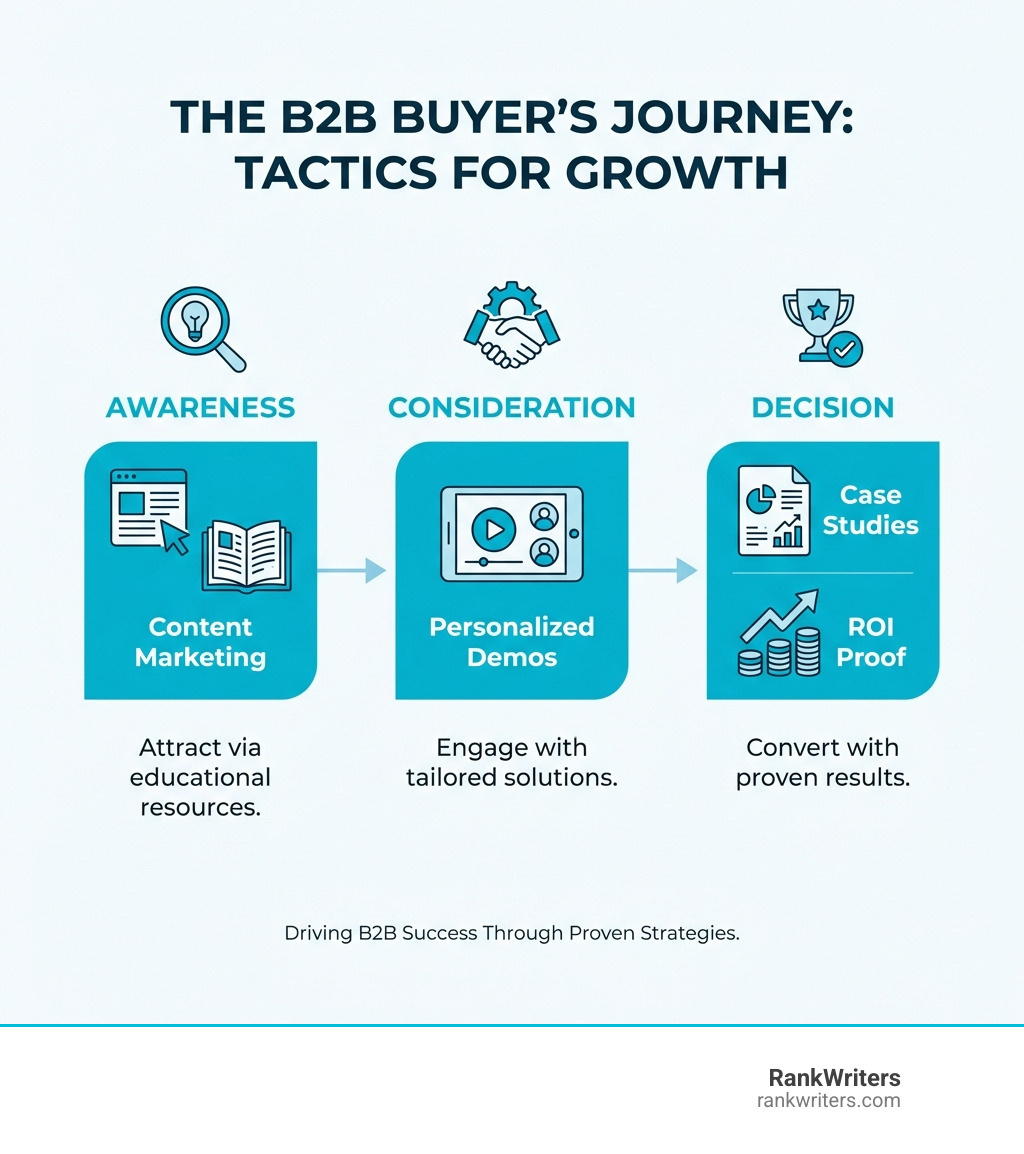
When it comes to B2B marketing, content and SEO are often the unsung heroes. They lay the groundwork for awareness, build trust, and consistently bring in qualified leads. We’ve seen how a well-crafted content strategy, optimized for search engines, can transform a business. It’s about creating valuable resources that address your audience’s pain points and guide them through their buyer’s journey. If you’re looking to polish your content, we even have resources on Killer Case Study Writing Made Easy.
Case Study: FinTech SEO Success
For a FinTech company like Blend, operating in the mortgage and consumer banking space, scaling content and establishing authority as an industry expert was paramount. They needed to build an SEO strategy from scratch, a task many B2B companies face when entering competitive digital landscapes.
The solution involved a meticulous approach: building a keyword cluster framework, optimizing core site pages, and creating a consistent stream of fresh content. The results were nothing short of remarkable: an impressive 183% increase in site traffic and over 50 unbranded keywords ranking on Page 1. Their site visibility jumped from 1.82% to 13.89%. This case study highlights how a focused SEO effort, even from a standing start, can significantly boost a B2B brand’s online presence and authority. You can read more about this kind of success in our Best SEO for B2B: A Case Study.
Case Study: Content Strategy for Inbound Lead Generation
LENOX, a division of Newell Rubbermaid, is a B2B manufacturer of industrial tools. Their challenge was common: relying too heavily on sales for lead generation and qualification. Their marketing team aimed to shift this burden, allowing sales to focus on closing deals and engaging with end-users.
Their content-fueled strategy centered on building specialized personas for their metal-cutting audience. They developed a rich resource center with blog posts, case studies, and whitepapers addressing customer pain points. A sophisticated lead scoring system tracked engagement, identifying “hot leads” ready for sales. The outcome? Marketing’s contribution to the sales pipeline grew significantly, and a staggering 50% of qualified leads became inbound. This demonstrates how content can empower marketing to become a true demand-generation engine. This change is detailed in B2B Marketing: Content strategy results in 50% of qualified leads being inbound.
Case Study: Repurposing Content for a 3x Increase in Deals
Five9, a cloud contact center software provider, faced a challenge familiar to many: creating content that generated leads but failed to sustain engagement or drive significant ROI. Their initial product-focused video campaigns quickly lost steam.
Their new approach, championed by their CMO, was buyer-centric. They developed detailed customer personas through interviews and surveys to understand true pain points. This led to an in-depth e-book on agent efficiency. The magic happened in the repurposing: this single e-book was transformed into 63 different assets, including 11 blog posts and 33 social media posts, and used in nurture campaigns across the sales funnel. This strategic shift from a channel-first to a content-first approach yielded phenomenal results: four times as many leads and a threefold increase in closed deals. It’s a powerful reminder that maximizing a core content asset can dramatically amplify your marketing impact.
Innovative Campaigns That Smashed B2B Marketing Benchmarks
Who says B2B marketing has to be boring? In a world saturated with traditional thought leadership, breaking the mold with creative, empathetic campaigns can yield incredible results. We love seeing B2B brands accept humor, storytelling, and unconventional formats to capture attention and drive engagement.

Case Study: A Creative, Empathetic Approach to Advisory Services
KPMG, a global professional services firm, needed to reinvigorate its consumer advisory services in a challenging market. Instead of dry whitepapers, they adopted a strategic and creative approach that emphasized empathy and understanding of their target audience—consumer-led businesses.
Their campaign went against the grain, using spoof consumer goods to demonstrate their deep understanding of the consumer landscape. This bold move resonated powerfully. The campaign surpassed industry benchmarks by a staggering 480% in click-through rates and achieved over 9 million impressions within just three weeks. It also led to an 11% increase in opportunity volume and an impressive 68% boost in opportunity value for their Consumer Consulting division. This case study proves that connecting with your audience on an emotional, relatable level, even in B2B, can drive extraordinary engagement and business growth. You can find more Award-winning campaign insights on our site.
Case Study: Using Audio to Target the C-Suite
Spotify Advertising wanted to educate brands and media buyers about their digital audio advertising platform. Their “All Ears on You Campaign” showcased the attention music streamers give to audio content. To truly capture the attention of C-suite executives, they devised “A Song For Every CMO”—a collection of original songs paying tribute to leaders at major brands.
This highly personalized and creative approach was complemented by a centerpiece film and deployed across various channels. The results were impressive: the campaign generated 1.5 billion impressions, engaged 10,000 high-value targets, and attracted 185,000 new users to the Spotify Advertising platform. This highlights the power of innovative content, especially audio, to reach and resonate with busy B2B decision-makers. Find out more about Behind the scenes of a successful B2B audio campaign.
Case Study: The Award-Winning B2B Podcast
SAP, a global enterprise software company, aimed to raise awareness about its cutting-edge SAP Leonardo technologies (machine learning, big data, blockchain) and engage a wider audience beyond traditional B2B content. They took a big risk by venturing into an unconventional format: a fictional science-fiction podcast series.
The podcast, Searching for Salai, reimagined the cultural narrative around new technologies, blending entertainment with education. This innovative storytelling paid off handsomely. The podcast garnered two prestigious awards: Best Podcast/Audio Series and Content Marketing Project of the Year at the Content Marketing Institute’s 2019 Content Marketing Awards. This demonstrates that B2B brands can use creative, entertaining content to educate and engage audiences, proving that B2B doesn’t have to be dry. Listen to some great stories on the Best Story Wins podcast.
The Power of Data & Technology in Modern B2B Marketing
In today’s B2B landscape, data-driven strategies are non-negotiable. They improve decision-making, improve customer targeting, and, most importantly, boost ROI. Technology—from marketing automation and CRM to advanced AI—plays a pivotal role in changing raw data into actionable insights and streamlined processes. Modern B2B marketing relies on leveraging these tools to create efficiency and deliver personalized experiences at scale.

Case Study: Achieving 198% ROI Through Automation
Pitney Bowes, a global technology company, recognized the need to automate its B2B marketing and sales processes to drive efficiency and improve ROI. They deployed Adobe solutions, aiming to streamline operations and reduce costs.
Just 18 months after deployment, the company saw a remarkable 198% return on investment. They reduced their annual operating costs by over $100,000 by trimming IT spend through automation. Furthermore, the time required to create reports was halved, and data anomalies decreased dramatically from 30 per day to just one per week. This case study underscores how strategic investment in marketing automation technology can lead to significant financial returns and operational improvements.
Case Study: Uncovering Anonymous Traffic to Boost Attribution
DealHub, a Configure, Price, Quote (CPQ) platform, faced a common B2B marketing challenge: understanding where inbound leads truly originated and identifying anonymous website traffic. Without clear attribution, optimizing marketing spend is like shooting in the dark.
By implementing attribution solutions, DealHub was able to identify 80% of its anonymous traffic. This newfound visibility dramatically increased its inbound attribution from a mere 30% to an impressive 85%. They also recognized 80% of attribution for outbound efforts coming from paid-media assistance, effectively reducing their attribution blind spot to between 15% and 20%. This precision allowed them to reallocate budgets more effectively and gain a detailed understanding of the customer journey, proving that data visibility is key to open uping marketing efficiency.
Case Study: Generating a $66M Pipeline with AI-Powered Targeting
Marathon Health, a nationwide healthcare network, needed to transform its marketing team into a demand-generation powerhouse and streamline its sales process to target companies actively seeking solutions. They acceptd AI-based segmentation and conversational email.
Within two months, they sent over 22,000 emails with a 38% open rate, resulting in $4.5M in net-new pipeline and a 55% increase in average email open rates for health companies. Overall, Marathon Health saw an astounding $66M in net-new pipeline and 211% in-market buying growth since July 2021. This case study exemplifies how AI-powered personalization and targeted outreach can dramatically accelerate pipeline generation and drive significant revenue growth in B2B marketing. For more insights on this, check out our AI-powered B2B marketing insights.
A Deep Dive into Successful Case Studies in B2B Marketing
In a complex B2B sales environment, demonstrating value and driving growth often requires a multi-faceted approach. From highly personalized Account-Based Marketing (ABM) to robust eCommerce platforms that revolutionize customer experience, these case studies b2b marketing efforts showcase diverse tactics for success. For more examples, visit our main B2B Marketing Case Studies page.
How to use case studies in B2B marketing for pipeline generation
SAP, a market leader in enterprise software, faced the challenge of effectively marketing to its top 10% of accounts, which contributed a third of its revenue. Their existing marketing lacked the personalization needed for these high-value relationships.
SAP implemented an Account-Based Marketing (ABM) program, focusing on dedicated, one-to-one marketing plans for select high-value clients. This involved consulting experts, building an internal business case, carefully selecting accounts based on growth potential and sales team cooperation, and gathering deep customer insights. Maintaining exclusivity in the program was crucial to avoid watering down the personalized approach. The results were impactful: SAP created $27 million in new pipeline opportunities and progressed $57 million further down the pipeline. This case study clearly demonstrates how ABM, with its focus on personalization and sales-marketing alignment, can significantly boost pipeline generation. Find More on ABM strategy here.
Examples of case studies in B2B marketing for digital change
Transcat, a provider of calibration and compliance services, needed to digitize its multiple business lines (new equipment sales, rentals, used equipment) to offer a modern, full-featured experience to its customers. This digital change was key to improving customer engagement and operational efficiency.
By deploying an Adobe Commerce platform, Transcat successfully unified its diverse business models onto a single, flexible platform. This modernization created a seamless online experience that resonated with customers. The tangible result was a 2.5-time increase in site registrations, indicating strong customer engagement with the new digital platform. This highlights how investing in a robust commerce platform can drive significant digital change and customer adoption in the B2B space.
Case Study: Scaling B2B Sales with a Self-Service Portal
Sealed Air (SEE), a packaging solutions provider, operated in an industry where complex orders were traditionally placed over the phone or via email, making it a “black box” experience for customers. They aimed to transform this into a transparent, self-service buyer portal.
The company’s digital change efforts enabled customers to place 80% of their orders entirely online through the new portal. Even more impressively, for customers who actively engaged with the portal, they quickly moved 83% or more of their total order volume to the online channel. This shift not only improved customer experience by offering sophisticated, intuitive self-service options but also automated approximately 15% of manual touches per order, showcasing how a well-designed self-service portal can revolutionize B2B sales and operational efficiency.
Frequently Asked Questions about B2B Marketing
Navigating the complexities of B2B marketing can bring up a lot of questions. We’re here to shed light on some of the most common inquiries, helping you make informed decisions for your business.
What are the most effective B2B marketing channels and tactics?
The most effective B2B marketing channels and tactics are those that align with the longer sales cycle, multiple decision-makers, and intellectual buying process inherent in B2B.
- Content Marketing: This is foundational. Creating valuable educational content—like blog posts, whitepapers, e-books, and case studies—addresses pain points, builds authority, and nurtures leads. It’s often the first step in the buyer’s journey.
- SEO (Search Engine Optimization): Optimizing your content and website for relevant keywords ensures your target audience finds you when they’re actively searching for solutions. For example, a company offering SaaS tools might target keywords like “enterprise SaaS tools.”
- Account-Based Marketing (ABM): For high-value accounts, ABM offers a hyper-personalized approach, treating each target account as a market of one. It involves close alignment between sales and marketing.
- Social Media Marketing (SMM): While different from B2C, social media is crucial for B2B. Platforms like LinkedIn are invaluable for thought leadership, networking, and direct engagement. In fact, 72% of B2B buyers indicate using social media to research solutions, and 84% of B2B executives state using it for buying decisions.
- Email Marketing: Segmented and personalized email campaigns are highly effective for nurturing leads, sharing valuable content, and announcing product updates or events. Marketing automation tools can guide leads throughout their buyer’s journey.
- Referral Marketing: Leveraging existing satisfied customers to generate new leads is incredibly powerful in B2B, where trust and credibility are paramount.
How can B2B companies build strong customer relationships?
Building strong customer relationships and fostering loyalty in B2B is about more than just transactions; it’s about becoming a trusted partner.
- Personalization: Tailoring communications, content, and solutions to the specific needs and challenges of each client demonstrates you understand their business.
- Customer-First Approach: Continuously striving to understand your customers’ motivations, pain points, and needs, then designing your services and interactions around them.
- Consistent Communication: Regular, valuable touchpoints—whether through newsletters, account check-ins, or exclusive content—keep your brand top-of-mind.
- Value-Added Content: Providing resources that help your clients succeed, even if it’s not directly selling your product, builds goodwill and positions you as an expert.
- Excellent Customer Service: Responsive, proactive, and problem-solving support is critical. In B2B, a single point of contact or a dedicated account manager can significantly improve the relationship.
- Fostering Loyalty: Beyond satisfaction, loyalty comes from consistently delivering on promises, evolving with your clients’ needs, and celebrating their successes.
What are the emerging trends for B2B marketing?
The B2B marketing landscape is constantly evolving. Staying ahead of these trends is essential for sustained growth:
- AI and Machine Learning: AI is revolutionizing everything from content creation and personalization to lead scoring and sales forecasting. It enables hyper-segmentation, targeted ads, and conversational email journeys, as seen with Marathon Health.
- Video Marketing: Engaging video content, including explainer videos, customer testimonials, and even humorous campaigns like Dialpad’s, is becoming increasingly important for communicating complex B2B solutions in an accessible way.
- Conversational Marketing: Chatbots and AI-powered conversational tools are enabling real-time interactions, lead qualification, and personalized customer support, making the buyer’s journey more efficient.
- Hyper-Personalization: Moving beyond basic personalization, B2B marketers are leveraging data to create truly unique experiences for individual buyers, often through ABM strategies.
- Data Privacy Focus: With increasing regulations and customer awareness, transparent and ethical data collection and usage will be critical for maintaining trust.
- Sustainability Messaging: As businesses become more environmentally and socially conscious, demonstrating your company’s commitment to sustainability can be a significant differentiator in B2B purchasing decisions.
Conclusion: Your Blueprint for B2B Marketing Success
The case studies b2b marketing world offers a wealth of insights. What we’ve learned from these examples is that success in B2B marketing hinges on a few core principles:
- Data-Driven Decisions: Every strategy, from content creation to campaign optimization, benefits from being rooted in analytics and performance metrics.
- Creative Storytelling: B2B doesn’t have to be boring. Innovative content, whether a humorous video or an award-winning podcast, can break through the noise and engage audiences.
- Strategic Content: A well-planned content ecosystem, from foundational SEO to repurposed assets and specialized personas, is crucial for nurturing leads and driving sales.
- Technology Integration: Leveraging marketing automation, CRM, and AI tools streamlines processes, improves personalization, and provides measurable ROI.
At RankWriters, we specialize in helping B2B companies like yours implement these very strategies. Our systematic, future-proof approach combines SEO, AI Search (AEO, GEO), and traditional SEO to generate consistent inbound leads and drive revenue. We’re here to help you turn your marketing efforts into powerful growth engines.
Ready to see your own success story unfold? Let us help you develop a blueprint for your B2B marketing case studies.