

Case study writing can be challenging, but they’re one of the most effective tools for converting prospects into customers. Here’s how to make the process simple and impactful:
- Start with Results: Lead with measurable outcomes to immediately grab attention. Highlight key metrics like revenue growth or cost savings right in the headline.
- Tell a Story: Use a clear beginning (challenge), middle (solution), and end (results) to keep readers engaged. Focus on how your solution helped the client succeed.
- Explain the “Why”: Go beyond listing actions. Share the reasoning behind your decisions to show expertise and build trust.
- Keep It Specific: Use clear, relatable language and avoid jargon. Include hard numbers, client quotes, and visuals to make your case study credible and engaging.
- Handle Confidentiality: If naming clients isn’t an option, use detailed descriptions (e.g., “a mid-sized law firm in Chicago”) and focus on results to maintain impact.
9-Step Formula For Writing The PERFECT Case Study
sbb-itb-16c0a3c
Why the Old Case Study Writing Format Doesn’t Work
The old-school case study writing structure has started to feel like a relic. Traditionally, case studies follow a rigid “problem-solution-results” format: they outline the challenge, explain the fix, and finally share the outcome. While this setup may have been effective over a decade ago, it struggles to hold the attention of today’s readers. With shorter attention spans becoming the norm, people often abandon these long, drawn-out narratives – sometimes in less than 10 seconds [5]. Let’s unpack why this format no longer resonates and explore how leading with results can make all the difference.
Where the ‘Problem-Solution-Results’ Format Falls Short
The predictable flow of traditional case study writing has become a turnoff. Even though 73% of B2B buyers rely on case studies to guide their decisions [8], many of these documents fail to deliver what readers are actually looking for [9]. Why? Because this structure buries the most compelling information – the results – at the very end, often losing the reader’s interest long before they get there.
“The problem with report-like case studies is that they’re neither effective nor engaging. They take lots of effort to write but turn off hiring managers almost instantly as they’ve seen the same cookie-cutter process over and over again.”
– Bogomolova Anfisa, Senior UX Designer [11]
Another issue is the lack of emotional connection. When case studies read like dry technical reports, they fail to resonate with readers who crave relatable, human stories. A data dump, no matter how accurate, doesn’t inspire or engage [9]. To capture attention in today’s fast-paced environment, case studies need to shift focus.
Start with Results, Not Features
One of the biggest mistakes in case study writing is focusing on what was done instead of why it matters. Leading with product features – your cutting-edge API, advanced algorithms, or complex processes – can make your case study feel more like a sales pitch than a success story [2]. Readers, especially potential clients, care far more about the results than the technical details.
Take Textel’s 2023 case study for Valvoline as an example. Instead of diving into the technicalities of their MMS API, they opened with a bold outcome: “Valvoline… Increases Coupon Send Rate by 76% with Textel’s MMS Picture Texting.” That single statistic immediately grabbed attention and communicated the value [2]. By starting with results, they gave readers a reason to keep reading. In contrast, leading with features forces readers to trust you before you’ve shown them any proof.
This shift from features to outcomes is more than just a change in structure – it’s about showing real value. Feature-driven case studies answer the question, “What does your product do?” Outcome-driven ones answer, “How will this improve my business?” And that’s the question that truly drives purchasing decisions [2]. By centering on outcomes, you align your case study with what modern readers care about most: clear, measurable impact.
Case Study Writing: How to Get Results
Crafting an effective case study is all about telling a story that grabs attention and delivers value. To stand out, focus on three key strategies: lead with measurable outcomes, explain the reasoning behind your actions, and structure your narrative so it flows smoothly from challenge to solution. These elements not only highlight the results but also provide the context and logic that make those results meaningful.
Start with the Numbers: Put Results First
The best case studies grab attention right away by showcasing results upfront. Don’t make readers dig through paragraphs of background – hit them with your most impressive metric right in the headline or introduction. For example, a title like “Client Increases Coupon Send Rate by 76% with MMS Texting” immediately communicates the benefit and sets the stage for the story.
Include an “At a Glance” section early on with 3–5 key results in a bullet list or sidebar. Why? Because 78% of B2B buyers want to see tangible value before investing their time or money [1][13]. They often skim content to decide if it’s worth their attention [13]. Focus on metrics that directly impact the bottom line, like revenue growth, cost savings, or productivity improvements. Use action-packed language with strong verbs like “boosted”, “achieved”, or “transformed” to emphasize the impact of your solution [13][6][12].
Explain Why You Did It, Not Just What You Did
While it’s important to explain what actions you took, the real magic lies in sharing why you made those choices. This not only highlights your problem-solving abilities but also demonstrates your expertise in a way that builds trust with potential clients [1][4]. When readers understand the reasoning behind your strategy, they’re more likely to stay engaged and see how your approach could work for them.
Effective case study writing organizes content in a clear cause-and-effect structure, following a logical “stimulus → response” pattern [14]. For instance, if you noticed users abandoning a checkout page through heat maps, explain how that insight led you to simplify the form fields. This step-by-step progression helps your audience connect the dots and see how your methods can be applied to their own challenges [1].
Tell a Story with a Clear Beginning, Middle, and End
A compelling narrative ties everything together. The strongest case study writing templates follow a simple three-act structure: the beginning sets up the challenge, the middle details the approach, and the end reveals the results and their lasting impact [10][6]. Position your client as the hero of the story, with your solution acting as the tool that helps them succeed [6][13]. This approach resonates more than framing your company as the “savior.”
Start by describing the specific problem in relatable terms. Highlight the pain points and potential consequences of leaving the issue unresolved. Avoid overwhelming readers with technical jargon – focus on how the problem affected real people [10][6]. In the middle, walk through the journey from problem to solution, connecting each decision to the insights or data that led to it. Finally, go beyond just listing results in your conclusion. Paint a picture of the “new normal” for your client, showing how these changes impacted their business goals and set the stage for future success [16][13]. This structure ensures your case study is not only informative but also memorable and impactful.
Case Study Writing Without Naming Clients
Confidentiality agreements don’t have to limit the power of your case studies. In fact, 78% of B2B businesses rely on case studies to showcase their impact, and many of these are anonymous [1]. The trick is to replace the absence of brands with detailed data and engaging storytelling. When you can’t use a recognizable client name, focus on transparency, measurable results, and relatable narratives to build trust and credibility. This section dives into case study writing that is compelling and protects client identities without losing their effectiveness.
How to Keep Case Studies Anonymous While Staying Specific
When confidentiality is a factor, being vague won’t cut it. Labels like “a large company” or “a major retailer” lack the detail needed to engage readers. Instead, paint a clear picture with precise descriptors. Include specifics such as industry, company size, location, or market position. For example, saying “a Fortune 500 transportation company” or “a mid-sized law firm in Chicago with 45 attorneys” provides enough context to resonate with your audience while maintaining client anonymity [2][6].
“The more color you provide here, the more potentially impactful your case study’s results will be.” – Sydney Go, Author, Semrush [2]
Adding technical details can also make your case study more compelling. Instead of using broad terms like “digital transformation”, describe the exact challenge your client faced. For instance, say “migrating assets from an IBM AS/400 system to a Flutter-based mobile app” [19]. When quoting stakeholders, avoid names and focus on roles, such as “Director of Operations, Global Financial Services Firm” [21]. If visuals are part of your case study, blur logos or any identifying elements to maintain authenticity while protecting client privacy [18].
Showing Results Without Naming Names
Detailed client descriptions set the stage, but it’s the results that truly sell your story. Without a well-known brand to lean on, hard data becomes your strongest proof point. Use specific metrics, percentages, and dollar amounts to demonstrate the impact of your work. Highlight these numbers prominently in headlines, subheadings, or an “At a Glance” section. For example: “Regained 2.7 FTEs of engineering time” or “Spent 3 years and $2.5 million with no results before switching providers” [10][6].
To make your case study relatable, anchor it in industry-specific challenges and trends. Addressing pain points that resonate with your target audience – like compliance hurdles in healthcare or seasonal inventory struggles in retail – helps readers see themselves in the story [17][6]. Interestingly, anonymity can sometimes work in your favor. Without the constraints of client approvals, you can delve into the raw, unfiltered parts of the story – like budget overruns, internal resistance, or initial failures – that named clients might shy away from [18][20]. This level of honesty can make your case study writing easier, and feel more genuine and relatable.
“Anonymity grants marketers permission to explore the juiciest parts of customer stories they’d never normally touch.” – Luke Gain, Creative Director, Velocity Partners [20]
The Basic Structure of an Effective Case Study
When it comes to crafting a compelling case study, sticking to a clear, results-focused framework is key. This approach not only keeps your story concise but also ensures it resonates with readers. After all, 78% of B2B buyers review case studies before making a purchase decision [13]. That means presenting information in a logical, engaging way is critical. The challenge lies in balancing consistency with storytelling so your case study feels professional yet relatable.
A well-structured case study typically includes five key parts: headline, introduction, challenge, solution, and results. The headline and snapshot immediately grab attention by showcasing the biggest win. The introduction sets the stage, the challenge builds tension, the solution highlights your expertise, and the results deliver proof of success. Case studies usually range between 500 and 1,500 words [1], with the results section taking up the most space [22].
Introduction and Background
Start by introducing the client in one or two sentences. Focus on key details like industry, company size, or location, but keep it brief. The goal here is to set the stage without overwhelming readers with unnecessary background information.
Challenge, Solution, and Results
This section is where the real storytelling happens. Begin by outlining the client’s main pain points – think issues like lost revenue, wasted time, or ineffective strategies. Then, explain your strategic approach and the actions you took to address those challenges. This makes it easier for readers to see themselves in similar situations.
The results section should be the most detailed part of the case study [22]. Use hard numbers, before-and-after comparisons, and direct quotes to showcase the impact of your solution. For example, call out key achievements like “Increased coupon send rate by 76%” or “Saved $108,000 annually”. Visual aids like charts and graphs can also help translate complex data into something easy to digest [6].
This narrative flow naturally leads to a conclusion that reinforces the transformation achieved.
Conclusion and Key Points
Wrap up by summarizing the main takeaways, tying them directly to what your audience cares about. This isn’t just a recap – it’s your chance to provide actionable insights. Including advice from the client adds an extra layer of credibility, offering a peer’s perspective rather than a direct sales pitch. Finally, guide the reader with a clear call to action, whether it’s booking a demo, downloading a resource, or reaching out to your team. This ensures they know exactly what to do next.
Words to Use and Words to Avoid
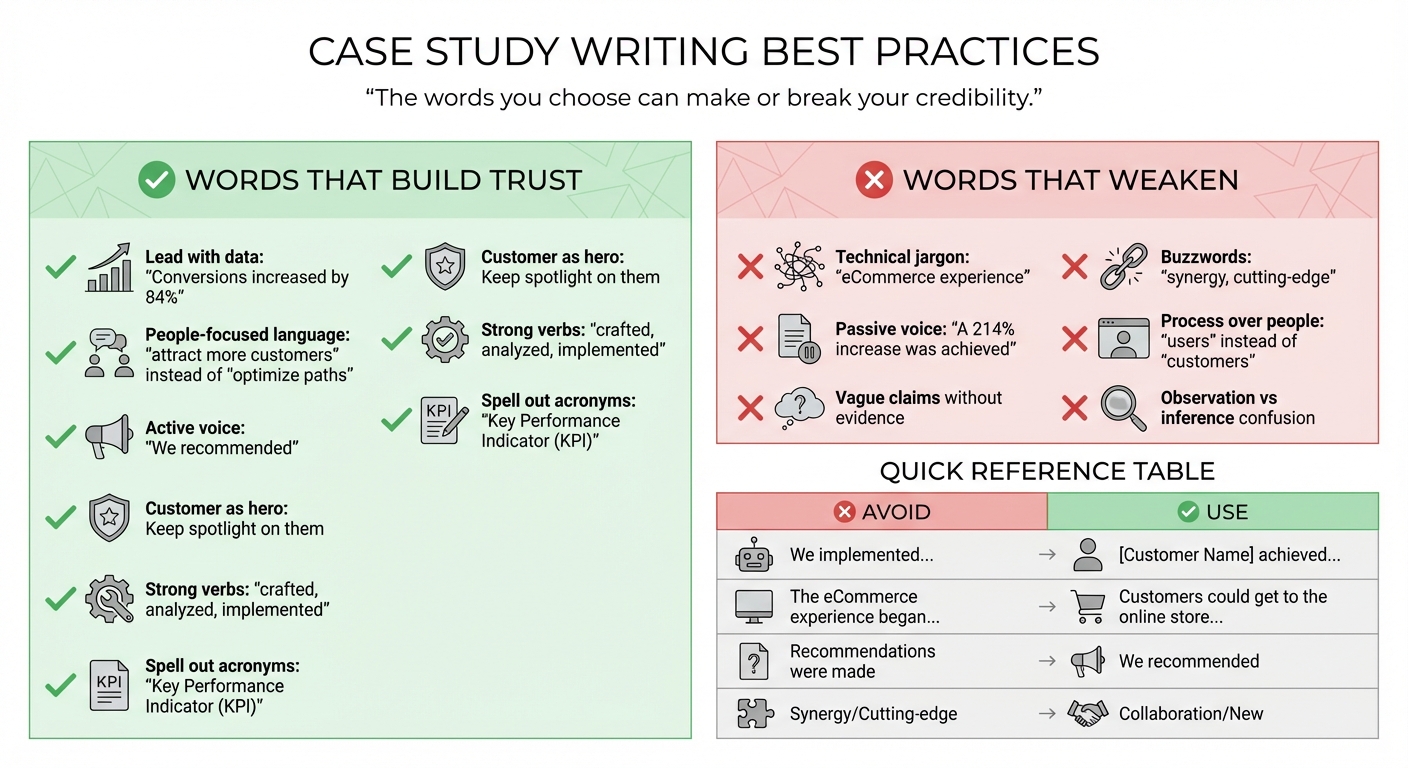
Words to Use vs Avoid in Case Study Writing
The words you choose when writing a case study can make or break how readers perceive your authority and reliability. Every word plays a role in shaping your credibility. The difference between a case study that resonates and one that misses the mark often lies in whether you use clear, action-driven language or fall back on jargon and passive phrasing. Let’s break down the types of language that build trust and the ones that weaken your message.
Words That Build Trust and Connection
Start strong with data. Numbers grab attention and immediately establish impact. For example, instead of saying, “The client was happy because conversions increased”, go with “Conversions increased by 84%, which…”[10]. Leading with results makes your case study more compelling.
Use language that prioritizes people over processes. For instance, replace “optimize the paths to their online store” with “attract more customers to their online store”[10]. Similarly, swap out “users” for terms like “customers” or “people” to make the story feel more relatable[10]. If you’re introducing industry-specific tools or terms, always explain them the first time they appear.
Active voice is your friend when it comes to showing accountability and authority. Say “We recommended” instead of vague phrases like “Recommendations were made”[10][15]. Keep the spotlight on the customer, framing them as the protagonist of the story. As Meredith Sell, Content Writer at Wordtune, puts it:
“The customer is the hero, not you, so make sure the case study keeps the spotlight on them. Your solution is just a way to help them achieve their ultimate goals.”[7]
Strong verbs like “crafted”, “analyzed”, and “implemented” can add clarity and energy to your case study writing[10]. And don’t forget to spell out acronyms the first time you use them – like “Key Performance Indicator (KPI)” – before switching to the shorthand[10].
Words That Weaken Your Message
Jargon is a major roadblock for readers outside your niche. Kristin Bigness, Creative Lead at Seer Interactive, cautions:
“Filling a case study with jargon can alienate more people than you may think.”[10]
Instead of technical terms like “eCommerce experience” or overused buzzwords like “synergy”, opt for simpler alternatives such as “online store” or “collaboration”[10][3].
Passive voice can sap the energy and clarity from your writing. Compare “A 214% increase in organic traffic was achieved” to “The strategy increased organic traffic by 214%”[2][15]. The latter feels more direct and engaging. Also, be careful not to confuse observation with inference. For example, don’t declare “people are confused” as a fact when what you mean is “users clicked the wrong button”[10].
Stay away from vague claims or exaggerated adjectives that lack evidence. As Bigness points out:
“It’s a pet peeve of mine when people look at data and say ‘people are confused’ like it’s a cold, hard fact. There is a big difference between observation and inference.”[10]
Instead of making sweeping statements, back up your points with specific metrics.
| Avoid | Use Instead | Why |
|---|---|---|
| “We implemented…” | “[Customer Name] achieved…” | Shifts focus to the client’s success[7] |
| “The eCommerce experience began with…” | “Customers could get to the online store by…” | Makes the language more relatable and human-centered[10] |
| “Recommendations were made” | “We recommended” | Active voice demonstrates accountability[10] |
| “Synergy” or “Cutting-edge” | “Collaboration” or “New” | Avoids overused buzzwords and keeps it simple[3] |
Sample Case Study Template
This template is designed to cover all essential elements while keeping the flow engaging and easy to follow. It uses a logical story arc to maintain reader interest, from the opening sentence to the final call to action. Whether you’re naming your clients or keeping them anonymous, this structure works across various industries.
Template Breakdown
Start with a headline that highlights results and includes a specific metric. For example: “How an SEO Agency Helped an Artisan Bakery Increase Mobile Organic Traffic by 460%” [2]. Keep it concise – 12 words or fewer – and use strong action verbs like “boosted”, “transformed”, or “increased.”
Follow this with an executive summary – a quick 2-4 sentence overview or a bulleted list of key takeaways. For instance: “In December 2023, Textel reported that their client Valvoline increased their coupon send rate by 76% by implementing MMS Picture Texting. The case study highlighted how the visual nature of MMS specifically addressed the challenge of low engagement with standard text coupons” [2].
The introduction and background section should briefly set the scene in two or three sentences. Keep it straightforward and relevant.
Crafting the Challenge Section
Next, outline the challenge – the specific problem your client faced. Be precise. Instead of saying “wait times were too long”, say “30-minute wait times frustrated customers and hurt retention.” Specific details make the challenge relatable and impactful.
In the solution section, explain why certain actions were taken, not just what was done. Translate technical jargon into clear benefits. For example, instead of “multi-threaded asynchronous processing”, say “handling twice the player load on launch day.” Use visuals like charts, graphs, or screenshots to break up text and provide tangible proof of your efforts.
The results section is where you showcase your success. Highlight your most impressive metrics and include customer quotes to add credibility. For example, a Hofy customer said: “I’m happy. Everyone’s happy. The users are super happy” [2]. Visual aids, like before-and-after comparisons or data visualizations, can make complex information easier to understand.
Wrap it up with a brief summary and a direct call to action, such as “Schedule a demo” or “Contact us for a free assessment.” Aim for a concise case study, ideally between 500 and 1,500 words, to keep it focused and impactful.
This framework can be adjusted to suit your specific industry and audience.
How to Customize the Template
Once you have the basic structure, tweak it to emphasize metrics that matter most to your audience. For SaaS companies, highlight processing speed or cost efficiency. In healthcare, focus on reducing errors or improving patient outcomes. For retail, showcase conversion rates and revenue growth.
If the client must remain anonymous, use descriptive terms like “a regional health insurer” or “an artisan bakery.” You can still use exact data points, such as “5,000 members avoided progression to Type 2 diabetes”, to maintain credibility without revealing the client’s identity.
Tailor your language to your audience. For CFOs, emphasize ROI and cost savings. For department managers, focus on workflow improvements and ease of use. This approach ensures your case study feels personalized rather than generic.
Finally, include visuals that align with industry expectations. SEO agencies might use organic traffic charts, while financial services could feature ROI tables. Build a diverse library of case studies, with at least one for every market vertical or product combination you offer. This way, every prospect can find a story they relate to.
Conclusion
Case study writing doesn’t have to be complicated. The best ones highlight results upfront, tell a clear and engaging story, and follow a straightforward structure that’s easy to skim. Make sure to showcase your strongest metrics right away in headlines and summaries to grab attention.
While the traditional problem-solution-results format has its place, it can feel rigid and predictable. Instead, aim for a narrative flow with a beginning, middle, and end to keep readers hooked. Share the reasoning behind your actions – not just the actions themselves. Ditch the technical jargon and focus on clear, relatable benefits. Most importantly, back up every claim with specific data and customer testimonials.
Whether you’re naming clients or keeping them anonymous, the principles outlined here work across all industries. Start with compelling data, use plain language, and add visuals to simplify complex ideas. As Zac Zuber-Zander from RingCentral puts it:
“A good case study avoids the unnecessary minutiae, knows what it’s trying to say, and communicates it quickly and without ambiguity” [6].
These strategies build on the core ideas discussed earlier to help you make an immediate impact. Begin by reviewing your current case studies to find areas where you can emphasize stronger results. Talk to your top customers with open-ended questions to uncover powerful stories, and create a library of examples that resonate with your audience’s challenges. By applying these refined techniques, you can enhance your case studies and make them more effective at connecting with readers and driving qualified leads. Reach out to our sales team or book a demo today to elevate your case studies and achieve better results.
FAQs
Why should case studies focus on results first?
When you lead a case study with results, you grab attention right away and build trust almost instantly. Highlighting measurable outcomes upfront allows readers to quickly understand the value and relate it to their own challenges – no need to wade through unnecessary details first. This strategy not only boosts credibility but also emphasizes tangible impact, making your case study more compelling. Focusing on results rather than features ensures your story connects with prospects and keeps them interested.
How can I create a compelling case study while protecting client confidentiality?
To protect client confidentiality while creating an engaging case study, start by securing written consent and clarifying which details can be shared. Swap out identifying information, such as specific names or locations, with more general descriptions like “a prominent U.S. corporation” or “a mid-sized financial institution.” Instead of diving into proprietary methods, highlight measurable outcomes – think percentage increases in efficiency or notable cost reductions – and explain why those results were meaningful.
Incorporate anonymized quotes to lend credibility without exposing personal details, and make it clear that the case study prioritizes client privacy. Before releasing the case study, double-check that it complies with privacy regulations, such as GDPR, to steer clear of any legal issues. By focusing on results and carefully anonymizing sensitive information, you can craft a powerful narrative while maintaining your client’s trust.
What makes a case study both engaging and effective?
An effective case study tells a story that’s both clear and results-focused, grabbing the audience’s attention with measurable outcomes right from the start. For instance, instead of diving into features, lead with a strong result like, “Boosted revenue by $50,000 in just three months.” Then, provide context by explaining why these results matter and how they solved the client’s specific challenges. The story should flow naturally, guiding readers through the problem, the actions taken, and the ultimate impact.
To make the case study credible and relatable, include specific data points – percentages, revenue increases, or time saved – that demonstrate tangible success. Adding relatable details, such as industry-specific challenges, helps the audience see themselves in the story. Visuals, quotes, and context can further enrich the narrative by showcasing the thought process behind decisions. The focus should always be on why actions were taken and the value they delivered, rather than just listing what was done. Skip generic “problem and solution” templates and aim for a story that highlights the client’s success and return on investment (ROI).
Wrap up with a clear takeaway or recommendation, leaving readers with a lasting impression and a nudge toward action.