

Introduction
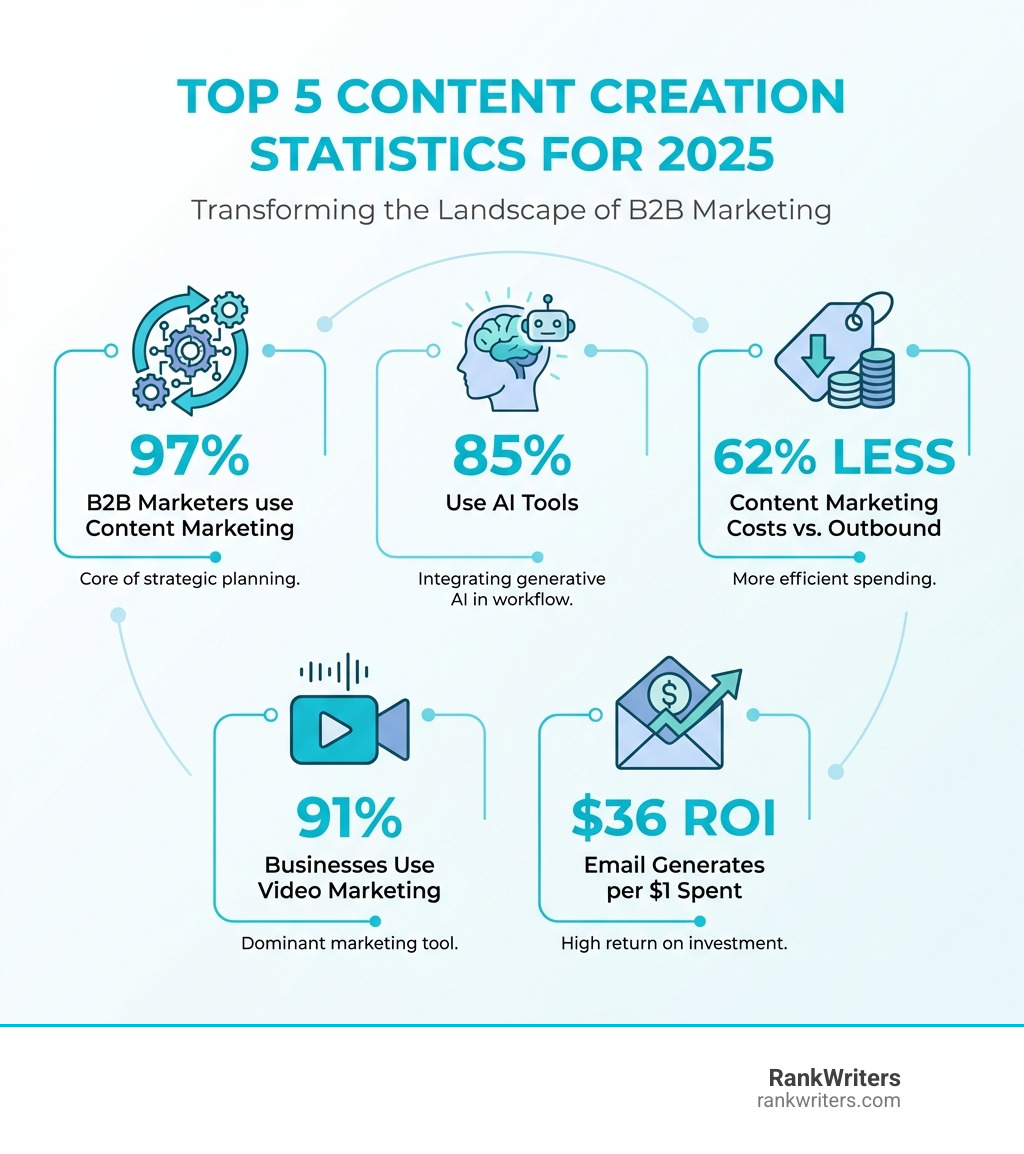
Content creation statistics reveal a landscape in change. In 2025, 97% of B2B marketers use content marketing as part of their strategy, yet only 28% report being highly successful. The difference? Data-driven decisions backed by real numbers.
Key Content Creation Statistics You Need to Know:
- 95% of marketing leaders report rising demand for content, but only 14% feel confident they have the tools to keep pace
- 85% of B2B marketers now use generative AI tools in their content workflow
- Content marketing costs 62% less than outbound marketing while generating 6x more likely leads to convert
- Video dominates: 91% of businesses use video as a marketing tool, with 93% reporting positive ROI
- Email remains king for ROI: Generating $36 for every $1 spent
The shift is undeniable. AI Overviews now appear for 10% of all keywords and have seen a 116% increase since launching. Meanwhile, 89% of citations in these AI results come from pages not even in the top 10 traditional search rankings. The rules have changed.
Marketing leaders waste over 15 hours per week on tasks they believe could be automated. They want to launch campaigns in one to two weeks, but 69% can’t get multi-channel campaigns out the door in less than three to four weeks. The gap between ambition and execution has never been wider.
Content marketing isn’t just about creating more—it’s about creating smarter. The organizations winning in 2025 understand their audience (82% of top performers cite this as their #1 success factor), produce high-quality content (77%), and measure performance effectively (53%). They’re not just using AI; they’re using it strategically.
I’m Brandie Young, a Fractional CMO and GTM strategist who’s spent years helping businesses steer marketing changes, and I’ve seen how leveraging content creation statistics can transform struggling campaigns into revenue-generating engines. Through my work with companies across fintech, legal, and B2B sectors, I’ve learned that data-driven content strategy isn’t optional anymore—it’s the foundation of sustainable growth.
The Strategic Value of Content in 2025
The world of content marketing is constantly evolving, and staying ahead means understanding the foundational shifts. We’re seeing content move from a “nice-to-have” to an absolute necessity, driving everything from brand awareness to direct sales. But what do the numbers tell us about its strategic importance?
The Growing Demand and Investment
The demand for content is soaring. A staggering 95% of marketing leaders report a rising demand for content, yet only a small fraction (14%) feel fully confident they have the necessary tools to keep pace. This creates both a challenge and a massive opportunity for those who can adapt.
It’s not just about demand; budgets are following suit. Nearly half of marketers (46%) anticipate an increase in their content marketing budget in 2025. This shows a clear recognition of content’s value at the executive level. We’re seeing this investment across various sectors. For instance, 97% of B2B marketers integrate content marketing into their strategies, underscoring its indispensable role in business-to-business engagement.
B2C marketers are also heavily committed. Around 24% of B2C marketers allocate a significant portion—10% to 24%—of their total marketing budget to content. This highlights that regardless of your audience, content is a core investment area. For us at RankWriters, these content creation statistics confirm that businesses are hungry for effective content solutions, and those who deliver quality and strategy will thrive.
For more in-depth insights into B2B trends, we often look to authoritative sources like Content Marketing Institute research on B2B trends.
Measuring Overall Success
While investment is increasing, success rates paint a nuanced picture. Roughly 28% of B2B marketers and 29% of B2C marketers consider their content marketing efforts to be extremely or very successful. This suggests that while many are investing, a significant portion are still aiming for optimal results.
A key differentiator for success lies in strategy. We’ve observed that only 29% of marketers with a documented content strategy rate it as extremely or very effective. However, an additional 58% find their documented strategy moderately effective. This tells us that simply having a strategy isn’t enough; it needs to be well-defined, adaptable, and consistently reviewed. Having a clear roadmap helps us align our content efforts with specific business objectives, turning moderate results into stellar ones.
When we look at the top goals B2B marketers achieved this year through content marketing, brand awareness takes the lead at 87%. Generating demand and leads follows closely at 74%, and nurturing subscribers or audiences comes in at 62%. These content creation statistics reinforce that content isn’t just for the top of the funnel; it’s a powerful tool throughout the entire customer journey, building trust and guiding prospects toward conversion.
The AI Revolution in Content Creation
Artificial Intelligence isn’t just a buzzword anymore; it’s fundamentally reshaping how we approach content. From brainstorming to drafting to optimization, AI tools are becoming indispensable, driving efficiencies and opening new avenues for creativity.
AI Adoption and Usage
The adoption of AI in content creation is widespread and growing rapidly. A substantial 85% of B2B marketers now report using generative AI tools. This isn’t just occasional use; approximately 42% of marketers are engaging with AI tools a few times per week or even daily. This level of integration indicates that AI is moving beyond experimentation and becoming a routine part of the workflow.
The applications are diverse. The top three areas where marketers are leveraging AI in content marketing include writing and content generation (42%), social media content creation (40%), and personalization and recommendation (34%). This shows that AI isn’t just for long-form articles; it’s enhancing our ability to create engaging, custom content across multiple platforms.
Furthermore, marketers are getting smarter about how they use AI. Nearly half of AI users (49%) are now creating complex, multi-step prompts to guide AI toward better results. This move from simple queries to sophisticated prompt engineering reflects a growing understanding of AI’s capabilities and how to harness them effectively. We’re continually refining our prompt strategies to ensure our AI-assisted content is not just good, but exceptional.

The ROI and Efficiency of AI
The investment in AI is paying off. A significant 68% of marketing leaders report a positive ROI on their investment in AI. This tangible return on investment is a powerful motivator for continued adoption and integration.
Beyond just ROI, AI is also proving its worth in terms of content performance. An impressive 71% of social media marketers who use AI tools report that AI-generated content actually outperforms content made without it. This suggests that AI isn’t just making our lives easier; it’s making our content better and more engaging for audiences.
One of the most compelling content creation statistics related to AI is its potential to reduce operational costs. A remarkable 83% of marketing leaders believe that fully automating content creation would reduce their agency spend. This highlights the efficiency gains AI can bring, allowing us to reallocate resources to more strategic initiatives. In fact, many marketing leaders spend over 15 hours per week on tasks they believe could be automated. AI offers a pathway to reclaim this time, freeing up our teams for higher-value creative and strategic work.
However, it’s not all smooth sailing. We’ve seen that 95% of generative AI pilot projects fail. The reasons are varied but often include a lack of integration with existing technology (47%), compliance or legal concerns (56%), insufficient technical resources or IT support (53%), governance concerns around brand safety (48%), cultural resistance (48%), and a lack of executive sponsorship (22%). This underscores the importance of a well-planned, holistic approach to AI implementation, focusing on systemic integration rather than just tool adoption.
The Most Important Content Creation Statistics by Channel
Different content channels demand different strategies, and understanding the unique content creation statistics for each is crucial for maximizing impact. Let’s explore some of the most prominent channels and what the data tells us.
Video Content Statistics
Video is no longer optional; it’s a cornerstone of modern content strategy. A compelling 91% of businesses now use video as a marketing tool, and 93% of video marketers report a positive ROI from their efforts. This high return on investment makes video an incredibly attractive channel for businesses of all sizes.
The dominance of short-form video is clear. It’s not only the most leveraged media format by marketers but also consistently reported as delivering the highest ROI. Platforms like YouTube, TikTok, and Instagram Reels have normalized concise, impactful video content, capturing audience attention quickly. Speaking of platforms, YouTube remains the undisputed leader, being the most widely used video marketing platform with 82% of marketers leveraging it.
When it comes to optimal length, consumer preference leans heavily towards brevity. About 51% of people say the optimal length for an effective video is 30-60 seconds, with 91% preferring videos less than two minutes. However, we’ve also seen data from Wistia indicating that videos running between 30 and 60 minutes can be highly effective at converting viewers, suggesting that longer-form video has its place for deeper engagement and complex topics. The key is to match the video length to the content’s purpose and the audience’s intent.
For more detailed insights into video marketing, Wyzowl’s state of video marketing report is an excellent resource.

Social Media Content
Social media is where a vast portion of the global population spends their time, making it an essential content distribution channel. Globally, about 64% of the world’s population uses social media, spending an average of 2 hours and 21 minutes there daily. This massive audience and engagement time present incredible opportunities for brands to connect.
For B2B marketers, LinkedIn continues to deliver exceptional value, with 84% citing it as the social media platform with the best ROI. Its professional focus makes it ideal for thought leadership and lead generation. For broader marketing efforts, Instagram is frequently cited as the platform delivering the highest ROI for marketers, especially for visual content and engaging directly with consumers.
When it comes to content types that resonate most on social media, authenticity and entertainment are key. Approximately 66% of social media marketers report that funny content is the most effective for their brand, closely followed by relatable content at 63%. Trendy content also performs well (59%). This shows that to succeed on social, our content needs to be engaging, shareable, and tap into cultural relevance.
Blogging and SEO Content Creation Statistics
Despite the rise of video and social media, the written word, particularly blogging, remains a critical component of content strategy, especially for search visibility. A significant 68% of online experiences still begin with a search engine. This statistic alone underscores the enduring importance of SEO.
However, the landscape for bloggers is getting tougher. Fifty-three percent of bloggers admit it’s become harder to attract visitors from search engines. This is partly due to the evolving nature of search, including the rise of AI Overviews. These AI-generated summaries are changing how users interact with search results. Notably, 89% of citations within AI Overviews now come from URLs that aren’t even in the top 10 traditional search rankings. This means we can no longer solely rely on traditional ranking factors; our content needs to be comprehensive and authoritative enough to be cited by AI.
When it comes to blog post length, the average in 2025 was around 1,350 words, a figure that has decreased for the second year in a row. This suggests a move towards more concise, yet still comprehensive, content. Our top SEO strategy for 39% of marketers involves optimizing on-page content based on keywords. This foundational practice, combined with a focus on quality and comprehensiveness for AI-driven search, is how we ensure our content continues to perform.
Measuring What Matters: ROI, Leads, and Sales
At the end of the day, content marketing needs to deliver tangible business results. We’re not just creating content for content’s sake; we’re doing it to drive revenue, generate leads, and build a stronger brand. Understanding the content creation statistics around ROI, leads, and sales is paramount to proving its value.
Proving the ROI of Content
One of the most compelling arguments for content marketing is its cost-effectiveness. Content marketing costs 62% less than outbound marketing, and the leads it generates are six times more likely to convert. This efficiency is a game-changer for businesses looking to maximize their marketing spend.
Email marketing, in particular, stands out for its incredible return on investment. For every $1 spent on email marketing, it generates an astounding $36 in ROI. This makes email a powerhouse for nurturing leads and driving conversions, proving that direct communication remains incredibly effective.
When it comes to measuring success, sales figures are a primary indicator. Over 41% of marketers measure the success of their content marketing strategy directly through sales. Furthermore, more than one in three marketing leaders (and 40% of all marketers) cite conversion rates as a top KPI they prioritize tracking. This shift towards hard metrics demonstrates a greater accountability and focus on the bottom line within content marketing.
Generating High-Quality Leads
Content marketing is a lead-generation machine. A robust 76% of marketers report that their content marketing efforts helped generate demand and leads in the past 12 months. Not only is it generating leads, but it’s generating quality leads. A strong 70% of marketers would rate their leads as being “high quality,” indicating that content attracts genuinely interested prospects.
Personalization plays a crucial role in enhancing these results. A powerful 94% of marketers agree that personalization boosts sales. Tailoring content to individual needs and preferences makes it more relevant and impactful, directly contributing to conversion.
The modern buyer’s journey also highlights the importance of content in lead generation. A remarkable 96% of prospects report doing their own research before speaking with a human sales representative. This means our content is often the first point of contact, educating and qualifying leads long before they interact with our sales teams. This underscores why high-quality, informative content is essential for filling the sales pipeline.
Frequently Asked Questions about Content Creation
We often get asked about the fundamental aspects of content creation. Here are some of the most common questions, backed by the latest content creation statistics.
What percentage of marketers use content marketing?
Content marketing is a ubiquitous strategy in today’s digital landscape. A significant 97% of B2B marketers incorporate content marketing into their overall strategy. Similarly, a majority of B2C marketers also leverage content marketing to engage their audiences. For us, this means content isn’t just an option—it’s a fundamental pillar of modern marketing. We use it to achieve top goals like building brand awareness (87% of B2B marketers’ goal) and generating demand and leads (74% of B2B marketers’ goal).
What type of content is most effective?
When it comes to effectiveness, video consistently takes the crown. Video has been voted the most-often-created type of content for marketing for four consecutive years, showcasing its enduring appeal and impact. More specifically, short-form video is reported by marketers to have the highest ROI, making it a powerful format for quick engagement and strong returns. For B2B marketers, the most used content formats include short articles or posts (92%), videos (76%), and case studies or customer stories (75%). This diverse mix allows us to cater to different stages of the buyer’s journey and various audience preferences.
How is AI impacting content creation?
AI is having a transformative impact on content creation, fundamentally changing workflows and capabilities. A substantial 85% of B2B marketers are now using AI tools in their content processes. We’re seeing AI primarily used for writing and content generation (42%), social media content creation (40%), and personalization and recommendation (34%). This widespread adoption is driven by tangible benefits, with 68% of marketing leaders reporting a positive ROI on their AI investment. AI is making content creation more efficient, more targeted, and ultimately, more effective.
Conclusion
The world of content marketing is dynamic, challenging, and filled with immense opportunity. As these content creation statistics clearly show, success in 2025 and beyond hinges on a data-driven, strategic approach that accepts new technologies like AI while staying true to the fundamentals of audience understanding and quality content.
We’ve seen that demand for content is soaring, budgets are increasing, and AI is no longer a futuristic concept but a present reality, driving efficiency and even outperforming human-only content in some areas. However, challenges persist, from measuring ROI effectively to navigating the evolving search landscape.
At RankWriters, we believe in a systematic, future-proof approach to content. We combine traditional SEO with cutting-edge AI Search Optimization (AEO and GEO) to ensure our content not only ranks but also gets cited by AI Overviews, generating consistent inbound leads for our clients. The future of content is here, and it’s smarter, more efficient, and more impactful than ever before.
Are you ready to adapt your content strategy to these new realities and turn these insights into actionable growth? Learn how to future-proof your content strategy with RankWriters.