
Local franchisee marketing focuses on how individual franchise locations drive visibility and demand in their specific markets while staying compliant with national brand standards.
Franchisees often underestimate the importance of local marketing, assuming national campaigns will automatically drive foot traffic. But with 82% of smartphone users researching purchases online and 76% visiting local businesses within 24 hours, ignoring local efforts can result in lost sales. This guide explains why franchisees must balance corporate branding rules with local strategies to succeed.
Key Takeaways:
- Local Franchisee Marketing is Critical: National campaigns build awareness, but local efforts drive sales.
- Common Franchisee Mistakes: Over-reliance on corporate campaigns, inaccurate business listings, ignoring reviews, and using off-brand materials.
- Effective Strategies:
- Optimize your Google Business Profile and update local listings.
- Use local SEO by targeting city-specific keywords and unique content.
- Automate tasks like lead follow-ups and review generation.
- Focus on community engagement through sponsorships and tailored messaging.
Franchisees who prioritize local marketing while staying compliant with corporate guidelines can improve visibility, reduce costs, and increase revenue. Start by updating your business listings, responding to reviews, and running geo-targeted ads to connect with your community.
What Franchisees Control vs. What Franchisors Control
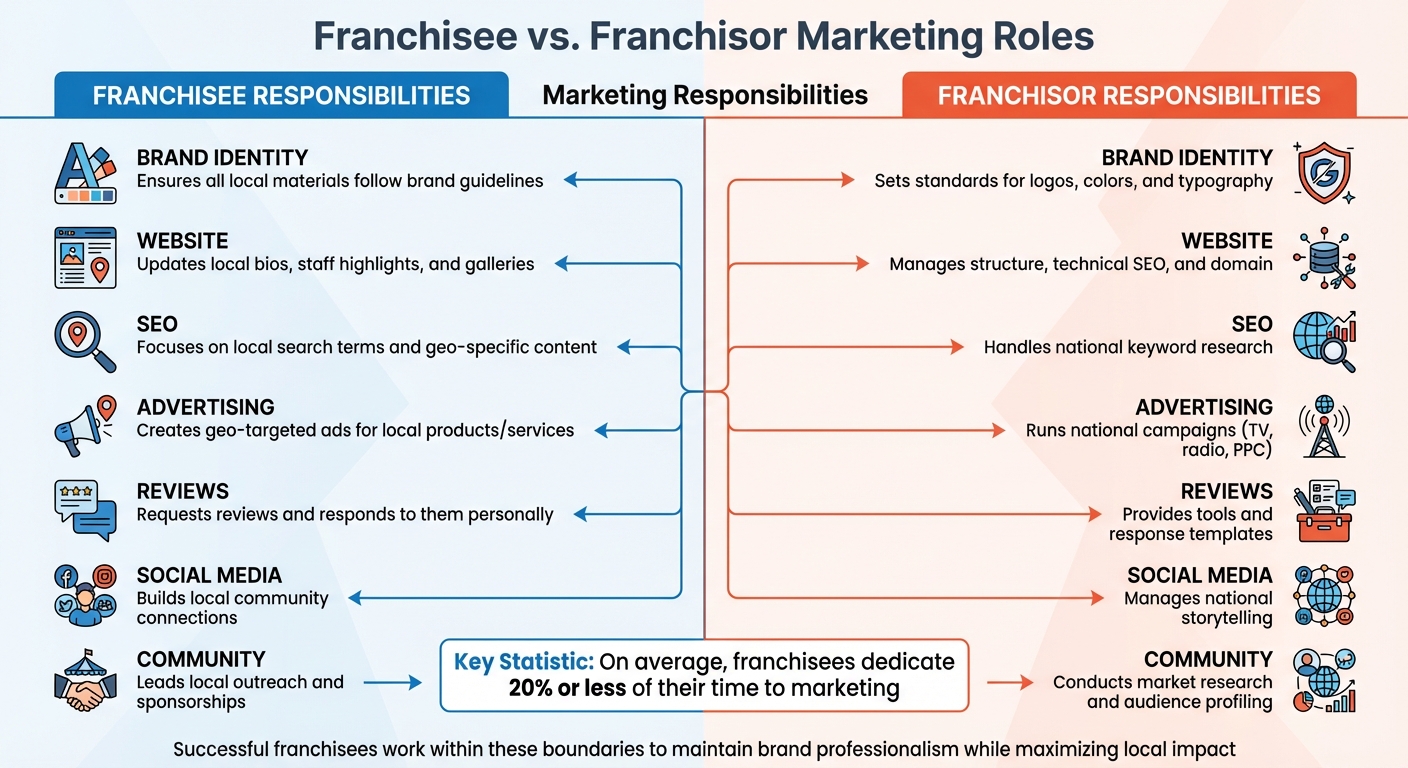
Franchisee vs Franchisor Marketing Responsibilities Comparison
As mentioned earlier, understanding your role in local marketing can directly affect your revenue. Knowing the boundaries between franchisee and franchisor responsibilities is crucial for avoiding missteps and maximizing local results. The division of tasks exists to ensure balance: franchisors focus on protecting the brand, while franchisees work to drive local sales. But when these boundaries blur, problems arise – either franchisees get stuck waiting for corporate approval, or they take matters into their own hands and risk using off-brand materials.
On average, franchisees dedicate 20% or less of their time to marketing [5]. This limited time makes it essential to focus on local efforts that complement, rather than duplicate, corporate strategies. The most successful franchisees understand this balance and prioritize high-impact local tactics that national campaigns can’t replicate. By staying within these boundaries, you can make the most of your local marketing efforts while adhering to corporate guidelines.
What Is Local Franchisee Marketing? The Marketing Franchisees Manage
Franchisees excel at hyper-local marketing. This includes creating location-specific content like photos, staff highlights, local FAQs, and project galleries [3][4]. You’re also in charge of managing your Google Business Profile, responding to reviews, and optimizing for “near me” searches that bring in nearby customers.
Local outreach is another key area. Franchisees handle community engagement through activities like sponsoring events, building partnerships with local organizations, and working with chambers of commerce or trade groups [1][5]. These efforts not only enhance visibility but also help generate backlinks, which can boost your search rankings.
Managing location-specific social media profiles is another responsibility. While staying aligned with corporate branding, franchisees can use these platforms to connect with the community and engage directly with customers [3]. Additionally, requesting and responding to reviews is crucial for building trust at the local level [1][3]. These organic leads are often far more cost-effective – up to 80–90% cheaper – than corporate-led PPC campaigns [4], making them a valuable tool for growing your business.
Next, let’s look at what franchisors handle to maintain brand consistency.
Marketing Areas Franchisors Manage
Franchisors are responsible for the core elements that define the brand. This includes setting standards for logos, typography, colors, and brand voice – essential elements that ensure the franchise is instantly recognizable [5]. They also control the main website, managing its structure, technical SEO, and national keyword strategies to build overall authority [3].
Corporate also takes charge of national advertising campaigns, such as TV, radio, and broad PPC efforts. These large-scale initiatives ensure consistent messaging and efficient media buying [3]. Additionally, franchisors provide the tools and templates franchisees need for local marketing, such as digital asset management systems and review response templates [4][5]. Miriam Ellis, Local SEO Subject Matter Expert at Moz, puts it this way:
“A brand promo only works when all sides are equally committed to making each location of the business visible, accessible, and trusted.” [2]
To protect the brand’s reputation, franchisors enforce compliance rules. This might include approval workflows and withholding co-op marketing funds if franchisees use materials that don’t meet brand standards [5].
Comparison Table: Franchisee vs. Franchisor Marketing Roles
Here’s a quick look at how marketing responsibilities are divided:
| Marketing Area | Franchisor Responsibility | Franchisee Responsibility |
|---|---|---|
| Brand Identity | Sets standards for logos, colors, and typography [5] | Ensures all local materials follow brand guidelines [5] |
| Website | Manages structure, technical SEO, and domain [3] | Updates local bios, staff highlights, and galleries [3] |
| SEO | Handles national keyword research [3] | Focuses on local search terms and geo-specific content [4] |
| Advertising | Runs national campaigns (TV, radio, PPC) [3] | Creates geo-targeted ads for local products/services [3] |
| Reviews | Provides tools and response templates [4] | Requests reviews and responds to them personally [3] |
| Social Media | Manages national storytelling [3] | Builds local community connections [3] |
| Community | Conducts market research and audience profiling [8] | Leads local outreach and sponsorships [5] |
The takeaway? Successful franchisees don’t push against these boundaries; they work within them. By focusing on local execution and using corporate-provided tools and templates, you can maintain brand professionalism without overspending on creative resources.
Common Problems in Local Franchisee Marketing
Even with clear roles outlined, many franchisees face challenges when it comes to executing local marketing strategies. The gap between understanding what needs to be done and consistently following through often results in lost revenue. Recognizing these common mistakes is essential to avoid costly errors and highlights why balancing corporate and local marketing efforts is so important.
Mistakes Franchisees Make with Local Marketing
One of the biggest missteps is relying entirely on corporate campaigns to drive traffic. Many franchisees assume that national advertising covers all their marketing needs, leading them to neglect their Google Business Profile, ignore customer reviews, and skip engaging on local social media platforms. This overdependence on brand recognition can be a costly mistake, especially considering that 87% of consumers use local search to evaluate businesses [3].
Inaccurate local listings are another major issue. If your business hours, address, or phone number are incorrect on Google, you risk losing customers who are ready to buy but can’t reach you. Miriam Ellis, Local SEO Subject Matter Expert at Moz, puts it plainly:
“Franchisors can lose [customers] at this stage through misinformation in the brand’s local business listings – like incorrect hours or bad directions that lead customers to the wrong place and cause them to give up.” [1]
These errors not only lead to immediate lost sales but also damage consumer trust, especially when combined with other branding missteps.
Going rogue with branding is another common problem. Under pressure to stand out locally, franchisees sometimes resort to creating their own materials, like hand-drawn signs, outdated logos, or hiring vendors unfamiliar with brand guidelines. According to Matthew Jonas, President of TopFire Media, this approach causes “confusion among customers, diluted brand identity, and eroded customer trust” [9]. Deviating from brand standards – whether through off-brand language, colors, or typography – can weaken the overall perception of the business.
Ignoring reviews is another costly error. With 76% of consumers checking reviews before making a local purchase [3], failing to respond to feedback not only misses an opportunity to build loyalty but also risks worsening negative impressions when issues are left unresolved.
Lastly, many franchisees rely on generic corporate messaging that doesn’t resonate locally. For example, promoting “sub sandwiches” in New Orleans instead of “po’ boys” or ignoring local weather and community events makes marketing efforts feel out of touch. This cookie-cutter approach leads to lower engagement and wastes valuable marketing dollars.
How Poor Local Marketing Reduces Revenue
These mistakes don’t just hurt visibility – they directly impact revenue. Consider this: 60% of restaurants fail within their first year, and only 20% survive to see their 15th year [9]. While operational challenges play a role, weak local marketing often speeds up failure by making it harder for customers to find and connect with the business.
Poor local marketing creates three specific revenue drains. First, you lose ready-to-buy customers when they can’t find accurate information about your business. Second, acquiring new customers becomes more expensive – organic leads from effective local SEO cost 80–90% less than paid leads [4]. Third, failing to engage with your community or respond to feedback limits repeat business and loyalty.
Here’s a breakdown of how these mistakes hurt your bottom line:
| Marketing Mistake | Business Impact | Impact on Revenue |
|---|---|---|
| Inaccurate Listings | Customers can’t find or contact you | Immediate loss of sales |
| Ignoring Reviews | Damaged online reputation | Higher customer churn and fewer leads |
| Rogue Branding | Unprofessional and inconsistent image | Reduced trust and diluted brand equity |
| Generic Messaging | Lack of local relevance | Ineffective spending and low engagement |
The upside? These challenges can be addressed. Franchisees who focus on executing local marketing strategies while staying within brand guidelines consistently outperform those who treat local marketing as an afterthought. These common pitfalls set the stage for the next section, which explores actionable strategies to help franchisees succeed in their local markets.
Effective Strategies for Local Franchisee Marketing
Franchisees can turn challenges into opportunities by using three proven strategies that align with brand guidelines while boosting local visibility. These strategies – local SEO, automation, and community engagement – not only complement each other but also create a cycle of growth. Strong local SEO enhances community engagement, which generates reviews and content that further improve search rankings. Let’s dive into how these approaches can power your local marketing efforts.
Strategy 1: Local SEO That Aligns with Brand Guidelines
Local SEO is a vital area where franchisees have significant influence. While the franchisor typically handles technical aspects like website structure and domain authority, local franchisees control the signals that drive customers to their doors. Consider this: 76% of people who search for something nearby on their smartphone visit a related business within a day, and 28% of those searches lead to a purchase [2]. That’s why nailing your local SEO is critical.
Start with your Google Business Profile. Searches for “open now” have skyrocketed by 300% [2], showing that customers want businesses they can visit immediately. Keep your hours updated, especially during holidays, to meet these expectations.
Your location page is another key element. Avoid using generic content that’s duplicated across multiple franchise locations. Instead, aim for 600–900 words of unique, locally relevant copy that incorporates city-specific keywords, local photos, and references to nearby landmarks [4][3]. This not only appeals to local customers but also prevents keyword cannibalization, where your locations compete against each other in search rankings. For example, instead of generic terms like “portable containers”, use phrases like “Orlando portable containers” to target local intent.
Reviews are equally important. 76% of consumers read online reviews before making a local purchase [3], and businesses that respond to negative reviews often see 33% of reviewers post a more positive follow-up review [6]. Use corporate-approved response templates to reply to all reviews – ideally within 24 hours – while staying consistent with brand guidelines.
Lastly, implement LocalBusiness schema markup on your location page. This structured data helps Google interpret key details like your address, hours, and services, improving your visibility in local search results [4][3]. Check with your franchisor to see if schema markup is already part of your website template. If not, request it. With local SEO in place, the next step is to save time and increase efficiency through automation.
Strategy 2: Using Automation for Local Campaigns
Time is one of the biggest constraints franchisees face. Automation tools can help you run professional, effective campaigns without adding hours to your workload. In fact, businesses using marketing automation report a 451% increase in qualified leads and a 14.5% boost in sales productivity [11].
Start by setting up centralized lead management. Automation can instantly route leads to your location based on geography or service type, reducing errors and ensuring you don’t miss any opportunities. Speed is crucial – 78% of consumers choose the first business that responds to their inquiry [10]. Use automated follow-ups via SMS or email to keep prospects engaged.
For paid advertising, automate your targeting by focusing on the top 5 to 20 ZIP codes near your location [12]. This ensures your budget is spent on high-converting areas rather than distant, less relevant ones. Dynamic templates can help you include local details – like your address or a neighborhood-specific promotion – while staying in line with brand standards [5].
Consider adding Conversations AI to your website, WhatsApp, and SMS channels. These 24/7 virtual assistants can answer common questions, book appointments, and capture leads after hours without requiring human intervention [10]. This frees up your team to focus on in-person interactions.
Automation can also streamline review generation. Platforms can send review requests to customers after a purchase, helping to build trust and improve your local visibility. With 80% of marketers expected to use AI-powered tools for personalization by 2026 [11], adopting these tools now can give you an edge over competitors.
Strategy 3: Connecting with Your Local Community
Once you’ve optimized your SEO and automated your campaigns, the final piece of the puzzle is building strong ties with your community. While national ads create awareness, local engagement fosters loyalty. 90% of consumer purchases still happen in physical stores, and 82% of smartphone users consult their devices right before making an in-store purchase [2]. Bridging the gap between online research and in-store visits is key to winning over local customers.
Start by sponsoring local events or partnering with community organizations. These efforts not only build goodwill but can also earn backlinks from local websites, like chambers of commerce or news outlets, which improve your online reputation [1]. For example, sponsoring a youth sports team or a charity event can generate positive word-of-mouth and strengthen your position in the community.
Use local social media to showcase your involvement. Share photos of completed projects, highlight employees, or promote location-specific specials. As Miriam Ellis from Moz advises:
“60% of your posts should be engaging, timely content, 30% should be shared content, and only 10% should be promoting your products & services” [1].
Tailor your messaging to reflect local preferences. For instance, if your franchise is in New Orleans, feature “po’ boys” instead of generic “sub sandwiches.” In Hawaii, highlight menu items that resonate with local tastes. These small adjustments show that you understand and respect your community [1].
Finally, create hyperlocal content that answers specific questions, like “how much does a move cost in [City Name]” [4]. This approach captures high-intent “near me” searches and positions your business as the go-to local expert.
Frequently Asked Questions: Local Franchise Marketing
Isn’t SEO a national effort? How does it help an individual franchise location?
At RankWriters, we ensure SEO operates at multiple levels. National SEO builds brand authority and visibility across broad, non-geographic searches, but it does not reliably capture local intent.
Franchise locations win business when they appear in searches tied to a specific city, neighborhood, or “near me” query. Local franchise SEO is designed to surface each location when customers are actively looking for services in that market, which is where real conversion happens.
If corporate is already investing in SEO, won’t I overpay by doing it locally too?
At RankWriters, we make certain local SEO is treated as a separate effort, not one that duplicates. A properly structured franchise SEO program separates responsibilities clearly. Corporate SEO focuses on national keywords, brand strength, and shared assets, while franchise locations target local intent and conversion-driven searches. When those lanes are defined, local SEO spend is not redundant; it fills a gap corporate efforts are not meant to cover.
How can I stay brand-compliant while doing SEO for my local franchise?
Brand compliance and local SEO remain aligned when the program is correctly structured. Franchise-safe SEO relies on approved templates, consistent messaging, controlled page structures, and predefined metadata rules. This allows locations to localize content for their market while staying fully aligned with brand voice, positioning, and legal requirements. At RankWriters, we have found the key is governance built into execution, not manual policing after the fact.
Will local SEO cause franchisees to compete against each other in search results?
RankWriters implements guardrails to ensure geographic boundaries and keyword intent are properly defined. Search engines recognize location signals and user proximity.
A well-architected franchise SEO strategy assigns each location a clear territory and targets location-specific search terms, preventing overlap and cannibalization. When done right, each franchisee competes only within their own market.
How long does it take to see results from franchisee SEO?
RankWriters clients see fairly fast results. Local SEO typically delivers results faster than national SEO because competition is narrower and intent is higher. Most franchise locations begin seeing improved visibility within the first few months, with inbound leads following as local authority builds.
The exact timeline depends on market competition and execution quality, but local SEO is often one of the quickest paths to sustainable demand for individual franchisees.