


Why Your Cosmetic Surgery Practice Needs SEO to Thrive
SEO for cosmetic surgeons is the process of optimizing your practice’s online presence to rank higher in search results, attract qualified patients, and convert online searches into booked consultations. Here’s what matters most:
Core Components of Cosmetic Surgery SEO:
- Local SEO – Optimize Google Business Profile, maintain NAP consistency, and dominate the Local 3-Pack
- Keyword Research – Target high-intent terms like “rhinoplasty cost [city]” and “best breast augmentation surgeon near me”
- Content Marketing – Create educational blogs, procedure guides, and before-and-after galleries that answer patient questions
- Technical SEO – Ensure fast page speed, mobile-friendliness, secure HTTPS, and proper site architecture
- Reputation Management – Collect and respond to reviews on Google, RealSelf, and Yelp
- Link Building – Earn backlinks from authoritative medical directories and local partnerships
Why It Matters:
77% of patients begin their healthcare search online, and 60% of clicks go to the top 3 search results. Without a strong SEO strategy, you’re invisible to potential patients actively searching for your services.
The cosmetic surgery market is saturated. Traditional referrals aren’t enough anymore. Over 42,000 people search for “plastic surgery” every month in the US alone, and if your practice isn’t ranking on page one, competitors are capturing those leads.
SEO isn’t just about visibility—it’s about trust. Patients researching procedures want to see your expertise, credentials, and patient results before they book. High rankings signal authority and credibility, making SEO your most cost-effective patient acquisition channel.
I’m Alizabeth Leng-Barton, and I’ve spent years helping brands build search visibility through strategic SEO for cosmetic surgeons and AI-driven content. I specialize in aligning search strategy with patient intent to drive sustainable growth for medical practices.
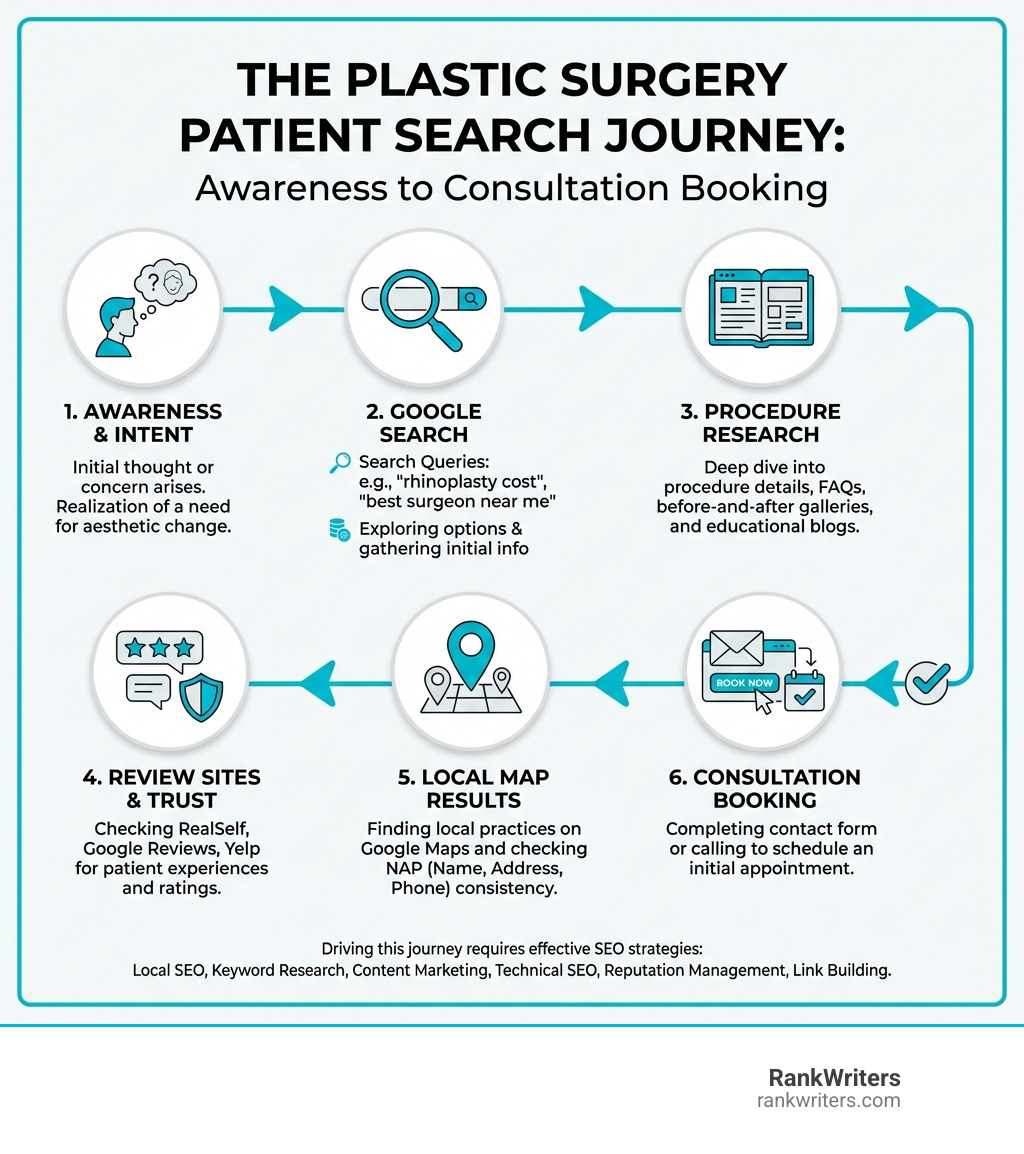
Why SEO for Cosmetic Surgeons is the Ultimate Growth Engine
In the competitive landscape of the United States, particularly for practices in Pennsylvania and Westmoreland County, relying solely on word-of-mouth is no longer a viable long-term strategy. While a recommendation from a happy patient is gold, it doesn’t scale. This is where SEO for cosmetic surgeons becomes your practice’s ultimate growth engine.
Statistics show that 77% of patients start their search online before ever picking up the phone. If you aren’t appearing where they are looking, you simply don’t exist in their decision-making process. Furthermore, 60% of clicks go to the top 3 results on Google. If your practice is buried on page two, you are missing out on the lion’s share of potential leads.
Beyond just “being seen,” SEO builds a foundation of patient trust. Research on internet use for health information confirms that more than half of internet users rely on search engines to research surgical procedures. When a potential patient finds your site at the top of the rankings, Google is essentially giving you a “badge of authority.”
In a saturated market, having a plastic surgery lead generation strategy that runs 24/7 is your biggest competitive edge. While your competitors are sleeping, your optimized content is answering questions about recovery times, costs, and safety, warming up leads before they even step into your office.
The Core Pillars of a Successful SEO Strategy
To dominate the search engine results pages (SERPs), we must look at SEO as a multi-layered structure. It’s not just about mentioning “liposuction” a few times on your homepage; it’s about building a site that search engines love to crawl and users love to browse.
On-Page Optimization vs. Technical SEO
On-page SEO is everything the user sees—the words, the images, and the structure of your content. Technical SEO is everything happening under the hood that helps Google’s search algorithms understand your site.
| Feature | On-Page SEO | Technical SEO |
|---|---|---|
| Focus | Content quality, keywords, and HTML tags | Site speed, indexing, and architecture |
| Elements | Title tags, Meta descriptions, H1-H3 headers | XML Sitemaps, Robots.txt, SSL (HTTPS) |
| Goal | Relevance to the user’s search query | Ease of crawling for search engine bots |
| Updates | Regular blog posts and page refreshes | Core Web Vitals and server optimizations |
The Mobile-First World
With over 177.8 million mobile search users in the US, Google has shifted to mobile-first indexing. This means Google primarily uses the mobile version of your content for indexing and ranking. If your site looks great on a desktop but is a nightmare to steer on a smartphone, your rankings will suffer. We’ve detailed more info about mobile vs desktop impact to help you understand how to prioritize your design.
Page Speed and User Experience (UX)
A page that takes more than three seconds to load risks losing nearly half its visitors. Potential patients are often in a state of high intent but low patience. Using tools like Google PageSpeed Insights is non-negotiable for identifying bottlenecks. Fast loading speeds, secure HTTPS protocols (SSL), and intuitive site architecture ensure that patients stay on your site longer, which signals to Google that your site is valuable.
Mastering Keyword Research and Content Marketing
Keyword research is the diagnostic tool of digital marketing. It tells us exactly what your patients are worried about, what they want to change, and what they can afford.
Identifying High-Intent Keywords for Cosmetic Surgeons
Not all keywords are created equal. We categorize them into two main buckets:
- Informational Keywords: “How long is rhinoplasty recovery?” or “What is Ozempic face?” These are great for blog posts and building authority.
- Transactional/Commercial Keywords: “Best breast augmentation surgeon in Pennsylvania” or “tummy tuck cost near me.” These are the “money” keywords that drive consultations.
When we approach how to target keywords for SEO, we focus on “long-tail” keywords. These are longer, more specific phrases that may have lower search volume but much higher conversion rates because the user knows exactly what they want.
The Power of Content-Centric SEO
Google’s latest updates heavily favor Google’s EEAT guidelines: Experience, Expertise, Authoritativeness, and Trustworthiness. Because cosmetic surgery falls under the YMYL (Your Money or Your Life) category, Google holds your content to a much higher standard.
Your content strategy should include:
- Procedure Guides: In-depth pages for every service you offer (Rhinoplasty, Liposuction, etc.).
- Educational Blogs: Answering common questions and debunking myths.
- Video Marketing: YouTube is the world’s second-largest search engine. Embedding videos of you explaining a procedure can increase “dwell time” on your site, which boosts SEO.
- Before-and-After Galleries: These are the #1 thing prospective patients look for. Ensure they are optimized with alt-text like “breast augmentation before and after results Westmoreland County.”
For a deeper dive into planning your editorial calendar, check out our content strategy for plastic surgeons.
Dominating Local SEO and Reputation Management
For a surgeon in Pennsylvania, ranking for “plastic surgery” globally is useless. You need to rank for “plastic surgeon near me” or “cosmetic surgery Westmoreland County.” Since 46% of searches are local, local SEO is your bread and butter.
Optimizing Local SEO for Cosmetic Surgeons
The goal is to appear in the Google Maps 3-Pack. This accounts for over 20% of all clicks on desktop and even more on mobile.
- Google Business Profile (GBP): Claim it, verify it, and fill it out completely. Add high-quality photos of your office and staff.
- NAP Consistency: Your Name, Address, and Phone number must be identical across the web—from your website to the American Society of Plastic Surgeons directory and Yelp.
- Local Landing Pages: If you serve multiple areas within Pennsylvania, create dedicated pages for each, such as “Cosmetic Services in Greensburg” or “Plastic Surgery Westmoreland County.”
Reviews: The New Referrals
72% of new patients use reviews as their first step in finding a doctor. A robust review response strategy is vital. Don’t just collect reviews on Google; look at RealSelf and Yelp too. Responding professionally to both positive and negative reviews shows you care about patient experience. We have an extensive guide on attract more patients that covers these reputation management nuances.
Advanced Tactics: Link Building and AI Visibility
Once you have the basics down, it’s time to level up. SEO is no longer just about Google’s traditional blue links; it’s about appearing in AI-generated answers and building a fortress of authority.
Link Building for Plastic Surgeons
Links from other websites to yours are like “votes” of confidence. However, spammy links will get you penalized. Focus on:
- Guest Posting: Writing for reputable medical journals or local PA news sites.
- Directory Listings: Ensuring you are in high-authority medical directories.
- Community Involvement: Sponsoring a local Westmoreland County event can earn you a high-quality local backlink.
Explore our specialized tactics for link building for plastic surgeons to see how we earn high-authority placements.
AI Search Optimization (AEO) and GEO
The future of search is Generative AI. Tools like ChatGPT, Perplexity, and Google’s AI Overviews are changing how patients find information. To stay ahead, we use a systematic approach to Generative Engine Optimization (GEO).
- Schema Markup: This is machine-readable code that helps AI understand your services, prices, and reviews. Use schema markup for rich results to ensure your star ratings appear directly in search results.
- Topic Clustering: Instead of random blogs, we organize content into “clusters”—for example, a pillar page on “Facial Rejuvenation” linked to sub-pages on “Facelifts,” “Eye Lifts,” and “Dermal Fillers.”
Measuring Success and Choosing the Right Partner
You can’t manage what you don’t measure. A successful campaign requires constant monitoring of Key Performance Indicators (KPIs).
Key Metrics to Track
Using Google Analytics, we track:
- Organic Traffic: How many people are finding you via search?
- Keyword Rankings: Are you moving up for high-intent terms?
- Conversion Rate: How many website visitors are actually filling out a contact form?
- ROI Analysis: What is the cost per lead compared to traditional advertising?
In-House vs. Outsourcing
Many surgeons try to handle SEO in-house, but the technical requirements and constant algorithm updates (Google had seven major updates in 2024 alone!) make it a full-time job. Partnering with a specialized firm like RankWriters ensures you have a team of experts focused on systematic lead generation.
We don’t just write blogs; we create future-proof content that aligns with traditional SEO, AEO, and GEO. For more details on our specific approach, read our dedicated page on SEO for plastic surgeons.
Frequently Asked Questions about SEO for Cosmetic Surgeons
How long does it take to see results from SEO for cosmetic surgeons?
SEO is a marathon, not a sprint. Typically, you will start seeing movement in rankings within 3 to 6 months. However, in highly competitive markets like major Pennsylvania metros, it can take 6 to 12 months to dominate the first page for the most competitive terms. Factors include your current domain authority, the quality of your content, and how aggressive your competitors are.
Is social media more important than SEO for plastic surgery?
Social media is fantastic for brand awareness and showing off “behind-the-scenes” content, but it serves a different purpose. SEO captures “high-intent” traffic—people actively searching for a solution to a problem right now. Social media is often “findy” traffic—people browsing who might be interested later. An integrated marketing strategy uses both, but SEO consistently provides a higher ROI and a higher lead-to-consultation close rate (14.6% for SEO vs. 1.7% for traditional print).
Should I handle SEO in-house or outsource to a specialized firm?
Unless you have a dedicated digital marketing team with technical SEO expertise, outsourcing is usually more cost-effective. A specialized firm has access to expensive data tools (like Ahrefs or Semrush) and stays updated on algorithm changes that can tank an unoptimized site overnight. Outsourcing allows you to focus on what you do best: surgery and patient care.
Conclusion
In today’s digital-first world, SEO for cosmetic surgeons is no longer optional—it is the foundation of a modern medical practice. By investing in a systematic, future-proof strategy that combines technical excellence, high-intent keyword targeting, and local dominance, you can ensure a consistent flow of inbound leads for years to come.
The digital landscape is changing rapidly with the rise of AI search, but the core principles of providing value and building trust remain. Don’t let your practice linger on page two while your competitors capture the market.
Ready to grow your practice? Partner with RankWriters for Expert SEO Content and let us build your systematic lead generation machine today.