


Why Your Plastic Surgery Practice Needs SEO to Thrive
SEO for plastic surgeons is the process of optimizing your website to rank higher in search engine results when potential patients search for cosmetic procedures, building trust through authoritative content, and converting online visibility into booked consultations.
Quick Answer: The Four Pillars of SEO for Plastic Surgeons
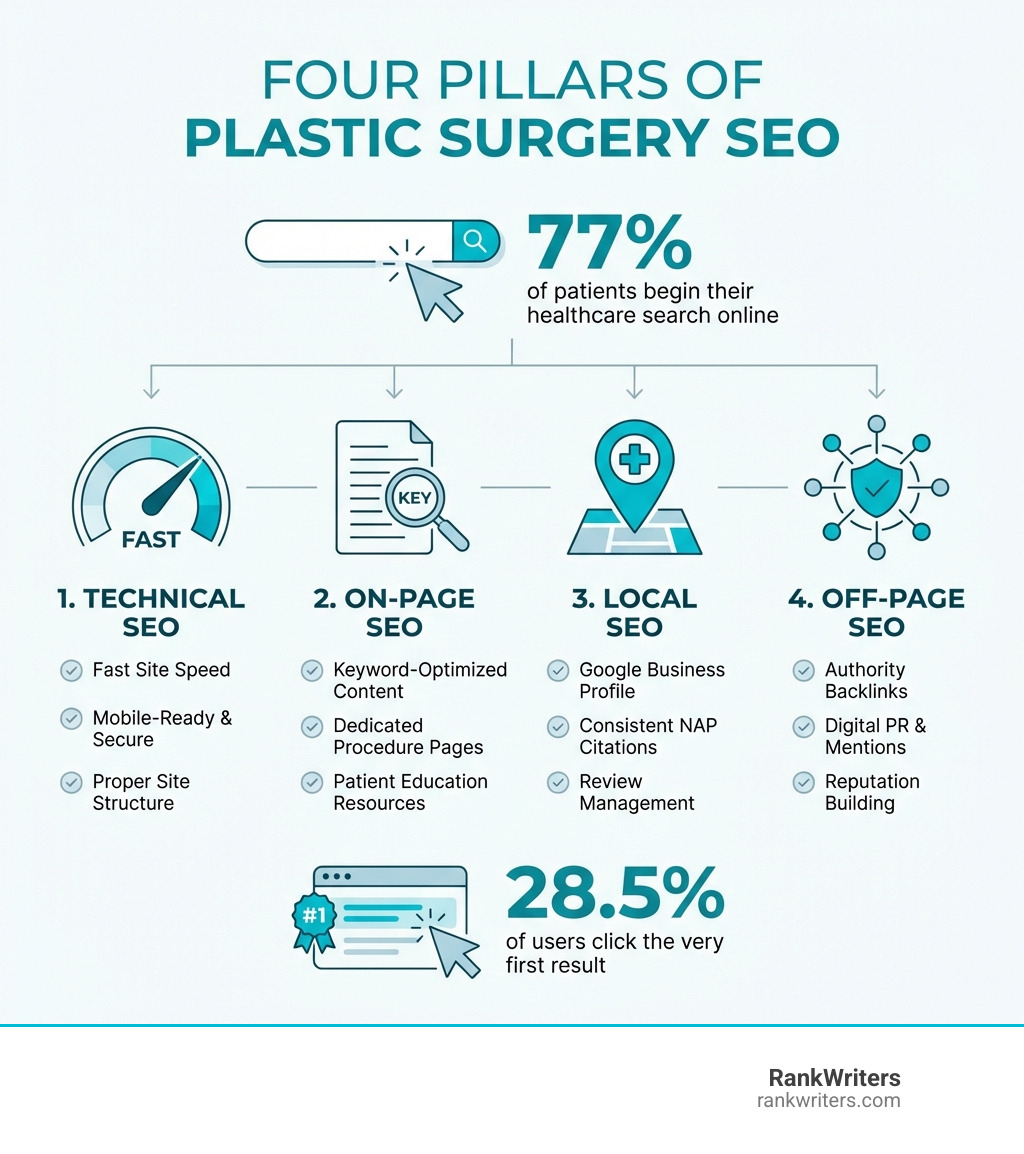
- Technical SEO – Fast site speed, mobile optimization, secure HTTPS, and proper site structure
- On-Page SEO – Keyword-optimized content, procedure pages, and patient-focused educational resources
- Local SEO – Google Business Profile optimization, consistent NAP citations, and review management
- Off-Page SEO – Building authority through quality backlinks, digital PR, and reputation management
The patient journey has fundamentally shifted. 77% of patients begin their search for healthcare services online, and 60% of those searches result in a booked appointment with a provider whose website ranked on the first page of Google.
If your practice isn’t showing up when someone searches “breast augmentation near me” or “best rhinoplasty surgeon in Westmoreland County,” you’re losing potential patients to competitors who invested in their digital presence.
Search engines are the new front door to your practice. Around 42,000 people search for “plastic surgery” every month in the United States alone. That’s 42,000 potential consultations—if your website appears in those critical top search results.
The challenge is clear: 68% of all online experiences begin with a search engine, and most clicks go to top-ranking results. In the saturated plastic surgery market, even the most skilled surgeons remain invisible without a strategic SEO approach.
This isn’t about gaming the system; it’s about building an authoritative online presence that helps patients find you. It involves creating content that answers their questions, demonstrates your expertise, and guides them from research to consultation.
I’m Brandie Young, and I’ve spent years helping plastic surgery practices transform their digital presence through data-driven SEO strategies that generate consistent patient leads. Throughout my work with medical and aesthetic practices, I’ve seen how effective SEO for plastic surgeons can double consultation bookings and establish practices as trusted authorities in their local markets.
This guide will walk you through the exact framework successful practices use to dominate local search results, attract qualified patients, and build sustainable growth through organic visibility.
Why SEO is a Non-Negotiable for Modern Plastic Surgeons
The digital landscape has dramatically reshaped how patients find and choose their healthcare providers, especially in a specialized field like plastic surgery. Gone are the days when word-of-mouth and traditional advertising were enough. Today, the journey begins online.
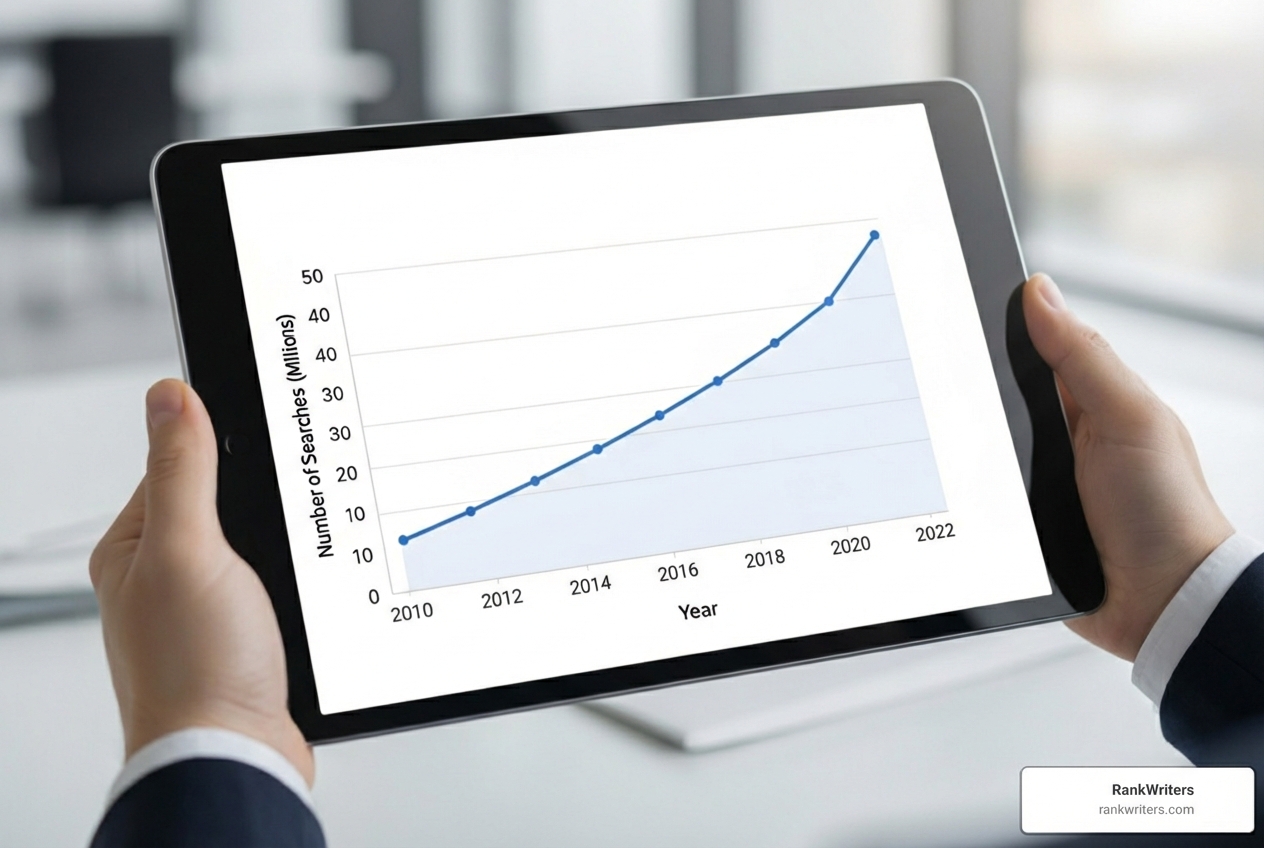
Patients are actively researching procedures, comparing surgeons, and evaluating practices long before they ever pick up the phone. In fact, more than half of internet users rely on search engines when researching health-related information, including surgical procedures. If your practice isn’t visible in those crucial search results, you’re missing out on a vast pool of potential patients.
The plastic surgery market is highly competitive. Without a robust SEO for plastic surgeons strategy, even the most talented surgeons can be overlooked. We can refine your digital strategy to ensure you stand out.
SEO builds trust and credibility. Higher-ranking websites are perceived as more reliable and authoritative—a vital trust signal for potential patients, reassuring them of your expertise.
Traditional marketing methods can’t keep up. While referrals remain valuable, they lack the scale for consistent growth. SEO offers a cost-effective way to acquire patients actively searching for your services. It’s a high-return investment connecting you with high-intent individuals. Studies show that 75% of Web users never scroll past the first page of search results, and a staggering 60% of clicks go to the top 3 results. If you’re not there, you’re practically invisible.
Understanding Google’s E-E-A-T and YMYL Standards
For plastic surgeons, understanding Google’s ‘Your Money or Your Life’ (YMYL) standards and the E-E-A-T framework is critical. Plastic surgery falls squarely into the YMYL category because it directly impacts a person’s health, appearance, and finances. This means Google holds plastic surgery websites to an exceptionally high standard.
To rank well, your website must demonstrate:
- Experience: Showcasing real-world experience, such as a surgeon’s years in practice or the number of procedures performed.
- Expertise: Presenting content that reflects deep knowledge, including detailed procedure guides and scientific references.
- Authoritativeness: Establishing your practice as a recognized authority through mentions in reputable medical journals or features in local news.
- Trustworthiness: Building confidence through transparent information, secure website connections (HTTPS), and ethical patient testimonials.
Building E-E-A-T into your content is about more than SEO; it’s about patient safety and ethical practice. It ensures your information is helpful, medically sound, and credible, aligning with Google’s preference for helpful content created to benefit people, especially in YMYL areas. You can learn more from Google’s guidelines on helpful, reliable, people-first content.
How Search Engines Rank Plastic Surgery Websites
Search engines use complex algorithms to rank websites. For SEO for plastic surgeons, these algorithms weigh numerous factors to assess your site’s relevance, quality, and authority.
Key ranking factors include:
- Technical SEO: The health of your website, including site speed, mobile-friendliness, and security.
- Content Quality: Is your content comprehensive, accurate, and does it demonstrate E-E-A-T?
- User Experience Signals: How users interact with your site (e.g., bounce rate, time on page).
- Backlink Authority: The quantity and quality of links from other reputable websites.
- Local Search Signals: Your Google Business Profile optimization, consistent Name, Address, Phone (NAP) information, and online reviews.
Google’s algorithms are constantly evolving. In 2024 alone, Google had four core updates and three spam updates. These updates can significantly impact rankings, often intensifying scrutiny on medical content and E-E-A-T signals. Practices that delay adaptation can see 30-50% traffic drops, making proactive SEO essential.
Mobile optimization is critical. With 50% of users browsing on mobile devices and Google prioritizing mobile-friendly websites, a non-optimized site means losing both SEO value and real patients.
The Core Pillars of SEO for Plastic Surgeons
To compete and thrive online, we build our SEO for plastic surgeons strategy on four interconnected pillars. Each supports the others, creating a comprehensive and robust online presence that drives sustainable growth.

Pillar 1: Technical SEO Foundation
Technical SEO is your website’s structural integrity. It ensures search engines can crawl and index your site, providing a smooth, secure user experience.
- Website Health and Site Speed: A slow website is a conversion killer. A one-second delay in page load time reduces conversions by 7%. We optimize images, leverage browser caching, and minimize code to ensure fast loading. You can test your site speed with Google PageSpeed Insights to see where you stand.
- Mobile-First Optimization: With over half of all searches on mobile, your site must be mobile-friendly. Google uses mobile-first indexing, so we ensure your site is responsive with easy-to-tap buttons and readable text on any screen.
- Core Web Vitals (LCP, INP, CLS): These are Google’s key metrics for user experience:
- Largest Contentful Paint (LCP): How quickly the main content loads.
- Interaction to Next Paint (INP): How quickly your site responds to user input (like clicks).
- Cumulative Layout Shift (CLS): How stable your page layout is during loading.
Meeting these benchmarks is crucial for user satisfaction and rankings.
- HTTPS Security: A secure website (HTTPS) is non-negotiable. It protects patient data and is a direct ranking factor.
- Schema Markup: This structured data helps search engines understand your content (services, reviews, FAQs). It can increase click-through rates by up to 30% by enabling rich snippets in search results.
Essential technical SEO elements we implement:
- XML Sitemap: A roadmap for search engines.
- Robots.txt: Directs search engine crawlers.
- Clean Code: Avoiding bloated page builders that slow your site.
- Internal Linking Structure: Logically connecting related pages.
- Image Optimization: Compressing images and using descriptive file names and alt text.
Pillar 2: Content and On-Page Optimization
Content is king for SEO for plastic surgeons. This pillar focuses on creating high-quality, patient-centric content optimized for both patients and search engines.
- Keyword Research Methodology: We uncover what your ideal patients search for, moving from broad topics like “rhinoplasty” to specific phrases like “best rhinoplasty surgeon Westmoreland County.” Using advanced tools, we analyze search volume, competition, and intent to target high-value keywords.
- Procedure-Specific and High-Intent Terms: We focus on terms indicating a patient is ready to act, such as procedure-specific keywords (“liposuction Westmoreland County”), geo-targeted keywords (“facelift Pennsylvania”), and high-intent terms like “breast augmentation cost.”
- Long-Tail vs. Short-Tail Keywords:
- Short-tail keywords (e.g., “plastic surgery”) are broad and highly competitive.
- Long-tail keywords (e.g., “non-surgical nose job cost Westmoreland County”) have clearer intent and 2.8x better conversion rates. We target both, emphasizing long-tail terms for qualified leads.
- Creating Helpful Plastic Surgery Content: Your website should be a valuable resource. We create educational content that answers patient questions and demonstrates your expertise, including detailed procedure explanations, FAQs, and patient success stories.
- Service Page Optimization: Each procedure deserves a dedicated, optimized page with a procedure overview, benefits, risks, patient testimonials, before-and-after galleries (with consent), and clear calls-to-action (CTAs).
- On-Page Elements: We optimize:
- Title Tags: The clickable headline in search results.
- Meta Descriptions: A brief summary under the title.
- Headers (H1, H2, H3): Structuring content for readability and SEO.
- URLs: Short, descriptive, and keyword-rich.
- Image Alt Text: Describing images for accessibility and search engines.
Pillar 3: Local SEO Dominance
Local SEO is a high-ROI investment because 92% of patients choose practitioners within 15 miles. It ensures you appear when nearby patients search. With 46% of all Google searches being local and 78% of local searches leading to an online conversion, dominating local search is non-negotiable.
- Google Business Profile (GBP) Optimization: This is your digital storefront on Google. We fully optimize your GBP with accurate NAP, relevant categories, compelling service descriptions, high-quality photos, and active Q&A responses.
- NAP Consistency and Local Citations: Your practice’s NAP must be identical across all platforms (website, GBP, directories like Yelp, Healthgrades, and the American Society of Plastic Surgeons). Inconsistencies harm local rankings.
- Online Reviews Management: Reviews are a huge trust signal and a local ranking factor. We encourage happy patients to leave positive reviews and advise on professional, HIPAA-compliant responses. Practices with 50+ reviews see 75% more conversions. Be aware of the FTC’s 2024 rules against fake reviews.
- Geo-Targeted Landing Pages: For practices targeting specific areas like Westmoreland County, we create dedicated landing pages. For example, a page for “Breast Augmentation in Westmoreland County” or “Rhinoplasty in Greensburg” allows us to target geo-specific keywords effectively.
Pillar 4: Off-Page SEO and Authority Building
Off-page SEO builds your practice’s authority across the internet, signaling to search engines that other reputable sources trust your content.
- Building Credibility: High-quality backlinks from authoritative websites act as votes of confidence, strengthening your site’s authority.
- Link Building for Plastic Surgeons: Our ethical link-building tactics include:
- Guest Posting: Writing articles for reputable health or local publications with a link back to your site.
- Local Sponsorships: Sponsoring community events to earn mentions and links.
- Digital PR: Getting your practice featured in local news or online publications.
- Resource Creation: Developing unique content that other sites want to link to.
- Social Media Signals: While not a direct ranking factor, an active social media presence indirectly boosts SEO by increasing visibility, driving traffic, and earning mentions and backlinks.
- Online Reputation Management: This involves monitoring online mentions to ensure a positive brand image, contributing to the “Trustworthiness” in E-E-A-T.
Turning Clicks into Consultations: A Growth-Focused Framework
The goal of SEO for plastic surgeons isn’t just rankings; it’s turning clicks into consultations. Our framework optimizes the patient journey to maximize your ROI and drive consistent plastic surgery lead generation.
Conversion Optimization Strategies
Once a visitor lands on your site, Conversion Rate Optimization (CRO) makes it easy and compelling for them to become a patient.
- Clear Calls-to-Action (CTAs): Every page should have prominent, action-oriented CTAs like “Book a Consultation” or “View Before & After Gallery.” Strategic CTAs can boost conversions by up to 121%.
- User-Friendly Navigation: A confusing website leads to bounces. We ensure intuitive navigation guides patients to the information and contact points they need.
- A/B Testing: We continuously test headlines, buttons, and page elements to see what resonates with your audience and drives conversions.
- Trust Signals: Reinforce credibility by displaying surgeon certifications, awards, authentic patient testimonials, and security policies.
- Optimized Contact Forms: Keep contact forms concise. Long forms create friction and reduce completions.
- Reducing Friction: Streamline the entire process with fast loading times (a one-second delay reduces conversions by 7%) and a seamless mobile experience (mobile optimization can increase conversions by 27%).
Tracking and Measuring SEO Success
Data drives our decisions. Tracking SEO performance is crucial to understanding what works and refining our strategy.
Key Performance Indicators (KPIs) we monitor include:
- Organic Traffic Growth: Visitors from search engines.
- Keyword Rankings: Your position for target keywords.
- Conversion Rate: The percentage of visitors who complete a desired action.
- Google Business Profile Insights: Tracking calls, direction requests, and clicks from your GBP listing.
- Patient Reviews Growth: Monitoring the quantity and quality of new reviews.
- ROI Analysis: Connecting SEO efforts to booked consultations and revenue.
Tools like Google Analytics and Google Search Console provide insights into user behavior and traffic sources, allowing for continuous optimization. Using Google Analytics to monitor performance is key to this process.
The Future of SEO for Plastic Surgeons: AI and Algorithm Updates
The world of search is dynamic. Staying ahead requires adapting to AI and algorithm updates with a proactive, future-proof strategy.
- Google’s Core Updates: Google’s algorithms evolve constantly. As mentioned, Google had four core updates and three spam updates in 2024. These updates intensify scrutiny on medical content and E-E-A-T signals, and practices that delay adaptation can see significant traffic drops.
- AI in Search (SGE): Google’s AI Overviews are reshaping search by providing direct answers. To appear in these summaries, your content must be factual, answer patient questions, and show strong E-E-A-T. Structured data is also critical for AI comprehension.
- Voice Search Optimization: Voice search is rising with smart speakers. Patients ask conversational questions (e.g., “What’s the best plastic surgeon near me for rhinoplasty?”). We optimize for this by creating content, like FAQs, that directly answers these natural language queries.
- Proactive Strategy: We don’t just react to changes; we anticipate them. Our systematic, future-proof approach combines traditional SEO with AI Search Optimization (AEO) and Google Earth Optimization (GEO) to ensure your practice remains visible and competitive, regardless of how search evolves.
- A Strong Content Strategy is Future-Proof: Google always rewards helpful, reliable, people-first content. Investing in high-quality, E-E-A-T-driven content is the best way to future-proof your SEO for plastic surgeons strategy. Early adopters of AI-driven SEO will have an edge.
Frequently Asked Questions about Plastic Surgery SEO
We often encounter similar questions from plastic surgeons eager to improve their online presence. Here are some of the most common inquiries and our expert answers:
How long does it take for my practice to see results from SEO?
SEO is a long-term investment. Initial improvements can appear in 3-6 months, but significant, sustained results (more qualified patient leads and consultations) typically take 6-12 months.
The timeline is influenced by several factors:
- Competition: Highly competitive markets require more time.
- Your starting point: A new website will take longer than an established one.
- Budget and resources: A more aggressive strategy yields faster results.
- Algorithm updates: Google’s updates can shift timelines.
SEO benefits are cumulative. Long-term investment builds a stronger foundation with compounding returns.
What are the most important ranking factors for a plastic surgeon’s website?
For plastic surgeons, the most important ranking factors revolve around trust, expertise, and user experience, given the ‘Your Money or Your Life’ (YMYL) nature of medical content:
- E-E-A-T Signals: Demonstrating Experience, Expertise, Authoritativeness, and Trustworthiness.
- High-Quality, Helpful Content: Content that genuinely answers patient questions and is medically accurate.
- Local SEO Factors: An optimized Google Business Profile, consistent NAP, and positive patient reviews.
- Mobile-Friendliness and Site Speed: A fast, responsive website that meets Google’s Core Web Vitals.
- High-Authority Backlinks: Links from reputable medical or local websites.
- User Experience (UX): Low bounce rates and high time on page signal value to Google.
Should I handle SEO in-house or outsource to an agency?
This is a common dilemma. Both options have pros and cons:
Handling SEO In-House:
- Pros: Full control, direct team communication, and potentially lower costs if you have in-house expertise.
- Cons: Requires significant time, deep SEO knowledge, expensive tools, and expertise in medical regulations (HIPAA, YMYL). It also diverts focus from patient care.
Outsourcing to an Agency (like us):
- Pros: Access to specialized expertise, advanced tools, and dedicated resources for faster results. An agency manages algorithm changes, competitive analysis, and the technical details of medical SEO, including E-E-A-T and compliance.
- Cons: The cost can range from $3,000 to $10,000 per month for comprehensive SEO for plastic surgeons, or $500 to $3,000 per month for local SEO. However, the ROI from new patient acquisition often outweighs this cost.
For plastic surgeons, the complexity of SEO in a competitive, regulated field makes outsourcing to an expert agency the most effective choice. It lets you focus on patient care while we handle your online growth.
Lift Your Practice with a Strategic SEO Blueprint
We’ve covered the critical role of SEO for plastic surgeons, from Google’s E-E-A-T standards to the four core pillars, conversion strategies, and the future of AI search.
SEO is a critical investment in your practice’s long-term growth. It builds a dominant online presence that attracts qualified patients, improves your reputation, and establishes you as a trusted authority.
At RankWriters, we specialize in providing a systematic, future-proof approach that combines traditional SEO with advanced AI Search (AEO) and Google Earth Optimization (GEO) strategies. Our goal is to drive consistent inbound leads and help your practice thrive.
Don’t let your exceptional surgical skills be hidden by a lagging online presence. It’s time to ensure your digital footprint is as refined and precise as your surgical work.
Take the next step in growing your practice with a proven SEO strategy for plastic surgeons.