


Why Your Law Firm’s Website Is Your Most Important Marketing Asset
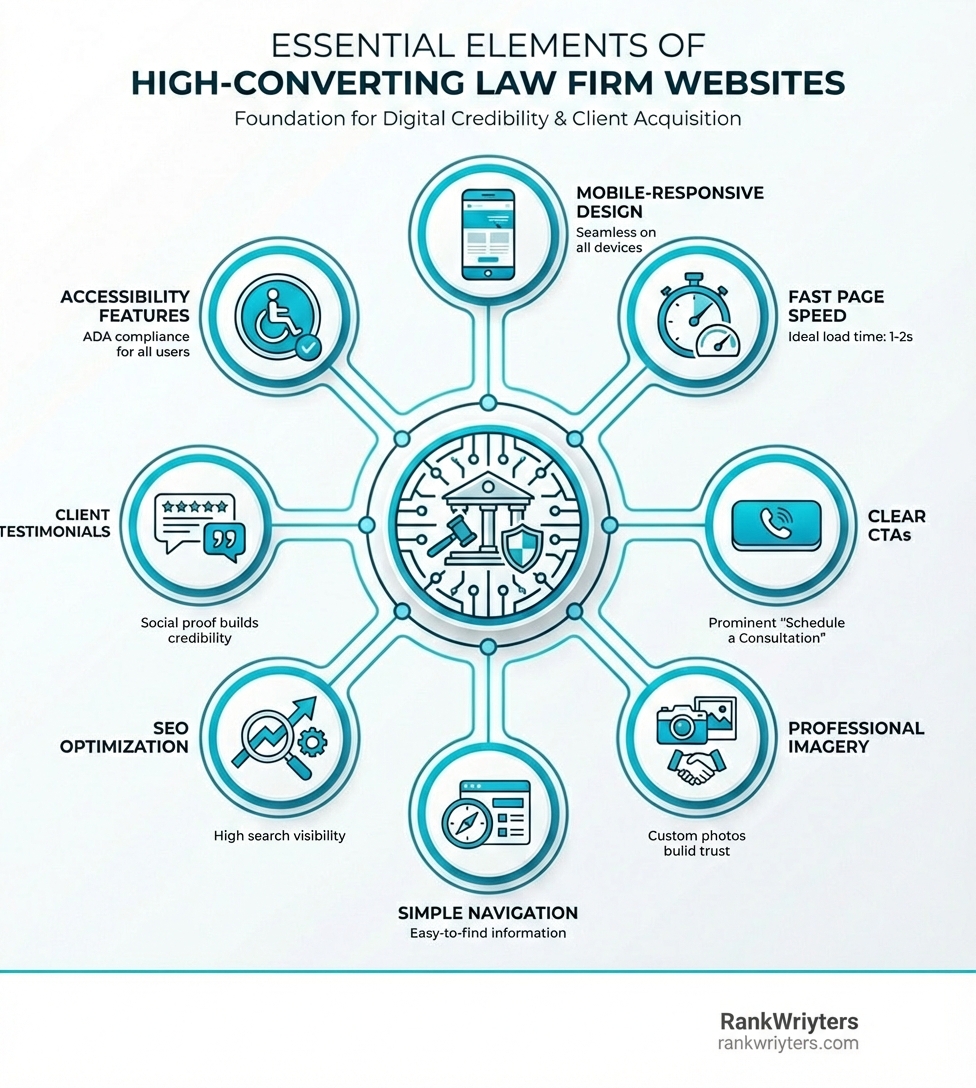
Web design for lawyers is the foundation of your digital presence and the primary way potential clients judge your firm’s credibility before ever picking up the phone. Here’s what effective law firm web design must include:
- Mobile-responsive design – Over half of all web traffic comes from mobile devices
- Clear calls-to-action (CTAs) – Prominent “Schedule a Consultation” or “Call Now” buttons
- Fast page speed – 1-2 seconds is ideal; slow sites lose clients immediately
- Professional imagery – Custom photos, not stock images, to build trust
- Simple navigation – Practice areas, attorney bios, and contact info easy to find
- SEO optimization – So the 96% of clients using search engines can find you
- Client testimonials – Social proof that builds credibility (95% of people are influenced by reviews)
- Accessible design – ADA compliance to reach all potential clients and avoid lawsuits
Think about the last time you searched for a professional online. You probably judged their credibility within seconds based on their website’s design. Your potential clients do the same thing. Research shows that nearly half of all website visitors view a website’s design as crucial for credibility. If your site looks outdated, loads slowly, or is hard to steer on mobile, you’re losing qualified leads to competitors before they even read about your practice areas.
The stakes are high. Law firm marketing is competitive, and 96% of potential clients use a search engine to find legal advice. Yet less than one-third of shoppers found it easy to get the information they needed from law firm websites. This gap represents a massive opportunity for firms that get web design right.
Your website isn’t just a digital brochure—it’s your 24/7 lead generation engine. When designed strategically, it guides stressed, overwhelmed people through their legal crisis to the point where they trust you enough to reach out. When designed poorly, it sends them straight to your competitor’s contact form.
I’m Brandie Young, a Fractional CMO and GTM strategist with experience in legal marketing, including developing effective web design for lawyers that converts visitors into clients. Through my work with law firms, I’ve seen how the right website design can transform a practice’s client acquisition and revenue.
The Foundations of a High-Converting Law Firm Website
A law firm’s website is far more than just an online business card; it’s a critical tool for client acquisition and building trust. The design choices we make directly impact how potential clients perceive our firm and whether they choose to engage our services. At the heart of effective web design for lawyers lies a focus on user experience (UX), building trust and credibility, and ensuring technical performance.
User experience (UX) plays a pivotal role in ensuring our website effectively attracts and converts clients. When potential clients land on our site, they are often in a state of distress or urgency, seeking clear and concise answers to their legal problems. If our website is confusing, slow, or difficult to steer, they’ll likely “bounce” to a competitor. Statistics reveal that at least 42% of people view seamless browsing as a top expectation, highlighting the need for an intuitive and frustration-free experience. A customer-centric and accessible law firm website design generates new business and contributes to our firm’s growth over time.
Building trust and credibility starts the moment a visitor lands on our page. A professional, well-organized website instantly conveys competence and reliability. This is further reinforced by elements like professional imagery, transparent practice area descriptions, and compelling attorney bios. We want our website to serve as a virtual handshake, reassuring visitors that they’ve found a capable and trustworthy legal partner. As the research indicates, nearly half of all website visitors view a website’s design as crucial for credibility.
Mobile-first design isn’t just a trend; it’s a necessity. With more than half of all web traffic coming from mobile devices, our website must perform flawlessly on smartphones and tablets. Google actively uses mobile-friendliness as a key signal for ranking, meaning a non-responsive site will struggle to appear in search results, regardless of how good it looks on a desktop.
Page speed is another non-negotiable aspect of a high-converting law firm website. We’ve all experienced the frustration of a slow-loading page, and potential clients are no different. One to two seconds is an ideal loading time to keep a lead’s attention. Slow pages not only drive clients away but also reduce our chances of ranking high in search engines. Google specifically advises businesses to consider mobile site speed as a growth driver, emphasizing its impact on attracting and retaining clients. To ensure our site is fast, we need to optimize images, minimize code, and choose a reliable web host.
Finally, professional imagery is paramount. While stock photos might seem like an easy solution, they often make our firm appear generic or untrustworthy. Instead, we should invest in custom, high-quality photographs of our team, office, and even local landmarks in Pennsylvania. This authenticity helps build a genuine connection with potential clients, showcasing our firm’s unique identity.
A well-designed website acts as our firm’s digital storefront, working 24/7 to attract and convert clients. We provide More info about our SEO Services for Attorneys to help you further optimize your online presence.
Key Elements of Effective Web Design for Lawyers
When we talk about the essential elements of a law firm website design, we’re focusing on features that guide visitors, instill confidence, and encourage them to take the next step. It’s about making it easy for them to find what they need and trust us with their legal concerns.
- Simple Navigation: Potential clients seeking legal help are often in a stressful situation. Complicated navigation is a surefire way to send them straight to a competitor. Our website’s menu should be clear, intuitive, and use easily understandable labels like “Practice Areas,” “Our Team,” “Client Reviews,” and “Contact Us.” If our navigation is too complicated, they’ll just bounce and call the next attorney they can find.
- Prominent Contact Information: This is non-negotiable. Our phone number should be visible on every page, ideally in the header, and easy to spot. The vast majority of our leads will want to call us on the phone to discuss their case.
- Click-to-Call Phone Numbers: We need to make our phone numbers clickable on mobile devices. This simple HTML trick means that when a user taps our number, it’s automatically entered into their dial pad, allowing them to place a call with just one click. This frictionless experience is crucial for converting mobile users.
- Attorney Bios: Our “About Us” or “Our Team” pages are opportunities to showcase our attorneys’ expertise, experience, and personalities. These bios should go beyond just credentials, offering a glimpse into what makes each attorney unique. This builds rapport and helps clients connect with us on a human level.
- Practice Area Pages: Clearly outlining our practice areas is essential. We should use both legal terminology and everyday language to describe the services we offer, such as “Family Law” (divorce, child custody) or “Personal Injury” (car accidents, slip and fall). Each practice area should have its own dedicated page with relevant information, case examples, and calls-to-action. This helps potential clients quickly determine if our firm can handle their specific needs.
- Client Testimonials and Reviews: Social proof is incredibly powerful. As the research shows, 95% of people are influenced by reviews! Featuring prominent client testimonials and reviews on our site builds trust and demonstrates our track record of success. We’ll dive into the ethical considerations for these later, but strategically placed, well-managed testimonials are invaluable.
Beyond these elements, we also pay attention to details like typography. Choosing The best fonts for law firms can subtly improve readability and professionalism.
Optimizing for Mobile and User Experience (UX)
In today’s digital landscape, optimizing our law firm’s website for mobile devices and ensuring an exceptional user experience (UX) isn’t just a best practice—it’s a fundamental requirement for success.
Responsive design means our website automatically adjusts its layout and content to fit any screen size, whether it’s a desktop monitor, a tablet, or a smartphone. This ensures a consistent and seamless browsing experience for all visitors. With more than half of all web traffic coming from mobile, a non-responsive site is effectively invisible to a huge segment of potential clients.
Google understands this shift, which is why Google uses mobile-friendliness as one of the key signals for ranking in search results on any platform. This means even if our analytics show more desktop users, improving our site’s mobile experience will boost our overall search visibility. A slow mobile experience drives clients away, while a fast one attracts and keeps them.
To achieve optimal performance, we must focus on fast mobile loading times. Large images, unoptimized code, and excessive scripts can all contribute to slow page speeds. We need to compress images, leverage browser caching, and ensure our hosting is robust. We can check our law firm website’s site speed with Google’s Test My Site tool.
User experience (UX) encompasses every interaction a client has with our website. It’s about making their journey as smooth and effective as possible. This means logical information architecture, clear calls-to-action, and easy-to-read content. A great way to prioritize UX is through usability testing. This involves asking real people to complete tasks on our website and observing their actions and reactions. For instance, we might ask them to find our contact information or a specific practice area. This feedback is invaluable for identifying pain points and making data-driven improvements.
Imagine a potential client, perhaps a young professional in Westmoreland County, Pennsylvania, searching for legal advice on their smartphone. A mobile-optimized site with fast loading times and an intuitive layout means they can quickly find our practice areas, read attorney bios, and easily click to call us. This frictionless experience helps convert a casual search into a valuable lead.
Content and SEO: The Engine for Client Attraction
Even the most beautiful website won’t attract clients if it’s not filled with compelling, client-focused content and optimized for search engines. This combination is the true engine for client attraction in legal marketing.
Our web design for lawyers must prioritize client-focused copywriting. This means writing for understanding and clarity, rather than using overly complex legal jargon. If it means using simpler words and shorter sentences, we go with it. It’s much better for our audience to be able to scan our writing and immediately get what we’re trying to say. Potential clients are often overwhelmed, so our content should address their pain points, answer their questions, and offer solutions. We need to put ourselves in their shoes: What are they feeling? What information do they desperately need? We have a comprehensive guide on Content for Lawyer Websites that digs deeper into this.
Clarity and simplicity are paramount. While we are legal experts, our website content should avoid making our visitors feel like they need a law degree to understand us. The goal is to inform and reassure, not to impress with legal complexity.
Showcasing expertise is achieved not just by listing our credentials but by demonstrating our knowledge through helpful, informative content. This can include blog posts, articles, and detailed explanations of legal processes relevant to our practice areas in Pennsylvania. By providing valuable resources, we position ourselves as trusted authorities.
Finally, while we can’t guarantee outcomes, strategically presenting case results (where ethically permissible and with appropriate disclaimers) can powerfully illustrate our firm’s capabilities and success. This provides tangible evidence of our ability to help clients achieve positive outcomes.
SEO Basics for Law Firm Websites
Search Engine Optimization (SEO) is the process of optimizing a website so it gets more traffic from search engines like Google, Yahoo, and Bing. For law firms, SEO is crucial because 96% of potential clients use a search engine to find legal advice. Without a strong SEO strategy, our beautifully designed website might as well be invisible.
Here are the basic steps to implement SEO for our law firm’s website:
- Keyword Research: We need to understand what terms potential clients are typing into search engines when they’re looking for legal help. This involves identifying relevant keywords related to our practice areas (e.g., “personal injury lawyer Westmoreland County,” “divorce attorney Greensburg PA”). We then incorporate these keywords naturally into our website content. We offer A Complete Guide to SEO for Law Firms for more in-depth knowledge.
- On-Page SEO: This refers to optimizing individual web pages to rank higher and earn more relevant traffic in search engines. Key elements include:
- Header Tags (H1, H2, H3, etc.): These aren’t just for making text bigger; they create a content hierarchy that signals the importance of information to both users and search engines. A well-structured page with clear header tags is easier to read and understand.
- Meta Descriptions: These short snippets appear under our page title in search results. While not a direct ranking factor, a compelling meta description can significantly improve click-through rates.
- Content Quality and Freshness: Google prioritizes content that is helpful, accurate, and up-to-date. Regularly updating our content and adding new, valuable articles keeps our site fresh and relevant.
- Local SEO: For law firms, local SEO is incredibly important. Many clients search for attorneys in their immediate geographic area. This involves optimizing our website and online presence for local search queries. A critical component of local SEO is setting up and optimizing our Google My Business for Law Firms profile, ensuring our firm appears prominently in local map results.
By implementing these SEO basics, we ensure that our law firm’s website is not just a pretty face but a powerful tool for attracting qualified leads right here in Pennsylvania.
Ethical and Effective Use of Testimonials
Client testimonials and reviews are incredibly valuable for building trust and credibility with potential clients. After all, 95% of people are influenced by reviews! They act as powerful social proof, reassuring new visitors that our firm has a track record of successful outcomes and satisfied clients. However, as legal professionals, we must steer the ethical landscape surrounding testimonials carefully.
The American Bar Association (ABA) and state bar associations, like those in Pennsylvania, have specific rules regarding attorney advertising and client communications. Rule 7.1 of the ABA rules on communications succinctly prohibits lawyers from making false or misleading statements. This extends to testimonials.
Here are best practices for ethically and effectively using testimonials:
- Obtain Explicit Permission: Always get written consent from clients before publishing their testimonials. This protects their privacy and ensures compliance.
- Ensure Authenticity: Testimonials must be genuine. We should never fabricate reviews or incentivize clients to provide overly positive (and potentially misleading) feedback. The Federal Trade Commission (FTC) also has guidelines on featuring online customer reviews, emphasizing transparency.
- Use Appropriate Disclaimers: It’s crucial to include disclaimers, such as “Past results do not guarantee future outcomes” or “Every case is unique, and results will vary.” This manages expectations and adheres to ethical advertising standards in Pennsylvania.
- Avoid Implying Specialization Without Certification: While testimonials can highlight our expertise, we must be careful not to imply specialization in a field of law without requisite certification, authorization, or accreditation, as outlined in ABA Rule 7.2.
- Focus on Service, Not Just Results: Encourage clients to comment on the quality of our service, our communication, and their overall experience, rather than solely on the financial outcome of their case.
- Integrate Naturally: Testimonials can be featured on our homepage, practice area pages, and attorney bios. Video testimonials can be particularly impactful.
By adhering to these guidelines, we can leverage the power of client testimonials to build trust and credibility, turning positive past experiences into future client acquisitions.
DIY vs. Professional Web Design for Lawyers: A Strategic Comparison
When it comes to creating or revamping a law firm website, one of the first big decisions we face is whether to take the do-it-yourself (DIY) route or hire a professional web designer. This choice hinges on several factors: our budget, the time we can invest, our technical skill level, our customization needs, and our long-term goals for the website. Understanding the pros and cons of each approach is crucial. We have a dedicated guide on DIY SEO vs. Hiring an Agency: Pros and Cons for Law Firms that can offer further insights.
Below is a side-by-side comparison of common options for web design for lawyers.
| Feature | DIY Website Builders & Templates | Professional Design |
|---|---|---|
| Cost | Lower initial cost, usually a monthly subscription or one-time template fee. | Higher upfront investment, often a project-based fee or ongoing retainer. |
| Time | Requires significant time from you or your staff to build, customize, and troubleshoot. | Requires far less of your time because an agency or freelancer manages the process. |
| Customization | Limited by the template structure and platform features, which can lead to a generic look. | Highly custom design custom to your firm’s brand, goals, and practice areas. |
| SEO | Basic SEO tools are usually included, but advanced optimization needs additional expertise. | Planned and built with SEO best practices, including technical SEO and a keyword strategy. |
| Maintenance | You handle updates, security patches, and any technical issues as they arise. | Maintenance, security, and updates are often bundled into a service package or retainer. |