


Why Legal Content is Your Firm’s Most Powerful Client Magnet
Legal content writing is the strategic creation of informative articles, blog posts, and web pages that help law firms attract potential clients, demonstrate expertise, and rank higher in search results. It transforms complex legal concepts into accessible content that answers client questions while building trust and authority.
Quick Answer: What Legal Content Writing Does for Your Firm
- Attracts Clients: Captures the 90% of people who search for attorneys online
- Builds Trust: Establishes your expertise before prospects ever call
- Saves Money: Generates organic leads without the high cost-per-click of paid ads
- Creates Assets: Produces evergreen content that works for you 24/7
- Increases Visibility: Helps you rank for keywords potential clients actually search
With over 1.3 million attorneys in the U.S., your firm faces fierce competition. The legal industry consistently ranks among the top five for highest average cost-per-click in search advertising, with the average CPC in Google Ads reaching nearly $7 in 2023. Meanwhile, 48.6% of people research their legal issues online before hiring a lawyer.
This creates a critical challenge: How do you stand out and capture attention without burning through your marketing budget?
The answer is legal content writing. When done right, it becomes your firm’s most cost-effective client acquisition engine. Quality content doesn’t just improve search rankings—it builds the trust and credibility that turn website visitors into paying clients. It answers questions, demonstrates your expertise, and positions your firm as the obvious choice when someone needs legal help.
But creating content that drives results requires more than just writing blog posts. You need a strategic approach that balances what potential clients are searching for with what search engines reward. You need content that speaks to real human challenges while establishing your legal authority.
I’m Brandie Young, and I’ve spent years helping legal professionals develop effective content strategies through my work as a Fractional CMO and GTM strategist with deep expertise in legal content writing. I understand the unique challenges law firms face in digital marketing, and I’ve seen how the right content strategy can transform a firm’s online presence.
What is Legal Content Writing?
At its core, legal content writing is crafting written materials about legal topics. But it’s far more nuanced than simply putting words on a page. For law firms, it’s a powerful marketing tool designed to engage audiences, convert prospects, and build enduring relationships. Unlike technical legal drafting (like briefs or contracts), marketing-focused content simplifies complex legal concepts for a general audience, making them understandable and relatable.
It’s about bridging the gap between human challenges and legal support. When someone faces a legal issue—whether it’s a family matter, a personal injury, or a business dispute—they’re often stressed, confused, and seeking answers. Our content helps address those pain points, offering clarity and demonstrating that we understand their situation. This is how we showcase our expertise, not through jargon, but by providing valuable, accessible information that answers their most pressing questions.
Think of it as proactive client service. We’re not just waiting for the phone to ring; we’re providing helpful resources that resonate with potential clients, often long before they even realize they need a lawyer. This strategic approach to What is SEO Content Writing? ensures that when they do need legal representation, your firm is already a trusted resource.
The High Cost of Invisibility
If you’re not online, you’re practically invisible. An astounding 90% of people search for attorneys online. This means your potential clients are actively looking for solutions, and if your firm isn’t showing up in those searches, you’re missing out on a massive opportunity.
Many firms still rely heavily on paid advertising, but the cost-per-click in the legal sector is notoriously high. While paid ads offer immediate visibility, they stop delivering results the moment your budget runs out. Organic content, on the other hand, is a long-term investment. It’s about building digital assets that continue to attract leads and drive traffic long after they’re published. This is the fundamental difference between SEO vs. PPC: Pros, Cons, and Differences. SEO-driven content creates a sustainable pipeline of qualified leads, offering a better return on investment over time.
Beyond initial client acquisition, strategic content also fosters client loyalty and generates referrals. By consistently providing valuable information, you reinforce your firm’s reputation as a knowledgeable and trustworthy partner. Clients who feel informed and supported are more likely to return for future legal needs and recommend your services to others. It’s about cultivating relationships, not just closing cases.
Building Your Blueprint: Crafting a Winning Legal Content Strategy

A winning legal content strategy is like a blueprint for a house; without strategic planning and clear goals, your efforts will likely fall flat. Our approach to SEO Content Strategy involves a systematic process to ensure every piece of content serves a purpose.
We start by defining your firm’s objectives, whether it’s increasing leads for a practice area, establishing thought leadership, or improving online visibility. Once goals are clear, we map out a content plan with topic clusters and pillar pages. These foundational pages cover a broad topic comprehensively, linking to more specific articles (clusters). This structure helps users steer your site and signals your authority to search engines, boosting rankings. You can learn more by exploring Pillar Content.
A critical step is competitive analysis. We analyze what your competitors are doing to find their strengths, weaknesses, and content gaps. This helps us uncover opportunities for your firm to differentiate itself and capture market share. Understanding How to Analyze Competitive Attorney Keywords is key to finding these openings.
Step 1: Identify and Understand Your Target Audience
Who are you trying to reach? Effective content speaks directly to specific individuals, not “everyone.” That’s why we create detailed client personas. These are profiles of your ideal clients, covering their pain points, motivations, goals, and online search habits.
Understanding search intent is paramount. Are they looking for a quick answer, doing in-depth research, or ready to hire? Our 5 Steps to Match Content to Potential Client Search Intent guide you through this. Since 48.6% of people research legal issues online before hiring a lawyer, your content must meet them at every stage of their journey. By understanding their demographics and decision-making process, we can tailor content that truly resonates.
Step 2: Master Keyword Research and Topic Ideation
Once we know who we’re talking to, we need to figure out what they’re asking. This is where keyword research comes in. It’s not just about finding popular search terms; it’s about uncovering the specific questions your potential clients are typing into Google. We look for a mix of keyword types:
- Head terms: Broad, high-volume terms (e.g., “personal injury lawyer”).
- Long-tail keywords: More specific phrases that indicate higher intent (e.g., “what to do after a car accident in Westmoreland County”).
- Local keywords: Terms that include geographic modifiers, crucial for attracting clients in Pennsylvania or specifically Westmoreland County (e.g., “divorce attorney Greensburg PA”).
Understanding Why is Keyword Research Important? is the foundation of a successful content strategy. We also stay updated on legal news and trends to generate fresh content ideas. Legal updates, recent court decisions, or changes in local ordinances can all be excellent fodder for timely and relevant content. For more inspiration, check out our guide on Content Ideas for Law Firm Blogs.
Step 3: Plan Your Content Calendar
Consistency is key in content marketing. A sporadic publishing schedule sends mixed signals to your audience and search engines. We help firms develop a realistic publishing schedule they can commit to. Whether it’s one in-depth article a month or a weekly series of shorter posts, the goal is a steady flow of valuable content.
Our strategy often includes content repurposing. A comprehensive blog post can be broken down into social media snippets, turned into an infographic, or expanded into an e-book. This maximizes the reach and impact of your efforts. Learn how to Create Consistent Content Production Machine by making the most of your existing assets. We also explore diverse content formats, ensuring we’re reaching clients where they are. Setting realistic production goals is crucial for long-term success.
The Art of Persuasion: Best Practices for Effective Legal Content Writing

When it comes to legal content writing, persuasion isn’t about manipulation; it’s about earning trust and demonstrating competence. Google demands high standards for legal topics, which fall under its “Your Money or Your Life” (YMYL) category. For YMYL content, Google emphasizes E-E-A-T: Experience, Expertise, Authoritativeness, and Trustworthiness. Our content embodies these principles to satisfy Google’s Quality Rater Guidelines, which you can read directly from Google.
Building E-E-A-T and YMYL in SEO is essential for ranking well and establishing your firm as a thought leader. This means backing up facts with experience, citing credible sources, and presenting a consistent brand voice. We also implement rigorous Fact-Checking Steps for Attorney SEO Content to ensure accuracy and compliance with ethical guidelines.
Write in Clear, Client-Friendly Language
Most people don’t want to decipher legalese; they want answers. Our goal in legal content writing is to translate complex legal concepts into clear, client-friendly language. This means avoiding jargon or explaining it simply when unavoidable. We often say, “If your grandmother can’t understand it, it’s too complicated.”
Empathy is a powerful tool. People seeking legal help are often going through difficult times. Our content should acknowledge their situation and speak to their concerns directly. Storytelling can make legal topics more engaging. Instead of just stating a fact, illustrate it with a relatable (and anonymized) example. Most people don’t read online content one word at a time; they scan. So, readability is paramount: use short paragraphs, bullet points, and clear headings.
Here are a few common legal terms, explained simply:
- Plaintiff: The person or party who starts a lawsuit.
- Defendant: The person or entity being sued or accused in a lawsuit.
- Findy: The pre-trial process where both sides exchange information and evidence.
- Statute of Limitations: A law setting the maximum time after an event to initiate legal proceedings. Missing the deadline can mean losing the right to sue.
- Contingency Fee: A fee arrangement where the lawyer is paid a percentage of the settlement or award. If the case is lost, the client typically doesn’t pay the lawyer’s fee.
Essential On-Page SEO for Legal Content Writing
Even the most brilliant legal content won’t help if no one can find it. That’s where on-page SEO comes in. These are optimizations made directly on your website pages to help them rank higher in search results.
Key elements include:
- Title Tags: The clickable headline in search results. It should be compelling and include your primary keyword.
- Meta Descriptions: The short summary beneath the title tag in search results that encourages clicks. For best practices, see our guide on Meta Descriptions Best Practices.
- Header Tags (H1, H2, H3, etc.): These structure your content, making it easier for readers and search engines to understand. Your H1 is your main topic, while H2s and H3s are subtopics. Learn more about On-Page SEO: Meta Tags.
- Internal Linking: Linking to other relevant pages on your website helps search engines find your content and passes authority between pages.
- Image Optimization: Using relevant, high-quality images with descriptive alt text improves accessibility and SEO.
- Local SEO: For firms in Pennsylvania, especially in Westmoreland County, local SEO is critical. This involves using location-specific keywords (e.g., “Westmoreland County family lawyer”), creating content about local laws, and optimizing your Google Business Profile. Our Local SEO Services for Law Firms are designed to help you dominate local searches.
Diversify Your Content Formats
While blog posts are a cornerstone of legal content writing, diversifying your content formats helps you reach a broader audience and cater to different learning styles. We recommend exploring:
- Blog Posts: The workhorse of content marketing. Regular, informative articles that answer common questions. Our Legal Blog Writing Service can keep your firm consistently publishing.
- Practice Area Pages: Detailed, evergreen content on your website explaining your specific legal services. These are crucial for conversions.
- Case Studies: Showcase your firm’s successes (anonymized, of course) to demonstrate your capabilities and build trust. See how a Case Study: Local Law Firm Doubles Organic Traffic through strategic content.
- Videos: Short explainer videos, Q&A sessions, or client testimonials can be incredibly engaging.
- Infographics: Visually appealing summaries of complex legal processes or statistics.
- Ebooks/Guides: Longer-form content that provides comprehensive information on a legal topic, often used as lead magnets. An Attorney Ebook for Consultation can be a powerful tool for lead generation.
The Role of AI in Modern Legal Content Writing
AI tools have made waves in content creation, and we’re often asked about their role in legal content writing. We view AI as a powerful tool to assist in research, outlining, and drafting. It can speed up parts of the process, but it’s not a replacement for human expertise, especially in a nuanced field like law.
AI lacks the human experience, empathy, and critical judgment necessary for effective legal content. We maintain human oversight, rigorous fact-checking, and careful editing to ensure accuracy, avoid plagiarism, and maintain your firm’s unique voice. Google’s stance is clear: quality and helpfulness are paramount. In fact, Google’s algorithmic updates in March 2024 targeted unoriginal, low-quality content, much of which was likely AI-generated without proper human oversight.
The impact of AI search (AEO) on organic traffic for law firms is a developing area. We explore this further in How Will AI Search Impact Traffic for Injury Attorneys?. Our approach combines AI’s efficiency with the irreplaceable touch of human legal expertise, ensuring your content is optimized, valuable, and trustworthy.
Amplifying Your Voice: Promotion, Tracking, and Outsourcing
Creating stellar content is half the battle; the other is ensuring people see it. Your articles won’t help if they’re just gathering digital dust. We use a multi-channel approach to content promotion to ensure your firm’s voice reaches its target audience.
Key content promotion channels include:
- Social Media: Platforms like LinkedIn and Facebook are excellent for sharing insights and engaging with potential clients.
- Email Marketing: An email list allows you to nurture leads and share content directly with subscribers. Check out our 10 Email Marketing Tips for Content Distribution.
- Online Forums & Communities: Engaging in relevant online discussions (e.g., Reddit) and linking to your helpful content can drive traffic and establish authority.
- Guest Posting: Writing for other reputable legal websites or industry publications can expand your reach and earn valuable backlinks. Be sure to avoid common pitfalls by reviewing 7 Guest Posting Mistakes to Avoid.
Tracking Performance and Measuring ROI
How do you know if your legal content writing is working? By tracking performance and measuring your return on investment (ROI). We believe in data, not guesswork. Key metrics we monitor include:
- Website Traffic: How many people visit your site and where they come from.
- Engagement Metrics: How long visitors stay and if they interact with your content.
- Conversion Rates: Are visitors taking desired actions, like filling out a contact form?
- Keyword Rankings: Is your content ranking for target keywords?
- Lead Quality: Are the leads generated through content high-quality prospects?
Tools like Google Analytics 4 are indispensable. We configure How to Measure ROI with Google Analytics 4 to track specific goals, providing clear insights into what’s working. Effective SEO for Lead Generation relies on precise conversion tracking to attribute leads directly to your content.
When to Hire a Professional Legal Content Writer
You’re a lawyer, not a full-time marketer. Your time is best spent serving clients. However, legal content writing is a demanding process that requires specialized skills. This leads to a critical question: handle it in-house or hire a professional?
Hiring a professional makes sense when you face:
- Time Constraints: Your team is already stretched thin and can’t consistently produce high-quality content.
- Lack of Expertise: You’re legal experts, but content marketing and SEO have their own intricacies. A professional understands how to appeal to both humans and search engines.
- Scaling Content Production: As your firm grows, an agency can scale production to meet demand without overwhelming your internal resources.
We’ve explored the pros and cons of DIY SEO vs. Hiring an Agency: Pros and Cons for Law Firms. When evaluating a legal copywriter, look for someone with a sound grasp of legal concepts, the ability to write clearly for a lay audience, strong SEO knowledge, and an ethical approach.
Here’s a quick comparison:
| Feature | DIY Legal Content Writing | Hiring a Professional Service (like RankWriters) |
|---|---|---|
| Time Investment | High – requires significant time from attorneys or staff | Low for your team – we handle the heavy lifting |
| Expertise | Legal expertise is high, but marketing/SEO expertise may be low | High legal understanding combined with advanced marketing/SEO expertise |
| Quality | Varies – can be excellent if time/skill allows, but often inconsistent | Consistently high-quality, SEO-optimized, and professionally written |
| Scalability | Limited by internal resources and capacity | Highly scalable – we can produce content at the volume you need |
| Cost | Hidden costs of attorney/staff time, potential missed opportunities | Transparent pricing, often a better ROI due to specialized results |
| Results | Potentially good, but often slower and less predictable | Faster, more consistent, and measurable results |
Frequently Asked Questions about Legal Content Writing
How do you make complex legal topics engaging for a non-legal audience?
We make complex legal topics engaging through empathy and clarity. We use storytelling and relatable examples to connect legal concepts to real-world scenarios your potential clients might face. Instead of just stating a law, we explain why it matters to them in Pennsylvania. We break down information using clear headings, bullet points, and short paragraphs. Most importantly, we avoid or simply explain legal jargon. The goal is to inform and empower, not confuse.
What is a realistic publishing frequency for a law firm blog?
For most law firms, consistency is more important than quantity. A realistic schedule is one you can maintain without sacrificing quality. We often recommend starting with 1-2 high-quality, well-researched blog posts per month. This allows you to produce valuable content without overwhelming your resources. As your firm grows, you can scale up your efforts. A consistent monthly or bi-weekly schedule is more effective than sporadic content bursts.
How does legal content writing help with local SEO?
Legal content writing is a secret weapon for local SEO, especially for firms in areas like Westmoreland County, Pennsylvania. We strategically use location-specific keywords like “divorce attorney in Greensburg PA.” We also create content addressing local laws and news relevant to your service areas. This signals to search engines that your firm is highly relevant to local queries. We also help optimize your Google My Business for Law Firms profile and earn local citations, which boosts local search rankings and attracts nearby clients.
Conclusion: Transform Your Expertise into Your Greatest Asset
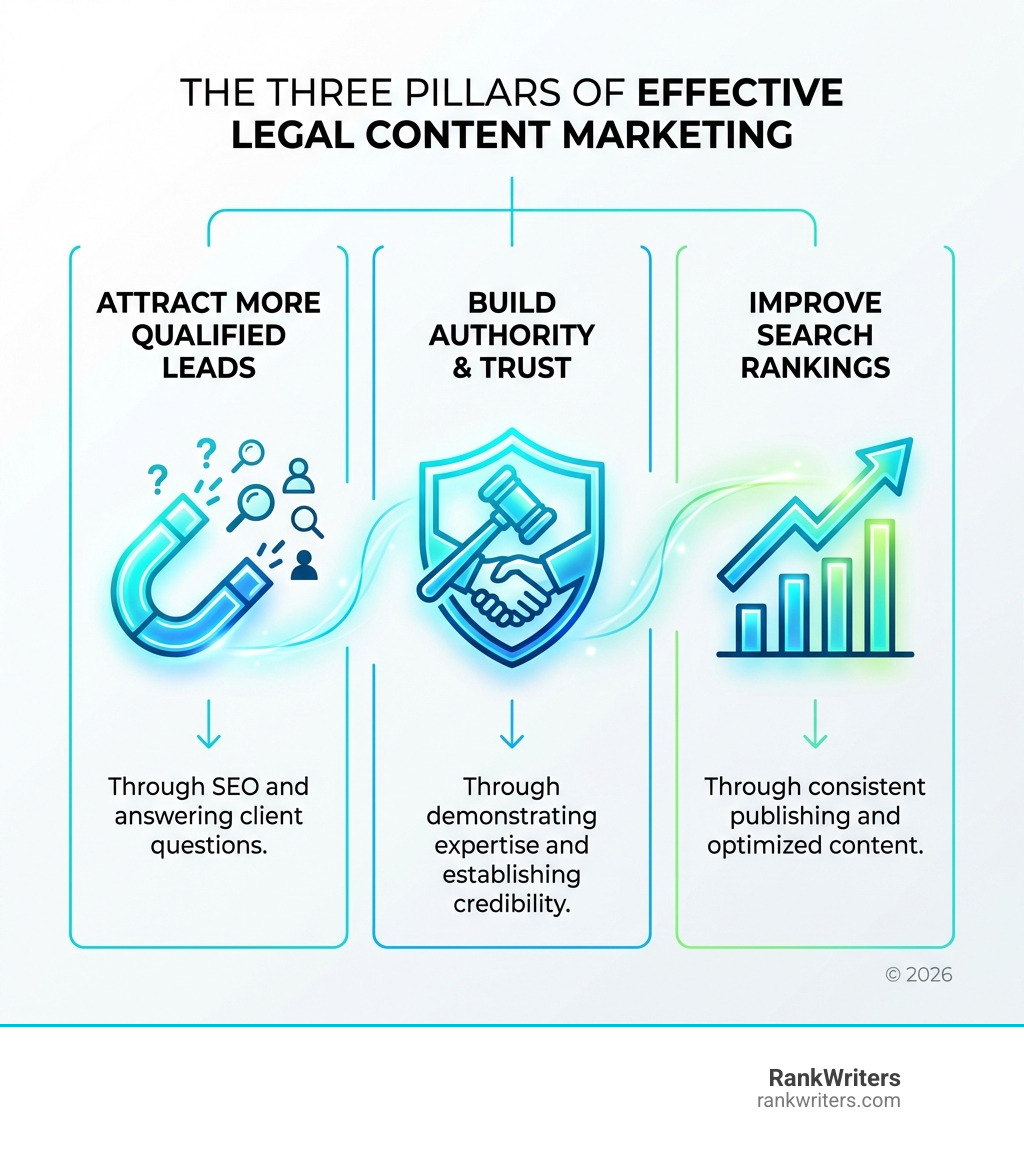
In a crowded legal landscape, legal content writing is essential. This strategic investment transforms your firm’s expertise into a powerful client magnet, building trust, establishing authority, and driving consistent growth. Effective content improves online visibility, attracts qualified leads, and nurtures client relationships more cost-effectively than traditional advertising.
Think of your content as a long-term asset, working 24/7 to educate, inform, and persuade potential clients. The future of legal marketing is about empowering those seeking help, and your content is the vehicle for that empowerment.
At RankWriters, we help law firms in the United States, including Pennsylvania and Westmoreland County, harness the power of strategic content. Our systematic, future-proof approach combines traditional SEO with advanced AI Search (AEO) and Geo-Optimized Search (GEO) strategies. This ensures your firm ranks high today and thrives in tomorrow’s evolving search landscape.
Don’t let your expertise remain hidden. Take the next step to grow your firm and connect with the clients who need you most. Learn more about our comprehensive SEO for Law Firms services and let us help you open up your full potential.