
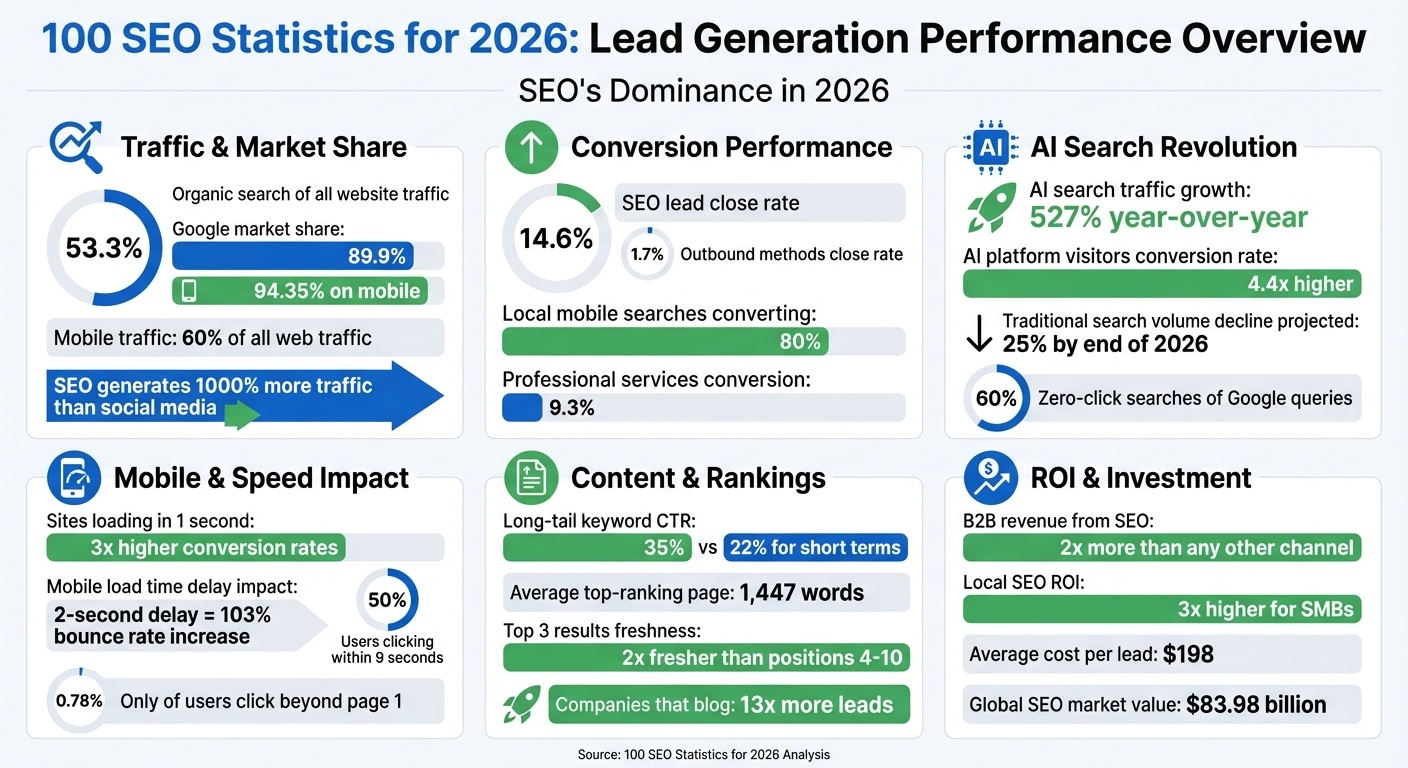
Fresh SEO Statistics for 2026. Organic search is still the top traffic driver in 2026, accounting for 53.3% of all trackable website visits. For B2B companies, it generates twice as much revenue as any other marketing channel. SEO leads convert at a rate of 14.6%, significantly outperforming outbound methods like cold-calling (1.7%). AI-powered search is reshaping the landscape, with visitors from AI platforms being 4.4x more likely to convert.
Key insights include:
- Google dominates search: 89.9% market share globally, 94.35% on mobile.
- Mobile-first approach: 60% of web traffic comes from mobile devices.
- Local SEO matters: 80% of local searches on mobile lead to conversions.
- AI search growth: Traffic from AI platforms surged 527% year-over-year in 2025.
- Content optimization is critical: Long-tail keywords and updated content rank higher.
SEO strategies must now account for both traditional search engines and AI-driven tools to maximize visibility and conversions.
SEO Lead Generation Statistics 2026: Key Performance Metrics
1. Search Visibility & Market Trends
Search trends play a major role in driving leads. While AI is reshaping how people discover information, traditional search engines still dominate. The following 17 statistics for 2026 illustrate the changing dynamics of search visibility and its impact on lead generation:
- Organic search accounts for 46.98% of website traffic. This marks a 3.65% drop from 2025, but it remains the top source of traffic [5].
- Between 68% and 93% of online experiences start with a search engine, proving its importance in attracting leads [11][12].
- Google processes over 8.5 billion searches daily, or about 99,000 searches every second. This highlights the massive scale of search activity [11][7].
- Google dominates with 89.9% of the global search market and handles between 94.35% and 95.13% of mobile searches, making it a key player for lead generation [11][7].
- 60% of searches now end without a click, thanks to AI-driven instant answers, pushing businesses to rethink how they capture leads [7].
- 15% of daily searches are entirely new, offering businesses a chance to attract early-stage leads [7][12].
- Traditional search volume is projected to decline by 25% by the end of the year as users increasingly turn to AI-powered discovery tools [7][14].
- Searches on AI platforms have exploded, with AI search traffic up 527% year-over-year. Tools like ChatGPT, Perplexity, and Google’s AI Mode are leading this surge [2].
- Mobile devices generate 60% of web traffic, and 58% of Google searches come from mobile users. Additionally, 92.3% of people access the web via mobile [7][12][13].
- Half of searchers click within 9 seconds, and 25% within just 5 seconds, making quick visibility essential [5].
- Only 0.78% of users click beyond the first page of search results, underscoring the importance of securing top rankings [7].
- A staggering 94% of webpages get no traffic from Google, emphasizing the need for strong, strategic optimization [5].
- Organic results dominate, capturing 94% of all clicks. The top organic result is 19 times more likely to be clicked than the top paid ad [11].
- SEO generates over 1000% more traffic than social media, proving its power to drive significant visitor numbers [7].
- 71% of B2B buyers begin their product research with a search engine, reinforcing the importance of search visibility in B2B lead generation [12].
- 57.6% of SEO professionals report growing competition from AI tools, making advanced strategies essential to stand out [5][11].
- The global SEO market is valued at $83.98 billion, reflecting the heavy investment in search visibility and optimization [11].
These numbers paint a clear picture of how search behaviors are evolving and highlight the need for businesses to adapt their strategies to stay competitive.
2. Content Performance & Rankings
Ranking well today means understanding the dual demands of search engines and AI-driven platforms. The data below sheds light on how factors like keyword choice, content length, freshness, and technical optimization affect rankings and drive leads in 2026.
Long-tail keywords – phrases with four or more words – have become a major force in search behavior. Around 70% of searches now include more than three words, and these detailed queries boast a 35% click-through rate, compared to just 22% for shorter terms [7]. This is crucial for lead generation since users typing in specific phrases often have a clear intent. Additionally, 68% of the terms that trigger AI Overviews are low-volume queries (fewer than 100 monthly searches), emphasizing the growing importance of niche-focused content [2].
But it’s not just about keywords – content depth matters, too. The average top-ranking Google page contains 1,447 words [7], though the ideal word count varies by industry (see table below). AI-generated content is now present on 86.5% of top-ranking pages. However, only 1.74% of new pages make it into the top 10 within a year, a sharp drop from 5.7% in 2017 [10].
Freshness is another key factor. The top three search results tend to be nearly twice as fresh as those ranking in positions 4–10. AI search platforms, in particular, prioritize content that’s 25.7% fresher than traditional organic results [10]. In fact, 72% of top-ranking pages have been updated in the past year. AI-generated content is making waves here, too – two-thirds of it ranks within two months of being published, and 17.3% of Google’s top 20 results now feature AI-generated content, up from just 2.3% in 2020 [2][5].
Technical optimizations also play a big role in boosting click-through rates (CTR) and capturing leads. Titles with 40 to 60 characters perform best, while URLs that include target keywords see a 45% higher CTR compared to those that don’t [5]. Blogging remains a powerhouse for lead generation – companies that blog see 13 times more leads and ROI compared to those that don’t [15]. Businesses using AI to scale content production create 42% more content each month, averaging 17 articles instead of 12. That said, 97% of these companies still manually edit AI outputs before publishing [5][10].
| Industry | Avg. Word Count (Top 5) | Recommended Refresh Frequency |
|---|---|---|
| Healthcare | ~2,200 | Every 6–9 months |
| Finance | ~2,000 | Every 9–12 months |
| Legal | ~1,900 | Every 12–15 months |
| SaaS | ~1,800 | Every 8–10 months |
| Manufacturing | ~1,600 | Every 14–18 months |
| Ecommerce | ~1,200 | Every 6–8 months |
3. Mobile & User Experience Metrics
Mobile is at the heart of SEO in 2026. With mobile devices accounting for 62.73% of global website traffic [5], it’s clear that smartphones dominate how people browse the web. In fact, 92.3% of all internet users access the web via their smartphones, and 51% of users rely exclusively on mobile devices [7][3]. For businesses focused on lead generation, delivering a strong mobile experience isn’t optional – it’s critical.
Speed matters more than ever. If your mobile site takes longer than 3 seconds to load, you risk losing 53% of your visitors. A mere 2-second delay can increase bounce rates by 103%, and every additional second cuts conversions by 7% [7]. On the flip side, fast-loading sites win big: websites that load in just 1 second see 3x higher conversion rates compared to those taking 5 seconds [3]. Faster speeds mean more leads, making mobile optimization a must.
Yet, many websites still struggle. As of November 2025, only 54.6% of websites met Core Web Vitals standards, leaving nearly half of sites delivering less-than-ideal mobile experiences [5]. On average, mobile pages take 87.84% longer to load compared to desktop [1]. For businesses that prioritize mobile speed, the rewards are clear – a faster site can lead to a 32% drop in bounce rates [7].
But speed isn’t the only factor shaping mobile user engagement. Changing search habits are also playing a big role. For instance, 36% of users now rely on visual search tools like Google Lens, which handles over 20 billion searches monthly, including 4 billion shopping-related queries [7][4][16]. Voice search is also growing, making up 20% of all queries, while 87% of smartphone owners use search daily [7][4].
When it comes to click-through rates, the first organic mobile listing gets 6.74%, slightly lower than desktop’s 8.17% [16]. However, with 58% of all Google searches happening on smartphones, the potential for leads remains high [7]. In the U.S., Google dominates mobile search with a 95% market share [4]. Among younger audiences, mobile is even more prominent – 80% of Gen Z and 62% of Millennials use their phones as their primary search tool [4]. If your mobile experience isn’t fast, visually appealing, and optimized for search engine features, you’re leaving leads on the table.
sbb-itb-16c0a3c
4. Local SEO & Conversion Metrics
Local search turns online intent into real-world action. In 2026, a staggering 99% of consumers used the internet to find local business details[18], and 80% of local mobile searches led to a conversion[17]. Even more compelling, 76% of people searching for something nearby on their smartphones visited a related business within a day[19]. With 1.5 billion “near me” searches happening monthly[19], local SEO has become a game-changer for lead generation, especially for those aiming to dominate the competitive map pack.
The benefits of local visibility are massive. Businesses featured in the Local Map Pack see a 126% boost in traffic and 93% higher engagement rates[21]. Nearly half – 42% – of local searchers click on Map Pack results[22], while the first organic position grabs 39.8% of clicks[22]. For small and medium-sized businesses, the return on investment is undeniable: local SEO delivers three times the ROI compared to other strategies[7], with an average cost per lead of just $31, far below the B2B average of $200[9].
Online reviews play a pivotal role in local conversions. A star rating below 4.0 deters 78% of consumers from considering a business[21], while a single one-star improvement can increase calls and clicks by 44%[21]. Adding 10 new reviews can lift a Google Business Profile‘s conversion rate by 2.8%[21]. Businesses that respond to over 30% of their reviews double their lead volume[7], and for every 25% increase in review responses, the conversion rate improves by 4.1%[21]. On average, a verified Google Business Profile garners 200 clicks or interactions monthly[18]. While reviews drive engagement, accurate business information builds trust.
Accuracy in local data is critical for success. Sixty-two percent of consumers avoid businesses with incorrect details – like outdated hours or wrong addresses – online[18]. Google’s “Openness” signal now prioritizes businesses that are currently open for immediate-need searches, often hiding those that are closed[20]. Despite this, 58% of businesses still neglect local optimization[21], leaving a wide-open opportunity for those that do. With 40.16% of local queries now triggering Google’s AI Overviews[18] and 58% of consumers using voice search to find nearby businesses[18], keeping information accurate and updated across platforms is more important than ever.
AI-driven search is transforming local discovery. Visitors from AI-powered searches often bring higher conversion value, showing up to 4.4x greater worth compared to traditional traffic[2], alongside a 27% lower bounce rate on retail sites[2]. Local search now extends beyond search engines to platforms like social media, where search traffic grew fivefold in 2025[22]. For businesses focused on local SEO, the numbers speak for themselves: 88% of local searches result in a phone call or physical visit within 24 hours[7], making local search one of the quickest paths to turning interest into action.
5. Organic Traffic & Lead Generation Impact
Organic search continues to dominate as the leading source of website traffic, accounting for 46.98% of all global web visits[5]. But its true strength lies in its ability to convert: nearly 49% of marketing professionals rank organic search as the most effective long-term channel for lead generation ROI[23]. These stats highlight how organic traffic fuels conversions across industries.
Conversion rates, however, vary widely depending on the sector. For instance, professional services boast an impressive 9.3% conversion rate[24], while industries like government administration (4.92%), public relations (4.66%), and nonprofits (4.62%) also perform well[8]. On the other hand, B2B technology and real estate see lower rates, around 1.7%, emphasizing the need for tailored approaches[24]. The type of content also plays a role: white papers convert at 4.6%, case studies at 3.5%, and landing pages at 3.1%[5]. Without specific optimization, the average visitor-to-lead conversion rate hovers around 2–3%[23], but thought leadership SEO campaigns can deliver a staggering 748% ROI[4].
Organic traffic isn’t just effective – it’s cost-efficient too. The average cost per lead across industries is approximately $198[23], though this varies significantly. For example, IT & services see costs as high as $369.88, healthcare at $285.82, and financial services at $271.54, while nonprofits enjoy a much lower $43.36[23]. Content marketing further amplifies efficiency, generating 3x more leads than traditional outbound methods while costing 62% less[24]. Local SEO also delivers a 3x higher ROI for small and medium-sized businesses[7]. Additionally, organic results outperform paid search, receiving 19x more clicks than top paid ads[1].
Emerging trends, like AI-driven search, are reshaping how organic traffic impacts lead generation. AI-powered visitors deliver 4.4x higher conversion value for organic leads[2]. Retail sites, for example, see a 27% lower bounce rate and 38% longer session durations from AI referral traffic[2]. Meanwhile, zero-click searches now account for over 58% of Google queries[4], making it crucial for brands to optimize for featured snippets and AI Overviews. Being cited in these areas can boost click-through rates from 0.6% to 1.08%[2].
Timing is another critical factor. Following up within five minutes increases the likelihood of conversion by 9x, yet 80% of leads never convert[8][23][24]. On average, it takes 64.5 days to convert a lead[8]. Long-tail keywords also play a pivotal role, generating 1.76x more clicks than single-word queries[1]. Additionally, 70% of marketers report that leads are arriving later in the buying process because of AI tools used for initial research[6]. By 2026, 37% of marketers expect leads to be significantly more informed[6]. This shift underscores that organic traffic isn’t just about quantity – it’s about drawing in the right audience at the right time.
6. AI & Answer Engine Optimization Trends
Search is undergoing a major transformation. According to Gartner, traditional search engine usage is expected to decline by 25% by 2026 as more users turn to generative AI-powered answer engines [4]. AI search traffic has skyrocketed, showing a 527% year-over-year increase by late 2025 [2]. AI Overviews – those instant summaries and snippets – now attract over 2 billion users monthly [2]. These trends highlight the growing dominance of zero-click searches, where users get their answers directly from AI summaries without needing to visit a website [2].
User habits are also shifting dramatically. When an AI summary appears, only 8% of users click on a traditional organic link, and 26% of such searches end without any further action [2]. Additionally, 80% of users rely on AI summaries for at least 40% of their searches, while 35% of Gen Z in the U.S. primarily use AI chatbots to find information [2]. By 2026, AI Overviews are expected to feature in nearly half (47%) of all search results, and 17.3% of Google’s top-ranked content will be AI-generated [4][2]. These changes are redefining how people interact with search platforms.
For marketers, this evolution opens new doors. Visitors coming from AI search platforms are 4.4 times more likely to convert compared to those from traditional organic search [2]. AI-referred traffic also boasts a 27% lower bounce rate and a 38% longer session duration on retail websites [2]. Being cited as a source in an AI Overview can significantly increase click-through rates, from 0.6% to 1.08%. However, it’s worth noting that 70% of users only read the first third of these overviews, making early citations crucial [2].
This shift in behavior has led to the rise of Generative Engine Optimization (GEO), a new approach to search optimization. GEO focuses on securing mentions and citations within AI-generated responses [7]. Interestingly, even as AI usage grows, over 80% of users remain skeptical of AI-generated answers and prefer human-verified content to build trust [2].
To stay relevant, content strategies are evolving. AI engines prioritize content that’s structured for easy extraction, such as direct answer blocks, schema markup, and modular sections with clear headings. Long-tail, conversational queries often trigger AI Overviews, so content should aim to provide precise answers to specific questions [2]. Experts suggest that while AI enhances clarity, it doesn’t create it. Marketers are also targeting micro-intents and using user-generated content from platforms like Reddit and Quora to ensure their material is credible and easily citable by AI systems.
While traditional organic search still drives the majority of web traffic, these AI-driven trends demand a shift in strategy. The goal is no longer just ranking higher but becoming a trusted source that AI engines consistently reference. This approach will be key to capturing leads and maximizing opportunities in 2026.
Conclusion
SEO remains a dominant force for generating top-tier leads in 2026, even as the search landscape evolves in unexpected ways. Organic search continues to lead the pack, driving 53.3% of all website traffic, delivering 1,000% more visitors than organic social media, and producing double the revenue for B2B companies compared to any other marketing channel [3][4]. Plus, SEO leads boast a 14.6% close rate, far outpacing the 1.7% seen with traditional outbound methods [3].
Emerging AI trends are adding new layers to this already powerful tool. While Gartner predicts a 25% drop in traditional search volume [4], the quality of traffic coming from AI-powered search platforms is impressive. Visitors from these platforms are 4.4 times more likely to convert, with bounce rates 27% lower and session durations 38% longer than those from traditional organic search [2]. The key question for businesses isn’t whether to invest in SEO – it’s how to refine strategies to capture both traditional rankings and AI-driven citations.
To thrive in 2026, a data-focused strategy is essential. Sites with faster load times – just 1 second – see conversion rates three times higher than those with 5-second load times [3]. Local SEO remains a reliable driver of quick, transactional results, while content optimized for both traditional and AI search requires schema markup, clear headings, and direct answer blocks to stand out.
As these trends intersect, the global SEO market is on track to hit $143.9 billion by 2030 [5], showcasing the channel’s resilience amid technological shifts. Nearly 70% of companies report better ROI when incorporating AI into their SEO efforts [2][5]. By balancing AI visibility with traditional rankings, prioritizing conversions, and creating content verified by human expertise, marketers can position themselves for success. This ongoing evolution highlights the need for flexible, integrated SEO strategies that adapt to the changing digital landscape.
FAQs
How is AI-driven search reshaping SEO strategies in 2026?
AI-powered search engines are shaking up SEO strategies by emphasizing accurate answers, credible sources, and well-structured, real-time content instead of the old-school focus on keywords. These advanced systems aim to provide precise, context-aware results, which means brands need to adjust their approach. It’s now all about making content easy for AI to find, ensuring it’s trustworthy, and keeping it current.
To keep up, businesses should prioritize content that directly answers user questions, uses structured data, and comes from authoritative sources. This shift calls for an active effort to keep content relevant and visible in a world where search engines are becoming smarter every day.
Why is mobile optimization important for generating leads?
Mobile optimization plays a key role in generating leads because it directly impacts both search visibility and user experience. With a staggering 60% of global web traffic coming from mobile devices, businesses that focus on creating mobile-friendly websites are in a better position to attract and keep visitors engaged. Plus, mobile searches often result in higher conversion rates, making it a powerful tool for bringing in quality leads.
Another benefit of mobile optimization is its ability to improve click-through rates (CTR). Given that a large portion of mobile searches lead to no clicks, having a site that’s fast, responsive, and simple to navigate on a mobile device can make all the difference. By addressing these factors, businesses can grab user attention more effectively and maximize their lead generation potential.
Why is local SEO important for businesses in 2026?
In 2026, local SEO is crucial because people increasingly turn to the internet to find businesses near them. In fact, having a verified Google Business Profile can generate approximately 200 interactions per month. That’s 200 chances to build trust, connect with potential customers, and increase foot traffic to your business.
If your goal is to attract local customers, optimizing for local search helps your business stand out. It ensures your business appears in front of people actively searching for the products or services you offer in their area. In today’s digital-first world, local SEO isn’t just helpful – it’s a major factor in driving growth and engaging with your community.