


Why Law Firm Blog Writing Is Your Secret Weapon for Client Acquisition
Law firm blog writing is a powerful tool for attracting new clients, establishing thought leadership, and building a strong digital presence.
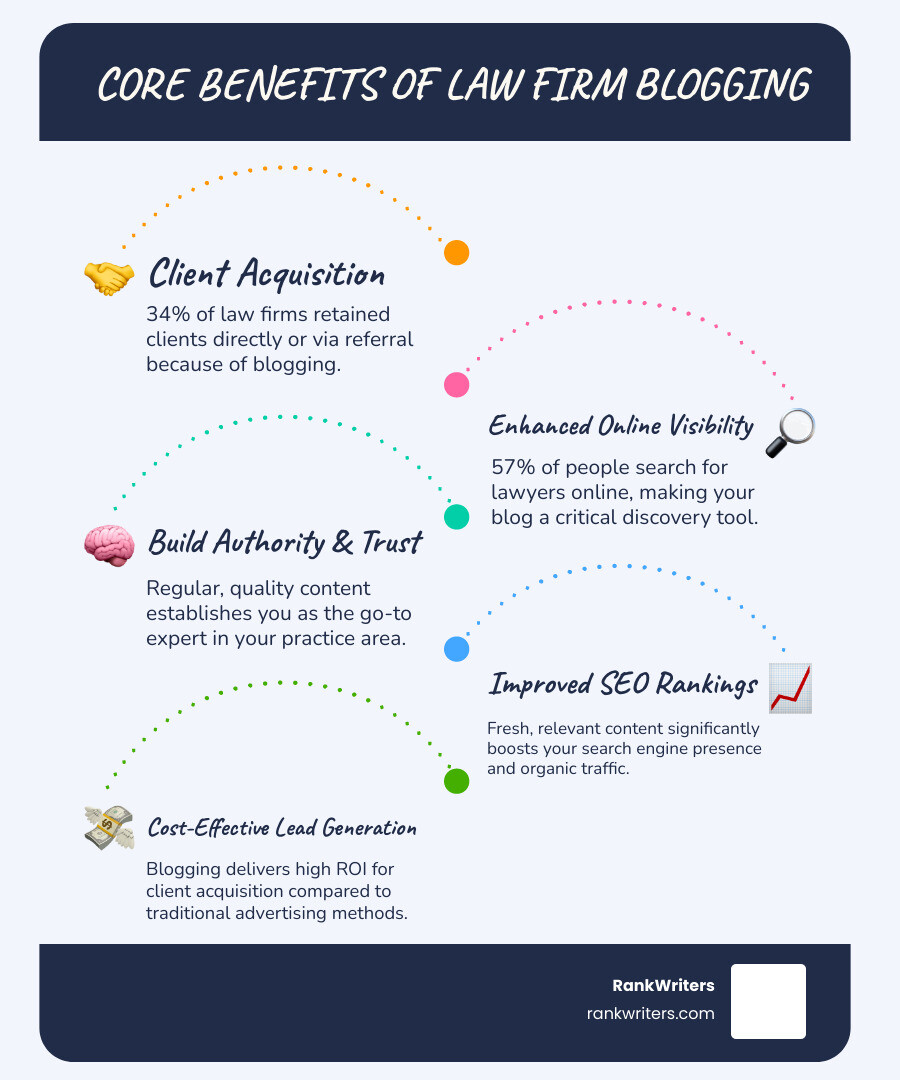
Core Benefits of Law Firm Blogging:
- Client Acquisition: 34% of law firms have retained clients directly or via referral because of blogging.
- Online Visibility: 57% of people search on their own for a lawyer, making your blog a critical findy tool.
- Authority Building: Regular, quality content establishes you as the go-to expert in your practice area.
- SEO Performance: Fresh, relevant content significantly improves your search engine rankings.
- Cost-Effective Marketing: Blogging delivers high ROI compared to traditional advertising.
Getting Started:
- Focus on client questions and pain points.
- Choose a niche (practice area or geographic focus).
- Prioritize quality over keyword stuffing.
- Publish consistently (weekly or bi-weekly).
- Make content scannable with headings and short paragraphs.
Many law firms struggle with blogging. They write sporadically, use too much legal jargon, or create content that doesn’t address what potential clients want to know. The result is a dormant blog that generates zero leads while competitors dominate search results.
When done right, a law firm blog becomes a client-generation engine that works for you 24/7. It builds trust before prospects pick up the phone, answers the questions keeping them up at night, and positions you as the obvious choice when they’re ready to hire.
The key is understanding that legal blog writing is different from legal writing. You’re not drafting briefs; you’re having a conversation with someone who needs help and is trying to determine if you’re the right person to provide it. This means cutting the legalese, getting straight to the point, and being helpful.
This guide covers the exact strategies successful law firms use to turn their blogs into lead-generation machines, from choosing topics to measuring results. For more foundational strategies, check out our guide on SEO for Law Firms.
I’m Brandie Young, and I’ve helped law firms build content strategies that drive results through strategic law firm blog writing that balances client needs with search optimization. Let’s get into the specifics.
The “Why”: Unpacking the Core Benefits of a Law Firm Blog
Your law firm’s website is more than an online billboard; it’s a dynamic platform for client engagement and practice growth. Law firm blog writing is the cornerstone of this digital marketing effort.

A well-maintained blog significantly improves your search engine optimization (SEO) rankings. Google favors websites that regularly publish fresh, relevant content. Each blog post is an opportunity to target keywords potential clients are searching for, making your firm easier to find online. This increased visibility translates to more website traffic, which is critical since 57% of people search for a lawyer on their own.
Beyond visibility, blogging builds credibility and establishes authority. By consistently sharing insightful information, you position your firm as a trusted voice. This is vital as younger clients are particularly concerned with a law firm’s online presence. A blog allows you to demonstrate your expertise and understanding of current trends, which can also lead to valuable lawyer-to-lawyer referrals.
The ultimate goal is client acquisition. Professionally written blogs increase potential clients by educating your audience, explaining legal concepts, and offering real-world advice. This helps prospects understand their need for legal representation and see your firm as the solution. In fact, 34% of law firms report retaining clients due to their blogging efforts. It’s a cost-effective marketing strategy with a high ROI, necessary for firms aiming for organic growth. For a deeper dive, explore our guide on Content Marketing for Law Firms.
Finding Your Voice and Standing Out
In a crowded legal market, simply listing services isn’t enough. Your blog is a powerful storytelling platform to connect with clients on a deeper level. By telling your firm’s story, you humanize your brand and create a relatable identity. This means aligning your firm’s values with your niche, showcasing your culture, and featuring your employees. When you “show, don’t tell,” you back up claims of experience with evidence. For instance, instead of just saying “we’re experienced,” highlight a recent success (while respecting confidentiality).
Maintaining brand consistency across your blog is also crucial. Your tone, logo, formatting, and images should all reflect your firm’s identity, building trust and recognition. By providing well-researched, fresh content and making your attorney bios shine with unique achievements, you continually establish credibility. Storytelling is powerful; research shows that the story behind a service can significantly increase its perceived value. Allowing your personality to shine through creates an authentic connection that distinguishes your firm. To learn how a focused approach can amplify your message, read about how Niche Marketing Boosts SEO Attorneys.
From Clicks to Clients: The ROI of Blogging
Law firm blog writing delivers a strong return on investment (ROI). We see law firms consistently achieve improved SEO, better communication, and increased search-driven traffic. But how is this success measured?
We track key metrics like website traffic, engagement, and, most importantly, conversion rates—the number of inquiries generated from blog content. Tools like Google Analytics and Google Search Console are indispensable for understanding user interaction, traffic sources, and which keywords bring people to your site.
Beyond direct conversions, your blog is a powerful lead generation tool. Valuable content encourages prospects to trade their contact information for deeper insights (like downloading a guide), allowing you to nurture them through email campaigns. This systematic approach transforms readers into qualified leads and, eventually, clients. By regularly analyzing performance, we refine the content strategy to focus on what works best to drive consultations and grow your firm. For a comprehensive look at budgeting, explore How Much Should Your Law Firm Marketing Budget Be?.
Laying the Foundation: Strategy, Niche, and Quality
A solid strategy is paramount for effective law firm blog writing. The goal is to write content that resonates with your ideal client and positions your firm as the expert solution.
Start by defining your target audience and understanding their needs. Creating “buyer personas”—detailed profiles of your ideal clients—can guide your content creation. For example, a family law firm needs a softer tone than a corporate law firm, whose content might be more formal.
Choosing a niche is a critical step. As legal blogging expert Kevin O’Keefe emphasizes, start a “niche publication.” Broad practice areas can be too competitive. An ultra-niche focus, whether geographic (e.g., “Westmoreland County DUI Defense”) or within a practice area (e.g., “Pennsylvania Estate Planning for Small Business Owners”), allows you to become the authority. This ensures your content is highly relevant to a specific group, making it easier to dominate search results.
Finally, prioritize quality over SEO. While SEO is crucial, keyword stuffing without genuine value will backfire. Google prioritizes user-centric content; if your blog is helpful and engaging for readers, it will naturally perform better in search. Write for clients first, and SEO benefits will follow. For a complete understanding of how SEO fits into your strategy, review A Complete Guide to SEO for Law Firms.
Crafting Client-Focused Content: A Guide to Effective Law Firm Blog Writing
Successful law firm blog writing creates content that serves your clients. This means understanding their user intent—what they’re really looking for when they search. Your content should solve their problems and provide tangible value.
A challenge for lawyers is simplifying complex legal topics without “dumbing them down.” The key is to explain the essence of a legal concept in layman’s terms, avoiding excessive jargon. Translate complex ideas into accessible language. For example, instead of discussing res judicata, explain “what happens if you sue someone twice for the same thing?”
We also advocate a “show, don’t tell” approach. Instead of stating your firm offers “high-quality representation,” demonstrate it with testimonials, case results (where ethical), or examples of how your firm handled a tricky situation. This builds trust more effectively than empty claims. By focusing on the client’s perspective and answering their questions, you provide practical advice and position your firm as a helpful resource. For more insights, visit Content for Lawyer Websites.
Dominating Search with Practice Area-Specific Content
To dominate search results, we recommend a “10x content” strategy: creating content that is ten times better and more comprehensive than anything else ranking. While many firms write 500-word pages, we’ve found that articles of 2,000+ words often make a significant impact. The principle is to be the most thorough, authoritative resource available.
This approach involves creating comprehensive pillar pages—extensive guides that cover a broad topic in depth. We start by picking a key practice area, then conduct a thorough competitor analysis, examining the word count, depth, and media used by top-ranking firms. Our goal is to create content that is significantly more detailed and user-friendly.
We outline the content carefully, breaking it down into headlines and sub-topics to ensure complete coverage. We often recommend a single, long-form page rather than many short sub-pages to consolidate authority and improve user experience. This strategy turns your blog posts into invaluable resources that attract search engines and genuinely help potential clients. To master competitive keyword analysis, explore How to Analyze Competitive Attorney Keywords.
The Art of Persuasion: Best Practices for Law Firm Blog Writing
Effective law firm blog writing isn’t just about what you say, but how you say it. Content structure can dramatically impact reader engagement and retention.

Legal blog posts often fall into three main types:
- Case Law Breakdown: Analyzing recent court decisions and their implications.
- Evergreen Analysis: Explaining fundamental legal concepts that remain relevant.
- Future Forecast: Discussing upcoming legislative changes or legal trends.
A powerful technique is to “invert” your post by putting the conclusion at the beginning. For example, instead of building up to a new law’s impact, start with: “Here are three immediate actions your business needs to take due to the new Pennsylvania employment law.” This provides immediate value and encourages readers to dig into the details.
Crafting an effective headline is also paramount. It must be clear, specific, and compelling. Focus on what the reader will gain and who the content is for. While “power words” can add flair, clarity comes first. For instance, “3 Things Westmoreland County Employers Need to Know About the Supreme Court’s Vaccine Ruling to Avoid Liability” is far more effective than a generic title. For more on structuring compelling legal content, see How to Structure Lawyer Blog Posts for Content Marketing.
Lawyers can also join the conversation by engaging with current events in their niche. Keep an eye on relevant news and provide your firm’s commentary and insights to establish thought leadership and show awareness of issues impacting your clients.
Making Content Skimmable and Readable
Most people scan online content; they don’t read it word-for-word. “Walls of text” will lose readers quickly. Your goal is to make content easy to read, even for complex legal topics.
Subheadings are your best friend. They break down main points into digestible sections, guiding the reader. As a rule, we aim for sections no longer than 300-350 words. To make your post easy to read, organize it in easy-to-skim sections separated by subheads.
In addition, use short paragraphs (4-5 sentences), bullet points, and numbered lists to present information concisely. This improves readability and helps simplify sophisticated legal content. By avoiding long paragraphs and using clear language, we ensure your message is consumed effectively. Even your font choice can impact readability; consider our recommendations on The Best Fonts for Law Firms.
Avoiding Common Pitfalls in Law Firm Blog Writing
It’s easy to fall into common traps when writing legal blog posts. Avoiding these pitfalls is crucial for maintaining quality, credibility, and ethical standards.
- Lack of Focus: Covering too many topics or being too general confuses readers. Write on a single, specific topic for clarity.
- Inconsistent Tone: A fragmented marketing message can be disorienting. Maintain brand consistency in your voice.
- Giving Legal Advice: Your blog is for informational purposes only. Always include a disclaimer to manage expectations.
- Excessive Jargon: Getting “down in the legal weeds” with jargon and case citations alienates your audience. Simplify your language.
- Poor Proofreading: Misspellings and grammatical errors damage credibility. Always proofread carefully or use an editor.
- Outdated Content: Outdated information can mislead clients and harm SEO. Regularly update old posts and add a “last updated” note.
- Improper Sourcing: Never copy content in full. Summarize information, add your unique commentary, and always link to the original source to avoid copyright infringement and search engine penalties. For robust content, our Fact-Checking Steps for Attorney SEO Content are invaluable.
Amplifying Your Voice: Technology, Promotion, and Measurement
Creating great content is half the battle; ensuring it reaches your target audience and generates measurable results is the other half.
Choosing the right blog platform is foundational. WordPress is a popular choice for its comprehensive features, plugin ecosystem, and user-friendly backend, offering flexibility and scalability. Platforms designed specifically for legal professionals are also an option, often integrating with practice management software.
Incorporating video into your legal blog is also increasingly important. Users spend significant time watching videos online, and the trend is growing. Short explainer videos, client testimonials, or brief analyses of legal news can boost engagement and make complex topics more accessible.
Measuring your blog’s success is crucial for refining your strategy. We use tools like Google Analytics to track visitors, page views, bounce rates, and conversions. This data helps us understand what content resonates and how users interact with your site. Conversion tracking, such as monitoring form submissions or calls from blog posts, provides tangible proof of ROI. Regular performance reviews allow us to optimize your law firm blog writing for maximum impact. When considering these tasks, weigh the pros and cons of DIY SEO vs. Hiring an Agency: Pros and Cons for Law Firms.
Leveraging AI Tools and Upholding Ethical Standards
AI tools are effective assistants for law firm blog writing. We view AI as a “human-assisted” tool, not a replacement for human expertise and judgment.
AI can streamline content creation by brainstorming topic ideas, generating outlines, and assisting with drafting or editing for clarity and persuasiveness. The key is providing detailed, accurate prompts to guide the AI effectively.
However, using AI in legal content comes with significant ethical considerations. Accuracy is paramount; AI can “hallucinate” or provide incorrect information, so a human expert must verify every fact and legal reference. Plagiarism is another concern if AI draws too heavily from existing sources. We recommend disclosing AI use where appropriate and ensuring the final content reflects your firm’s unique voice. The ethical responsibility for the content ultimately rests with the law firm. For strategies on optimizing for the future of search, read How to Dominate in AI Search: A Guide for Attorneys.
The Power of a Clear Call to Action (CTA)
The ultimate goal of most law firm blog writing is to convert readers into clients. This requires a clear, compelling call to action (CTA) in every post to guide the reader on what to do next.
A strong CTA should be explicit and easy to find. Common examples include:
- “Contact us today for a free consultation.”
- “Call our office at [phone number] to discuss your case.”
- “Schedule an appointment online.”
- “Fill out our contact form for a confidential case evaluation.”
For lead generation, you might also use gated content as a CTA, such as “Download our free guide on [specific legal topic] for more in-depth information.” This captures contact information for nurturing prospects. Your website should serve as a demand generation tool, and a well-placed CTA is essential. Without a clear next step, even the most informative post is a dead end. To optimize your CTAs, check out our Top 5 Calls to Action for Attorneys.
Frequently Asked Questions about Law Firm Blogging
How often should a law firm post on its blog?
Consistency is key. While there’s no magic number, we recommend a manageable schedule, such as weekly or bi-weekly. The most important thing is to maintain that frequency. Quality always trumps quantity; one excellent post every two weeks is better than three mediocre ones each week. A content calendar can help you plan topics and deadlines, ensuring a steady stream of valuable content.
How long should a law firm blog post be?
The ideal length varies by topic and goals. For standard informative posts, we generally aim for 800-1,200 words. This allows for sufficient depth while remaining digestible. For pillar pages or comprehensive guides designed to dominate search results, we often recommend 2,000+ words. The principle is to fully answer the user’s query and provide comprehensive value.
Can I write the blog myself or should I hire a service?
The answer depends on your firm’s resources and goals. Writing your own blog provides an authentic voice but is incredibly time-consuming. Lawyers are legal experts, not necessarily content marketing or SEO experts. Time spent writing blog posts is time away from billable work.
Hiring a specialized service, like ours, offers significant benefits. We handle planning, keyword research, content creation, SEO optimization, and promotion, allowing you to focus on practicing law. This often leads to higher-quality content, better SEO performance, and a stronger ROI. Many lawyers find outsourcing content creation is a more efficient and effective strategy for growing their firm. For a deeper dive, consider our Legal Blog Writing Service.
Conclusion: Turn Your Blog into a Client-Generation Engine
We’ve covered a lot of ground, from the undeniable benefits of law firm blog writing to the intricate details of crafting compelling, client-focused content. The strategies we’ve discussed — niche selection, quality over quantity, client-first writing, structural best practices, ethical AI use, and clear calls to action — are not just theoretical ideas. They are proven methods that transform your blog from a static online presence into a dynamic, client-generating engine.
Your law firm’s blog is a long-term asset, continually building authority, trust, and visibility for your practice. It’s how you answer questions before they’re asked, establish credibility before the first consultation, and ultimately, connect with the clients who need your expertise most.
At RankWriters, we specialize in helping law firms in Pennsylvania and across the United States implement these very strategies. Our systematic, future-proof approach combines SEO, AI Search Optimization (AEO), and Google Entity Optimization (GEO) to ensure your content not only ranks but also converts. We understand the nuances of legal content and how to position your firm as the go-to authority.
The future of legal marketing is here, and it’s driven by high-quality, strategically optimized content. Are you ready to take the next step and harness the full power of your law firm’s blog?
Explore how our specialized SEO services can lift your firm’s online presence and drive consistent inbound leads: https://rankwriters.com/seo-for-law-firms/.