
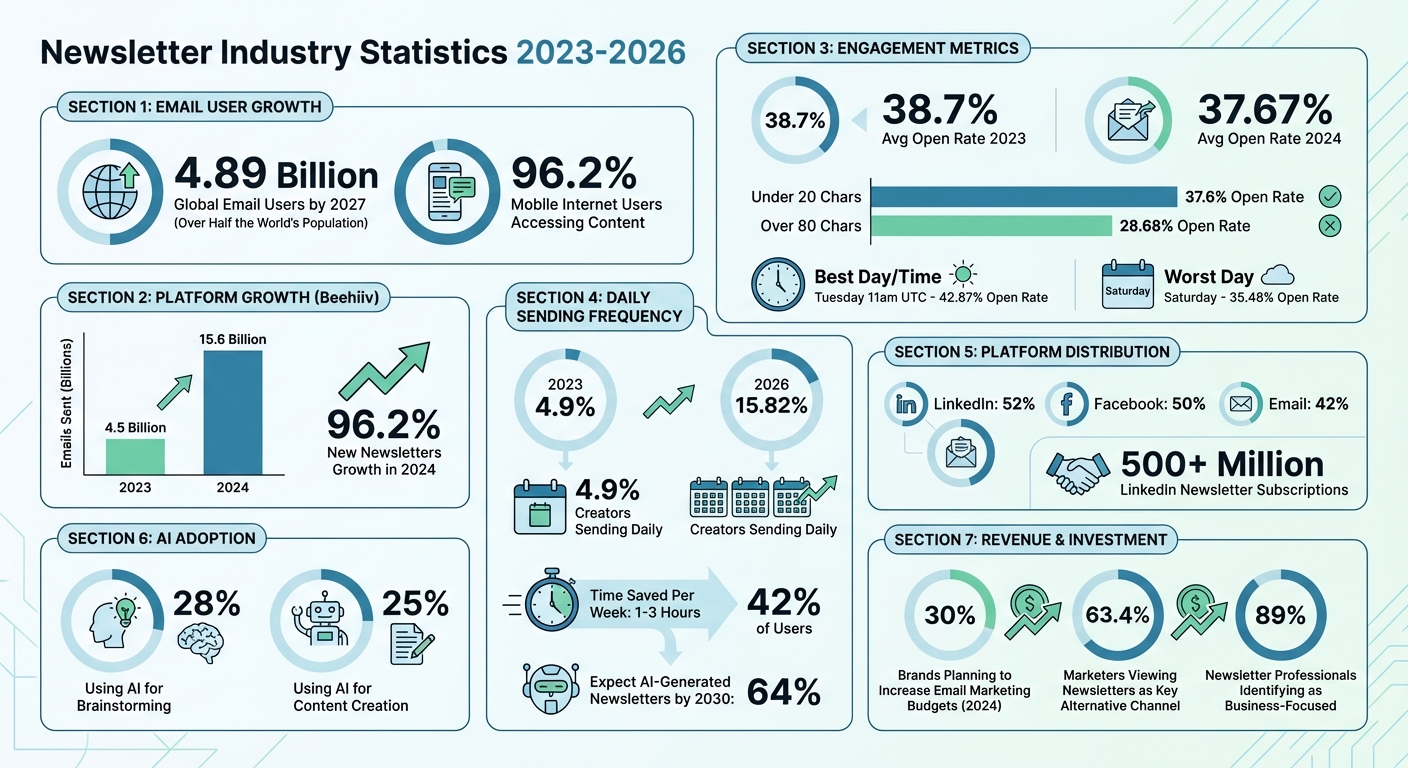
Marketing newsletters aren’t dead – they’re thriving. In fact, despite predictions of decline due to AI, short-form video, and social media dominance, marketing newsletters have proven to be one of the most reliable tools for creators and brands. By 2025, global email users reached 4.89 billion, and platforms like beehiiv sent 15.6 billion emails in 2024, up from 4.5 billion in 2023. With average open rates at 37.67%, email engagement continues to outperform social media.
Key Takeaways:
- Email remains a core channel, with marketing newsletters evolving into multi-platform ecosystems (LinkedIn, Facebook, and web-based publishing).
- AI tools help streamline newsletter creation and improve personalization, saving creators time and boosting engagement.
- Revenue opportunities include paid subscriptions, sponsorships, affiliate marketing, and premium content, with some newsletters earning six-figure revenues in months.
- Personalized, opinion-based content is outperforming generic updates, as readers value connection and trust.
Marketing newsletters are no longer just email – they’re now dynamic content hubs driving growth and engagement across platforms.
Newsletter Industry Statistics 2023-2026: Growth, Engagement & Revenue Trends
Are Marketing Newsletters Dead? Experts’ Predictions For 2026
sbb-itb-16c0a3c
Why Experts Predicted the Death of Newsletters
The doubts surrounding the future of marketing newsletters weren’t unfounded. In context, 2020 and 2024, the newsletter industry underwent massive changes, driven by several factors that made it seem like the medium was on its last legs. Platforms like Beehiiv and Substack made it easier than ever to launch marketing newsletters [4]. While this accessibility opened doors for many creators, it also saturated the market, sparking predictions of an inevitable collapse.
Too Many Emails, Not Enough Attention
The rapid increase in newsletters outpaced readers’ ability to keep up. Experts started referring to this phenomenon as a “newsletter bubble” [4]. By 2024, Beehiiv alone accounted for a staggering 15.6 billion emails sent [2]. With inboxes overflowing, the average open rate dropped from 38.7% in 2023 to 37.67% in 2024 [2].
“The golden age of newsletters is peaking and may already be on the decline. The reason is simple. There are too many of them.” – Alem Tedeneke, Media Lead, World Economic Forum [6]
To make matters worse, email providers like Google, Yahoo, and Apple introduced stricter filtering systems, shunting newsletters into Promotions tabs, where they were often ignored [4].
Social Media and Short-Form Content Took Over
As newsletters struggled to compete for inbox space, platforms like TikTok and Instagram Reels dominated attention with their addictive, algorithm-driven feeds [4]. In fact, this shift was particularly noticeable among younger demographics: 64% of Gen Z and 59% of Millennials now discover products through social media apps rather than email [7]. The passive act of scrolling replaced the active decision to open and engage with a newsletter.
AI Would Replace Written Content
The rise of AI added another layer of uncertainty. Tools like Microsoft Copilot and Google Gemini led to fears that newsletters would become obsolete. AI assistants could summarize content, making it unnecessary for readers to open individual newsletters at all [6]. Adam Ryan, Co-founder of WorkWeek, predicted a future where users would receive one summary email instead of multiple newsletters [4].
“We’re entering a world where audiences might ‘read’ your newsletter without opening it, because their AI already has.” – Alem Tedeneke, Media Lead, World Economic Forum [6]
If AI became the primary gatekeeper, it could spell disaster for newsletter creators. Open rates would plummet, ad clicks would vanish, and the direct connection between writers and their audiences could disappear altogether [4]. With 64% of newsletter professionals anticipating AI-generated newsletters by 2030 [1], and 55% foreseeing a significant drop in revenue generation [1], the outlook appeared grim.
Yet, despite these challenges, newsletters evolved in ways that no one predicted, paving the way for the thriving ecosystem we see today.
The State of Marketing Newsletters in 2026
The forecasts were off. Instead of fading into irrelevance, newsletters have evolved into dynamic, multi-faceted tools that thrive across platforms. By 2026, they’ve grown far beyond simple email updates, becoming multi-platform content ecosystems that meet audiences wherever they spend their time.
Marketing Newsletters Are No Longer Just Email
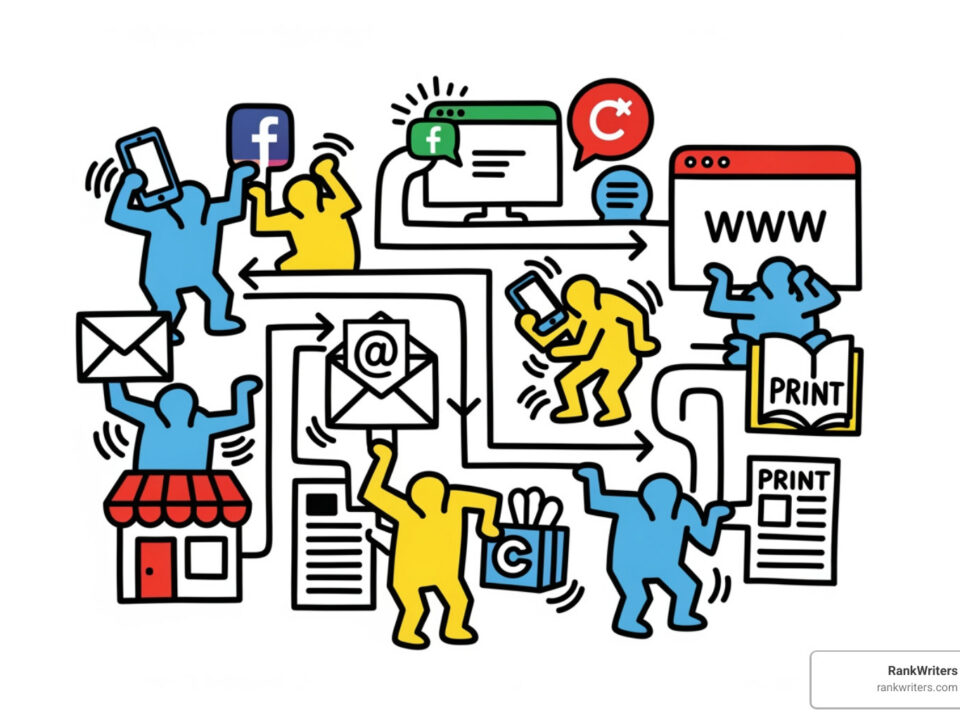
Newsletters now span emails, dedicated web pages, and even social media platforms. For instance, 52% of creators leverage LinkedIn, while 50% use Facebook, with email still holding strong at 42% [1].
LinkedIn’s newsletter feature has skyrocketed, hitting over 500 million subscriptions across the platform [6]. A standout example is M.M.LaFleur, a women’s workwear brand that launched “The M Dash” on LinkedIn in 2025, effectively engaging professional women where they’re already active [8]. This shift reflects what experts call the “Shopify-fication” of newsletters – tools like Beehiiv and Substack have made it easier for creators to manage everything from growth to ad revenue without needing custom tech setups [4].
“Beehiiv did for newsletters what Shopify did for e-commerce.” – Adam Ryan, Co-founder, WorkWeek [4]
Interestingly, newsletters are now targeting two distinct audiences: human readers and AI assistants like Microsoft Copilot or Google Gemini, which summarize content for users [6]. This dual strategy ensures newsletters remain indispensable, even as AI reshapes how people consume information.
Email Remains the Backbone of Engagement
While newsletters have expanded to other platforms, email continues to be the core driver of engagement. By 2027, the global number of email users is expected to hit 4.89 billion, accounting for over half the world’s population [2][5]. With an average open rate of 37.67%, email engagement far outpaces that of social media platforms [2].
Daily email sends are on the rise. In 2023, only 4.9% of creators sent daily newsletters, but by 2026, that figure jumped to 15.82% [2]. This growth highlights email’s reliability for building meaningful connections. People are more intentional about sharing their email addresses, making newsletters feel more personal and less fleeting than social media feeds [4].
“Email is still the most valuable place to have an audience.” – Matt McGarry, Founder, Newsletter Operator [4]
With 96.2% of global internet users accessing content on mobile devices [2], optimizing for smaller screens has become non-negotiable. Successful newsletters now feature larger font sizes (16+), generous white space, and concise subject lines under 20 characters to keep readers engaged on mobile. These adjustments are setting newsletters up for sustained growth in both subscribers and publisher investment.
Subscriber Growth and Increased Publisher Investment
The numbers tell a clear story: newsletters are thriving. Beehiiv saw a 96.2% jump in new newsletters in 2024 [2]. That same year, the platform sent 15.6 billion emails, a sharp rise from 4.5 billion in 2023 [2]. Meanwhile, 30% of brands planned to boost their email marketing budgets in 2024 [3].
Publishers are doubling down on newsletters, with platforms reporting robust growth in both creation and investment. The evidence is clear – newsletters aren’t fading away. They’re evolving, diversifying, and proving themselves as an essential tool for creators and brands alike.
6 Trends Redefining Marketing Newsletters in 2026
Newsletters continue to evolve as a powerful communication tool, adapting to new trends that shape their role in 2026. Here’s a closer look at six key shifts redefining how newsletters are created, shared, and monetized.
Trend 1: Expanding Beyond the Inbox
Newsletters are no longer confined to email. Creators are now distributing content across multiple platforms. For instance, 52% use LinkedIn, and 50% rely on Facebook, surpassing email’s 42% usage [1]. LinkedIn’s native newsletter feature alone boasts over 500 million subscriptions [6]. Meanwhile, platforms like Substack and Beehiiv have become vital for SEO and visibility, with 62% of professionals believing web-based publishing outperforms inbox-only strategies [1].
“Don’t be just a newsletter. Start with a newsletter. Be newsletter-first. But don’t be a newsletter-only.” – Matt McGarry, Founder, Newsletter Operator [4]
The winning formula combines visibility from platforms like LinkedIn and social media with the deeper engagement of email lists. This strategy acknowledges two audiences: human readers and AI tools like Microsoft Copilot or Google Gemini, which summarize content for users [6].
Trend 2: Evolving Content Formats
Newsletters now blend video, images, and audio to cater to diverse content preferences. Short-form video leads the way, favored by 53% of social and newsletter teams [8]. Carousels, ranking third at 14%, often outperform Reels in engagement [8]. Many platforms even offer AI-generated audio versions, enabling subscribers to listen on the go with minimal effort [2].
The design of newsletters is also shifting. Formats like “Smart Brevity” make content easily skimmable for both readers and AI tools. Subject lines under 20 characters see the highest open rates at 37.6%, compared to 28.68% for those over 80 characters [2]. Mobile-friendly layouts with larger fonts and more white space are becoming standard.
Interactive features are now commonplace. In-email polls and surveys allow direct engagement, while onboarding surveys collect data at sign-up to tailor content [2]. For example, Alex Pattis and Zachary Ginsburg, co-founders of Last Money In, generated $500,000 in annual recurring revenue (ARR) within seven months by offering a “Deal Sheet” paid upgrade, delivering exclusive venture capital opportunities directly to subscribers [2].
“The era of email newsletters being a one-way communication channel is long gone.” – beehiiv [2]
Trend 3: Personal Voices Over Corporate Messaging
Audiences are gravitating toward newsletters with personality and opinions over polished, corporate-style updates. Newsletters featuring personal insights and bold opinions see higher open and conversion rates [1].
This shift stems from declining trust in faceless brands. Readers now prefer content from individuals with distinct perspectives. As one expert noted, the blending of roles – journalist, creator, and more – has reshaped how people engage with information [2].
“The newsletters that will survive the shakeout share three qualities AI can’t replicate: voice, authenticity and trust.” – Alem Tedeneke, Media Lead, World Economic Forum [6]
In response, brands are building in-house content teams to create more relatable, creator-style content.
Trend 4: AI-Powered Newsletter Creation
AI tools are transforming newsletter production, handling tasks like research, drafting, and planning while leaving creators free to focus on adding unique insights [9].
Currently, 28% of newsletter professionals use AI for brainstorming, and 25% rely on it for content creation [1]. Among users, 42% save 1–3 hours per week [1]. AI applications include:
| AI Application | Adoption Rate |
|---|---|
| Administrative Tasks | 70.1% |
| Generative Content | 53.7% |
| Analysis and Insights | 44.5% |
| GEO Insights | 22.0% |
| Predictive AI | 19.5% |
In one case, the “AI Advantage Newsletter” used AI tools like Claude and GPT-4 to streamline production. Within a year, it gained 9,781 subscribers and generated $13,640 in monthly revenue, while its founder reduced their weekly workload from 15 hours to 5 hours [9].
A popular approach involves a 60/40 split: AI handles 60% of tasks like research and drafting, while humans focus on editing and adding personal touches [9]. This balance ensures accuracy and maintains a human touch.
“Using AI for content creation isn’t about replacing human expertise – it’s about amplifying it.” – IncomePill Team [9]
As AI streamlines production, personalization emerges as a critical differentiator.
Trend 5: Advanced Personalization
Basic personalization, like adding first names, is no longer enough. Today’s newsletters leverage CRM data and predictive tools to tailor entire sections of content for specific subscriber segments [9].
Newsletters using advanced personalization generate 3–5x more revenue per subscriber compared to those that don’t [9]. By 2030, 67% of creators expect subscribers to demand even more tailored content [1].
AI tools now analyze subscriber behavior to optimize send times and suggest relevant topics. For instance, newsletters sent on Tuesday at 11 am UTC achieve 42.87% open rates, while Saturday emails drop to 35.48% [2]. Automation also helps remove unengaged subscribers, keeping open rates high [2].
Platforms are incorporating AI features like automated site maps and predictive insights, making it easier for creators to deliver highly relevant content [2].
Trend 6: Diversified Revenue Streams
Newsletter monetization has expanded far beyond traditional advertising. Creators now generate income through paid subscriptions, sponsorships, affiliate marketing, events, premium communities, and product upsells [2].
Among marketers, 63.4% view newsletters as a key alternative channel for 2026, followed by podcasts at 41.1% [8]. Notably, 89% of newsletter professionals identify as business-focused, using newsletters as a tool for growth rather than simple content creation [8].
Why Newsletters Are Stronger Than Ever
Newsletters, once thought to be losing relevance, have proven their staying power in 2026. While social media platforms grapple with algorithm changes and privacy regulations, newsletters continue to deliver reliable results. They provide direct access to an audience that has actively chosen to engage, making them a dependable and self-controlled marketing channel in today’s unpredictable digital world.
1. Full Control Over Your Audience
One of the biggest advantages of marketing newsletters is the control they offer. Unlike social media, where algorithms and policy changes can drastically reduce your reach overnight, email operates on an open-source protocol that isn’t governed by any single tech giant [4]. When someone subscribes to your newsletter, you connect with them directly – no middleman deciding whether your content reaches their inbox.
This level of control is more important than ever. In 2026, 63.4% of marketers named newsletters as their go-to alternative to social media [8].
“Email gives you the power to truly own your audience, unlike social platforms and search engines.” – Tyler Denk, CEO, beehiiv [2]
By 2027, over 4.89 billion people – more than half of the global population – are expected to use email [2]. That kind of reach, combined with the direct relationship email fosters, creates a protective “moat” around your audience [4].
2. Building Trust Through Consistent Communication
Marketing newsletters are uniquely effective at building trust and fostering long-term relationships. In fact, 42% of newsletter professionals say their most successful growth strategy is word of mouth, driven by recommendations from current subscribers [1]. This trust stems from regular, authentic communication that algorithms simply can’t replicate.
The rise of personality-driven content has only amplified this benefit. Newsletters that include personal insights or opinions often outperform generic, corporate-style updates in both open rates and conversions [1].
“The marketing newsletters that will survive the shakeout share three qualities AI can’t replicate: voice, authenticity and trust.” – Alem Tedeneke, Media Lead, World Economic Forum [6]
Interactive features like polls and surveys have also become popular in newsletters, encouraging two-way communication and strengthening subscriber relationships. These tools not only help build trust but also provide valuable feedback, allowing creators to refine their content. Many niche newsletters have used this approach to grow loyal audiences and generate impressive revenue.
But trust isn’t the only area where newsletters excel – they’ve also proven resilient in the face of privacy challenges.
3. Consistent Results Despite Privacy Changes
While privacy regulations like GDPR and updates from major tech companies have disrupted digital advertising, newsletters have remained steady. By relying on first-party data – information that subscribers willingly share – newsletters continue to deliver personalized, targeted content without relying on third-party cookies [7]. This gives them a significant edge in today’s privacy-conscious world.
The value of personalization is clear: 94% of marketers say that tailored customer experiences directly impact sales [7]. Open rates show that marketing newsletters maintain strong engagement, even as other channels struggle. Additionally, 46% of professionals believe newsletters generate ad revenue faster than podcasts, videos, or websites [1].
Take the venture capital newsletter Last Money In, for example. Between 2024 and 2025, it launched a paid tier and achieved $500,000 in annual recurring revenue within just seven months [2]. This kind of success highlights the financial potential of newsletters, even in a rapidly changing digital landscape.
The Future of Marketing Newsletters: Adapt or Fade
By 2026, successful newsletters will be part of a larger owned-media strategy. Marketers sticking to old-school email blasts will find it hard to keep up with creators who embrace multi-channel approaches, AI-driven tools, and fresh formats. Let’s dive into how expanding distribution, leveraging AI, and experimenting with formats are shaping the future of newsletters.
Creators are already branching out, using platforms like LinkedIn and Facebook alongside traditional email campaigns [1]. This doesn’t mean email is obsolete – it’s still a vital tool for building deeper connections and loyalty. But combining email with platforms like LinkedIn for visibility and audience growth creates a winning strategy [6].
1. Expand Distribution Beyond Email
Publishing your marketing newsletter across multiple platforms boosts your reach and safeguards against sudden algorithm changes on any single channel. Beyond social media, you can publish newsletters as web pages to improve SEO, making your content searchable and more enduring than the fleeting nature of inboxes [2]. This also ensures your content is accessible to search engines and AI tools, which increasingly pull information from across the web.
“Don’t be just a newsletter. Start with a newsletter. Be newsletter-first. But don’t be a newsletter-only.” – Matt McGarry, Founder, Newsletter Operator [4]
The most effective creators distribute their content widely while keeping email as the hub for engagement and monetization.
2. Use AI for Personalization and Workflow
AI is revolutionizing how marketing newsletters are created and delivered, but it works best as a supportive tool rather than a replacement. Right now, 28% of newsletter creators use AI for brainstorming and planning, and 25% use it for content creation [1]. Early adopters report saving one to three hours per week on average [1].
The real game-changer is personalization. 94% of marketers agree tailored customer experiences drive sales [7], yet creators who skip personalization often earn the least [1]. AI can help by analyzing subscriber behavior, segmenting audiences, and tailoring content to match reader preferences. Structuring newsletters with clear headers and scannable sections not only benefits readers but also makes your content easier for AI assistants like Microsoft Copilot and Google Gemini to summarize [6].
3. Experiment with Formats and Revenue Streams
Relying on just one revenue stream or content format can limit your growth. The most successful newsletter creators diversify their income through paid subscriptions, sponsorships, affiliate partnerships, and selling their own products or services [1][4].
For example, Matt Navarra, founder of Geekout, earned $25,000 in a year simply by recommending other newsletters through a referral network – a passive, secondary revenue stream [2].
Trying out new formats is just as important. Go beyond plain text emails by adding interactive features like polls and surveys, providing audio versions for readers who prefer to listen, or reworking your content structure based on direct feedback from your audience [2].
FAQs
How are marketing newsletters thriving in the age of social media and AI?
Newsletters have transformed into versatile, multi-platform tools, extending far beyond the confines of traditional email. Today, creators distribute newsletters not just through email but also on platforms like LinkedIn and dedicated web-based sites. To keep things fresh and engaging, they’re incorporating interactive features like polls, videos, and modular content blocks, giving newsletters a more dynamic and modern feel.
AI is reshaping how newsletters are created and delivered, boosting both productivity and personalization. Teams are leveraging AI to draft content, refine subject lines, and customize newsletters to match individual subscriber preferences. This approach enables highly tailored experiences, while human oversight ensures the content retains its genuine tone and authenticity. On top of that, newsletters have opened the door to new revenue streams – think paid subscriptions, sponsorships, and premium content. As a result, newsletters have become a powerful, independent channel, offering creators a way to thrive without relying on social media or algorithm-driven platforms.
What are the main ways newsletters generate revenue in 2026?
In 2026, marketing newsletters bring in revenue through several channels, proving to be a flexible tool for both creators and businesses. Here are the main ways they make money:
- Paid subscriptions and membership tiers: Readers pay for access to exclusive content or special perks.
- Sponsorships and advertising: This includes affiliate deals and brand partnerships.
- Other revenue streams: These might involve hosting events, offering premium community memberships, or selling related products like e-commerce items, research reports, or podcasts.
These varied income strategies show why newsletters continue to be a strong and profitable option in the ever-changing digital world.
How does AI improve marketing newsletter personalization?
AI is reshaping how marketing newsletters connect with readers by diving into audience behavior and preferences to craft content that’s tailored to each subscriber. By leveraging predictive analytics and CRM data, it can automatically segment audiences and deliver content that aligns with individual interests.
This approach makes marketing newsletters more relevant and engaging, allowing brands to strengthen relationships with their readers while managing to scale their efforts effectively.