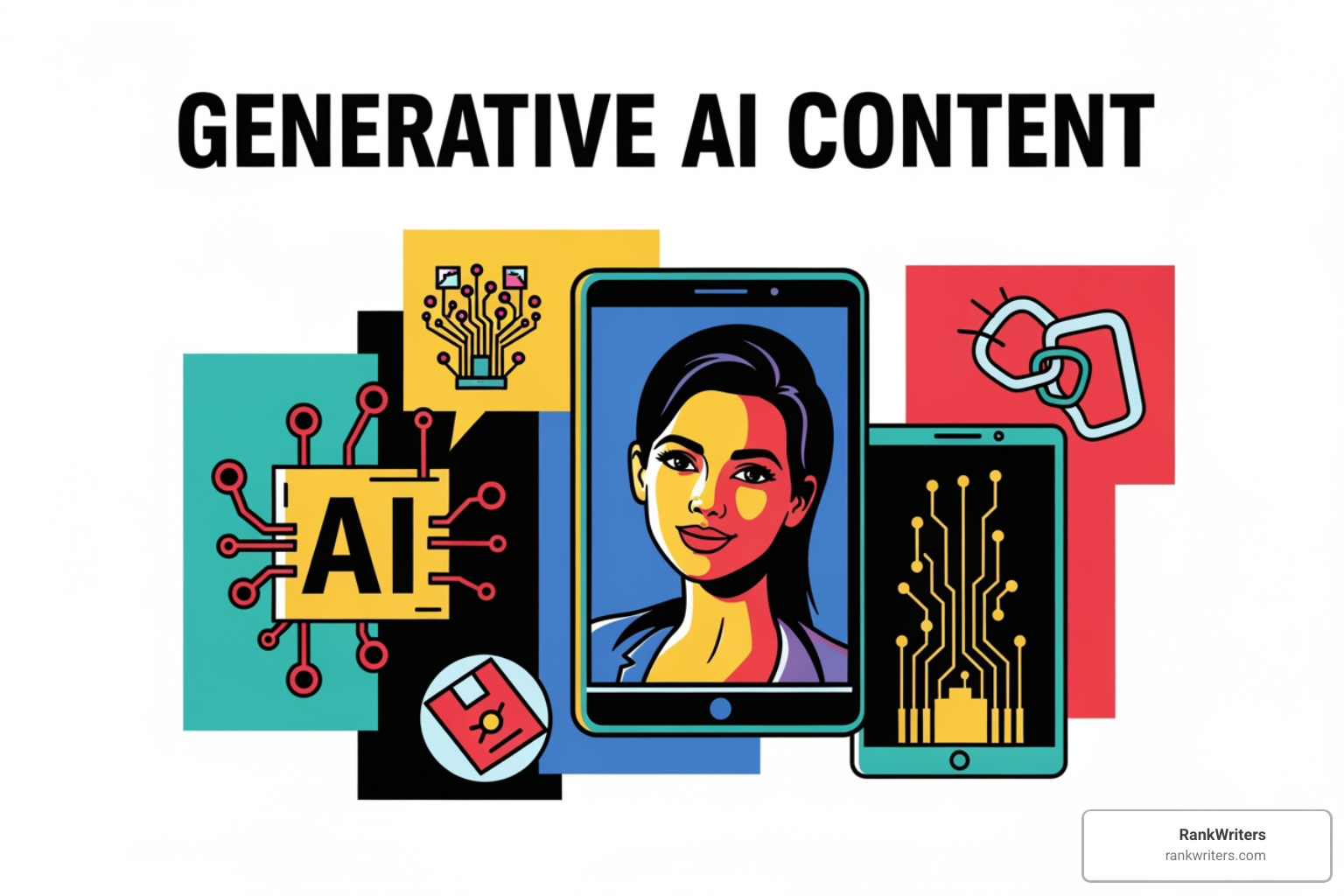

The Technology Behind Generative AI Content
At its heart, Generative AI content represents a significant leap from traditional artificial intelligence. While both fall under the AI umbrella, their core functions differ dramatically.
Generative vs. Traditional AI: Creating vs. Classifying
Traditional AI is like a skilled analyst, excelling at understanding and classifying existing data. It can identify spam, recognize objects in photos, or predict stock prices. Its job is to analyze and categorize.
Generative AI, in contrast, is like an artist or writer. Its superpower is creating new content. Instead of just identifying a cat, it can generate a novel image of a cat. It doesn’t just classify; it creates. This ability to generate new data—text, images, audio, or code—is what sets it apart.
Here’s a quick comparison:
| Feature | Traditional AI | Generative AI |
|---|---|---|
| Primary Goal | Classify, predict, analyze existing data | Create new, original data |
| Output | Labels, scores, predictions, classifications | Text, images, audio, video, code, 3D models |
| Learning Type | Often supervised learning (labeled data) | Often self-supervised learning (unlabeled, vast data) |
| Complexity | Can be simpler models, focuses on discrimination | Typically larger, more complex models (foundation models) |
| Example | Spam filter, facial recognition, fraud detection | ChatGPT, DALL-E, Midjourney, Sora |
Core Models and Training: The Brains Behind the Creation
This creative magic starts with sophisticated models and intensive training. The journey of Generative AI content begins with foundation models—deep learning models trained on immense volumes of raw, unlabeled data from the internet.
Through a process called self-supervised learning, the model performs millions of “fill-in-the-blank” exercises, like predicting the next word in a sentence or a missing part of an image. It continually adjusts itself to improve its predictions, encoding patterns and relationships from the training data into billions of parameters. This enables the model to generate content autonomously in response to user “prompts.”
One of the most common types of foundation models are Large Language Models (LLMs), like the GPT series. These are trained on vast text datasets to understand and generate human language. For instance, GPT-3 was trained on around 45 terabytes of text data—equivalent to a quarter of the entire Library of Congress.
A critical architectural innovation that powered this advancement is the Transformer network, introduced in 2017. Its “self-attention” mechanism allows models to weigh the importance of different parts of the input data, making them incredibly effective for sequence-based tasks like language. This led to the first Generative Pre-trained Transformer (GPT) in 2018, paving the way for today’s generative AI boom.
This training process is incredibly resource-intensive, requiring thousands of GPUs, weeks of time, and millions of dollars. While this has limited model creation to large tech companies, the rise of open-source foundation models is starting to democratize access, allowing developers to build on existing platforms without the prohibitive cost of training from scratch.
For a deeper dive into the historical progression of this fascinating field, you can explore A Brief History of Generative AI.
Applications Across Industries: From Art to Algorithms
The impact of Generative AI content is already being felt across a multitude of sectors.
- Content Creation: AI is revolutionizing content production, from generating articles and marketing copy to creating stunning visuals with text-to-image models (DALL-E, Midjourney) and photorealistic videos with text-to-video models (Sora, Veo).
- Healthcare: Generative AI accelerates drug findy by creating novel molecular structures and generates synthetic medical data to train diagnostic models while protecting patient privacy.
- Software Development: Tools like GitHub Copilot suggest code in real-time, helping developers write, convert, and automate testing for new programs, streamlining workflows.
- Gaming: Generative AI is used to create new assets, environments, and storylines for video games, enhancing development efficiency and creative possibilities.
- 3D Modeling: Automating the creation of 3D models from text, images, or video is becoming possible, potentially revolutionizing industries from product design to entertainment.
- Robotics: Generative AI helps robots learn new trajectories for motion planning, allowing them to perform complex tasks more efficiently.
These applications highlight the immense potential of generative AI to augment human capabilities.
Limitations and Risks: The Double-Edged Sword
Despite its promise, Generative AI content comes with significant limitations and risks.
- Inaccuracies (“Hallucinations”): AI can “hallucinate,” inventing false information, facts, or citations with confidence. Because it predicts content based on patterns rather than a knowledge base, AI-generated content can be inaccurate or misleading. Human fact-checking is essential.
- Bias: Trained on vast datasets reflecting real-world societal biases, AI can inherit and amplify these biases, leading to discriminatory or offensive outputs. This requires careful data selection, auditing, and human oversight.
- Environmental Impact: The massive scale of training and running these models has a substantial environmental footprint. Training a single large model can consume as much energy as hundreds of homes in a year, and the required data centers use vast amounts of water for cooling. This energy consumption translates to significant carbon emissions, raising serious questions about sustainability.
- Quality and “Slop”: Without careful human guidance, AI can produce generic, low-quality content, or “slop.” This can dilute the quality of online information, making human editing paramount to ensure content remains valuable.
Understanding these foundations, applications, and challenges is the first step toward using generative AI responsibly.
Aligning with Google’s E-E-A-T for AI-Powered Content
At RankWriters, we know Google’s mission is to provide useful information. For creators, this means a relentless focus on quality and helpfulness for people. Google’s algorithms reward content demonstrating Experience, Expertise, Authoritativeness, and Trustworthiness (E-E-A-T). This principle applies whether content is human-made, AI-generated, or, as we recommend, a powerful combination of both.

Google doesn’t care how you create content; it cares if it’s good. Google penalizes low-quality, spammy content, regardless of origin. Our goal is to ensure any Generative AI content we create meets or exceeds these high E-E-A-T standards.
Demonstrating Experience and Expertise
When creating Generative AI content, our primary concern is to infuse it with genuine human insight, as AI lacks personal experience.
- Human Oversight and Fact-Checking: We subject AI drafts to rigorous human review and fact-checking to correct “hallucinations” and ensure accuracy.
- Adding Personal Anecdotes and Unique Insights: The human touch—first-hand experiences, unique perspectives, and original analysis—makes content stand out. Our writers add personal stories and insights that AI cannot replicate.
- Subject Matter Expert Review: For complex topics, we ensure content is reviewed by qualified subject matter experts to add a layer of credibility and depth.
- Original Analysis: While AI can summarize information, we push for original thought and analysis to demonstrate true expertise and provide unique value.
Building Authoritativeness and Trust
Trust is the cornerstone of credibility. When using AI, transparency and ethical practices are paramount.
- Transparency About AI Use: We advocate for clear disclosure when AI tools generate significant portions of content to build reader trust.
- Author Bylines: Every piece of content should have a clear author byline, attributing it to a human expert to reinforce accountability.
- Citing Sources: We carefully cite all sources, especially when AI has helped gather information, to substantiate claims and allow readers to verify them.
- Avoiding Spammy Practices: We ensure our AI-assisted content avoids keyword stuffing, thin content, or other spammy tactics that undermine trust.
- Watermarking AI Content: The industry is moving towards greater transparency, with major players like OpenAI and Google pledging to watermark AI-generated content to combat misinformation. The spirit of transparency applies to all Generative AI content.
The Future of Search and Generative AI content
Search is rapidly evolving, with Google’s AI Overviews (formerly SGE) providing synthesized answers directly on results pages.
- How Quality Content Fits In: In this new era, high-quality, helpful content is more important than ever. AI Overviews pull information from authoritative sources. At RankWriters, we produce comprehensive, well-researched content that becomes a prime candidate for inclusion in these AI-powered summaries.
- Satisfying User Intent: AI search prioritizes satisfying user intent. Our content must answer direct questions and anticipate follow-up queries.
- Structured Data: Using structured data (schema markup) helps search engines and AI models better understand our content’s context, making it easier to extract and present information accurately in AI Overviews.
By focusing on E-E-A-T and adapting to the evolving search landscape, we ensure our Generative AI content is not just compliant, but also highly visible and effective.
A Practical Guide to Creating Compliant Generative AI Content
At RankWriters, we accept generative AI as a powerful ally, not a replacement for human ingenuity. Our approach is to leverage AI’s speed while ensuring every piece of content reflects human expertise, creativity, and ethical standards. Think of AI as a power tool and the human as the master craftsman.

Our focus is on quality, creating content that resonates with our audience in the United States, Pennsylvania, and Westmoreland County and drives results for our clients. Here’s our step-by-step guide:
Step 1: Strategic Ideation and Outlining
AI is excellent for kickstarting the creative process.
- Using AI for Brainstorming: We use AI to generate ideas and topics based on target keywords and audience interests, helping overcome writer’s block.
- Keyword Research: AI tools help analyze search trends and identify high-performing keywords.
- Structuring Articles: AI can quickly create detailed outlines with logical flow and headings, providing a solid framework for readers and search engines.
- Generating Topic Clusters: For broader strategies, AI helps identify related topics to build content clusters, ensuring thorough coverage and internal linking.
Step 2: Drafting with AI as an Assistant
Once the outline is in place, AI becomes an invaluable drafting partner.
- Generating First Drafts: AI can quickly produce initial drafts, significantly speeding up the process and allowing our writers to focus on refinement.
- Overcoming Writer’s Block: When faced with a blank page, AI can provide a starting point by generating sentences or paragraphs.
- Summarizing Complex Topics: For research-heavy pieces, AI can efficiently summarize complex information and extract key points.
- Creating Initial Copy: AI can generate various forms of initial copy, from email subject lines to ad copy, saving time on repetitive tasks.
Step 3: The Crucial Human Touch
This is the most important step, turning raw AI output into high-quality, E-E-A-T compliant Generative AI content.
- Editing for Voice and Personality: AI struggles with nuance and brand voice. Our human editors refine the language to inject personality, ensuring it aligns with our client’s brand and resonates with the audience.
- Adding Unique Insights: We inject personal experiences, original perspectives, and expert opinions that AI cannot generate to build authority and trust.
- Fact-Verification: Every AI-generated fact, statistic, and claim is rigorously fact-checked against reliable sources to maintain credibility.
- Improving Readability: Our editors ensure the content is clear, concise, and flows naturally by refining sentence structure, vocabulary, and overall coherence.
Step 4: Transparency and Disclosure
Building trust with our audience and search engines requires transparency.
- When to Disclose AI Use: We disclose AI assistance when it generates a significant portion of the content (e.g., a full draft). For minor tasks like grammar checks, a formal disclosure may not be needed, but a general policy is good practice.
- How to Write a Disclosure: A simple, clear statement at the beginning or end of the article is sufficient, such as: “This article was created with the assistance of generative AI tools and reviewed by a human editor.”
- Building Reader Trust: Transparency fosters trust and reinforces our commitment to ethical content creation.
- Examples of Disclosure Statements:
- “Parts of this content were generated using AI technology, then edited and verified by our human team.”
- “AI tools were used to assist in the drafting of this article, with all facts and insights validated by a subject matter expert.”
By following these steps, we ensure our Generative AI content meets the highest standards of quality, authenticity, and compliance.
Navigating the Risks and Rules Beyond Google
While Google’s E-E-A-T guidelines are crucial, Generative AI content also involves a complex landscape of legal, ethical, and platform-specific rules.

This broader landscape requires a balance between innovation and responsibility.
Understanding Copyright and Generative AI Content
Copyright is one of the most contentious issues for Generative AI content.
- Copyright Ownership Issues: The legal system is struggling with who owns AI-generated work. In the U.S., the Copyright Office has stated that works created by AI without any human input cannot be copyrighted, as the law requires human authorship.
- Fair Use and Lawsuits: AI developers often claim training models on copyrighted material is “fair use.” However, copyright holders like The New York Times and Getty Images have filed high-profile lawsuits, arguing this training is infringement. The outcomes of these cases will shape the future of AI and intellectual property.
- The Evolving Law: The law is still developing. For the latest analysis, you can refer to the Generative AI and Copyright Law report.
At RankWriters, we advise ensuring significant human involvement in creating and editing AI-assisted content. This is the best path to potential copyright protection and mitigating infringement risks.
Ethical Considerations and Mitigation
Beyond legalities, there are profound ethical considerations for Generative AI content.
- Data Privacy: Generative AI models trained on vast datasets may include personal information, making ethical data sourcing and anonymization critical.
- Algorithmic Bias: AI models can inherit and amplify biases from their training data, leading to discriminatory content. Mitigation requires careful data selection and human review.
- Spreading Misinformation: AI’s ability to generate convincing text, images, and video makes it a powerful tool for spreading disinformation.
- Deepfakes: AI-generated media that swaps a person’s likeness can be used for malicious purposes like fraud, harassment, and political manipulation.
- Mitigation Strategies: Key strategies include maintaining human oversight, being transparent about AI use, adhering to internal ethics, supporting watermarking to identify AI content, and advocating for diverse training data to reduce bias.
Adhering to Platform-Specific Guidelines
Different platforms have their own rules for Generative AI content. It’s crucial to understand and follow them.
- Example: Adobe Stock: Platforms like Adobe Stock have specific guidelines for AI content. Contributors must label all AI-generated work, ensure they have the commercial rights to the output, and avoid using prompts that reference real people, artists, or third-party IP. If the content resembles a real person or property, a release is required. These rules highlight the importance of understanding each platform’s policies. For details, review the Adobe Stock Generative AI Guide.
By staying informed about these evolving legal, ethical, and platform-specific requirements, we can responsibly leverage the power of generative AI.
Frequently Asked Questions about Generative AI Content
As the landscape of Generative AI content continues to evolve, so do the questions surrounding its use. Here, we address some of the most common concerns.
Does Google penalize AI-generated content?
No, Google does not penalize AI-generated content specifically. Google’s stance, reiterated during its helpful content updates, is clear: it penalizes low-quality, unhelpful, or spammy content, regardless of whether it was created by a human or an AI.
Our focus at RankWriters, and what Google rewards, is content that demonstrates E-E-A-T (Experience, Expertise, Authoritativeness, Trustworthiness) and genuinely serves the user’s needs. If AI is used to create content that is factually inaccurate, poorly written, lacks original insight, or is designed purely for search engine manipulation, it will likely not rank well. Conversely, high-quality Generative AI content that has been carefully reviewed, edited, and improved by human experts, and which provides real value to the reader, can perform just as well as human-written content.
Can I get a copyright for my AI-generated images or text?
Generally, no, if there is no significant human authorship involved. In the United States, the Copyright Office has ruled that works created solely by artificial intelligence, without human input, cannot be copyrighted. Copyright law requires evidence of human authorship.
However, the situation becomes more nuanced with Generative AI content that involves substantial human creativity and modification. If you use AI as a tool to assist in creation, and then heavily edit, refine, or combine the AI’s output with your own original elements in a way that demonstrates creative human input, you may be able to claim copyright on the human-authored elements or the final compilation. The legal landscape is still evolving, and this area is subject to ongoing debate and interpretation. For optimal protection, significant human creative effort remains key.
How can I detect if content was written by AI?
Detection tools designed to identify AI-generated text or images do exist, but they are often unreliable and prone to false positives. Many AI detectors work by looking for patterns, predictability, or lack of “perplexity” that are common in AI-generated text. However, as AI models become more sophisticated, their outputs become harder to distinguish from human-written content.
Google itself advises against relying solely on AI detectors. Instead, Google’s guidance emphasizes focusing on the quality and helpfulness of the content itself. Rather than trying to determine who wrote it, the focus should be on whether the content provides accurate, valuable, and trustworthy information that satisfies user intent and demonstrates E-E-A-T. Relying on unreliable detectors can also lead to unfair accusations, as demonstrated by instances where legitimate human-written content was incorrectly flagged as AI-generated.
Conclusion
The age of Generative AI content is not just upon us; it’s rapidly reshaping the digital landscape. As we’ve explored, Google’s guidance is clear: quality, helpfulness, and E-E-A-T remain paramount, regardless of whether content is human-generated or AI-assisted.
AI is a powerful tool, capable of accelerating ideation, drafting, and optimization. However, it is not a replacement for human expertise, creativity, or ethical judgment. The future of successful content creation lies in a synergistic human-AI collaboration, where AI handles the heavy lifting, and human specialists infuse the content with the unique insights, authenticity, and nuanced understanding that only we can provide.
At RankWriters, we are committed to creating high-quality, SEO-optimized content that excels in this new era. Our systematic, future-proof approach combines traditional SEO, Answer Engine Optimization (AEO), and Generative Engine Optimization (GEO) to ensure our clients’ content not only ranks well but also genuinely connects with their audience and drives revenue.
Learn more about our SEO Content Services