

Getting mentioned in AI tools like ChatGPT and Perplexity requires structuring content so it is easily extracted, trusted, and attributed as a source. Here’s what you need to know:
- AI prioritizes structured, data-driven content: Use clear headings, concise answers, lists, and tables to make your content easy for AI to extract and cite.
- Authority matters: Build a network of related, well-linked articles (topic hubs) and ensure your site demonstrates expertise and credibility.
- Recency is key: Regularly update your content with new stats, examples, and dates to stay relevant. AI prefers newer content over older material.
- External mentions boost visibility: Get your brand referenced on trusted platforms like LinkedIn, GitHub, or industry blogs.
- Track performance: Use tools to monitor how often your content is cited in AI responses and adjust your strategy accordingly.
- Answer-first approach: Start each section with a direct, clear answer to match how AI processes queries.
- Consistency wins: Maintain a steady content production system, focusing on conversational, AI-friendly topics.
Quick Comparison
| Factor | What AI Prefers | How to Achieve It |
|---|---|---|
| Content Structure | Clear, concise, and structured | Use lists, tables, and direct answers |
| Recency | Recently updated content | Refresh stats, examples, and metadata |
| Authority | Trusted, well-linked topic hubs | Build interconnected articles |
| External Mentions | Brand referenced on trusted platforms | Secure mentions on industry-relevant sites |
| Performance Tracking | High citation frequency | Monitor with tools like Promptmonitor |
The ultimate guide to AEO: How to get ChatGPT to recommend your product
How AI Tools Decide What Content to Mention
When you ask an AI model a question, it doesn’t just randomly pick sources. Instead, it follows a multi-step process to decide what information to include. It starts by identifying the intent behind your query – whether you’re looking for a definition, a how-to guide, a comparison, or a recommendation. From there, it pulls potential documents and evaluates them using quality filters.
These filters, often called rerankers, assess content based on the E-E-A-T principles: Experience, Expertise, Authoritativeness, and Trustworthiness. AI models lean toward content from sites known for credibility and clear author attribution, like GitHub, Stack Overflow, and PubMed.
For content to even be considered, it must be easy for machines to read. Pages with structured data (like Schema.org markup), clean HTML organization, and concise, answer-first formatting – where the main response is presented within the first 40–60 words – are prioritized. Fun fact: listicles account for 50% of top AI citations, pages with tables are 2.5 times more likely to be cited, and long-form posts over 2,000 words triple their chances of being referenced.
AI models also monitor engagement signals, such as click-through rates and user feedback, to weed out less helpful sources. For instance, 67% of ChatGPT’s top 1,000 citations come from original research or first-hand data, and claims supported by statistics are 40% more likely to get cited than those based on qualitative statements.
In short, AI models value content that’s clear, credible, and well-structured. These factors are key to boosting your visibility in AI-generated responses.
Comparison Table
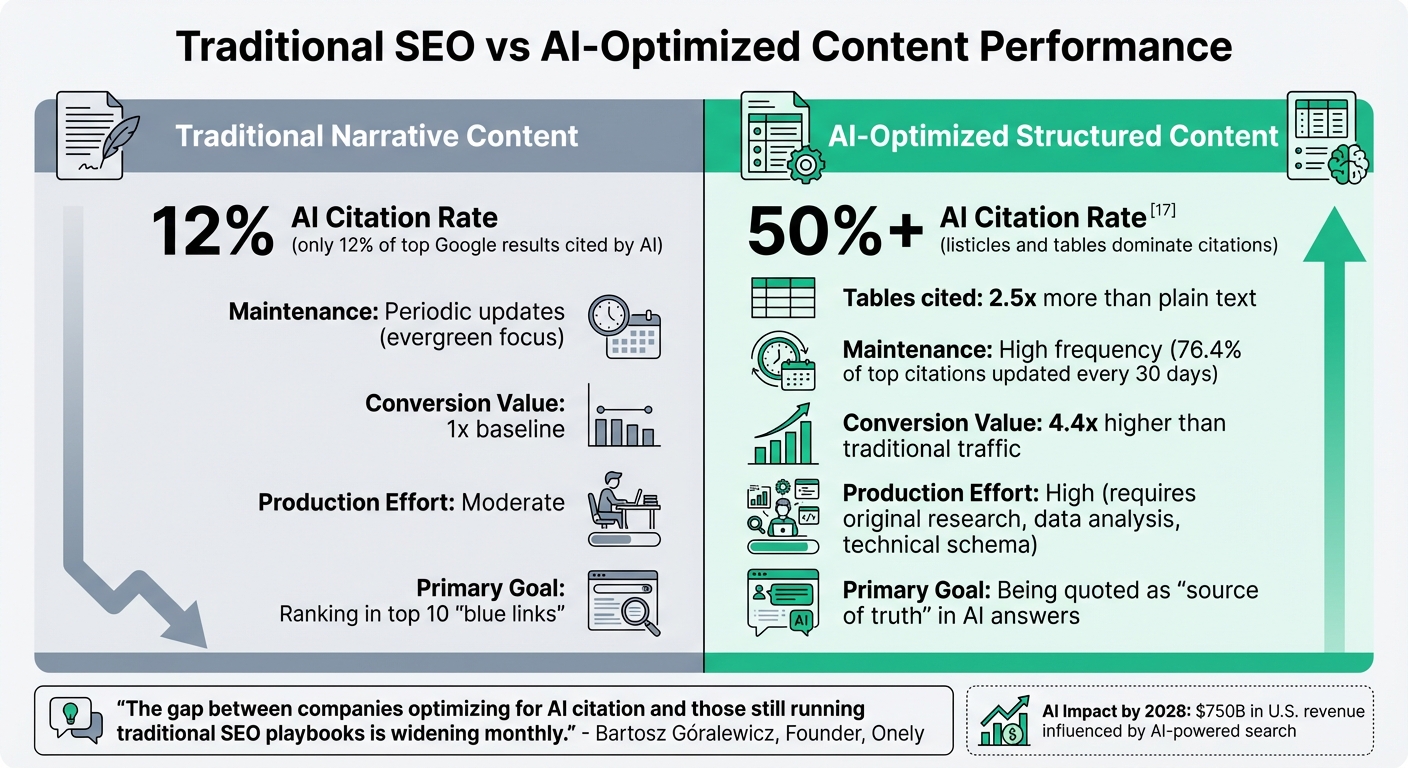
Traditional SEO vs AI-Optimized Content: Citation Performance Comparison
1. Build a Topic Authority Hub Around Your Core Offers
What it is
Build a connected set of pages that collectively demonstrate deep expertise around your core topic, rather than relying on isolated posts.
Why AI systems care
AI tools assess topical authority across clusters of related content and are more likely to cite sites that show consistent, reinforced coverage of a subject.
What to do
Create a pillar page for the core topic, publish supporting subtopic pages, and interlink them with descriptive anchor text using consistent terminology.
To make your site a go-to resource for AI systems, focus on building a topic authority hub that showcases your expertise. AI doesn’t just look at individual pages; it evaluates how well your entire site demonstrates authority on a subject. While a single blog post might address one question, a collection of interconnected content helps establish you as a credible expert. This strategy, often called the hub-and-spoke model, positions your site as a reliable source AI systems are more likely to cite.
Here’s how it works: Start with a pillar page – a comprehensive, in-depth article (around 1,500–3,000 words) covering your core topic. Then, create supporting “spoke” articles that dive into specific subtopics, address niche questions, or explore related issues. Use clear and descriptive anchor text to link these pages together, forming a strong internal linking structure. This setup not only makes it easier for AI to understand the relationships between your content but also reinforces your authority on the topic.
AI-Friendly Parameters
Aligning your hub with AI-friendly parameters further strengthens your credibility. For instance, systems like Perplexity reward websites that build interconnected ecosystems rather than isolated pages. Features like boost_page_with_memory and related_pages_limit help AI recognize consistent terminology and comprehensive coverage across your site.
To ensure your hub captures the full scope of user queries, cover a variety of content types. Include alternative phrasing, comparisons (e.g., “X vs. Y”), and solutions to common problems (e.g., “how to fix…”). Organize your cluster around three main query types: category questions (definitions), comparison questions (evaluating competitors), and problem-solving guides (how-to articles).
Finally, keep your content current. Update cornerstone pages at least quarterly with fresh statistics, examples, and insights. Data shows that content updated within the last 30 days gets 3.2 times more citations than older material. Regular updates signal to AI systems that your site is both up-to-date and trustworthy, increasing the likelihood of being cited as a reliable source.
At RankWriters, we design content specifically to be parsed, summarized, and attributed by AI search systems, not just ranked in traditional SERPs.
2. Write Content That Directly Answers AI Queries
What it is
Creating content that explicitly answers common, high-intent questions in clear, standalone language.
Why AI systems care
AI systems generate responses by matching user questions to passages that directly resolve the query with minimal interpretation.
What to do
Identify common questions related to your topic and answer them directly using concise paragraphs, clear headings, and FAQ-style formats.
Once you’ve established authority on your topic, the next step is to create content that directly addresses AI-driven queries. AI models are designed to scan for concise, clear answers to use in citations. To increase the likelihood of being referenced, adopt an “answer-first” approach. This means placing your response within the first 40–60 words of each section. Think of it as BLUF – Bottom Line Up Front – making it easier for AI to extract the key information.
Structure your headings as questions. For instance, instead of titling a section “Email Marketing Benefits”, use “What are the benefits of email marketing?” This aligns with how users typically interact with tools like ChatGPT and Perplexity, ensuring your content matches user intent.
Break your content into clear, standalone sections. A scannable layout is crucial because AI often processes web pages in segments. This approach ties into formatting best practices, which are discussed later in this guide [2].
Formatting plays a big role in attracting citations. Lists and tables, for example, improve readability and citation rates. Additionally, content that includes precise, data-backed insights tends to perform better than vague or qualitative statements.
Maintain a neutral, informative tone throughout. AI models favor balanced and factual content over material that leans heavily into sales language. Use semantic HTML tags like <h2>, <ul>, and <strong> to make your content’s structure clear. Additionally, implementing FAQ schema markup can help define question-and-answer relationships, making it easier for AI crawlers to understand your content [5].
3. Keep Content Fresh for Perplexity‘s Recency Preference
What it is
Regularly updating existing content so it reflects current information, terminology, and examples.
Why AI systems care
AI tools like Perplexity prioritize recent, actively maintained content when selecting sources for time-sensitive or evolving topics.
What to do
Review priority pages on a set cadence, update facts and examples, refresh publish or modified dates where appropriate, and add brief “last updated” signals on-page.
Perplexity doesn’t treat content age the same way traditional search engines do. Instead, it uses backend parameters like time_decay_rate and item_time_range_hours to gradually lower the visibility of older content, even if it was once highly authoritative. This means a recently published, well-researched article can outperform a long-standing high-authority page that hasn’t been updated in years. Acting more like a real-time discovery tool, Perplexity is where users go for up-to-the-minute information – whether it’s stock prices, software updates, or breaking news – where being current directly impacts credibility.
Content visibility can drop off quickly. Some SEO experts have noted that rankings can decline within just 2–3 days if content isn’t refreshed. Studies also reveal that AI-cited content is 25.7% more recent than Google’s organic search results, and ChatGPT tends to reference URLs that are 393–458 days newer than those found in typical search results [16]. This shift highlights just how crucial it is to keep writing SEO friendly content that is regularly updated.
“ChatGPT prioritizes RECENT over PERFECT. A 2022 guide loses to mediocre content published yesterday.”
– Metehan Yeşilyurt, Co-Founder and Chief Growth Officer, AEO Vision [2]
Why regular updates are essential
To combat the rapid decay of content relevance, regular updates are essential. But don’t worry – you don’t need to rewrite entire articles. Instead, focus on updating key details. For instance, refresh statistics with the latest numbers (adding phrases like “as of January 2026” to clarify), update screenshots of software interfaces or pricing tables, tweak titles (e.g., “Best Tools 2025” becomes “Best Tools 2026”), and revise your meta description. Displaying a prominent “Last Updated” date at the top of your page can also signal recency to both readers and search engines[16].
Technical updates can also help your content get rediscovered faster. For example, update your XML sitemap’s lastmod field and use Schema.org’s dateModified tag whenever you make changes. Implementing the IndexNow protocol is another smart move – it can notify Bing (and indirectly Perplexity) about updates in real-time, reducing the rediscovery time from weeks to just hours [16]. To stay ahead, establish a quarterly schedule to review cornerstone content like pricing guides, product comparisons, and integration tutorials, ensuring they remain relevant within Perplexity’s fast-paced system.
4. Format Content for Easy AI Extraction
What it is
Structuring content so individual ideas can be easily isolated, understood, and reused outside the full article.
Why AI systems care
AI systems extract and assemble answers from discrete passages, not long narrative blocks, and favor content that is cleanly segmented.
What to do
Use clear headings, short paragraphs, bullet lists, and standalone sentences that make sense without surrounding context.
AI models are designed to scan and interpret structured text efficiently. When tools like Perplexity or ChatGPT analyze your page, they prioritize self-contained sections that can function as standalone answers. If a paragraph relies heavily on surrounding context, it’s less likely to be cited. To address this, structure your content to make extraction straightforward.
Start each section with a direct answer within the first 40–60 words. This “answer-first” strategy allows AI systems to extract the key information immediately, without sifting through background details. For example, define terms or concepts right after the heading. This simple adjustment can increase your citation rate by as much as 140% [11]. After presenting the core answer, follow up with supporting details to provide context.
Using structured formats can further improve extractability.
Numbered lists and tables significantly outperform plain narrative text in AI citations. Data shows that listicles make up 50% of top AI citations, while tables are cited 2.5 times more often than unstructured paragraphs [11]. These formats create clear, easily identifiable boundaries that AI systems can process quickly. For instance, convert detailed explanations into bullet points, break down processes into numbered steps, and use labeled tables for comparisons or specifications rather than embedding them in long sentences.
“Retrieval-augmented generation (RAG) systems… don’t generally retrieve entire pages. Instead, they retrieve chunks: contextually relevant, self-contained sections that answer specific questions.”
– Jill Maldonado, Content Strategist, Victorious [17]
To further optimize, use proper semantic HTML tags like h2, ul, and strong, and implement JSON-LD schema markup – including FAQPage, HowTo, and Article schemas – to clarify relationships between entities. Products with robust schema markup are 3–5 times more likely to appear in AI recommendations compared to those without. Avoid vague pronouns at the start of paragraphs; instead, restate the subject to ensure clarity when sections are viewed in isolation. Keep paragraphs concise (2–4 sentences), prioritize quantitative data over ambiguous terms, and include descriptive alt text for better AI interpretation.
sbb-itb-16c0a3c
5. Build Brand Mentions Across External Sites
What it is
Ensuring your brand is referenced consistently across third-party websites, publications, and platforms.
Why AI systems care
AI systems use repeated brand mentions across independent sources as a trust and authority signal when selecting which sources to cite.
What to do
Secure brand mentions through guest content, citations, partnerships, and PR placements that clearly associate your brand with specific topics.
AI systems rely on web data to assess your credibility. When multiple reliable sources mention your brand, tools like ChatGPT and Perplexity start recognizing you as a “canonical reference” they can confidently recommend. A study analyzing 75,000 brands revealed that web mentions are the #1 factor influencing visibility in Google’s AI Overviews, while traditional backlink counts ranked much lower at #7 [3]. Brands in the top 25% for web mentions can gain up to 10x more AI Overview mentions compared to those in the next quartile [3]. This external recognition highlights the importance of co-occurrence in building brand authority.
So, what’s co-occurrence? It’s the frequency with which your brand is mentioned alongside key topics on trusted websites. AI models create internal “knowledge graphs” by tracking these patterns. For example, if your CRM software is consistently referenced on platforms like G2, Capterra, and industry blogs in discussions about real estate workflows, the AI starts associating your brand with that specific niche. This consistent pattern of mentions strengthens your authority and aligns with broader SEO and machine learning strategies. Platforms like Reddit are particularly influential – Reddit is cited in 141.2% of ChatGPT responses related to business and professional services, averaging 1.4 citations per response.
AI models reference trusted hubs
To maximize co-occurrence, focus on “trusted hubs” that AI models frequently reference. For instance, Perplexity relies on a curated list of domains, including GitHub, Stack Overflow, G2, LinkedIn, and Crunchbase. In finance-related queries, NerdWallet is cited in 75% of Google AI Mode responses. Start by securing detailed profiles and reviews on these high-value platforms.Another way to boost your authority is by producing original research or proprietary data that attracts citations. For example, in July 2025, Exploding Topics published a report titled “The AI Trust Gap”, which explored consumer attitudes toward AI. This research was picked up by outlets like eMarketer, ZDNET, and Inc., resulting in citations across Google AI Overviews for 3,800 keywords, generating an estimated $28,000 in traffic value and over 325 direct referrals from platforms like ChatGPT, Perplexity, Gemini, Grok, and Copilot [20]. When pitching journalists, focus on showcasing your new data rather than directly requesting mentions – this approach often yields better results.
6. Use Data to Understand AI Content Preferences
What it is
Analyzing performance signals to identify which content formats, topics, and structures are most frequently surfaced or cited by AI tools.
Why AI systems care
AI systems favor content patterns that have proven reliable, clear, and useful across repeated user queries and responses.
What to do
Track AI referral traffic, citation mentions, query patterns, and content formats that surface in AI tools, then prioritize and replicate what performs best.
Focus on what truly matters: how often your content gets cited in AI-generated responses. Keep an eye on citation frequency and share of voice (SoV) to gauge how often your content is referenced compared to your competitors[6]. If your brand gets mentioned but isn’t linked as a citation, it means you’re being “seen” but not necessarily “trusted”[6]. These metrics tie directly to earlier strategies around structuring content and building brand authority.
Another key metric? AI referral traffic. Visitors coming from AI searches convert 4.4 times better than those from traditional organic searches[2]. Dive deeper to identify which specific URLs and content formats – like tables, lists, or FAQs – are being retrieved and cited. If your comparison guides aren’t making the cut, consider reworking them with clear, easy-to-read tables that highlight key takeaways, as discussed in the formatting section.
Monitor content decay too. Pay attention when pages that were previously cited start disappearing from AI responses. Why? Because 76.4% of ChatGPT’s most-cited pages were updated within the last 30 days. A drop in citations might signal that your content is outdated. Regular monthly audits can help you refresh old stats or fix broken links, keeping your pages relevant and competitive.
“ChatGPT prioritizes RECENT over PERFECT. That amazing guide from 2022? It’s losing to mediocre content published yesterday.”
– Metehan Yeşilyurt, Co-Founder and Chief Growth Officer, AEO Vision[2]
Specialized tools can elevate your data strategy even further. For instance, Promptmonitor starts at $29/month and tracks citations across eight platforms. ZipTie, priced at $99/month, focuses on mentions and citations across ChatGPT, Perplexity, and AI Overviews. Armed with these insights, you can double down on what works – whether it’s updating content, leaning into quantitative insights (which enjoy 40% higher citation rates than qualitative ones), or refining your formatting – to stay visible in the ever-evolving AI landscape.
7. Create a Consistent Content Production System
What it is
Establishing a repeatable process for planning, producing, updating, and publishing content on an ongoing basis.
Why AI systems care
AI systems favor sources that demonstrate consistency, topical continuity, and long-term reliability rather than one-off content spikes.
What to do
Implement a content cadence with defined ownership, editorial standards, and regular updates across core topic areas.
Securing AI citations isn’t something you do once and forget about – it’s a continuous process. To succeed, you need a reliable content production system. Think of it as running a production line, where you have clear inputs, quality checks, and predictable outputs. Without this structure, you’re essentially publishing content without direction. One key shift to make? Move away from traditional keyword research and embrace a prompt mapping approach that aligns with how users interact with AI-driven queries.
Prompt mapping replaces generic keyword targeting with conversational, AI-friendly queries. For example, instead of going after broad keywords like “best project management software,” focus on the kinds of conversational prompts users might type, such as “What’s the best project management tool for small teams?” This method reshapes your content strategy to match AI’s conversational style, emphasizing question-based, comparison, and problem-solving prompts to guide your planning.
The importance of a tiered content refresh schedule
Once you’ve nailed prompt mapping, implement a tiered content refresh schedule. Start with your top-performing pages – like your top 10 traffic drivers and pricing pages – and update them monthly. This means adding fresh statistics, current screenshots, and a visible “Last Updated” timestamp. Core pillar content and detailed how-to guides should be reviewed quarterly, ensuring technical accuracy and adding relevant new sections. Meanwhile, supporting pages or older blog posts can be audited annually for significant updates or even considered for archiving. This tiered approach keeps your most valuable content competitive in AI-generated citations.
Before publishing, every piece of content should pass through a pre-publication checklist. This includes ensuring it directly answers the main query (using the BLUF – Bottom Line Up Front – approach), follows a clear heading structure, incorporates internal links, and uses proper schema markup like FAQPage or HowTo. While AI tools can assist with brainstorming and outlining, the final touch – original insights and editing – should always come from human experts to avoid generic or overly simplistic content.
“The companies that win are the ones treating LLM optimization as an ongoing experiment rather than a one-time project.”
– Katlyn Edwards, Author, Linkflow
Cut rediscovery time
Automating updates can also streamline your process. For example, tools like IndexNow allow you to push content updates to search engines almost instantly, cutting rediscovery time from weeks to hours.
Don’t forget to automatically update the dateModified field in your Article schema. To track how often your content is cited across AI platforms, tools like Promptmonitor (starting at $29 per month) and ZipTie (at $99 per month) can provide valuable insights into your citation frequency.
Structured content is proving to be a game-changer when it comes to meeting AI citation standards, leaving traditional narrative approaches struggling to keep up.
Traditional long-form narratives often bury key answers, making them less appealing for AI citations. In fact, only 12% of top Google results manage to secure a spot in AI-generated citations. The data paints a clear picture: generative search optimization success doesn’t guarantee AI visibility.
On the other hand, AI-optimized structured content is designed for easy extraction. Formats like listicles dominate, contributing to 50% of top AI citations, while tables are cited 2.5 times more often than plain text [11]. But there’s a catch – this type of content demands frequent updates. A staggering 76.4% of ChatGPT’s most-cited pages were refreshed within the last 30 days.
Why does this matter? AI-driven traffic isn’t just about visibility; it converts at a much higher rate. Visitors sourced through AI are 4.4 times more likely to take action compared to traditional organic traffic. For brands aiming to stay ahead, adapting to these new content requirements is no longer optional.
Here’s a side-by-side breakdown of how traditional content compares to AI-optimized structured content:
| Factor | Traditional Narrative Content | AI-Optimized Structured Content |
|---|---|---|
| Likelihood of AI Citations | Low; only 12% of top Google results are cited by AI | High; listicles and tables drive 50%+ of citations |
| Maintenance Requirements | Periodic; focused on evergreen relevance | High; 76.4% of top citations are updated every 30 days |
| User Engagement | Focused on storytelling and dwell time | Focused on immediate utility; AI visitors are 4.4x more valuable |
| Production Effort | Moderate; relies on standard writing and keyword research | High; requires original research, data analysis, and technical schema |
| Primary Goal | Ranking in the top 10 “blue links” | Being quoted as the “source of truth” in a generated answer |
Conclusion
Gaining recognition in AI-generated answers demands a well-planned, data-focused approach. The seven strategies we’ve discussed – creating topic authority hubs, crafting answer-first content, keeping content updated, optimizing formatting for extraction, earning external mentions, tracking performance with data, and maintaining consistent production – work together to elevate your business from simply ranking in search results to becoming a trusted source cited by AI. These steps shift your efforts from standard SEO practices to building a reputation as a go-to reference for AI systems.
AI is reshaping how businesses generate revenue. According to McKinsey, AI-powered search is expected to influence $750 billion in U.S. revenue by 2028 [1]. Meanwhile, Perplexity’s search volume saw a staggering 200% growth in 2025 [4]. Companies that fail to adapt risk being left out of AI-generated answers entirely. As Senso.ai aptly states:
“If you aren’t explicitly represented in the model’s trusted knowledge graph, you don’t just fall to page two – you disappear from the answer entirely” [8].
Staying visible in AI systems is a moving target, influenced by regular updates and contextual relevance [7]. This means businesses must commit to ongoing efforts, including strategically refreshing their content.
RankWriters‘ service is designed to help businesses implement these strategies effectively. By delivering consistent, optimized content, we help you establish and maintain AI authority. Our approach includes competitive research, keyword analysis, and monthly blog posts that not only keep your content fresh but also build the topical authority clusters that large language models (LLMs) recognize as expertise signals. With automated content delivery and built-in AI search optimization, we provide the scalable system you need to stay competitive – without the hassle of managing it yourself.
Adopting these strategies early creates a compounding effect. AI systems tend to reinforce established citations over time, meaning businesses that act now are positioning themselves as trusted sources for years to come.
FAQs
What can I do to make my content more likely to be mentioned in AI tools like ChatGPT and Perplexity?
To make your content stand out for AI tools, focus on creating material that’s clear, well-organized, and reliable. Begin with an answer-first approach, addressing user questions right away. Enhance readability by incorporating bullet points, tables, or schema markup where appropriate. Aim for detailed, long-form content that showcases original research, current data, and expertise in your area. Structuring your content into topic clusters can boost authority and make it easier for AI systems to interpret and reference your work. Keeping your content updated regularly and maintaining a professional tone further strengthens its credibility.
How do external mentions help improve visibility in AI-generated content?
When your brand gets mentioned on reputable platforms, it acts as a strong endorsement of its relevance and credibility in the eyes of AI systems. These external mentions can boost the chances of your brand being directly included in AI-generated responses. As a result, your brand’s visibility and influence in AI-driven content can grow significantly.
Why is it important to keep your content updated for AI recognition?
AI models value current and trustworthy information when determining which content to reference. Updating your content regularly boosts its relevance and trustworthiness, making it more likely to be referenced by systems like ChatGPT or Perplexity.
Staying up-to-date also showcases your expertise and ensures your content reflects the latest trends, appealing to both AI systems and human readers alike.