


Benchmarking organic traffic in 2025 is all about transforming data into actionable strategies. Here’s what you need to know upfront:
- Why it matters: Organic traffic still drives 53% of trackable website visits, making it a key metric for digital success.
- Key tools: Use Google Analytics 4 (GA4) and Google Search Console for tracking. Supplement with tools like SEMrush for competitor analysis.
- Metrics to focus on: Organic sessions, CTR, bounce rate, session duration, keyword rankings, and conversion rates.
- Setting benchmarks: Compare your performance against industry standards, competitor data, and your historical trends.
- Actionable steps: Track high-performing pages, refine underperforming content, and focus on long-tail keywords for better visibility.
How to Use SEO Benchmarks to Measure Your SEO Success
Setting Up Organic Traffic Tracking
To benchmark your organic traffic effectively, you need a reliable tracking system in place. While it might sound complex, setting up a system to collect accurate data can be done in just a few hours with the right tools and approach.
Setting Up Google Analytics 4 (GA4)
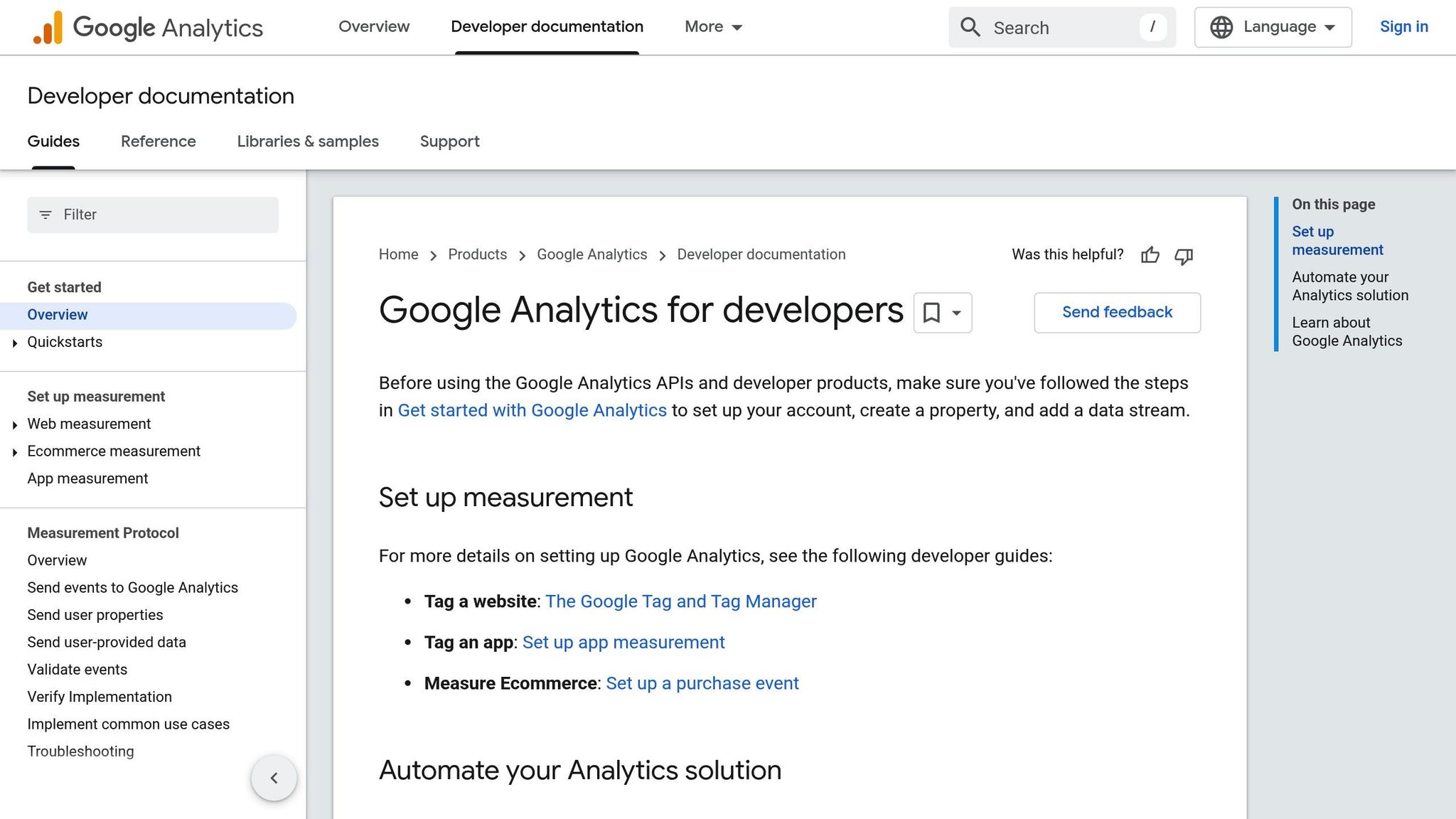
Google Analytics 4 is your go-to platform for tracking organic traffic. If you’re still using Universal Analytics, it’s time to switch – Google officially discontinued it on July 1, 2023.
Getting Started with GA4
Start by reviewing your property settings. Adjust the reporting time zone to match your business location and set your currency to USD ($) if you’re operating in the U.S. Don’t forget to select your industry category and enable a 14-month data retention period for year-over-year comparisons [10].
Key Data Settings
- Enable Google Signals to gain insights into cross-device user behavior [10].
- Set up internal traffic filters by excluding your office IP addresses. This ensures your team’s activity doesn’t interfere with your organic traffic data [10].
Tracking Organic Search Traffic
To analyze organic traffic, go to Reports > Acquisition > Traffic Acquisition in GA4 [4]. Change the grouping option from “Session default channel group” to “Session source/medium” for a detailed view of organic search data. For more advanced insights, use GA4’s Explore section to create custom reports. These can help you segment data by landing pages, user demographics, or even conversion paths [4].
Enhanced Measurement Features
GA4 includes an Enhanced Measurement feature that automatically tracks user interactions like scrolls, outbound clicks, site searches, and file downloads [5] [6]. Enabling this feature helps you assess how users engage with your content beyond simple page views, giving you a clearer picture of content performance.
UTM Parameters for Campaigns
Use Google’s Campaign URL Builder to create standardized UTM parameters [11]. Apply these to all campaign links, whether in emails, ads, or social media. This ensures consistent tracking across your marketing efforts.
Attribution and Reporting Models
Select an attribution model that aligns with your goals. This model determines how GA4 assigns credit for conversions across various touchpoints. When benchmarking organic traffic, pay attention to how the attribution window impacts the role organic search plays in multi-channel conversion paths [10].
Adding Other Analytics Tools
While GA4 provides a strong foundation for organic traffic tracking, additional tools can enhance your analysis.
Google Search Console
Integrate Google Search Console with GA4 for a fuller picture of your organic performance [7]. Search Console delivers query-level data, helping you see which search terms drive traffic to your site – something GA4 alone can’t provide.
For streamlined reporting, connect GA4 and Search Console to Google Looker Studio. This tool allows you to create visual dashboards, making it easier to understand and share your SEO data. For example, Analytics Mates designed a simple dashboard using this setup to visualize key metrics [7].
Competitive Analysis Tools
To understand how your organic performance compares to others in your industry, use competitive analysis tools [9]. While GA4 focuses on your site, these tools provide an external perspective, helping you set realistic benchmarks.
Cross-Platform Insights
With Google Search Console, you can analyze traffic differences between desktop and mobile users. If mobile traffic dominates, consider adjusting your benchmarks to reflect mobile-first behaviors [8].
Regular Data Checks
Ensure your tracking remains accurate by periodically reviewing your setup. For instance:
- Verify that cross-domain tracking works properly if your site spans multiple domains or subdomains [10].
- Exclude unwanted referrals, like those from third-party payment processors, to prevent skewed organic traffic reports [10].
Key Metrics for Organic Traffic Benchmarking
To effectively benchmark organic traffic, focus on key performance indicators (KPIs) that directly reflect your site’s performance. These metrics provide a foundation for understanding your website’s strengths and areas for improvement.
Metrics to Track
Organic Search Traffic
This metric shows how well your site attracts visitors through search engines. You can monitor monthly organic search traffic in GA4 by navigating to Reports > Acquisition > Traffic Acquisition [14]. Industry data reveals that 46% of businesses report monthly site traffic between 1,001 and 15,000 visitors [14].
Engaged Sessions and Average Engagement Time
These metrics, available in GA4, highlight user engagement and content quality. Industry benchmarks suggest that about two-thirds of websites maintain a bounce rate under 40%, while nearly half achieve 4–6 page views per visit [14].
Impressions, Clicks, and Click-Through Rate (CTR)
Google Search Console provides insights into how often your content appears in search results, how many clicks it earns, and the CTR. Studies indicate that most clicks go to first-page results, with the top three positions capturing the largest share [17].
Organic Keyword Footprint, Keyword Value, and Individual Keyword Rankings
These metrics track the total keywords your site ranks for, their estimated monetary value (based on Google Ads costs), and the positions of specific target keywords. Tools like SEMrush can help monitor these numbers. Notably, 21% of SEOs prioritize optimizing for search intent to improve rankings [14].
Total Linking Root Domains
This metric evaluates the growth of your backlink profile and its impact on your site’s authority [12].
“Organic Search traffic retains an important role in the channel mix of the financial services industry with high engagement both in terms of visit duration as well as page per visit compared to other verticals.”
– Fabrizio Ballarini, Head of Organic Growth at Wise [16]
Conversion Rate from Organic Traffic
This metric measures how effectively your SEO efforts drive business outcomes. You can calculate conversion rates by setting up goals in Google Analytics [14][17].
Setting Your Baseline
Once you’ve identified the key metrics, establish a baseline using historical data. This baseline serves as a reference point for assessing performance. Start by collecting at least three months of data from GA4 and Google Search Console. Compare month-over-month and year-over-year trends to spot patterns [18][20].
Seasonal trends play a significant role in organic traffic. For instance, e-commerce sites often see holiday traffic spikes, while B2B companies might experience slower activity during the summer. These trends should be factored into your analysis to set realistic benchmarks.
Use your current performance as the starting point rather than aiming for aspirational goals. For example, if your site averages 5,000 monthly organic sessions with a 2.5% conversion rate, these become your baseline metrics – even if industry averages suggest a bounce rate closer to 55% [20]. Tailor your benchmarks to reflect your actual performance.
Context matters too. Compare your click-through rates with averages for similar positions to spot underperforming pages. Additionally, consider tools like the visibility index for a more complete view of keyword performance [18][20].
“By establishing baseline metrics, you can measure your SEO progress accurately and identify areas that require improvement.”
– AICONTENTFY [19]
Document these baseline metrics in a spreadsheet or dashboard, noting the date range used for calculations. Don’t forget to assess technical factors like site speed, mobile-friendliness, and indexability to ensure your site is primed for growth [19].
Lastly, use GA4’s path exploration reports to track engagement metrics such as session duration and scroll depth. These behavioral insights go beyond raw visitor numbers, offering a clearer picture of how users interact with your site [18]. Your baseline metrics will be essential for setting goals and making strategic adjustments in the next steps.
sbb-itb-16c0a3c
Comparing Your Traffic to Industry and Competitor Benchmarks
Once you’ve established your baseline, it’s time to see how your organic performance measures up against industry norms and competitor data. This step helps you figure out whether you’re keeping up with the competition or if there’s room to level up.
Finding Industry Benchmarks
Industry benchmarks give you a sense of what’s typical for businesses in your field. With the SEO market projected to reach nearly $107 billion by 2025[22], understanding where you stand is more crucial than ever.
To start, you can use SEMrush’s Market Explorer. Here’s how: go to the tool, click “Create List”, set your “Location”, input at least three competitor domains, and hit “Create and analyze.” Switch to the “Benchmarking” tab to see a graph comparing organic traffic trends across the selected websites. Then head back to “Overview” to check out the top organic keywords and their traffic share[23].
For a more detailed look, Zero Gravity Marketing (ZGM) used data from Google Analytics 4 (GA4) and Google Search Console (GSC) to create an SEO benchmark report for 2024. This report covers metrics like impressions, organic clicks, click-through rate (CTR), average position, organic sessions, engaged sessions, and more. By averaging data across different industries, ZGM established a baseline to measure SEO performance[1].
Keep in mind that 70% of clicks go to the top 5 organic search results[3]. This makes tracking rankings and position-based benchmarks incredibly valuable. Additionally, with 69% of all search traffic coming from long-tail keywords[3], it’s worth paying attention to keyword diversity in your strategy.
Next, let’s dive into how you can gather industry data and analyze your competitors.
Analyzing Competitor Traffic
While industry benchmarks provide a big-picture view, competitor analysis gives you a closer look at what’s happening in your specific niche. By analyzing competitors targeting your audience, you can uncover trends, content gaps, and opportunities[25].
Start with SEMrush’s Traffic Analytics tool to compare bounce rates. Simply input your domain along with up to four competitors’ domains, then click “Analyze” to see a side-by-side comparison[23]. For keyword insights, use SEMrush’s Position Tracking tool. Go to the “Competitors Discovery” tab to find competitors based on the keywords you’re tracking. Sort the list by metrics like visibility, estimated traffic, or shared keywords, and click on a competitor’s domain for a deeper dive[23].
To understand your SEO rivals better, look at websites ranking for your target keywords. Pay attention to their content strategies, backlink profiles, and technical SEO practices[13]. You can also monitor competitor mentions in media to assess their overall approach[26].
“Ahrefs is my go-to software for SEO, and their functionalities for competitor analyses are super helpful right out of the gate. I can create detailed reports on competitive benchmarking by keyword and category. These help me and clients quickly spot gaps, underperforming areas, or highly competitive terms we do well on, but want to make sure we maintain.” – Ben Poulton, SEO consultant and founder of Intellar[24]
When analyzing backlinks, focus on metrics like referring domains, the number of backlinks gained monthly, and the quality of those links. You can use data from the previous month or the best-performing period in a season as a reference point for your share of search[15]. Always stick to publicly available information and respect privacy laws during your research[25].
Competitor analysis tools aren’t limited to SEO. They can also include social media monitoring, direct marketing insights, and broader competitive intelligence[24]. Finally, identify content gaps by comparing your content to your competitors’. Use this insight to set realistic improvement goals based on your current performance and industry standards[13].
Using Results to Set Goals and Take Action
Now that you’ve gathered your benchmark data and analyzed the competition, it’s time to turn those insights into an actionable plan. The true value of benchmarking lies in using that data to make decisions that deliver measurable business outcomes.
Finding Trends and Gaps
Dive into your GA4 and GSC data to uncover trends and identify gaps. Pay close attention to how your organic sessions are changing month over month to track visibility progress. Also, review your top-performing landing pages to understand what’s already resonating with your audience.
Organic search accounts for 53% of website traffic [28]. When analyzing your data, focus on these key metrics:
| Metric | What to Look For | Why It Matters |
|---|---|---|
| Organic Sessions | Month-over-month growth | Indicates visibility improvements |
| Landing Pages | High performers | Reveals effective content |
| Search Impressions | High visibility | Shows ranking potential |
Use GSC’s comparative data to pinpoint queries where clicks or impressions are lagging. For instance, if a page has high impressions but low clicks, consider refining the page title to better align with search intent [18].
Don’t ignore traffic from AI tools. Setting up a new channel group in GA4 to track referrals from platforms like ChatGPT, Gemini, and Claude can offer valuable insights – especially as zero-click searches now make up 60% of Google queries [29]. Additionally, use GA4’s path exploration reports to analyze user journeys, keeping in mind that 70% of clicks go to the top five organic search results [3].
These insights can help you define clear, actionable goals.
Setting Realistic Goals
Use your benchmarking data to establish SMART goals. Instead of aiming vaguely to “increase traffic”, create specific targets based on your current performance. For example, if your organic traffic is below the industry average of 33% of total website traffic [2][8], you might aim for a 20% increase over six months, focusing on metrics like session duration and CTR [21].
Some businesses have achieved a 40% boost in organic traffic within six months by prioritizing keyword research, content optimization, and technical updates.
Here are some benchmark targets to consider:
- A CTR above 3% is generally strong across industries.
- A bounce rate between 41% and 55% is typical.
- A session duration of 2–3 minutes reflects good engagement.
- An average of 2.5+ pages per session indicates effective navigation [28].
“If you only set vague SEO goals like ‘get more leads’ or ‘get more traffic,’ you will lack focus and direction.” – Marcus Miller [30]
“The most relevant goal is comparing your current organic search performance to previous periods.” – Nick Quirk, SEO Locale [8]
“Don’t optimize for traffic; optimize for the keywords that drive revenue.” – Neil Patel [3]
Focus on keywords that lead to conversions rather than just chasing high search volume. With 69% of search traffic coming from long-tail keywords and 34.1% of searches being branded [3], balancing discovery with brand-building is crucial.
Monitoring Progress and Adjusting Strategies
Once you’ve set clear goals, keep the momentum going with regular performance reviews. Schedule weekly or monthly check-ins to ensure your strategies are on track [30]. Monitor keyword rankings, backlink profiles, and organic traffic trends to quickly identify both opportunities and issues [31]. Regularly analyze content performance to spot gaps or underperforming pages. Tools like Screaming Frog or SEMrush can help address technical problems like broken links, duplicate content, or slow page speeds [27].
Update outdated or underperforming content with fresh data and emerging trends. Use GSC to track ranking changes and refine keywords that aren’t delivering results [27][28]. Address high bounce rates and short session durations by tailoring content to better meet user expectations.
Stay flexible as search landscapes shift. With search engines evolving into answer engines and AI-generated results becoming more common [29], use tools like Semrush to monitor brand mentions and engage with communities where your audience is active, such as Reddit and Quora [18][32].
“When you create content for SEO, it must always be linked to business goals. Because sadly, there is way too much content in SEO that was created for traffic as a vanity metric.” – Andrew Holland, Director of SEO at JBH [32]
Ultimately, let your benchmark data guide your decisions and adjust your strategies as needed, keeping your business objectives at the forefront.
Conclusion: Key Points for Benchmarking Organic Traffic in 2025
Benchmarking organic traffic is more than just crunching numbers – it’s about turning data into actionable strategies that drive growth. To do this effectively, you need accurate tracking, meaningful comparisons, and clear goals. Tools like GA4 and supplementary analytics platforms form the foundation of reliable tracking.
Industry benchmarks play a crucial role in providing context for your performance. Pairing these benchmarks with competitor analysis helps you understand your position in the market and uncover growth opportunities. This combination sets the stage for creating SMART goals – specific, measurable, achievable, relevant, and time-bound – that turn insights into tangible results.
“SEO success relies on consistent tracking, analysis, and adaptation. By setting clear benchmarks, monitoring progress, and adjusting strategies as needed, you’ll ensure continuous growth in search rankings and organic traffic. Staying proactive and informed is key to SEO efforts that deliver lasting results.” – Laura Nguyen, Digital Marketing Executive [13]
Once you’ve established your goals, continuous monitoring is essential to stay aligned with the ever-changing search landscape. Regular reviews – whether monthly or quarterly – of metrics like keyword rankings, traffic, conversions, and user engagement ensure your strategy remains effective and responsive [13]. This ongoing process of evaluation and adjustment is critical for maintaining SEO health.
Focusing on high-impact SEO tasks ensures your efforts yield results. Whether it’s addressing gaps in your content calendar, fixing technical SEO issues, or building a targeted backlink strategy, let the data from your benchmarking efforts guide your decisions [13]. By prioritizing tasks based on potential impact and available resources, you can avoid stagnation and keep your strategy moving forward.
With a solid tracking setup and thorough competitive analysis, benchmarking offers a sustainable way to grow and adapt to the shifting dynamics of search. It helps businesses pinpoint areas for improvement and craft SEO strategies that deliver results [15].
For expert help in implementing these strategies, check out RankWriters’ content marketing subscription. Turn your blog into a powerful lead and revenue generator. (Learn more at https://rankwriters.com)
FAQs
How can I use Google Analytics 4 and Google Search Console together to benchmark and improve my organic traffic?
To get a clearer picture of your organic traffic and improve it, link Google Analytics 4 (GA4) with Google Search Console (GSC). This connection allows you to see both how your site performs in search results and how users behave once they land on your pages. For example, you can pair GSC metrics like impressions and clicks with GA4 data such as page views and session duration to see the full journey of your visitors.
By studying this combined data, you can uncover trends, tweak your SEO strategies, and monitor your progress over time. For an even better analysis, tools like Looker Studio can help you visualize these metrics, making it easier to identify patterns and fine-tune your content strategy for stronger performance.
What are the best ways to set realistic benchmarks and goals for organic traffic in 2025?
To plan for realistic organic traffic goals in 2025, start by diving into your current website performance with tools like Google Analytics. Look at key metrics such as monthly organic visitors, bounce rates, and conversion rates. These figures will serve as your baseline for setting future targets.
Next, compare your data to industry standards and trends. This step helps you gauge how your site stacks up against others in your field. You can also analyze competitors to see how similar businesses are performing. This information is invaluable for setting goals that align with your growth potential.
Keep in mind that the digital landscape is constantly changing. Regularly revisit your benchmarks to account for shifts in your industry, updates to search engine algorithms, or changes in your business priorities. Staying adaptable ensures your goals are both practical and aligned with your long-term strategy.
How can I use competitive analysis tools to assess my market position and find growth opportunities?
To understand your market position and identify potential growth areas, take advantage of competitive analysis tools that offer a deep dive into your competitors’ strategies. Platforms like Semrush, Similarweb, and Ahrefs can provide valuable data on competitors’ keywords, traffic sources, and overall SEO performance.
In addition to these tools, performing a SWOT analysis can help you pinpoint your strengths, weaknesses, opportunities, and threats. Alternatively, frameworks like Porter’s Five Forces offer a structured way to analyze market dynamics and assess competitive pressures. These approaches allow you to uncover trends, address strategic gaps, and fine-tune your game plan to maintain a competitive edge. By pairing these insights with actionable data, you’ll be better equipped to make decisions that solidify your market position and drive growth.