


Franchise SEO helps multi-location businesses grow by improving both national and local search visibility. It ensures the brand’s authority boosts all franchise locations while tailoring content for local audiences. This dual approach drives more leads, increases store visits, and reduces reliance on expensive paid ads. Here’s what you need to know:
- National Impact: Builds the brand’s credibility, helping all locations rank better.
- Local Optimization: Targets “near me” searches, ensuring franchisees attract high-intent customers.
- Cost Savings: Organic leads cost significantly less than paid ads, offering long-term value.
- Key Focus Areas: Google Business Profiles, location-specific pages, consistent NAP (Name, Address, Phone) data, and local backlinks.
Looking for a powerful way to connect with customers both online and in-store? Franchise SEO benefits franchisors and franchisees alike.
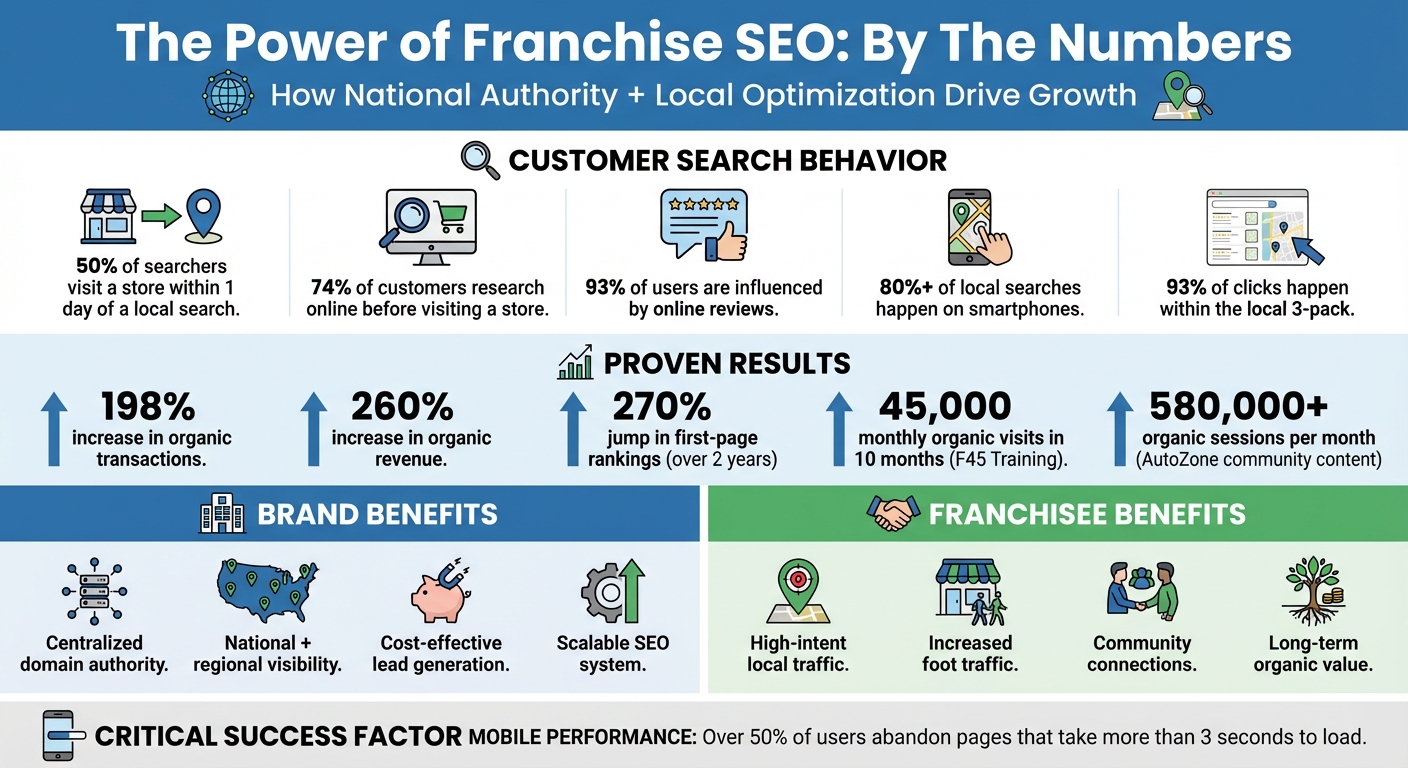
Impact of Franchise SEO: Key Statistics and Benefits for Brands and Franchisees
Franchise SEO: Strategies for Local and National Impact | Scorpion Insights
How Franchise SEO Benefits the Brand
Franchise SEO brings together the ranking power of all franchise locations under a single domain. By using a subfolder structure (e.g., brand.com/locations/dallas), the national brand’s established authority flows directly to each local page. This setup gives new franchise locations a head start in local rankings, leveraging the national brand’s credibility. [4].
The impact of this strategy is measurable. By focusing on localized keywords – like “plumbing in Dallas” or “gyms in New York” – brands can capture both local and regional search traffic [1][2]. Creating regional content hubs for states or major cities further boosts visibility in broader, high-volume searches that individual location pages might not cover [2]. Strategic internal linking between regional hubs and local pages also signals to search engines that the brand has extensive market coverage. This combination of keyword targeting and linking strengthens the brand’s national presence while boosting local performance.
Real-world success stories highlight how these strategies work:
“Semrush has 100% helped us rank our local franchises. It all comes back to credibility.” – Becky Lane, Director of Marketing, Sam The Concrete Man [7]
Another critical aspect is reputation management across all franchise locations. A poorly rated location can harm the national brand’s image, so maintaining consistent positive reviews is essential [5]. Positive feedback doesn’t just protect the brand’s reputation – it directly influences search rankings. Google also uses review snippets to enhance organic visibility and improve click-through rates [5].
On the technical side, implementing the LocalBusiness schema for every location page ensures search engines can accurately interpret key information like the business name, address, phone number, hours, and services [1]. Additionally, maintaining consistent NAP (Name, Address, Phone) details across platforms – even in small details like “St.” versus “Street” – reinforces the brand’s legitimacy and supports Google’s E-E-A-T (Experience, Expertise, Authoritativeness, and Trustworthiness) signals [4].
Together, these efforts create a self-sustaining system where SEO investments continually build on one another, driving long-term growth. By merging technical precision with brand authority, franchise SEO not only strengthens the national presence but also enhances the performance of individual franchise locations.
How Franchise SEO Benefits Franchisees
While the national brand establishes overall authority, individual franchisees see the most direct revenue gains from local SEO efforts. Local SEO attracts high-intent traffic, often leading to immediate conversions. These optimizations not only increase foot traffic but also strengthen ties within the community.
Local Search Optimization
For franchisees, success in local SEO starts with Google Business Profile (GBP). Claiming and verifying each location’s GBP ensures visibility in the “Local Pack.” Profiles featuring high-quality photos, accurate hours, and detailed service descriptions get more clicks compared to incomplete listings [5]. Beyond GBP, maintaining NAP (Name, Address, Phone) consistency across platforms like Yelp, Facebook, and the main website builds trust with search engines and avoids confusing customers [6][2].
Each franchise location benefits from having its own landing page, tailored with local keywords in meta tags and headers. For example, instead of generic descriptions, phrases like “emergency plumbing in Dallas 75201” can boost visibility [3][10]. Adding local touches – like staff photos, embedded Google Maps, and neighborhood-specific content – not only avoids duplicate content issues but also boosts relevance [2][4]. Using a local area code instead of a toll-free number further signals a strong community presence to both Google and potential customers [10][2].
Take F45 Training as an example: their localized pages brought in 45,000 monthly organic visits within 10 months [2]. Similarly, Lawn Love ranks highly for “lawn care service” in cities like Philadelphia and Raleigh by focusing on high-quality localized pages instead of generic templates [1]. Optimized local listings don’t just improve search rankings – they drive real-world engagement.
Increasing Foot Traffic and Sales
Strong local search visibility directly impacts revenue. Half of all searchers visit a physical store within a day of conducting a local search [6], and 74% of customers research online before visiting to confirm store hours, product availability, and more [8]. Franchisees that rank well in local searches capture these ready-to-act customers.
Reviews also play a critical role. With 93% of users influenced by reviews, actively encouraging customer feedback can boost conversions and improve local rankings [8][6]. Reviews not only enhance trust but also create rich snippets in search results, increasing click-through rates [8][5].
Unlike paid ads, which stop delivering results once the budget runs out, franchise SEO provides long-term value. For instance, one case study showed a 198% increase in organic transactions and a 260% rise in organic revenue through localized SEO efforts [6].
Connecting with the Local Community
Beyond optimization, community-focused strategies help franchisees deepen their local connections. Instead of relying on generic content, successful locations publish city-specific blog posts like “Top 5 Summer Events in [City]” or share testimonials that reference local landmarks [4][2]. This approach not only enhances relevance but also attracts backlinks from community websites.
Building local backlinks further strengthens a franchisee’s position in the community. Sponsoring youth sports teams, joining the local Chamber of Commerce, or partnering with nearby charities can earn valuable links from “Sponsors” pages or community directories [4]. These backlinks signal to search engines that the franchise is a trusted part of the local ecosystem.
For instance, AutoZone uses community-focused content to address DIY queries like “check engine light.” This strategy generates over 580,000 organic sessions per month by reaching customers early in their research process, often before they visit a store [1].
| Strategy Component | Franchisee Benefit | Key Implementation Task |
|---|---|---|
| Google Business Profile | Visibility in Map Pack | Claim, verify, and add high-quality local photos |
| Location Landing Pages | Ranks for “Near Me” queries | Create unique content for each location (e.g., /locations/city) |
| Review Generation | Higher conversion rates | Use in-store QR codes to link directly to review pages |
| Structured Data | Rich snippets in SERPs | Add LocalBusiness schema with consistent NAP and hours |
| Local Backlinks | Community authority | Join the local Chamber of Commerce and get listed |
With over 80% of local searches happening on smartphones [5], mobile optimization is crucial. Pages must load quickly – over 50% of users abandon mobile pages that take more than three seconds to load [5]. Adding LocalBusiness schema markup ensures search engines display rich snippets like operating hours and star ratings, making listings more appealing in mobile search results [5][1].
sbb-itb-16c0a3c
SEO Strategies for Franchises
Franchise SEO is all about finding the right balance between maintaining brand consistency and tailoring efforts for local audiences. A solid strategy ensures every location performs well in search results without running into duplicate content or technical issues. Let’s break it down into three key focus areas.
Setting Up Website Structure for Multiple Locations
The backbone of Franchise SEO lies in how your website is structured. A single domain with subfolders like brand.com/locations/city-name is ideal for keeping SEO authority centralized while giving each location its own space to shine [5][2].
For franchises offering various services, a subfolder hub structure works even better. Instead of a single page per location, create hubs like brand.com/city/service-name to target service-specific local keywords. A great example is F45 Training, which used this approach to hit 45,000 monthly organic visits in just 10 months. They used consistent templates for studio pages, featuring unique class schedules, team bios, and location-specific descriptions [2].
To avoid duplicate content issues, each location page should have 600–900 words of unique, locally relevant copy. Include elements like staff photos, FAQs tailored to the region, and testimonials referencing local landmarks. If Google flags pages as “Crawled – currently not indexed” in Search Console, it’s often a sign of overly templated content [1][3].
Another must-have is LocalBusiness structured data (JSON-LD), which helps search engines understand critical details like your Name, Address, Phone (NAP), hours, and services. For example, Food Network saw a 35% boost in visits after implementing structured data across 80% of its pages [5].
“Franchise SEO fails not because it’s difficult, but because it’s misunderstood. Traditional SEO strategies focus on optimizing a single website. But franchising isn’t a single-site problem; it’s a multi-location growth engine.”
– Fahim Ludin, CEO, Macro Digital [9]
Once your website structure is optimized, the next step is to measure performance and fine-tune your strategy.
Using Analytics to Track Performance
Tracking the right metrics across all locations is essential. Focus on key performance indicators (KPIs) like keyword rankings by city, local pack visibility, organic leads, service-page traffic, review velocity, and Google Business Profile interactions [9].
Call tracking tools like CallRail or WildJar can help connect online searches to offline conversions. These tools assign unique phone numbers to each location, so you can see which branches or campaigns are driving calls – a crucial insight since many franchise customers prefer calling over filling out forms [2].
Instead of relying on national averages, use Google Analytics to segment performance by geographic area. Tools like Ahrefs or Semrush can also help monitor your share of voice against local competitors [2]. Don’t forget to regularly check Core Web Vitals (LCP, INP, CLS) to ensure your site delivers top-notch mobile performance [5].
“Consistency makes your SEO system scalable, and franchisees love transparency.”
– Fahim Ludin, CEO, Macro Digital [9]
One franchise that embraced localized SEO tracking saw a 198% increase in organic transactions and a 260% jump in organic revenue [6]. With this data in hand, you’ll be ready to strengthen local authority through backlinks.
Building High-Quality Backlinks
Backlinks are a trust signal, and securing strong local links for each location page can make a big difference. Prioritize partnerships with local organizations, like Chambers of Commerce, charities, or youth sports teams, to earn links from their websites [3][4][5]. These local links carry more weight than generic national directories.
Use tools like “Link Intersect” to identify local websites that link to competitors but not to your franchise locations [3][2][5]. Another effective tactic is creating city-specific content that naturally attracts backlinks. For example, write blog posts like “Top 10 Summer Events in [City]” or conduct local research that news outlets and local blogs might reference [3][4][5].
Avoid shortcuts like buying bulk links or engaging in forum spam, as these tactics can harm your site’s reputation and lead to penalties [5]. Instead, focus on geographic relevance. A link from a local Chamber of Commerce or city government site is far more valuable than a generic directory listing.
“Semrush has 100% helped us rank our local franchises. It all comes back to credibility.”
– Becky Lane, Director of Marketing, Sam The Concrete Man [7]
Conclusion
Franchise SEO operates as a powerful tool for growth, driving both brand recognition on a national level and visibility in local markets. For franchisors, it amplifies brand authority, increases the overall franchise value, and generates cost-effective leads. For franchisees, it connects them with local customers actively searching for their services, turning online interest into in-store visits and sales. Unlike paid ads, which offer short-term visibility, SEO delivers lasting benefits that build brand equity over time. This combination of national and local strategies creates a scalable framework for growth.
Consider this: 50% of searchers visit a store within a day of searching, and 93% of clicks happen within the local 3-pack. Localized SEO has shown impressive results, including a 198% rise in organic transactions and a 260% increase in organic revenue [6]. One environmental services franchise saw a 270% jump in tracked queries ranking on the first page of search results over two years [1].
Yet, many franchises fail to fully leverage SEO, often relying on generic templates and inconsistent strategies. Brands that prioritize Franchise SEO – by structuring their websites effectively, maintaining accurate NAP (Name, Address, Phone) data, creating tailored local content, and building strong backlinks – are capturing market share while competitors struggle to stay visible.
Key Takeaways for Franchisors and Franchisees
A unified and well-planned approach can strengthen both national credibility and local relevance.
For franchisors: Establish a scalable structure using subfolders like brand.com/locations/city-name to consolidate domain authority. Centralize technical SEO efforts, including schema markup and site architecture. Provide franchisees with a “Local SEO Playbook” that outlines clear steps for managing NAP data, creating local content, and optimizing Google Business Profiles while maintaining brand consistency [4].
For franchisees: Success lies in executing local strategies effectively. Ensure your Google Business Profile links to your specific location page. Develop content that resonates with your community – introduce your team, highlight local services, and manage customer reviews actively. With 85% of consumers trusting online reviews as much as personal recommendations and 74% of in-store shoppers researching online first [8], your local SEO efforts can make or break a customer’s decision to choose you over a nearby competitor.
In short, Franchise SEO bridges national authority with local relevance. When franchisors and franchisees work together on this strategy, the results grow exponentially, creating a long-term competitive edge that only strengthens with time.
FAQs
How does Franchise SEO improve both national and local search rankings?
Franchise SEO amplifies a brand’s visibility by using scalable strategies such as in-depth keyword research, creating high-quality content, and fine-tuning technical aspects of the main website. These steps help the franchise rank for broad, brand-level search terms and establish authority on a national level.
At the same time, it sharpens the focus on local search optimization for individual franchise locations. This involves building geo-specific landing pages, optimizing Google Business Profiles, maintaining consistent NAP (Name, Address, Phone) details, and encouraging location-based reviews. These tactics ensure that each location captures “near-me” searches and secures a spot in Google’s Local Pack, where a significant portion of local search activity happens.
By blending national and local SEO efforts, Franchise SEO creates a system where the brand’s overall authority strengthens local rankings, while robust local signals enhance the brand’s broader search presence. This synergy drives more traffic, generates leads, and boosts conversions for both the franchisor and franchisees.
How does Google Business Profile support local SEO for franchisees?
Google Business Profile (formerly known as Google My Business) is an essential tool for franchisees aiming to improve local SEO. By setting up a well-optimized profile for each franchise location, businesses ensure that key details – like Name, Address, and Phone (NAP) – are accurately displayed. This helps Google showcase their locations in local search results and on Google Maps, making it easier for potential customers to find them through searches like “coffee shop near me.”
A polished profile does more than just boost visibility. It can drive more clicks, bring in foot traffic, and highlight critical information like operating hours, customer reviews, photos, and available services. Plus, it helps cut down on client acquisition costs by attracting organic leads without relying on paid advertising. Maintaining consistency and accuracy across all franchise profiles not only strengthens the brand’s reputation but also avoids duplicate content issues, solidifying its role as a cornerstone of any franchise’s local SEO plan.
Why is it important to keep NAP data consistent for franchise SEO?
Keeping your NAP data (Name, Address, Phone Number) consistent is a key factor in franchise SEO. Why? Because it helps search engines correctly associate each franchise location with its accurate details. This not only boosts local search rankings but also avoids the pitfalls of outdated or mismatched information.
When NAP data isn’t consistent, it can hurt your visibility in search results, making it harder for potential customers to find your locations. Uniform NAP details across all platforms create trust – not just with search engines but with users too. And that trust translates into more traffic and leads for every franchise location.