

SEO shortcuts might seem tempting, but they often lead to penalties, wasted resources, and long-term damage. Here’s why quick fixes like keyword stuffing, AI-generated content, and buying backlinks fail:
- Keyword stuffing: Violates search engine guidelines, reduces readability, and increases bounce rates.
- AI-generated content: Often lacks originality and fails to meet Google’s quality standards.
- Buying backlinks: Risks penalties and ranking drops after algorithm updates.
- One-time content updates: Fails to keep up with changing trends and user needs.
Instead, focus on creating content that provides real value to users. Write for people, not just search engines, and update your content regularly to maintain relevance. Avoid chasing temporary gains – lasting success comes from consistent, high-quality work.
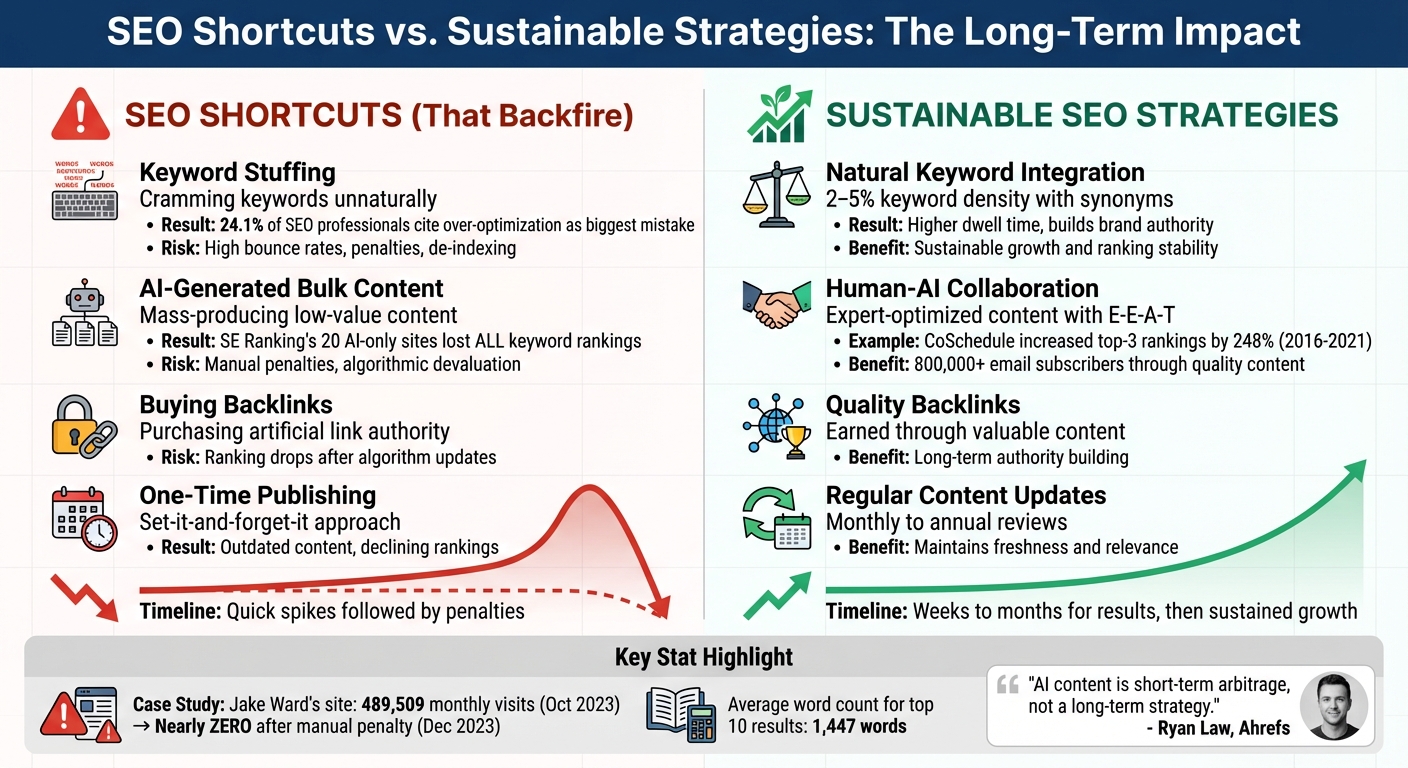
SEO Shortcuts vs Sustainable SEO Strategies Comparison
Stop Using These Outdated SEO Shortcuts Immediately (They’re Killing Your Rankings)
Common SEO Shortcuts That Backfire
Some SEO tactics might seem like clever hacks at first, but they often end up doing more harm than good in the long run. Let’s explore a few common shortcuts that can undermine your SEO success.
Keyword Stuffing: Why It Hurts Your Rankings
Keyword stuffing – cramming as many keywords as possible into your content – violates search engine spam policies and can lead to penalties or even removal from search results [4]. Modern algorithms like Google’s Panda, BERT, and MUM prioritize context and user intent over sheer keyword frequency. Over-optimized content not only fails to rank well but also drives users away, increasing bounce rates because it doesn’t meet their expectations [5].
“Keyword stuffing is actual spam and tends to be repeating a term in non-sensical patterns over and over… it just tends to be not helpful writing.”
- Danny Sullivan, Search Liaison, Google [8]
In a survey of 58 SEO professionals, 24.1% flagged over-optimization as one of the biggest SEO shortcut mistakes [6]. Keyword stuffing can also harm accessibility – filling alt text with irrelevant keywords creates nonsensical descriptions for screen readers [7]. Other outdated tactics like hiding keywords with white-on-white text or using 0px font sizes are easily detected by search engines. Instead, aim for a balanced approach: use synonyms, related phrases, and long-tail keywords naturally, keeping keyword density around 2% to 5% [8].
| Feature | Keyword Stuffing (SEO Shortcut) | Natural, Context-Driven Writing |
|---|---|---|
| Primary Goal | Manipulate search engine bots | Provide value to human readers |
| Readability | Stilted, repetitive, and awkward | Fluid, engaging, and professional |
| Search Strategy | Exact-match repetition | Use of synonyms and related topics |
| User Engagement | High bounce rates; low trust | Higher dwell time; builds brand authority |
| Long-term Risk | High risk of penalties/de-indexing | Sustainable growth and ranking stability |
Keyword stuffing is just one example of how short-term thinking can derail your SEO efforts. Other shortcuts, like relying on AI-generated content, can be equally damaging.
AI-Generated Bulk Content: Lacking Quality
While AI can be a helpful tool, relying on it for bulk content creation often backfires. AI-generated content tends to lack originality and fails to pass the scrutiny of search engine algorithms [10]. For example, SEO software company SE Ranking experimented by creating 20 websites filled entirely with AI-generated articles. Initially, these sites saw a boost in performance, but they eventually lost all keyword rankings – likely due to a manual review or algorithmic update [10].
Google has explicitly warned against “scaled content abuse”, where AI is used to churn out large volumes of low-value material. Since AI often rehashes existing information without adding meaningful insights, it misses the human touch needed to build trust and authority [9]. In fact, 6.9% of SEO experts identified generic, AI-generated content as a problematic practice [6].
“Using generative AI tools or other similar tools to generate many pages without adding value for users may violate Google’s spam policy on scaled content abuse.”
If you use AI in your workflow, treat it as a support tool for brainstorming, research, or outlining. Always enhance AI-generated drafts with your own expertise, unique data, and personal insights. This ensures your content aligns with Google’s E-E-A-T (experience, expertise, authoritativeness, and trustworthiness) standards [10].
The Problem with One-Time Content Updates
Another common misstep is treating SEO as a “set-it-and-forget-it” task. Publishing content once and never revisiting it leaves your site vulnerable to becoming outdated as information changes and competitors improve their resources [2]. SEO is a long-term game, with ranking improvements often taking weeks or months to materialize [12]. Regular updates and a steady publishing schedule – even monthly – signal to search engines that your site is active and reliable. Conducting content audits can help you spot declining traffic, broken links, or outdated material [2].
“SEO is a long-term strategy: ranking improvements typically take weeks or months to appear. Be skeptical of anyone promising overnight results.”
Instead of focusing solely on pushing out new content, prioritize refreshing and upgrading what you already have. Aim to create “10x content” – material that significantly outperforms existing top-ranking pages – and use internal links to spread SEO value across your site [11][4].
“Publishing just for the sake of it often leads to thin content and a poor user experience. Instead, growing SEO traffic can come from refreshing and improving existing content.”
- Adam Riemer, Digital Marketing Strategist, Search Engine Land [2]
sbb-itb-16c0a3c
How to Create SEO Content That Lasts
If you’re aiming for long-term SEO success, forget the shortcuts. Instead, focus on a well-rounded, human-first approach that prioritizes value over quick wins.
Write for People, Not Just Search Engines
The best SEO content addresses real problems and meets readers’ needs. Google’s Helpful Content Updates emphasize this by rewarding content that prioritizes searchers over algorithms. This is where E‑E‑A‑T – experience, expertise, authoritativeness, and trustworthiness – comes into play.
Rather than obsessing over exact-match keywords, aim for information gain. What can you add to the conversation that’s not already in the top search results? For example, between 2016 and 2021, CoSchedule‘s detailed, actionable content increased top-three rankings by 248% and grew its email list to over 800,000 subscribers [15][16].
“Does content also demonstrate that it was produced with some degree of experience, such as with actual use of a product, having actually visited a place or communicating what a person experienced?” – Google Search Quality Rater Guidelines [17]
Structure matters too. Use short sentences, subheadings, and bullet points to make your content easy to scan. Brian Dean’s 3,334-word guide on “SEO Copywriting” is a great example – it ranked #1 for its target keyword by delivering thorough value and unique frameworks [15][17]. While the average word count for top 10 results is around 1,447 words, quality always outweighs length.
By focusing on providing genuine value, you’re setting up a strategy that can adapt and thrive over time.
Keep Your Content Updated
Publishing content once and leaving it untouched is a recipe for declining rankings. Search engines prioritize freshness, meaning your content should reflect up-to-date data, trends, and user needs [14][16]. The frequency of updates depends on your industry. Fast-moving topics might need monthly reviews, while evergreen content could be checked annually [19].
“Great content is continually refined. The world changes fast, and that leaves content online that is dated, inaccurate, or at worst, misleading.” – Claire Brain, SEO Specialist [19]
Regular updates help prevent content decay and improve rankings. During reviews, fix broken links, update outdated facts, and refresh examples. If your title references a specific year, keep it current – change “Top SEO Tools in 2024” to “2025” as needed [18]. Also, stay alert to Google algorithm updates and adjust your content accordingly [19].
Don’t overlook existing content. Articles sitting on page two of search results are ripe for optimization. With a few smart updates, these pages can climb into the top three spots, capturing significantly more traffic [18][13].
How RankWriters Delivers Long-Term Results

RankWriters takes a sustainable approach to SEO by combining ongoing research, optimized content, and routine updates. Their subscription model includes competitive research, keyword and topic analysis, monthly blog posts, detailed reporting, and six-month content reviews [16].
Unlike bulk content mills or outdated keyword-stuffing tactics, RankWriters creates “10x content” – content that’s ten times better than anything currently ranking for your target keywords [11][13]. By naturally integrating keywords and using strategic internal linking, they build site-wide authority.
Subscribers also benefit from performance tracking via Google Analytics. This makes it easy to see what’s working and where tweaks are needed. With automated content delivery and the option to add extra posts, RankWriters ensures consistency without adding to your workload.
| Feature | SEO Shortcuts (Backfire) | RankWriters Approach (Long-Term Success) |
|---|---|---|
| Content Creation | AI-generated bulk content with no oversight | Human-AI collaboration with expert optimization |
| Keyword Strategy | Keyword stuffing and repetitive phrasing | Natural usage with synonyms and related topics |
| Update Frequency | One-time “publish and forget” | Ongoing tracking and six-month updates |
| User Value | Surface-level “copycat” content | Original insights and comprehensive coverage |
| Results Timeline | Quick spikes followed by penalties | Sustainable growth and ranking stability |
“SEO as we know it picked up camp and moved in with content marketing. We have a new roommate.” – CoSchedule [16]
Conclusion: Build for the Long Term, Not Quick Wins
Chasing SEO shortcuts might seem tempting with their promises of instant results, but they often come at a steep cost. Tactics like keyword stuffing, churning out bulk AI-generated content, or sporadic publishing may deliver brief traffic surges, but they also risk long-term damage. A prime example is Jake Ward’s site, which saw an impressive 489,509 monthly visits by October 2023. However, after receiving a manual penalty in December 2023, his traffic nosedived to nearly zero [20]. This stark outcome highlights why focusing on quality and steady growth is the smarter, more sustainable path.
The numbers don’t lie – quick fixes often lead to significant ranking losses and harsh penalties, especially after algorithm updates [1]. It’s a risky game, and one that rarely pays off in the long run.
“AI content is short-term arbitrage, not a long-term strategy.” – Ryan Law, Director of Content Marketing, Ahrefs [20]
True and lasting SEO success is built step by step, through consistent, high-quality content that earns trust over time [3]. This means prioritizing original ideas, keeping content updated, and always writing with real users in mind – not just search engines. Companies like RankWriters champion this sustainable approach, offering services like in-depth competitive research, optimized monthly blog posts, six-month content reviews, and performance tracking. These strategies create a strong, enduring advantage that competitors can’t easily replicate.
The choice is clear: you can either chase fleeting quick wins or commit to a strategy that grows and strengthens over time. Sustainable rankings come to those who create content that people want to read, share, and link to.
FAQs
Why does keyword stuffing harm your SEO rankings?
Keyword stuffing can hurt your SEO rankings by producing content that feels spammy and unappealing to readers. Search engines like Google are quick to penalize this tactic since it goes against their guidelines, which can push your site further down the search results.
Rather than improving your rankings, keyword stuffing damages your credibility with both search engines and your audience. The better approach? Write high-quality, engaging content that seamlessly includes relevant keywords. This way, you can build trust and achieve long-term SEO success.
How can using AI-generated content hurt my website’s SEO performance?
AI-generated content can hurt your SEO if it falls short in quality, contains inaccuracies, or duplicates existing material without offering genuine value to readers. Search engines like Google emphasize content that showcases expertise, authority, and trustworthiness (E-A-T). If your AI-generated content is poorly executed, it could trigger penalties under systems like Google’s Helpful Content update or even be flagged as spam. This can result in lower rankings – or worse, removal from search results altogether.
To steer clear of these pitfalls, prioritize original, well-researched, and audience-focused content that complies with search engine standards. AI tools can be helpful for brainstorming or drafting, but human oversight is crucial to maintain quality and ensure the content resonates with your audience.
Why is it important to regularly update your SEO content?
Keeping your SEO content up-to-date is key to staying relevant and in tune with current search trends. Regular updates can help maintain or even improve your search rankings, bring in steady organic traffic, and increase conversions.
Refreshing content also gives you the chance to target new keywords and adjust to shifts in search engine algorithms, which can help safeguard your rankings. It’s a smart way to ensure your content continues to meet both reader needs and search engine requirements as time goes on.