

When it comes to growing your brand’s visibility in AI-driven search results, knowing how to build brand mentions across external sites is key. These are references to your brand on third-party websites, even without a link. AI systems use these mentions to evaluate your brand’s relevance and authority. Here’s a quick summary of how to build and maintain strong external mentions:
- Why It Matters: AI prioritizes mentions from independent sources over your own website. About 85% of brand mentions in AI search engines come from third-party pages.
- How It Works: AI uses natural language processing to assess the context and frequency of mentions, linking your brand to specific topics or expertise areas.
- What To Do: Focus on guest content, media coverage, and partnerships to get your brand mentioned on trusted platforms. Consistency in your brand’s name, description, and topics across all mentions is critical.
Key Takeaway: External mentions are more influential than traditional backlinks for AI visibility. To stand out, ensure your brand is frequently and consistently referenced in relevant, trusted sources.
Why External Mentions Outweigh On-Site Optimization
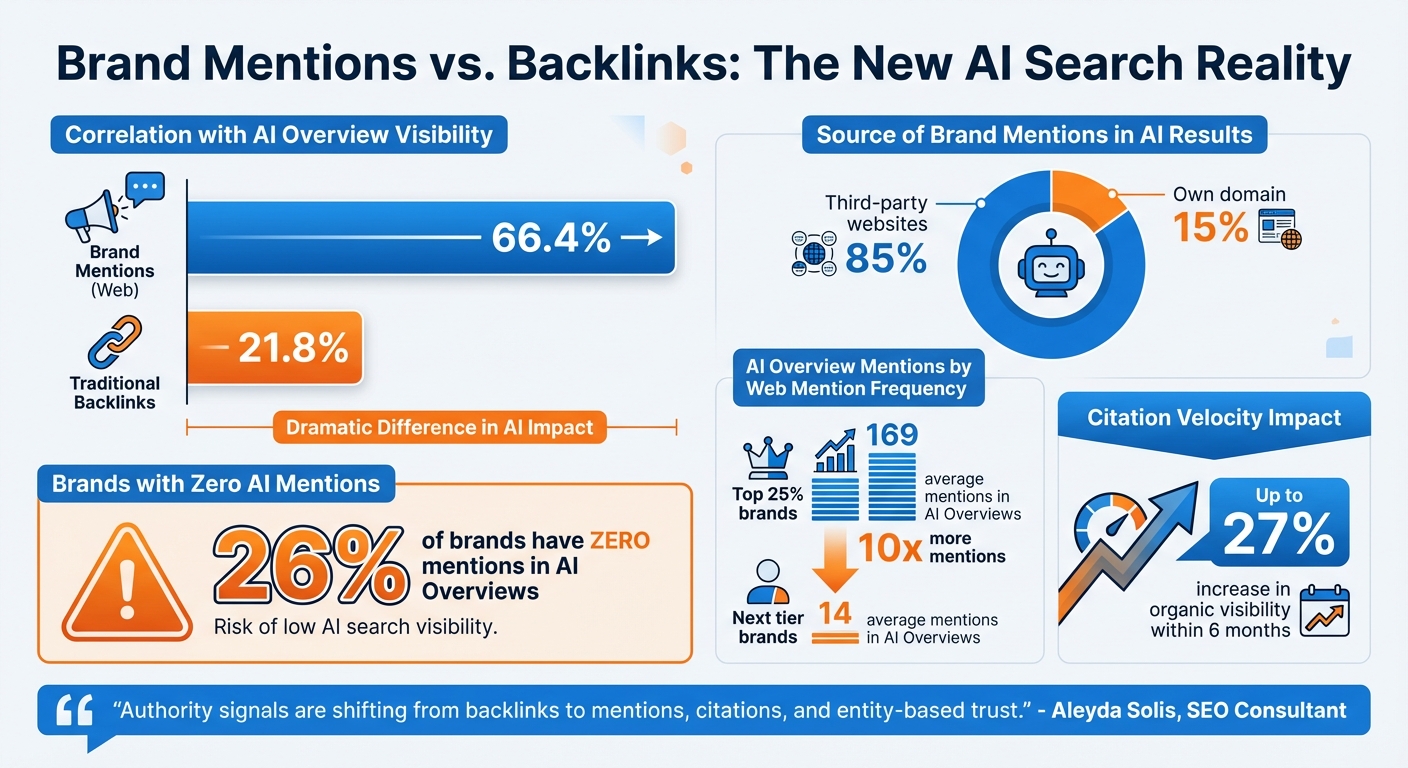
Brand Mentions vs Backlinks: AI Search Visibility Statistics
Your website content tells AI systems what you say you are. External mentions, on the other hand, reveal what others believe you are. This distinction plays a crucial role in how AI systems differentiate between self-promotion and genuine credibility.
Independent Validation vs. Self-Promotion
AI systems view the content on your website as raw data – essentially, your claims about yourself. External mentions from third-party sources, however, act as validation points, confirming or supporting those claims [5][1]. For instance, a mention in an industry journal, a customer review, or even a forum discussion serves as a stamp of authenticity for AI systems.
The numbers back this up. Brand mentions on the web, whether linked or unlinked, show a 0.664 correlation with AI Overview visibility, while traditional backlinks only correlate at 0.218 [8]. Why? AI systems dive deep into the semantic context across the web. A genuine mention in an external conversation often carries more weight than the most polished landing page [6].
“Unlinked mentions – text written about your brand on other websites – have very little impact on SEO, but a much bigger impact on GEO… LLMs derive their understanding of a brand’s authority from words on the page.”
How AI Systems Prioritize Independent Sources
AI systems rely heavily on independent validation to build what’s known as entity confidence. This involves tracking how often your brand is mentioned in connection with certain topics across a variety of trusted platforms [5][6]. These patterns help AI systems link your brand to specific areas of expertise. When tools like ChatGPT or Perplexity detect consistent mentions of your brand in reputable sources – such as news outlets, directories, or community forums – they treat these as signals of credibility [1].
The data tells a compelling story. Brands in the top 25% for web mention frequency receive 10 times more mentions in AI Overviews than those in the next tier, averaging 169 mentions compared to just 14 [8]. On the flip side, about 26% of brands have zero mentions in AI Overviews, often because they lack a strong external presence [8]. Even if your on-site optimization is top-notch, without validation from trusted third-party sources, AI systems may overlook you entirely.
How to Build Brand Mentions Across External Sites
To build brand mentions effectively, focus on earning credibility rather than relying on self-promotion. The aim is to position your brand in places where AI systems already seek authoritative signals. You can achieve this by concentrating on three main approaches: contributing guest content to industry websites, securing PR placements in media outlets, and obtaining citations through partnerships and directories. Expanding your efforts beyond guest content into media features and strategic collaborations will further strengthen your brand’s presence.
Guest Content on Industry Sites
Writing guest articles for respected industry websites helps establish your brand as an expert in its field. AI systems often assess co-occurrence – how frequently your brand is mentioned alongside specific topics across the web [1][2]. By contributing to niche platforms, you ensure your brand is associated with the right context for AI classification.
Choose platforms with strict editorial standards, as these provide stronger trust signals that AI systems value [5]. Use bylines from your team’s experts to showcase their credentials and real-world expertise. Be sure to include clear descriptions of your brand’s offerings and target audience. For instance, adding phrases like “XYZ, a leader in SaaS security” helps AI systems categorize your brand accurately [1][10].
Guest articles also serve as discrete citation units – pieces of verifiable information that AI systems can extract. Sharing proprietary data or unique insights, rather than generic promotional content, increases your chances of being cited more frequently [4][11].
PR Placements and Media Coverage
Beyond guest posts, securing coverage in reputable media outlets can further enhance your brand’s credibility. Features in high-profile publications generate valuable mentions that AI systems recognize as authoritative.
When pitching to journalists, offer them proprietary data, original research, or ready-to-use quotes rather than generic requests [1][2]. Focus on reporters who have recently covered topics relevant to your industry, and use tools like HARO, Qwoted, or Featured.com to respond to active media queries [12]. Aim for coverage in tier-one outlets such as The Wall Street Journal or TechCrunch to solidify your authority.
Citations and Partnership Announcements
Strengthen your brand’s AI trust signals by leveraging partnerships and maintaining consistent directory listings. Collaborations with other brands create dense connections that signal relevance to AI systems.
Ensure consistency in how your brand name, logo, and description appear in partnership announcements and directory listings [5]. Update your Organization schema with “sameAs” properties that link to trusted platforms like LinkedIn, Wikipedia, and Crunchbase [5][11], allowing AI systems to verify your brand identity across multiple sources.
Additionally, focus on securing mentions on “Citation Core” sites – high-authority platforms that AI frequently references. These include trade associations, professional directories, and leading industry publications [5][9]. Keep your Wikidata and Crunchbase profiles current, reflecting all partnerships and roles, to ensure your inclusion in knowledge graphs and other AI-driven systems [6][9].
sbb-itb-16c0a3c
Maintaining Consistency Across Brand Mentions
AI systems rely on consistent signals to accurately identify and understand your brand. When your brand’s name, description, or topic associations vary across platforms, it can confuse these systems, fragment your entity profile, and lower the chances of being cited. Keeping things consistent is key to establishing a strong identity and aligning your brand with the right topics – both of which are explored further in the following sections.
Consistency in Brand Name and Description
Your brand name, logo, and description should remain the same across all external platforms, including LinkedIn, Google Business Profile, industry directories, and guest bylines. AI systems use Natural Language Processing (NLP) to determine if different mentions refer to the same entity [1]. By maintaining uniform branding, you send clear “entity identity signals” that help AI systems verify your brand as a single, trustworthy entity [5].
On the flip side, inconsistent details across platforms can weaken these signals, making it harder for AI to trust your brand [3]. To avoid this, regularly audit your brand profiles to ensure they’re accurate and up-to-date. Additionally, use Organization schema on your homepage with “sameAs” properties that link to your official profiles on platforms like LinkedIn, Wikipedia, and Crunchbase [5]. Once your brand is consistently represented, the next step is to ensure these mentions align closely with your core industry themes.
Aligning Mentions with Your Core Topics
Consistency goes beyond visual and textual branding – it also extends to the topics your brand is associated with. AI models utilize “vector space” concepts to understand relationships, meaning that when your brand name frequently appears alongside specific topics (e.g., “Brand X” and “email marketing”), the AI begins to associate your brand with those subjects and relevant competitors [6]. This semantic pairing strengthens your authority in those areas.
To reinforce these connections, include explicit category keywords alongside your brand mentions in guest posts, press releases, or partnership announcements [1]. For example, consistently describing your business as “XYZ, a B2B lead generation platform” rather than alternating between terms like “marketing software” or “sales tool” helps maintain a clear topical focus. This targeted approach ensures AI systems can accurately map your brand within knowledge graphs, boosting your visibility and trustworthiness [6].
Building Brand Mentions into Your AI Visibility Strategy
External brand mentions play a crucial role in boosting your AI visibility. AI systems assess brand authority by analyzing three interconnected layers: Owned (your website and social profiles), Earned (external mentions and backlinks), and Structured (schema markup and knowledge graphs). When these layers align, AI models like ChatGPT, Gemini, and Perplexity are more likely to recognize your brand as a credible source worth citing [14].
To make the most of external mentions, your brand needs a clear on-site entity that AI can verify. This means ensuring your website is equipped with proper Organization schema and consistently covers relevant topics. Without these elements, AI systems struggle to connect your brand mentions to your site, leaving potential citations untapped [5][13]. By thoroughly covering your core topics, you give AI a reliable page to cite whenever your brand name appears elsewhere [14].
External mentions also kickstart a branded search loop. When people come across your brand in articles, press releases, or even Reddit threads, they often search for terms like “[Brand] reviews” or “[Brand] alternatives.” These searches serve as demand signals that AI systems use to prioritize which brands to recommend [1]. Brands that maintain steady growth in “Citation Velocity” – the rate of new mentions – can see up to a 27% increase in organic visibility within six months [14].
“Authority signals are shifting from backlinks to mentions, citations, and entity-based trust.” – Aleyda Solis, SEO Consultant [1]
The landscape is evolving. While backlinks still matter, especially when they come from trusted sources, brand mentions now hold the top spot in influencing AI visibility. Backlink volume, once a key factor, ranks much lower today [15]. This shift emphasizes the importance of building mentions in the publications and communities your audience already trusts. It’s not about reaching the widest audience but ensuring your mentions are relevant to where your potential buyers seek advice [1]. This focus on relevance builds a strong foundation for leveraging external mentions in your AI strategy.
Tracking and Adjusting Your Mention Strategy
To measure success, focus on AI Share of Voice (ASoV) – how often your brand is cited compared to competitors in AI-generated answers [16]. Traditional click-through rates no longer tell the full story, as AI aims to fulfill user intent without requiring a click. The new goal is to become the cited source in this zero-click environment [11].
Start by auditing your AI citations across platforms like ChatGPT, Gemini, Claude, and Perplexity. Search for your target queries and see if your brand is cited. If not, analyze the sources that are. Look for structural elements like tables, data points, or FAQPage schema that might be missing from your content [4]. Since each AI model has unique training data and retrieval methods, tracking across multiple platforms is essential for a complete picture [7].
Key metrics to monitor include Citation Frequency (how often your domain is explicitly mentioned) and AI Impression Share (how often your brand appears in AI overviews or chat results) [16]. Brands in the top 25% for web mentions earn up to 10x more AI Overview mentions than those in the lower quartiles [15]. Tools like Semrush‘s Prompt Tracking or Mention Network can help you track these metrics and identify gaps in your strategy [7][5].
Additionally, keep an eye on the rankings of third-party sites that mention your brand. If their rankings drop, your AI visibility may decline too [15]. When this happens, consider reaching out to editors with updated data, fresh statistics, or even affiliate commissions to secure better placements or refreshed mentions [15].
“Getting your brand to show up in AI search is really going to come down to whether or not you have a technology that can give you visibility into where you’re mentioned and where you’re cited by AI.” – Patrick Reinhart, VP, Services and Thought Leadership, Conductor [17]
To maintain relevance, review and update citation-worthy content every 6–12 months. Pay special attention to bottom-of-funnel keywords like “best [product]” or “[competitor] alternatives”, as these are key triggers for AI product recommendations [15]. Regularly track these queries to ensure your mention-building efforts are translating into AI visibility.
Using RankWriters for AI-Optimized Content
Once you’ve gathered insights, strengthen your mention strategy with optimized, citation-friendly content. Building external mentions requires a steady flow of high-quality, credible content both on your site and elsewhere. RankWriters can help by providing blog posts, content strategies, and AI search optimization designed to support your mention-building efforts. Their service delivers monthly blog posts structured for AI ingestion, using tables, bullet points, and schema markup that AI systems can easily extract and cite [4][17].
RankWriters also helps produce what experts call “citation units” – short, factual snippets optimized for AI models to extract and cite [11]. By publishing original research, proprietary data, or definition pages, you create resources that others are compelled to reference. This creates a positive cycle: your on-site content anchors external mentions, which then drive more branded searches and AI citations.
Additionally, RankWriters ensures your website thoroughly covers the topics most associated with your brand, reinforcing the consistency AI systems look for. Without a relevant on-site page to verify your authority, mentions become disconnected signals that fail to enhance visibility [14]. The service includes competitive research, keyword strategies, and content pillars to align your owned content with your earned mentions.
Their AI Search Optimization feature addresses technical requirements AI systems prioritize. This includes adding Organization schema with “sameAs” properties, creating FAQPage markup for common queries, and using an “answer-first” approach – placing concise answers at the start of each section to make them easily liftable for AI citations [16][5]. These technical elements, combined with a robust mention strategy, ensure your brand stands out in AI-driven environments.
Conclusion
External brand mentions are now a critical factor in establishing trust with AI systems like ChatGPT. Interestingly, about 85% of brand mentions in AI search results stem from third-party websites rather than your own domain [1]. This shift highlights how AI systems prioritize independent sources to confirm your credibility before referencing your brand. The more your brand is associated with relevant topics on trusted publications, forums, and industry sites, the stronger your “entity confidence” becomes – bolstering how AI perceives and trusts your brand [5][4]. To thrive in this evolving landscape, a strategic, multi-channel approach is no longer optional; it’s essential.
Tactics like guest posts, PR placements, and partnership announcements play a key role in reinforcing your brand’s credibility [2]. Take, for instance, a form builder in 2025 that actively engaged on Reddit and niche forums. This effort paid off as AI-powered search became its largest acquisition channel, with ChatGPT emerging as the top referral source [9].
Consistency across mentions is equally vital. AI systems rely on uniformity to verify your brand as a single, cohesive entity. When your brand name, description, and core topics are aligned across platforms like LinkedIn, industry directories, press releases, and guest articles, AI can confidently connect those mentions back to your website [5]. On the flip side, inconsistent branding can erode trust and weaken the signals you’ve worked hard to establish.
Tracking metrics like AI share of voice, citation velocity, and external placements is also crucial. Brands that excel in AI search are those that prioritize external mentions as a core part of their visibility strategy, rather than treating them as an afterthought.
Finally, aligning external signals with strong on-site authority completes the loop. RankWriters supports this integrated approach by providing AI-optimized content that strengthens your external mentions while ensuring your website is structured for AI citations. Their monthly blog posts, tailored content strategies, and AI Search Optimization tools help position your brand for success in this AI-driven era.
FAQs
How do AI Search engines evaluate credibility using external brand mentions?
External brand mentions refer to instances where your company, product, or team is highlighted on third-party platforms like news sites, guest blogs, research papers, podcasts, or partnership pages. These mentions act as trust signals for AI systems, indicating that your brand is acknowledged by independent, authoritative sources and is relevant to specific topics.
AI models value mentions that appear repeatedly across a variety of credible sources more than content on your own site. Why? Because these external mentions represent a shared agreement about your brand’s expertise and reliability. For example, being featured in trade publications, academic research, guest posts, or press releases showcases your brand’s credibility and strengthens its presence in knowledge graphs. This, in turn, increases the chances of your brand being referenced in AI-generated responses.
To cultivate these trust signals, consider tactics like publishing guest articles, securing PR placements, earning citations in research, creating co-branded materials with partners, and consistently associating your brand with relevant topics. When these efforts are sustained across diverse and reputable platforms, they not only boost your brand’s visibility but also solidify its trustworthiness in the eyes of AI systems.
What are the best ways to increase brand mentions on external websites?
To increase brand mentions on external websites, focus on building your brand’s trustworthiness and visibility across a variety of independent platforms. AI systems tend to value consistent, repeated mentions more than just on-site content, viewing them as strong trust indicators. Here are a few practical strategies to consider:
- Publish guest content: Share well-researched, insightful articles or guides on respected blogs and industry websites. Offering unique data or expert insights can help your content stand out and earn valuable mentions.
- Tap into PR opportunities: Use press releases to announce product launches, awards, or partnerships, and distribute them to relevant media outlets. Aligning your brand with specific themes or topics can strengthen its presence in AI systems.
- Secure editorial mentions: Contribute data, quotes, or expert opinions for industry reports or news articles. Even without backlinks, these mentions can significantly boost your brand’s visibility.
Consistency is essential. Use the same brand name, tagline, and keywords across all platforms to ensure AI systems recognize your brand as a cohesive entity. By combining these approaches, you can establish a strong presence that AI models are more likely to reference in their outputs.
Why do external brand mentions matter more than backlinks for AI visibility?
External brand mentions have become more impactful than traditional backlinks when it comes to AI-driven search systems. Why? Because they act as independent trust signals, proving a brand’s relevance in the real world. AI models like ChatGPT and Google’s AI Overviews give priority to brands that show up consistently in unlinked, third-party content – think news articles, podcasts, or industry reports – rather than just relying on backlinks from their own websites. When a brand is repeatedly mentioned across a variety of credible sources, it signals authority and accuracy, two critical factors AI systems use when deciding whether to reference a brand.
Although backlinks still matter for traditional search rankings, AI places greater emphasis on context and entity recognition. Mentions in the text of trusted, independent sites help AI understand what a brand is about and whether it’s trustworthy. This makes external mentions a much stronger and more dependable signal for AI visibility than backlinks or even on-site SEO efforts.