

By now, we know that AI tools like ChatGPT and Google AI Overviews are changing how information is discovered online. These systems exhibit clear AI content preferences, prioritizing concise, well-structured, and widely cited content, which directly influences visibility and traffic. To align with these preferences, teams must understand the impact of AI-generated content on search rankings. Based on that data, they can focus on formats like how-to guides, comparison lists, and structured data. Key findings include:
- Short content wins: 53.4% of AI-cited pages are under 1,000 words.
- AI referrals drive conversions: AI traffic converts 23x higher than traditional search.
- Citations matter: AI tools favor authoritative sources like Wikipedia and Reddit.
- Trends to track: AI Overviews dominate informational queries (99.9%), with question-based searches triggering responses 57.9% of the time.
To succeed, monitor referral traffic, citation patterns, and query trends. Use tools like Google Analytics 4 or Ahrefs to track AI-driven traffic and identify content gaps. Regular updates and testing will help you stay visible in AI-driven results.
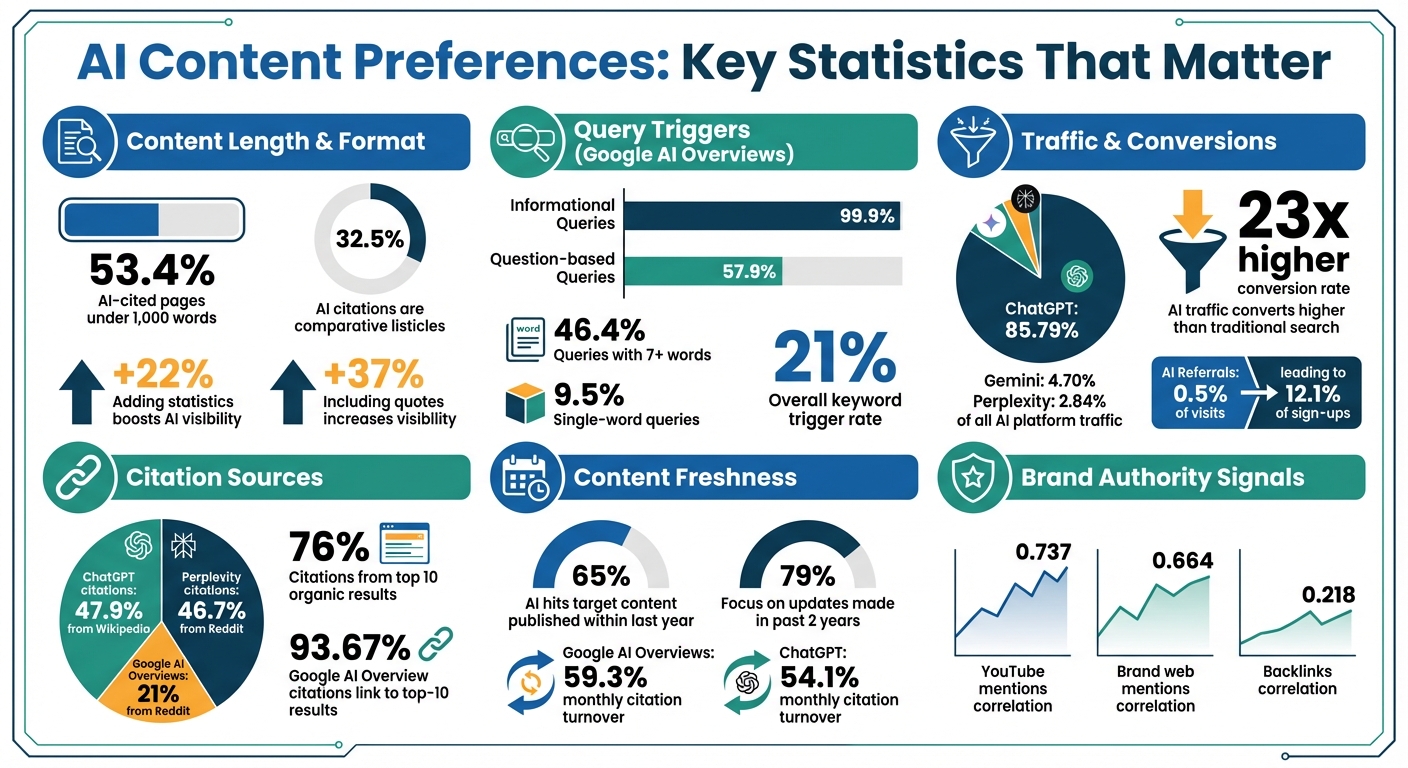
AI Content Preferences: Key Statistics and Performance Metrics
What Are AI Content Preferences
AI content preferences refer to the measurable patterns that guide how AI tools prioritize, retrieve, and cite information. These preferences influence decisions like which sources Google AI Overviews rank, the references ChatGPT uses to answer questions, and the types of content Perplexity selects. Essentially, these preferences are consistent, observable behaviors that shape how AI interacts with content.
These preferences directly impact content visibility. For instance, 76% of citations in Google AI Overviews come from pages already ranking in the top 10 organic search results [1]. Additionally, AI Overviews have reduced website clicks by about 34.5%, as users often find answers directly on the search results page [1]. This phenomenon, often called “The Great Decoupling,” highlights the importance of focusing on brand visibility within AI-generated responses rather than solely aiming to drive traffic [2].
Recognizing these patterns allows you to allocate resources more effectively. Data indicates that AI tools favor certain types of content: they prefer informational over transactional material, trust third-party mentions more than self-promotional content, and prioritize concise answers over lengthy guides. Understanding these tendencies ensures your efforts align with the formats AI tools are more likely to highlight. Let’s dive deeper into how these preferences are reflected in AI ranking decisions and content citations.
How AI Tools Show Content Preferences
AI tools reveal their biases through recurring patterns in three key areas: ranking decisions, query responses, and content citations. For example, Google AI Overviews appear for 21% of all keywords, but this skyrockets to 99.9% for informational searches [1]. Similarly, question-based queries trigger AI responses 57.9% of the time, while longer searches (seven or more words) yield responses 46.4% of the time compared to just 9.5% for single-word queries [1]. These trends demonstrate that AI tools lean heavily toward conversational, detailed queries over simple keyword searches.
Citation trends also shed light on AI preferences. ChatGPT, for instance, sources 47.9% of its citations from Wikipedia, while Perplexity leans on Reddit for 46.7% of its references [10]. Google AI Overviews, on the other hand, cite Reddit in 21% of cases and draw from a broader range of sources [10]. These differences reveal the types of authority each platform values. Interestingly, YouTube mentions show the strongest correlation with AI visibility, at approximately 0.737 across platforms [4]. Brand web mentions also have a strong correlation with AI Overview visibility, at 0.664, which is notably higher than the correlation for backlinks at just 0.218 [8].
“Unlinked mentions – text written about your brand on other websites – have very little impact on SEO, but a much bigger impact on GEO… LLMs derive their understanding of a brand’s authority from words on the page.” – Ryan Law, Director of Content Marketing, Ahrefs [8]
What You Need to Start Analyzing AI Preferences
To analyze AI preferences effectively, start by reviewing server logs for AI crawler activity. Look for user agents like GPTBot, ClaudeBot, and OAI-SearchBot to understand which pages AI models are accessing [7]. Google Search Console is another valuable tool – use it to identify queries that trigger AI Overviews for your content. You can also test manually by asking ChatGPT or Perplexity industry-specific questions and noting which sources they cite.
Focus on identifying patterns rather than pinpointing exact cause-and-effect relationships. AI models are updated frequently, and personalization can influence individual results, so it’s essential to track trends across multiple queries and platforms [2]. Pay attention to which content formats – such as how-to guides, comparison lists, or FAQ pages – are most commonly featured in AI responses. Additionally, monitor brand mentions across the web using tools that measure “AI Share of Voice”, which tracks the percentage of AI mentions your brand receives compared to competitors [2]. Keeping an eye on these trends is a crucial component of your broader strategy for increasing AI visibility and GEO.
Data Signals That Reveal AI Content Preferences
Understanding how AI tools engage with your content comes down to analyzing three key data signals: referral traffic, citation patterns, and the relationship between query types and content formats. These signals don’t offer hard-and-fast rules but instead highlight trends that can guide your approach. Since AI models evolve frequently, tracking consistent patterns over time is crucial for refining your strategy and aligning your content with AI preferences.
Referral Traffic from AI Tools
Referral traffic from AI platforms offers a window into which content types and topics resonate most with AI-generated responses. For instance, as of July 2025, ChatGPT dominates the AI referral landscape, driving a staggering 85.79% of all AI platform traffic with 5,244,855,278 visits. Other platforms like Gemini (4.70%), Perplexity (2.84%), and smaller players such as Grok, Claude, and Microsoft Copilot contribute smaller shares [9].
However, many AI platforms don’t provide referrer data, so a significant portion of this traffic appears as “Direct” in analytics. To pinpoint AI sources, use regex filters in Google Analytics 4. These filters can track session sources like .*chatgpt\.com.*|.*perplexity.*|.*gemini\.google\.com.*|.*copilot\.microsoft\.com.*|.*openai\.com.*|.*claude\.ai.* [5][9].
AI-driven traffic often outperforms traditional search in terms of conversion intent. For example, Ahrefs reported that while AI referrals made up just 0.5% of total visits, they generated 12.1% of sign-ups – a conversion rate 23 times higher than organic search [13]. Similarly, Buffer observed a 185% higher conversion rate from AI referrals compared to organic search [11]. This happens because users arriving via AI responses are often pre-qualified and ready to act.
Another trend to watch is misdirected traffic to non-existent pages. These URLs, generated by AI tools based on your site structure, can indicate demand for specific content. If such pages receive notable traffic, consider creating them or redirecting users to relevant resources [13]. Also, track indirect traffic – users who discover your brand via AI responses and later visit through branded search or by typing your URL directly [13].
With referral traffic insights in hand, the next step is to examine how citation patterns reveal content preferences.
Citation Patterns in AI Responses
AI citations showcase which content platforms trust and reference for specific topics. A citation includes a direct link and attribution, while a mention simply references your brand [11]. Being cited means your content has made it into an AI’s “trusted reference set” for that subject [7].
Different AI platforms have distinct citation behaviors. For example:
- ChatGPT draws 47.9% of its citations from Wikipedia.
- Perplexity heavily relies on Reddit, with 46.7% of its references coming from the platform.
- Google AI Overviews cite Reddit 21% of the time but also pull from a wide range of sources, with 93.67% of citations linking to top-10 organic search results [10].
These patterns reveal what each platform values. ChatGPT leans toward high Domain Rating sources (DR 80-100), Perplexity prioritizes real-time discussions, and Google AI Overviews align closely with traditional search rankings.
The structure and format of your content also play a big role in citation likelihood. Comparative listicles, for instance, account for 32.5% of all AI citations [10]. Adding statistics boosts AI visibility by 22%, while including quotes increases it by 37% [10]. Interestingly, over half (53.4%) of pages cited in Google AI Overviews are under 1,000 words, challenging the notion that only long-form guides get noticed [6].
Citations are highly dynamic, with monthly turnover rates of 59.3% for Google AI Overviews and 54.1% for ChatGPT [10]. AI tools also favor newer content – 65% of AI hits target material published within the last year, and 79% focus on updates made in the past two years [10]. This means keeping your content fresh is essential to staying relevant.
Beyond citations, understanding how query types influence content formats can further refine your strategy.
Query Types and Content Formats
AI responses are heavily influenced by the type of query, which in turn highlights the content formats you should prioritize. Informational queries dominate, with 99.9% of Google AI Overviews triggered by these keywords [1]. Specific query types and their trigger rates include:
- Question-based queries: Trigger AI responses 57.9% of the time.
- “Reason” queries: Asking “why” something happens has the highest trigger rate at 59.8%.
- Longer queries: Queries with seven or more words trigger AI responses 46.4% of the time, compared to just 9.5% for single-word searches [1].
Certain industries see varying trigger rates. For example, medical YMYL queries trigger AI Overviews 44.1% of the time, while financial and legal queries see lower rates at 22.9% and 23.6%, respectively [1].
The relationship between query types and content formats reveals clear patterns:
- Definition queries (47.3% trigger rate): Pair well with concise, structured explanations.
- Instruction queries (35.1% trigger rate): Align with how-to guides and step-by-step content.
- Comparison queries (26.2% trigger rate): Work best with “versus” articles and comparative lists.
- Local search queries: Have the lowest trigger rate at just 7.9%, indicating AI tools deprioritize location-focused content for now [1].
To track these patterns, monitor which pages attract AI referral traffic in Google Analytics 4 and test industry-specific questions across multiple AI platforms. Look for gaps where competitors are mentioned or cited but you aren’t, as these represent opportunities to create content that meets AI preferences [3]. By targeting the right query types and formats, you can better align your content with what AI tools value most.
Tools and Metrics for Tracking AI Preferences
After exploring referral traffic, citation patterns, and query-related content formats, let’s dive into the tools and metrics that can help you track how AI interacts with your content. Monitoring AI-driven traffic and engagement requires a specialized approach, as traditional SEO tools often fall short. For instance, many AI platforms don’t share referrer data, causing a chunk of their traffic to appear as “Direct” in analytics. However, with the right setup, you can uncover how AI platforms engage with your content.
Tools for Tracking AI Content Performance
Google Analytics 4 (GA4) can track AI traffic, but it requires some manual configuration. You’ll need to create a custom channel group for AI referrals. To set this up, go to Admin > Data Display > Channel Groups and create a new group named “AI Traffic.” Use the regex string below to group AI sources effectively:
.*chatgpt\.com.*|.*perplexity.*|.*gemini\.google\.com.*|.*copilot\.microsoft\.com.*|.*openai\.com.*|.*claude\.ai.*|.*writesonic\.com.*|.*copy\.ai.*|.*deepseek\.com.*|.*huggingface\.co.*|.*bard\.google\.com* [5]. Keep in mind that GA4 data updates typically have a delay of 24–48 hours.
Ahrefs Web Analytics simplifies AI tracking with its built-in “LLM” channel, eliminating the need for regex setup. It uses a lightweight script (under 2kb) and provides real-time data updates, often within a minute [5][13]. Additionally, Ahrefs Brand Radar offers a broader view, tracking mentions and citations across millions of AI-generated responses. This tool helps you measure your “AI Share of Voice” and assess your brand’s visibility in AI-driven queries [12][3].
For technical checks, an AI Crawler Access Checker ensures your site doesn’t accidentally block AI bots like GPTBot in your robots.txt file [13]. You can also monitor 404 error reports with Site Explorer to identify “hallucinated” URLs – non-existent pages that AI tools reference. In 2025, Ahrefs reported that 3.6% of AI referral traffic landed on such pages, presenting opportunities to create new content or set up redirects [13][14].
| Tool | Setup Difficulty | Key Advantage | Data Latency |
|---|---|---|---|
| Google Analytics 4 | High (requires regex) | Free and widely used | 24–48 hours |
| Ahrefs Web Analytics | Low (built-in LLM channel) | Real-time tracking | Under 1 minute |
| Ahrefs Brand Radar | Medium | Tracks AI Share of Voice | – |
Once your tools are configured, focus on the metrics that matter most for refining your content strategy.
Metrics to Track
Start by monitoring AI referral sessions, which measure how many users click through from AI platforms to your site. While AI-driven traffic currently accounts for just 0.1% to 0.5% of total web traffic [5], these visitors often arrive with high intent. According to Ahrefs, AI referrals convert at rates 23 times higher than traditional organic search [13][14].
Metrics like time on page and bounce rate can reveal whether AI-generated summaries align with your content. For example, data studies and how-to guides often see engagement times exceeding 180 seconds from AI referrals, while listicles tend to result in quicker exits [2]. Use GA4’s Pages report with your LLM filter to track these metrics by content format [5][2].
Another key metric is citation frequency, which helps build authority in the AI space. Identify which of your pages are most frequently referenced by AI platforms – these citations now function like backlinks in the AI-driven web [15]. Tools like Brand Radar can help you track your AI Share of Voice, showing how often your brand is mentioned in topic-related prompts compared to competitors [12]. While not an exact ranking, this metric offers valuable insights into your visibility within AI-generated results.
Don’t forget to monitor indirect traffic, which comes from users who discover your brand through AI mentions and later visit via branded search or by typing your URL directly [13]. Additionally, watch for hallucinated traffic in your 404 reports. If AI tools frequently generate URLs resembling your site’s structure but leading to non-existent pages, these could point to content gaps worth filling [13][14].
“AI search tracking is a compass – it will show if you’re headed in the right direction. The real risk is ignoring your AI visibility while competitors build presence in the space.”
- Louise Linehan, Content Marketer, Ahrefs [12]
How to Test and Improve Your Content Strategy
Testing is a crucial step in refining your generative search optimization strategy, especially when aligning with AI preferences. By experimenting with different formats, tracking results, and identifying patterns, you can ensure your content remains relevant and effective.
Testing Process for Content Formats
Start by determining the scope of your audit. Decide which AI platforms (like ChatGPT, Perplexity, Gemini, or Claude) and brand elements (such as products, authors, or sub-brands) you’ll consistently monitor [3]. Establish a baseline by measuring your current visibility – track mentions, citations, and your AI Share of Voice to see how often your brand appears compared to competitors [3].
Focus your efforts on formats with high potential – the types of content AI assistants already tend to cite. These include detailed guides, original research, buyer’s guides, and technical tutorials [3]. Instead of overhauling entire pages, make small, targeted updates, such as adding new data, updating publication dates, or filling in topic gaps. These “minimum viable content updates” can be highly effective [16].
You can also try format A/B tests by presenting the same core information in different structures. For example, test a 2,000-word technical guide against a structured data list to see which one gets more citations. Tools like Brand Radar can help you monitor which formats perform better [5][3]. Real-time tracking is invaluable here, as it allows you to see how quickly AI platforms pick up your content and how much traffic they drive [5].
Analyze your top-performing pages to uncover what AI platforms prefer – whether it’s technical depth, concise explanations, structured data, or a specific writing style. Additionally, keep an eye on indirect traffic and review 404 error logs for “hallucinated URLs” (URLs that AI might mistakenly reference). These insights will guide your future updates [13].
Once you’ve started testing, the next step is to log your findings and look for actionable trends.
Recording Test Results and Patterns
After running your tests, it’s essential to document the outcomes systematically. Use a simple spreadsheet to log details like publication dates, content formats, the AI platforms that cited your work, traffic changes, and any external factors that might have influenced the results [5]. The goal is to spot directional trends, such as noticing that “technical guides consistently get more citations on Perplexity” or that “question-based formats are more common in ChatGPT responses” [5].
“Treat quick updates as ongoing tests… visibility bumps compound over time with small improvements.”
- Louise Linehan, Content Marketer at Ahrefs [16]
Keep in mind that results won’t always be immediate. AI Overviews currently appear for 21% of all keywords [1], so it may take time for patterns to fully emerge. Stay patient and persistent as you refine your approach.
Track both actionable citations (links users click to complete tasks, like signing up or using a tool) and informational citations (references users read but don’t click). At Ahrefs, for example, AI-driven traffic accounted for just 0.5% of visits but led to 12.1% of sign-ups – a conversion rate 23 times higher than traditional organic search [13]. This highlights the importance of focusing on citation types rather than just raw traffic numbers.
To further refine your strategy, compare your content to top-cited competitor pages. Use AI tools to ask customer-focused questions across multiple platforms, noting which brands get cited, what content is referenced, and how results vary [3]. This process can help you identify topic gaps where competitors consistently outperform you. The aim isn’t to achieve perfection but to build a reliable playbook of what works, allowing you to replicate successful strategies across your content library.
How RankWriters Uses AI Content Data
RankWriters taps into AI content data to craft tailored strategies for its clients through their content marketing subscription. By analyzing patterns and leveraging AI in content strategy, they determine the optimal structure and focus for content. This approach ensures that the material aligns with what AI tools are more likely to highlight and recommend.
Building Content Pillars with AI Data
RankWriters develops content pillar strategies by honing in on query types that frequently trigger AI responses. The priority is creating educational content – like how-to guides, data studies, and comparison posts – over promotional material. These formats are already favored by AI assistants, making them more likely to be cited.
A major focus is on long-tail, question-based queries. For instance, queries with seven or more words have a 46.4% likelihood of triggering an AI response, compared to just 9.5% for single-word queries [1]. Additionally, 57.9% of question-based queries result in AI Overviews [1]. By identifying these high-probability queries during the planning phase, RankWriters ensures clients’ content is positioned to be surfaced and cited by AI tools.
To align with AI preferences, content pillar strategies incorporate clear hierarchical headings (H1, H2, H3), bullet points, and concise, fact-driven descriptions. This structure improves AI parsing capabilities and increases the chances of citation [2]. These pillars are integral to RankWriters’ broader Generative Engine Optimization (GEO) approach. The aim isn’t just to rank in traditional search engines but to secure mentions and citations within AI-generated responses, reflecting this shift in content strategy [2].
Tracking AI Trends Through Monthly Reports
RankWriters doesn’t stop at implementation – they continuously track performance to ensure content remains in sync with evolving AI trends. Through monthly reports and 6-month updates, they monitor AI referral sources using customized analytics [5].
These reports help identify shifts in AI traffic sources. For example, some websites have seen their primary AI traffic move from Gemini to ChatGPT over time [5]. Insights like these reveal which content formats are engaging users longer – data studies, for instance, average 207 seconds on-page [2] – and which topics are being cited most often. Such findings are then integrated into future content strategies.
The 6-month updates are especially valuable for keeping content fresh, as AI assistants increasingly prioritize current information [2]. These updates also pinpoint “mention gaps”, where competitors are cited by AI tools but the client’s brand is not. This allows RankWriters to target those missed opportunities with new, focused content [2].
Conclusion
AI content preferences follow clear trends that can shape your content strategy effectively. The data highlights that off-site signals – such as YouTube mentions (0.737 correlation) and branded web mentions (0.66–0.71 correlation) – play a much larger role in AI visibility than content volume or traditional backlinks [4]. This shift underscores the importance of building authentic brand authority across the web rather than focusing solely on optimizing individual pages.
“Correlation isn’t causation. We’ve spotted patterns between search metrics and AI mentions, but that doesn’t mean improving these metrics will automatically boost your AI visibility.” – Louise Linehan, Content Marketer, Ahrefs [4]
This observation emphasizes why it’s more valuable to focus on overarching trends rather than chasing exact metrics. AI attribution remains fragmented – only 11% of domains are cited by both ChatGPT and Perplexity [10], while Google AI Overviews experience a 59.3% monthly citation drift [10]. Instead of fixating on precise numbers, prioritize identifying consistent patterns in referral sources, citation triggers, and content formats that perform well across various AI platforms.
Despite the challenges in measurement, the value of AI-driven traffic is undeniable. The true advantage lies in the conversion quality of these referrals. While AI-driven visits may be limited, they are highly targeted. For instance, Ahrefs found that AI-search traffic made up just 0.5% of visits but contributed 12.1% of sign-ups – a conversion rate 23 times higher than traditional organic search [13]. These “educated clicks” demonstrate that AI users are already aligned with your value proposition.
Incorporating AI content optimization into your overall strategy is essential. The methods that enhance AI visibility – such as using clear structures, authoritative citations, and educational formats – also boost traditional SEO efforts. Focus on earning mentions where AI tools recommend your brand as a solution, and keep tracking patterns on a monthly basis to adapt as AI preferences continue to shift. By aligning your strategy with these evolving trends, you create a solid foundation for long-term success in AI-driven visibility.
FAQs
How can I track traffic coming from AI tools?
Tracking traffic from AI tools like ChatGPT or Google’s AI Overview takes a slightly different approach compared to traditional web analytics. The challenge? AI platforms often don’t pass along referrer data. This means visits from these sources typically show up as “direct” traffic in tools like Google Analytics 4 (GA4). To work around this, you can set up a custom segment in GA4 specifically for AI-related traffic. For example, flag sessions that land on pages frequently cited by AI tools, then compare their metrics – such as bounce rate, time on page, and conversions – against other traffic sources.
Another helpful tactic is using tools like Ahrefs to identify when your content is cited by AI platforms. Combine this with UTM parameters on AI-friendly content, such as concise FAQs or structured data, to better track clicks that do include referrer information. Instead of focusing solely on pinpointing exact attribution, look for patterns in traffic spikes and performance. Use these insights to fine-tune your AI-focused content strategy and maximize its impact over time.
What types of content are most preferred by AI tools?
AI tools are naturally drawn to content that’s straightforward and easy to digest. Formats like video walkthroughs, data visualizations (think charts and infographics), and on-page calculators are particularly effective. Why? They deliver quick, actionable insights in a way that’s easy for AI to process without wading through extensive text.
On top of that, AI often leans on structured written content, such as “best-of” lists, product comparisons, and detailed product pages. These formats, with their clear structure and factual focus, fit seamlessly into how AI organizes and generates responses.
By prioritizing these content types – visual/interactive assets and well-organized written pieces – marketers can better align their strategies with AI’s tendencies. Regularly testing, monitoring, and tweaking this approach ensures it stays effective as part of a broader AI-driven content plan.
How do AI citations help improve my content’s visibility?
When AI tools cite your content, it can boost your site’s visibility by establishing it as a trusted source in AI-generated answers and search engine results. This not only enhances your authority but can also bring more traffic to your website.
To improve the likelihood of being cited, prioritize structured data, keep your content updated regularly, and maintain solid technical SEO practices. These elements make it easier for AI systems to identify your content as relevant and dependable.