


Creating a consistent content production machine is more than just keeping a calendar. It’s a structured approach to planning, creating, and maintaining content that builds trust with both readers and AI systems. Why does this matter? Because AI tools like ChatGPT and Google prioritize well-maintained, regularly updated content when providing answers.
Key Takeaways:
- Consistency is critical: Sporadic publishing can hurt your credibility with AI.
- AI rewards structure: Sites with clear workflows, steady updates, and detailed coverage are more likely to be cited.
- Regular updates matter: Refreshing content every 3–6 months keeps it relevant for AI-driven searches.
- Assign clear roles: Define responsibilities for each stage of content creation to avoid delays.
- Use automation: Tools like RankWriters streamline repetitive tasks, from keyword research to publishing.
Why It’s Important:
- By 2026, AI-driven search is expected to overtake traditional search methods.
- 60% of mobile Google searches already result in “zero-click” outcomes, with answers provided directly on the page.
- Consistent content can generate 67% more leads and increase revenue by up to 23%.
The solution? Build a system that ensures your content is always on time, accurate, and ready to meet changing search trends. Let’s break it down step-by-step.
What Is a Content Production System
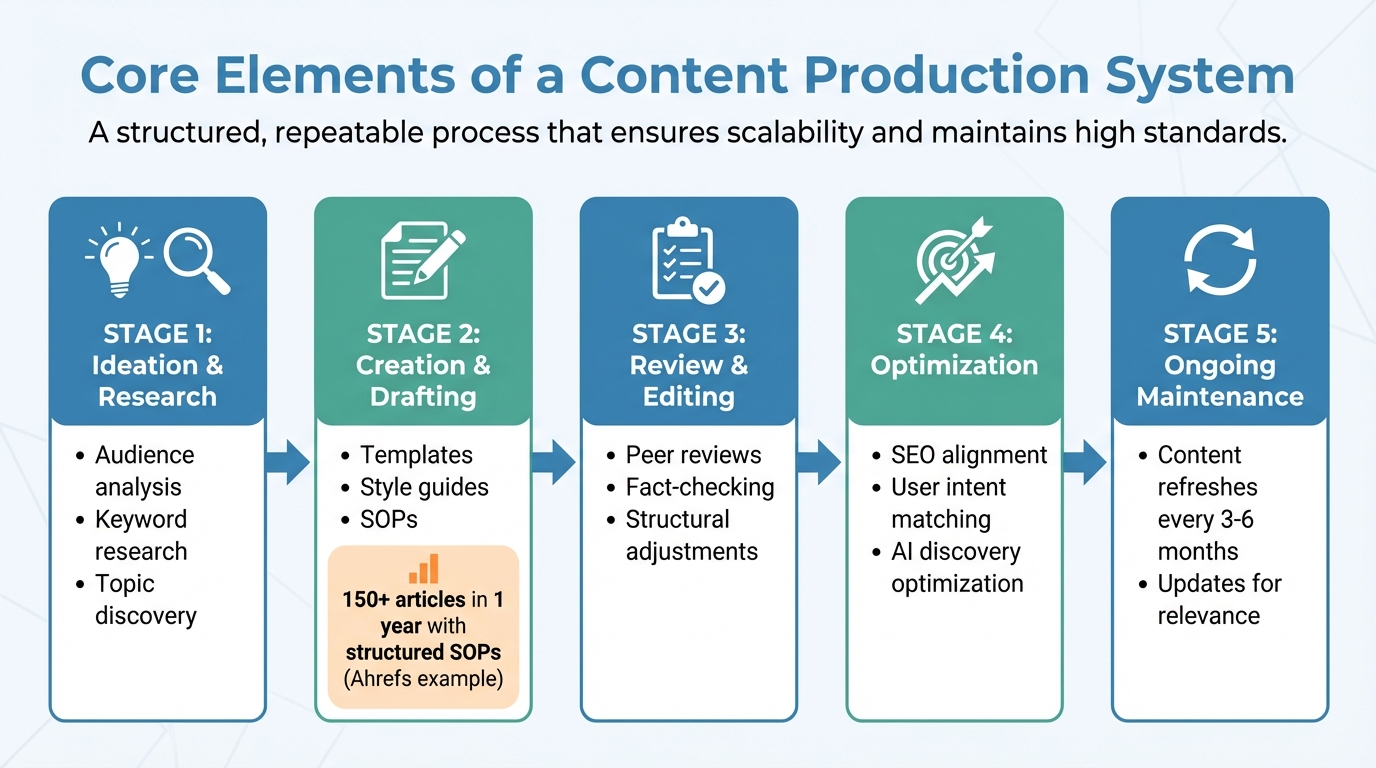
5-Stage Content Production System Workflow
A content production system covers every stage of content creation, from brainstorming ideas to keeping the content fresh and relevant long after it’s published. Think of it as the engine that transforms your content strategy into well-executed, effective pieces that continue to perform over time.
Unlike a simple content calendar, which only tracks when posts go live, a production system goes deeper. It ensures thorough research, a consistent tone, accuracy, and regular updates. Without this kind of structure, you risk falling into a pattern of rushed decisions, inconsistent quality, and missed deadlines.
Core Elements of a Content Production System
A strong content production system relies on several essential components that work together to ensure quality and consistency.
It all starts with ideation and research. This phase involves understanding your audience and analyzing keywords to uncover topics that are worth exploring. Once the groundwork is laid, the focus shifts to creation and drafting. Here, tools like templates, style guides, and standard operating procedures (SOPs) play a crucial role in maintaining a consistent brand voice. Joshua Hardwick, Head of Content at Ahrefs, highlights the importance of SOPs. His team managed to produce over 150 articles and 30 videos in just one year by adhering to a structured, repeatable process [3].
Next comes review and editing, where content is fine-tuned through peer reviews, fact-checking, and structural adjustments to ensure accuracy. The optimization phase aligns the content with user intent, making it ready for both traditional SEO and AI discovery tools. Finally, ongoing maintenance involves revisiting and refreshing content every three to six months to keep it relevant and effective [5][1].
This kind of structured approach ensures your process is both scalable and repeatable, saving time and effort while maintaining high standards.
Why AI Systems Favor Consistent Sources
AI algorithms, like those powering ChatGPT or Google’s AI Overviews, are more likely to prioritize websites that consistently publish high-quality content. These systems look for signals of reliability, such as a steady publishing schedule, comprehensive topic coverage, clear formatting, and regular updates.
Irregular publishing, on the other hand, can damage your credibility. Websites that show a long-term commitment to their topic areas through consistent updates and detailed coverage are viewed as more trustworthy. This operational discipline not only boosts your content’s visibility in AI-driven search results but also reinforces its reliability. Maintaining a regular publishing rhythm is key – a point that will be explored further in the next section.
Setting a Consistent Publishing Schedule
Once you’ve got a solid content production system in place, the next step is sticking to a consistent publishing schedule. Why does this matter? It’s not just about keeping your audience engaged – it’s also about signaling reliability to AI systems. A regular publishing rhythm shows AI models like ChatGPT that your site is active and dependable. Metrics such as “URL_freshness_score” play a role here, and research even suggests that adding artificial dates can improve rankings by as much as 95 spots [6]. A steady schedule helps reinforce your site’s trustworthiness in the eyes of AI.
Choosing a Weekly or Bi-Weekly Frequency
Your ideal publishing frequency depends on your team’s capacity and the type of content you’re creating. For example, long-form guides or in-depth tutorials might work best on a bi-weekly schedule, while news-focused or highly social content could require daily updates [2].
For most businesses, a weekly or bi-weekly schedule strikes the right balance. Publishing weekly – around four posts per month – can boost visibility and ROI, though it does require a higher investment. With freelance posts averaging $325 each, that’s about $1,300 per month [4]. On the other hand, bi-weekly publishing is often more manageable for smaller teams, especially if you’re focusing on pillar content that can be updated and repurposed over time [2][4].
It’s also smart to build in a time buffer to account for delays caused by freelancers, approval processes, or unexpected hiccups [2]. Planning your content one to two months ahead gives you a clear roadmap and helps your team stay on track [3]. Instead of cramming every calendar slot, aim for a steady, reliable rhythm.
Now, let’s look at why irregular publishing can hurt your AI visibility.
Why Irregular Publishing Hurts AI Visibility
Inconsistent publishing – like bursts of content followed by long periods of inactivity – sends the wrong message. It suggests a lack of commitment, and AI systems may interpret this as abandonment of your niche. This opens the door for competitors who maintain a steady presence to take over.
Consistency pays off. Publishing regularly can generate 67% more leads and increase revenue by up to 23% [7]. Marketing expert Neil Patel stresses that without consistent visibility, you’re missing out on valuable brand impressions [8].
To maintain a steady flow of content, try batching similar tasks together – like keyword research, drafting, or repurposing content for social media. This reduces context switching and keeps production efficient [5]. Above all, stick to a fixed publishing schedule. AI systems tend to favor sites that show up consistently over those that go silent for long stretches.
Assigning Clear Roles and Responsibilities
A publishing schedule won’t mean much if content production grinds to a halt because no one knows who’s responsible for the next step. When roles are unclear, delays pile up, deadlines get missed, and quality takes a hit. For example, if team members assume someone else will handle the SEO review or final approval, drafts can sit untouched, and your site’s visibility may suffer as a result.
To avoid this, assign specific people to each stage of the content production process. For instance, an SEO or Content Strategist should oversee topic selection and keyword strategy, while a Managing Editor ensures workflows stay on track and deadlines are met. Writers focus on creating drafts, specifically writing SEO friendly content that aligns with search intent, Subject Matter Experts (SMEs) confirm technical accuracy, and Content Operations handles publishing tasks like uploading to the CMS, adding metadata, and scheduling content distribution. With clear roles, production moves faster, and content quality improves.
Designating Team Members for Each Task
Break down your content workflow – starting from brainstorming ideas to hitting “publish” – and assign a single owner to each phase. For example:
- Content Strategist: Picks topics and keywords.
- Writer: Creates the first draft.
- Managing Editor: Reviews content for brand consistency.
- SME: Ensures technical details are accurate.
- Content Ops: Publishes content and manages metadata.
A well-crafted content brief can eliminate up to 90% of the back-and-forth between writers and editors [9]. When everyone knows exactly who to contact for feedback, production runs much more smoothly.
To keep things moving, map out review timelines for each stage. For example, set a 48-hour limit for editorial reviews to prevent bottlenecks. Also, implement a “Definition of Done” checklist that includes tasks like adding metadata, internal links, and accessibility checks. This ensures everyone knows when a piece is ready to move forward.
How RankWriters Simplifies Workflow Management
Once you’ve nailed down internal roles, automation can take your workflow to the next level. If your team is small or stretched thin, tools like RankWriters can handle repetitive tasks that often slow things down. From keyword research and outlining to drafting and optimization, RankWriters automates these steps, freeing your team to focus on strategy and final touches.
With automated delivery, your content moves through production predictably and efficiently. This not only saves time but also helps establish your site as a reliable source – something AI models tend to favor. By combining clear role assignments with automation, you can keep your content pipeline running like clockwork.
sbb-itb-16c0a3c
Creating Editorial Standards and Update Processes
After assigning roles and setting up a publishing schedule, the next step is to establish editorial standards that uphold quality and ensure consistent updates. Without clear guidelines, your team risks creating inconsistent or outdated content – something AI systems are quick to overlook. Tools like ChatGPT and Perplexity, for example, prioritize newer content, citing URLs that are, on average, 25.7% more recent than standard search results [6].
To stay competitive, quality and recency must be at the heart of your editorial strategy.
Developing Guidelines for AI-Integrated Content
Given the importance of keeping content fresh, your editorial guidelines should clearly define the impact of AI-generated content on your workflow and where human oversight is essential. While AI can assist with tasks like research and drafting, humans should always handle strategy, storytelling, and final approvals. Make it clear what AI should not be used for – such as generating case studies, testimonials, quotes, or regulated advice (like legal or medical content) without expert review [1]. Writers should also verify all AI-suggested URLs, statistics, and quotes, ensuring that AI-generated contributions are clearly marked [1].
Scheduling Regular Content Updates
Publishing new content is only part of the equation. AI systems favor websites that actively maintain and update their existing pages. Studies show that keeping content up-to-date can significantly increase its visibility in AI-driven search results [6].
To keep your content relevant, implement a 6-month refresh cycle for your top-performing pages. This involves updating key elements like data, images, and pricing. Avoid superficial changes, such as simply altering the publish date to appear current. As Mark Williams-Cook, Founder of Candour, explains:
“Google also has a binary trust signal when it comes to things like lastmod. So abuse it if you want to lose it.” [6]
Instead, focus on meaningful updates – add new data, expand insights, or clarify existing points. AI systems can differentiate between genuine improvements and surface-level edits [6]. Companies like RankWriters streamline this process by offering 6-Month Research Updates as part of their services, ensuring content remains fresh without requiring constant manual oversight. By combining well-defined editorial standards with a systematic update schedule, you can maintain the consistency and relevance that AI systems reward.
Developing Long-Term Topic Coverage
Building recognized authority doesn’t happen overnight. It’s not just about publishing frequently – it’s about creating a long-term strategy that establishes your site as a trusted source. When your site consistently and thoroughly covers a subject, AI systems begin to recognize it as a reliable resource worth referencing.
The goal is to move away from chasing fleeting keyword trends and instead focus on becoming a subject-matter expert. By organizing your content into interconnected themes, you signal to both users and AI that your site is the ultimate destination for that topic. Let’s dive into how to structure and select topics to create lasting value.
Structuring Content with Pillars and Clusters
One of the most effective ways to build authority is by using the hub-and-spoke model. This approach starts with a central pillar page that offers an in-depth overview of a broad topic. From there, you create spoke pages that explore specific subtopics in greater detail.
AI systems analyze content by breaking it into smaller chunks, converting text into numeric data to understand relationships between topics. By organizing your content with a clear hierarchy and linking pillar pages to spoke pages with descriptive anchor text, you help AI systems grasp the structure of your site. This reinforces your site’s topical authority and improves how it’s perceived by search engines [11][12].
While structuring your content provides the framework, it’s equally important to choose the right topics to fill that framework with long-term value.
Selecting Topics That Deliver Long-Term Value
Not every topic is worth your time. To focus your efforts, start by researching your audience and competitors. Tools like Ahrefs’ Site Explorer can show you which pages drive the most organic traffic for your competitors [3][10].
When evaluating potential topics, consider three key metrics:
- Traffic Potential (TP): This measures the total traffic a page can attract across all the keywords it ranks for. It’s a more reliable indicator than focusing solely on individual keyword search volumes.
- Keyword Difficulty (KD): This helps you assess how challenging it will be to rank for a topic.
- Business Potential: This metric evaluates how closely a topic aligns with your product or service. Prioritize topics where your offering is the essential solution (a score of 3) over those where it’s only partially relevant (a score of 1) [3].
To stay organized, track these metrics in a color-coded spreadsheet. This makes it easier to focus on topics that not only drive traffic but also align with your core business goals [10]. By selecting topics that resonate with your audience and align with your expertise, your content becomes indispensable to both users and AI systems, ensuring long-term visibility.
As Joshua Hardwick, Head of Content at Ahrefs, succinctly puts it:
“You need SOPs. They are life” [3].
Creating a repeatable system for identifying and prioritizing evergreen topics is essential for building the kind of authority that AI systems reward over time.
Using Automation to Scale Production
Scaling up content production often means automating repetitive tasks while leaving strategic decisions and judgment calls to humans. Automation can take care of moving content from draft to live, flagging pages for updates, and tracking performance metrics. This creates a dependable system that works in the background, ensuring nothing gets overlooked as production scales up. A smooth transition from drafting to publishing naturally leads into the topic of automated delivery systems.
How Automated Delivery Maintains Consistency
Manual publishing can slow things down. Tasks like uploading content to a CMS, scheduling posts, running quality checks, and coordinating across platforms quickly pile up, especially if you’re publishing weekly or bi-weekly. Automated delivery systems handle these steps seamlessly – uploading, scheduling, and distributing content – so everything stays on track.
Take RankWriters’ Automated Content Delivery, for instance. Once your content is approved, it’s automatically delivered to your site based on your publishing calendar. This eliminates the need for manual uploads and ensures posts go live on time. Plus, it tracks performance metrics, including search rankings and AI visibility. The system even monitors which pieces are cited in AI Overviews and flags content that needs refreshing, delivering regular updates to keep you informed.
Automation also helps by identifying content decay early. It tracks performance indicators like impressions, clicks, and AI Overview mentions. If performance dips, the system flags the content for review and triggers an update task. This proactive maintenance keeps your content relevant – something AI systems prioritize when selecting sources to cite.
With publishing consistency taken care of, the next logical step is optimizing your content for AI search tools.
Optimizing Content for AI Search Tools
A well-organized, automated workflow signals to AI systems that your content is fresh and systematically managed, increasing the likelihood of being cited. Unlike traditional SEO, getting cited in AI-generated responses requires a different strategy. AI tools like ChatGPT, Google Gemini, and Perplexity prioritize structured, citation-ready content that’s easy to extract and reference.
This means incorporating elements like concise answer blocks, entity-based optimization, and schema markup to make your content machine-readable. RankWriters’ AI Search Optimization features are tailored for this shift, focusing on Answer Engine Optimization (AEO) to get your content cited in AI-generated responses rather than just ranking in traditional search results.
For example, place short answer blocks – typically 50–80 words – right below question-based headings. These sections are formatted for easy extraction by AI tools like ChatGPT. Adding structured data, such as FAQ and HowTo schema, further clarifies your content’s purpose. Clearly defining key entities – whether they’re people, products, or concepts – ensures your content aligns with user search intent.
The numbers highlight why this matters. By March 2025, AI Overviews appeared in about 18% of searches, and 88% of those Overviews cited three or more sources [13]. However, clicks to websites drop significantly – nearly 50% – when Google includes an AI Overview, falling from around 15% to just 8% [13]. Prioritizing direct citations in AI-generated responses over traditional click-throughs positions your content as a trusted source in this evolving search landscape.
Conclusion
Creating a structured content production system is more than just publishing regularly; it’s about establishing long-term credibility that AI systems recognize. By maintaining consistent editorial standards, proactively updating content, and sticking to a predictable publishing schedule, your site becomes a trusted source for tools like ChatGPT for SEO. This is increasingly important, as nearly 60% of Google searches in 2024 didn’t lead to clicks – users found what they needed directly in AI-generated summaries [14]. This shift underscores the need for a systematic approach to content production to remain visible.
The numbers back this up. Consistently producing machine-readable content can significantly boost leads and revenue, helping your site stand out in AI responses rather than being overlooked. It’s clear that investing in a reliable system from the beginning pays off in the long run.
Building such a system requires some upfront effort – things like defining workflows, assigning roles, setting review schedules, and planning regular updates. But once established, the system works smoothly. Tools like RankWriters can automate content delivery, optimize performance for AI searches, and flag outdated content for updates. This ensures your content stays fresh and relevant without needing constant manual attention.
With this foundation in place, the next steps are simple. Implement Standard Operating Procedures for every stage of your content process, schedule content refreshes every 3–6 months, and use automation to maintain momentum. By combining consistency and automation, you’ll create a content ecosystem that earns trust, secures citations, and keeps your site visible in AI-driven search results.
FAQs
How can I keep my content relevant for AI-driven search results?
To keep your content aligned with AI-driven searches, it’s crucial to set up a reliable content production process. This means assigning clear responsibilities, sticking to high editorial standards, and scheduling regular updates to keep your content fresh. Leverage AI tools to check for accuracy, refine keyword usage, and improve formatting, ensuring your content remains both dependable and current.
By consistently updating your content and focusing on topics with lasting relevance, you can establish credibility with AI systems. These systems tend to favor sources that are consistently maintained and seen as authoritative.
What key roles are needed to maintain a consistent content production system?
A well-oiled content production system thrives on clearly defined roles, ensuring a smooth journey from brainstorming to publication. At the heart of this process is the content strategist. This person plans topics, aligns content with audience needs, and establishes a steady publishing rhythm that meets search demands shaped by AI insights.
Next, the editor steps in to uphold editorial standards, verify factual accuracy, and maintain a consistent tone – key elements that AI models recognize and value. Then comes the writer or creator, the one who transforms ideas into engaging, polished content. Alongside them, an AI tool specialist handles automation tools, runs plagiarism checks, and fine-tunes content to maintain quality.
Keeping everything on track is the project manager, who assigns tasks, monitors deadlines, and ensures smooth collaboration across the team. Meanwhile, a data analyst dives into performance metrics and AI visibility data to fine-tune the system, while an SEO specialist focuses on optimizing content for schema, topical relevance, and structured data.
Rounding out the team are subject-matter experts, who provide specialized knowledge, and designers, who create visuals to elevate the content. When each role is clearly defined and everyone knows their responsibilities, the system can consistently deliver high-quality content that earns trust and authority over time.
How can automation make content production more efficient?
Automation simplifies content production by taking over repetitive tasks and speeding up workflows. With AI tools, tasks like gathering data, creating outlines, drafting, and suggesting SEO-friendly phrases become more efficient. This frees up writers to concentrate on strategy and creativity, cutting down bottlenecks and making processes like research and first drafts quicker.
It also helps keep content current by automating updates, spotting outdated information, and refreshing pages regularly. This consistency not only keeps content relevant but also supports search engine visibility by avoiding penalties tied to infrequent updates.
When automation is part of a structured workflow, teams can scale their output without needing to grow their team. Smart tools help coordinate tasks, enforce deadlines, and track progress, transforming content creation into a seamless, predictable process that consistently delivers reliable and polished results.