

What is Conversational Search?
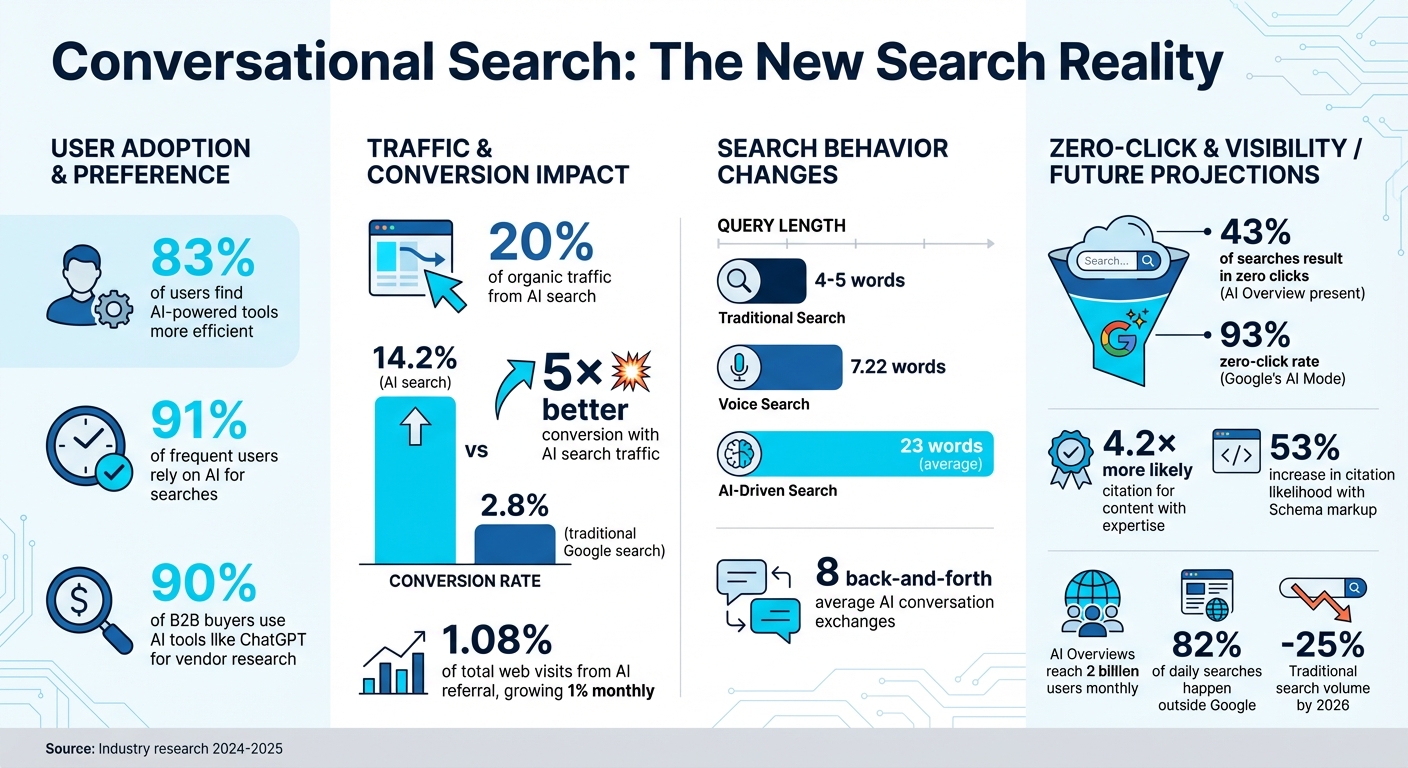
Conversational search is changing how we interact with search engines, moving away from short keyword phrases to natural, question-based queries. Instead of searching for “best CRM software”, users now ask questions like, “What CRM works best for a 50-person sales team that needs mobile access?” On average, AI-driven searches are 23 words long, compared to the 4-5 word length of traditional searches [6].
Key Points:
- 83% of users find AI-powered tools more efficient than traditional search.
- 91% of frequent users rely on AI for searches.
- AI search now accounts for 20% of organic traffic, with traffic converting 5× better than traditional search.
- Voice search is growing, with users asking natural, conversational questions.
To succeed, content must focus on answering specific questions clearly and concisely, using structured data like FAQ schema to improve AI citations. The goal isn’t just to rank but to be referenced in AI-generated responses.
Quick Overview:
- What Changed: Search is now conversational, with longer, natural queries.
- Why It Matters: AI-driven traffic converts better and dominates visibility.
- What to Do: Write modular, question-based content, use structured data, and track metrics like AI citations and referral traffic.
AI search is reshaping content strategies, making clear, actionable answers the new priority.
Conversational Search Statistics: AI Impact on Search Behavior and Traffic 2024-2026
Conversational Search: A Deep Dive
Conversational Search Defined
Conversational search is changing how we interact with search engines, moving away from short keyword phrases to natural, question-based queries. Instead of searching for “best CRM software”, users now ask questions like, “What CRM works best for a 50-person sales team that needs mobile access?” On average, AI-driven searches are 23 words long, compared to the 4-5 word length of traditional searches [6].
This shift is powered by Artificial Intelligence (AI) technologies, including Large Language Models (LLMs) and Natural Language Processing (NLP). These tools help search engines grasp context, subtle meanings, and user intent [1][6]. At the core of conversational search is Retrieval-Augmented Generation (RAG), which combines relevant web content into a single, well-rounded response, complete with citations [6][7]. Unlike traditional search engines that rely on keyword matching, conversational search is multi-turn – it remembers previous interactions, allowing for more refined and context-aware answers during ongoing conversations [3][8].
“The unit of optimization shifts from ‘keyword phrase’ to ‘complete question with context.'” – Bartosz Góralewicz, Founder and Head of Innovation, Onely [6]
How AI Tools Enable Conversational Search
AI tools like Google Gemini (previously Bard), ChatGPT Search, and Perplexity are at the forefront of conversational search, serving as “answer engines” that provide direct, meaningful responses [5][4]. These tools use vector-based semantic search, which translates queries into numerical representations to capture user intent. This means they can understand and connect similar ideas, like linking “extra cushion” with “maximum support”, even if the exact phrasing differs [10].
These platforms also employ query fan-out, where a single user query is broken down into dozens – or even hundreds – of related sub-queries. This broader exploration ensures the AI pulls information from a wide range of sources to deliver highly detailed answers [9][8]. On average, AI-driven conversations now involve eight back-and-forth exchanges, with the AI retaining the context of the entire dialogue [10]. It’s no surprise that 83% of consumers find AI-powered search tools more efficient than traditional search engines [2], and 91% of frequent AI users now prefer tools like ChatGPT for their search needs [2]. These advancements are also fueling the rise of voice search, where quick, conversational answers are key.
Voice Search and Its Impact
Voice search is taking conversational search to the next level, driven by AI advancements. Assistants like Siri, Alexa, and Google Assistant require concise and natural responses they can read aloud. This has made conversational, answer-focused content more important than ever [1]. AI-powered voice queries average 7.22 words, nearly double the length of traditional searches, reflecting the way people naturally speak [10].
For businesses, this shift has major implications for content strategy. Voice searches often focus on local intent (think “near me” queries), so content must address the specific questions users are asking. To stay visible, businesses need to optimize for position zero (featured snippets) and use FAQ schema markup to help AI understand their content structure. With 90% of B2B buyers now using AI tools like ChatGPT for vendor research [6], failing to adapt to conversational search could mean losing out on potential customers. This evolution highlights the growing importance of creating content that’s tailored for direct answers – an essential part of staying relevant in the age of AI-driven search.
Webinar: SEO for Conversational Search with Mike King
To implement these strategies at scale, consider partnering with an SEO content writing agency that specializes in answer-centered content.
Why Answer-Centered Content Matters
With the rise of AI-driven search, the way content is consumed has changed dramatically. AI platforms now act as intermediaries, pulling information from multiple sources to create a single, synthesized response for users [8]. This shift means content must focus on delivering concise, expert answers.
Here’s the kicker: users arriving via AI-generated answers are highly qualified. AI search traffic boasts a conversion rate of 14.2%, compared to just 2.8% for traditional Google search [6]. That’s a staggering fivefold difference, driven by the fact that AI pre-qualifies users by answering their queries upfront.
Modern search queries are also evolving. The average query now spans 23 words and often takes the form of a conversational question, such as “What is the best coffee maker for a small apartment?” This is a far cry from the short, 4–5 word keyword phrases typical of traditional search [6]. These detailed, conversational queries often signal higher buying intent [1].
The game has changed because AI systems no longer rank entire web pages. Instead, they extract specific passages that directly address a query [8]. This makes it crucial for content to be modular, self-contained, and factually accurate. In fact, content that demonstrates expertise and accuracy is 4.2× more likely to be cited by AI platforms [6]. Additionally, with 43% of searches resulting in zero clicks when an AI Overview is present – and that figure jumping to 93% in Google’s AI Mode [6] – being cited in AI-generated answers is more important than ever. The focus has shifted from traditional rankings to becoming a reliable source for AI synthesis.
Serving High-Intent Users
When users pose conversational queries, they’re often signaling a clear intent to solve a problem or make a decision. For example, while a search for “coffee maker” might indicate casual browsing, asking “What is the best coffee maker for a small apartment?” shows a specific need and readiness to act.
This is where passage-level retrieval becomes critical. AI platforms prioritize content with clear expertise and factual accuracy, which is why such content is cited 4.2× more frequently [6]. While the prevalence of zero-click results may seem concerning, it actually presents an opportunity. The goal is no longer to rank first in traditional search results but to be cited and referenced within the AI-generated answer. To achieve this, content must provide actionable, directly citable information.
What Makes Answer-Centered Content Effective
Creating answer-centered content involves a strategic approach that caters to both AI systems and human users. Here are five traits that make this type of content stand out:
- Natural language: Content should mirror the way people naturally speak and ask questions.
- Direct answers upfront: Provide concise, clear answers in the first few sentences under question-based headings so AI can easily extract and reference them [7].
- Scannable structure: Use bullet points, tables, FAQs, and subheadings to make information easy to locate for both humans and AI [8].
- Verifiable data: Include concrete statistics, expert quotes, and case studies to enhance credibility.
- Schema markup: Use structured data (like FAQPage or HowTo schema) to make content machine-readable, increasing the likelihood of being cited by 53% [8].
For instance, instead of a broad blog post targeting “mortgage refinance”, answer-centered content would address specific questions like, “Should I refinance my mortgage in 2026 if rates drop to 5.5%?” Each section would offer a complete, quotable answer in just a few sentences, supported by relevant data and examples.
Traditional Content vs. Answer-Centered Content
The shift to answer-centered content marks a fundamental change in how search engines process and present information. Understanding these differences is key to adapting your content strategy.
| Feature | Traditional Content | Answer-Centered Content |
|---|---|---|
| Query Type | Short-tail keyword fragments (4–5 words) [6] | Long-tail, conversational questions (23 words) [6] |
| Optimization Focus | Keyword density, backlinks, page-level ranking [8] | Semantic clarity, direct answers, passage-level retrieval [8] |
| User Intent | Broad discovery and link evaluation [6] | Specific problem-solving and task completion [6] |
| AI Compatibility | Optimized for crawlers and indexers [2] | Optimized for AI synthesis [2][6] |
| Success Metric | Ranking position and click-through rate [8] | Citation frequency, brand mentions, conversion quality [8][6] |
Traditional content was designed for a world of ranked search results, where appearing among the “10 blue links” was the ultimate goal. Now, answer-centered content thrives in a system where AI synthesizes information from multiple sources to provide a single, unified response [8]. The priority is no longer about ranking first but about being the most reliable and citable source.
“Traditional SEO is now only one piece of the content visibility puzzle. Generative SEO demands fluency across appearing in results, being seen as a thought leader, and driving influence.”
This evolution has also transformed how users engage with search results. In the past, users clicked through multiple links to evaluate and compare information [6]. Today, AI-generated answers deliver immediate solutions, removing much of that friction [2]. When users do click through, it’s often because they’re seeking deeper insights or are ready to take action. This explains why AI-driven search visitors convert 4.4× better than traditional organic visitors [7].
sbb-itb-16c0a3c
How to Optimize Content for Conversational Search
As search continues to evolve, optimizing for conversational queries has become essential. This involves creating content that answers real, naturally phrased questions and ensuring your technical setup supports AI-driven search. Users now interact with search engines and AI tools in a conversational style, whether they’re speaking to a voice assistant or typing into a chatbot. To stay relevant, your content should mirror this conversational flow.
On the technical side, it’s critical to make your content easy for AI systems to process, extract, and cite. This means using structured data to guide machine learning models and ensuring your site is accessible to AI crawlers. Since many conversational searches happen on mobile devices or through voice-activated assistants, optimizing for these platforms is equally important.
Target Question-Based Queries
Search queries have grown longer and more specific. While traditional searches averaged about 4 words, conversational queries now average 7.22 words – nearly double the length [5][10]. For example, instead of searching “CRM software”, users might ask, “What CRM should I use for a 50-person sales team that needs mobile access?”
To align with this shift, start by identifying real questions your audience asks. Tools like AnswerThePublic, AlsoAsked, and Google’s “People Also Ask” section can help you uncover these queries [1]. AI systems prioritize understanding the intent behind questions, so focus on related concepts – like “CRM”, “workflow automation”, and “customer data” – rather than isolated keywords [2].
Structure your content around these questions by using them as H2 or H3 subheadings. Follow each question with a concise, 40–60 word answer to increase the chances of being featured in AI summaries [1][7]. This modular approach makes your content easy for AI to extract and use in passage-level retrieval [3][8].
Take inspiration from Princess Cruises, which successfully used this strategy in 2024. To capture high-intent searches for Alaskan cruises, they created 70 new pieces of content and optimized 23 port landing pages around specific traveler questions. This led to a 261% increase in AI Overview mentions and a dominant share of impressions in AI-driven search results [4].
Design your content for multi-turn conversations by anticipating follow-up questions. For instance, if someone asks, “Should I refinance my mortgage in 2026?” they might follow up with “What documents do I need?” or “How long does the process take?” Guide users through logical progressions and back up your content with sourced, concrete data – like “Email marketing generates $42 for every $1 spent” – to increase its credibility and reference potential [7].
“90% of success comes from good topic selection.” – Ryan Law, Director of Content Marketing, Ahrefs [10]
Once your content is framed around these questions, use structured data to make it easier for AI systems to extract and cite.
Implement Structured Data Markup
Structured data is like a roadmap for AI systems, helping them understand, summarize, and cite your content accurately [4]. Schema markup is particularly useful here, as it signals the structure and relationships within your content.
Focus on schema types that align with conversational search, such as FAQPage, HowTo, Article, Product, Organization, and Person schema [3][4]. FAQPage schema is especially effective because it mirrors the question-and-answer format AI systems rely on. Similarly, HowTo schema can help AI parse step-by-step instructions, video timestamps, or necessary tools with precision.
The benefits are clear: content with structured data is 53% more likely to be accurately extracted and cited in AI-driven search results [8]. This isn’t just about visibility – it’s about becoming the source AI platforms trust when generating answers.
“Schema is like a cheat sheet for machines – it provides the machine-readable signals AI models rely on.” – JennyB Blackburn, 97th Floor [4]
To further build trust, use author metadata with Person schema to highlight expertise, credentials, and certifications [2][3]. Establish relationships between concepts, products, and individuals through entity modeling, allowing AI systems to map your brand within a broader knowledge graph [2][4]. Regularly validate your markup using Google’s Rich Results Test and ensure that AI crawlers like GPTBot, CCBot, and Claude-Web can access your content [7].
For faster updates, adopt the IndexNow protocol, which pushes changes directly to AI systems, ensuring your latest content is always available [8]. This is especially important for voice assistants and chatbots that rely on real-time data.
Optimize for Voice Search
Voice search queries tend to be longer, phrased as complete questions, and reflect natural conversation [1][8]. For example, instead of searching “best Italian restaurant”, a voice query might be, “What’s the best Italian restaurant near me that’s open right now?”
To optimize for voice search, focus on passage-level structure. Break your content into small, self-contained sections that can stand alone and still provide value when read aloud by a voice assistant [3][8]. This ensures your content is suitable for both traditional reading and voice-based consumption.
Since voice search is primarily mobile-driven, prioritize fast-loading pages with strong Core Web Vitals [4][8]. Slow-loading pages are less likely to be chosen for voice responses, no matter how good the content is. Optimize your site for mobile devices, ensure fast server response times, and use clean, efficient code.
Expand your reach with multimodal optimization by including transcripts for video and audio content. This allows AI to index and retrieve information from non-text assets, which is becoming increasingly important as AI platforms integrate multimedia into their responses [4][8].
Voice search also contributes to the growing trend of zero-click results, where users get answers directly from assistants without visiting a website [2][8]. Success in this space is measured by how often your content is cited, not by clicks. As Jana Garanko, Head of Content at Semrush, explains:
“The goal is no longer just ranking for clicks. It’s to become the trusted source that powers Google’s answer.” [5]
Measuring Answer-Centered Content Performance
Traditional metrics just don’t cut it anymore in the world of AI-driven search. Instead, conversational search demands a focus on metrics like citation frequency, AI share of voice, and zero-click exposure. These metrics reveal how much trust and visibility your content has within AI-generated responses.
Start by keeping an eye on AI citations – how often your domain is mentioned in AI-generated answers on platforms like ChatGPT, Perplexity, and Google AI Overviews [2][11]. Tools like Semrush Enterprise AIO and Ahrefs can help track these citations, but don’t skip manual spot-checks on 50–100 key queries for a more hands-on approach [4][5][6][7][12].
Another key metric is AI share of voice, which measures how often your content appears in AI responses compared to competitors. For example, between May and September 2025, Clemson University dominated the educational sector with a 91% AI Overview market share by focusing on AI-driven topic research and prioritizing strategic content [11].
Then there’s zero-click exposure, which is all about visibility. Even though zero-click rates in Google’s AI Mode can hit as high as 93%, the traffic that does come through AI referrals tends to convert at a much higher rate [6][7]. Together, these metrics create a solid foundation for actionable insights, which we’ll dive into below.
Key Metrics to Track
To go beyond the basics, here are some additional metrics worth watching:
- Answer Referral Traffic: This tracks visits from links embedded in AI-generated summaries. AI referral traffic currently accounts for about 1.08% of total web visits and is growing by roughly 1% each month [11].
- Semantic Coverage: Evaluate how often your brand shows up across related entities and subtopics in conversational AI results [2].
- Summarization Inclusion Rate (SIR): Measure the percentage of target queries where your domain is cited as a source [12].
- Conversion Quality: With 60% of users clicking through after viewing AI-generated overviews [2], segmenting this traffic in Google Analytics 4 can help you understand its higher conversion potential [6][12].
| Metric | What It Measures | Why It Matters |
|---|---|---|
| AI Citations | Frequency of AI mentions | Reflects trust and authority with AI systems |
| AI Share of Voice | Relative visibility in AI responses | Highlights your competitive positioning |
| Zero-Click Exposure | Visibility in summaries without clicks | Builds brand authority and attracts high-intent users |
| Answer Referral Traffic | Clicks from AI-generated links | Tracks direct conversion opportunities |
| SIR (Summarization Inclusion Rate) | % of queries where brand is cited | Measures how consistently your content is referenced |
“AI hasn’t replaced search – it’s replaced your website as the first touchpoint. The brands showing up in AI answers today are shaping the new customer journey.” – Seth Besmertnik, CEO of Conductor [11]
Using RankWriters for Ongoing Optimization
Once you’ve established these metrics, the next step is continuous optimization to stay ahead in conversational search. RankWriters’ Monthly Reporting service monitors citation frequency, AI share of voice, and referral traffic patterns, giving you clear insights into what’s working and what needs adjustment.
Their 6-Month Research Updates service ensures your content strategy stays aligned with evolving AI behavior. With AI systems like ChatGPT now favoring recent content over outdated guides [7], these updates help you spot new question trends, uncover semantic gaps, and seize competitive opportunities.
RankWriters also offers an AI Search Optimization feature to fine-tune the technical and structural elements that influence AI citation decisions. This includes adding proper schema markup (which increases the likelihood of accurate citations by 53% [8]), creating answer capsules for easier extraction, and ensuring AI crawlers like GPTBot and CCBot have seamless access to your content [7].
Conclusion
Conversational search is no longer a concept of the future – it’s here, reshaping how users interact with information. With AI Overviews reaching 2 billion users monthly and 82% of daily searches happening outside Google, relying solely on keyword rankings just doesn’t cut it anymore. Search has shifted from presenting link-filled lists to providing synthesized, direct answers, and your content strategy needs to keep pace.
This shift demands a fresh approach to content strategy. AI-driven search traffic boasts higher conversion rates compared to traditional methods. On top of that, 90% of B2B buyers are now leveraging AI tools like ChatGPT for vendor research [6]. And with traditional search volume predicted to drop by 25% by 2026 as users lean toward AI-based chat experiences [6][13], adapting to this new landscape is critical. Brands that thrive will embrace Search Everywhere Optimization, ensuring their presence spans across platforms like Google, ChatGPT, Perplexity, social media, and even voice assistants.
“The future of SEO isn’t GEO, it’s Organic Revenue Growth. Your brand search is going to become critically important.” – Andrew Holland, SEO Expert [7]
As outlined in the strategies above, modular, answer-focused content is the cornerstone of success, much like the benefits of featured snippets in traditional search. Structuring your content into scannable, modular blocks makes it easier for AI to extract and cite. Using schema markup can boost citation chances by 53% [8]. Instead of targeting short keyword fragments, focus on conversational queries averaging 23 words. Build content that predicts the next question users might have before they even ask. And, above all, track the right metrics: citation frequency, AI share of voice, and zero-click exposure – not just traditional rankings.
The game has changed, and so must your playbook.
FAQs
How does conversational search enhance user engagement and drive conversions?
Conversational search shifts the focus from traditional keyword queries to a more natural, dialogue-like interaction. Instead of relying on simple keyword matching, it dives into the context of a question. For instance, if someone asks, “What’s the best coffee maker for a small apartment?”, conversational search delivers precise, relevant answers tailored to the user’s intent. This eliminates the hassle of scrolling through multiple links, making the experience smoother and more user-friendly.
This approach doesn’t just simplify search – it builds trust. By providing quick and reliable answers, it keeps users engaged longer and increases their confidence in the source. Plus, it has a direct impact on conversions. AI-driven search traffic often converts at a much higher rate compared to traditional organic clicks. Even as zero-click searches grow, being featured in AI-generated responses still plays a key role in influencing purchasing decisions. In short, conversational search bridges the gap between asking a question and making a decision, offering a smarter and more intuitive way to search.
How can I create content optimized for AI-driven search results?
To make your content shine in AI-driven search, focus on crafting answer-ready material that matches how people naturally ask questions. Modern search engines now value direct, conversational answers over simply matching keywords.
Here’s how to get it right:
- Write like you talk: Use natural, conversational language and target long-tail queries that mirror how people speak.
- Center on questions: Build your content around common user questions and consider adding FAQ sections or HowTo schema for better AI compatibility.
- Keep answers short and sharp: Provide concise, standalone responses (40–60 words) that AI can easily pull and display.
- Leverage structured data: Use schema markup and include trust-building elements like author credentials or original research to improve visibility.
- Add multimedia: Incorporate images, videos, and audio to support multimodal search and voice-based queries.
By mapping out user journeys, anticipating follow-up questions, and regularly updating your content, you can position your material to meet the demands of AI-powered search and stay ahead of evolving trends.
How can businesses effectively optimize their content for voice search?
To make your content shine in voice search, it’s all about crafting natural, conversational text that mimics how people interact with digital assistants. Think long-tail, question-based keywords and short, snappy answers – perfect for being read aloud. Since voice search often pulls from featured snippets or AI-generated responses, aim for clear, direct answers in about 40–60 words.
Here’s how businesses can boost their visibility in voice search results:
- Write in a conversational tone: Focus on how people phrase questions, like “how to” or “near me” searches.
- Leverage structured data: Use FAQ and How-To schema to make it easier for AI systems to identify and extract answers.
- Emphasize local intent: Incorporate location-specific keywords to cater to users looking for immediate, nearby solutions.
- Optimize for mobile: Ensure your pages are fast and mobile-friendly, as most voice searches happen on smartphones.
By focusing on question-driven content and fine-tuning technical aspects like schema markup, businesses can stand out in voice search results, even as traditional click-through rates evolve.