


AI Search Tools Are Changing How People Find Information Online
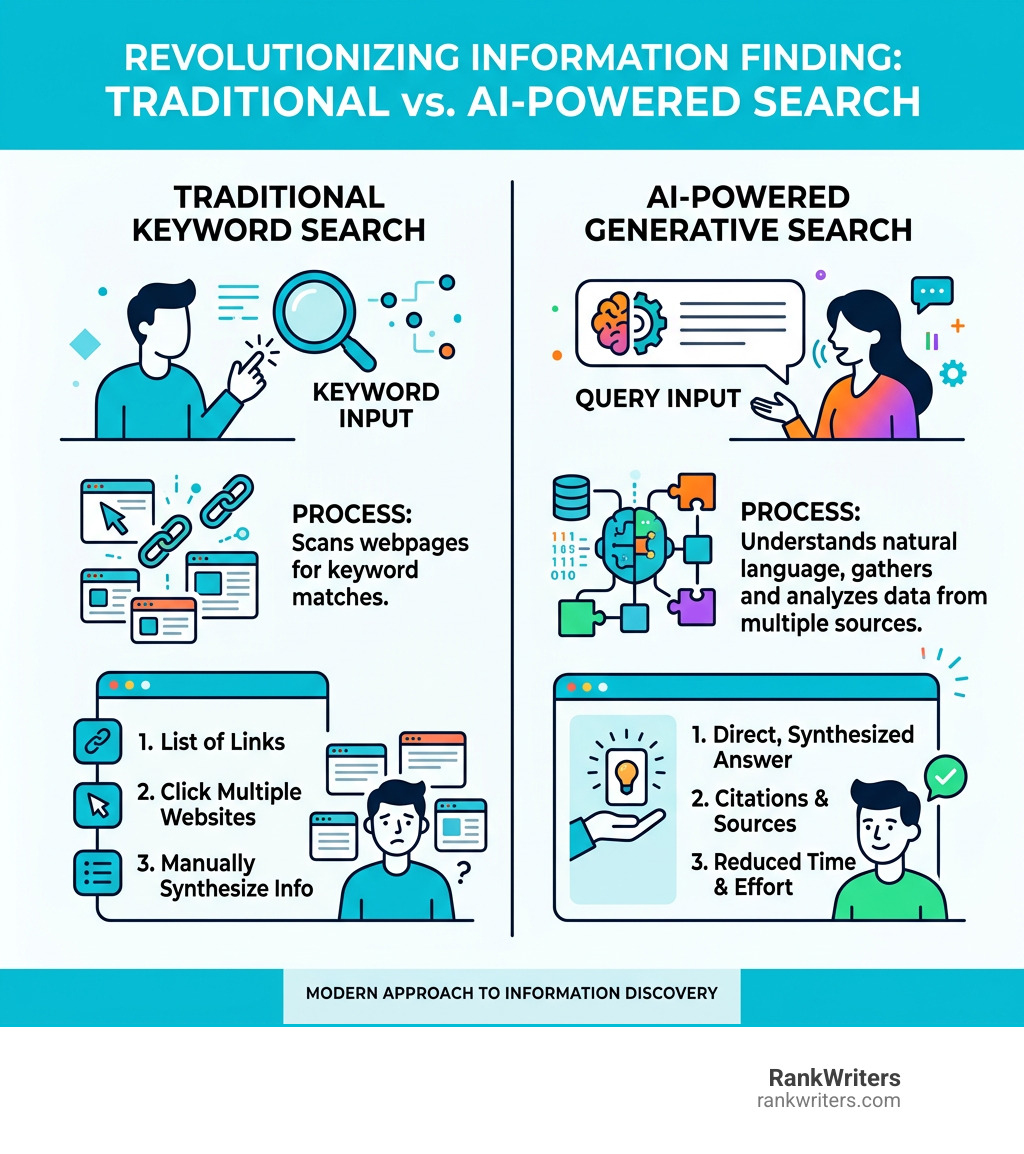
AI search tools are a new generation of search engines that use large language models (LLMs) to give you direct, synthesized answers instead of a list of links to click through.
Here are the top AI search tools worth knowing in 2026:
| Tool | Best For | Free Tier? |
|---|---|---|
| Perplexity | Research and sourced answers | Yes |
| Google AI Mode | Everyday search with Gemini | Yes |
| iAsk Pro | Students, homework, benchmarks | Yes |
| Andi | Privacy-friendly free search | Yes |
| DuckDuckGo | Privacy-first users | Yes |
| Komo | Filtered, category-based search | Free trial |
| Consensus | Academic literature reviews | Yes |
| Exa | Developers building AI apps | Free API tier |
Unlike traditional search engines, AI search tools understand your question in plain language and pull together a summarized answer from multiple sources, right on the page.
That shift matters more than it might seem. McKinsey research shows AI can reduce research time by up to 60%. Platforms like iAsk.Ai report processing over 750 million searches, with users saving roughly 80% of their research time. And over $31 million has flowed into AI search visibility tools in just the last two years, signaling that businesses are paying close attention.
For business owners and marketers, this isn’t just a tech trend. It changes where your customers find answers, and whether your brand is part of those answers at all.
By Allie Leng-Barton
Understanding AI Search Tools and How They Work
At their core, ai search tools function as “answer engines.” While a traditional search engine acts like a librarian pointing you to a specific shelf, an AI search tool acts like a researcher who reads the books for you and summarizes the relevant chapters.
These tools rely on Large Language Models (LLMs) and a process called Retrieval-Augmented Generation (RAG). Instead of just matching keywords, the AI performs real-time indexing of the web, processes the information using natural language processing, and synthesizes a unique response. This technology allows the engine to understand the intent behind a query, not just the words used.
The impact on productivity is measurable. According to a McKinsey study, generative AI has the potential to automate work activities that absorb 60 to 70 percent of employees’ time today. By shifting from manual link-clicking to automated synthesis, users can bypass the “search fatigue” that often comes with traditional browsing.

Key Differences Between AI Search Tools and Traditional Engines
The primary difference lies in the output. Traditional engines provide a list of links, forcing the user to visit multiple websites to piece together an answer. AI search tools provide a direct answer immediately.
- Linear vs. Conversational: Traditional search is linear (query > results). AI search is conversational, allowing for follow-up questions that maintain context.
- Synthesis vs. Selection: Traditional engines select the most relevant pages. AI engines synthesize information from those pages into a coherent paragraph.
- Google AI Overviews: Even the giants are changing. Google AI Overviews now appear at the top of results, offering a “snapshot” of key information with links for further exploration. This represents a hybrid model where traditional link lists coexist with AI-generated summaries.
How to Optimize Content for AI Search Visibility
As search behavior shifts, businesses must adapt their digital presence. This new field is often called Generative Engine Optimization (GEO). To remain visible, brands need to optimize content for AI by focusing on several key pillars:
- E-E-A-T: Experience, Expertise, Authoritativeness, and Trustworthiness are more critical than ever. AI models prioritize sources that demonstrate clear authority.
- Structured Data: Using Schema markup helps AI crawlers understand the context of your data, such as pricing, reviews, and locations.
- The llms.txt File: Much like robots.txt, a dedicated llms.txt file provides a clean, markdown-based summary of your site specifically for AI models to ingest.
- Natural Language: Content should be written to answer specific questions directly. If an AI asks, “What is the best mortgage for a first-time borrower?”, your content should provide a clear, concise answer that the AI can easily quote.
Top AI Search Engines for Research and Productivity in 2026
The landscape of ai search tools has matured significantly, with several key players dominating different niches of the market.
iAsk Pro has emerged as a powerhouse for accuracy. It achieved an 85.85% score on the MMLU-Pro benchmark, outperforming many standard AI models. According to the iAsk Pro Slashdot ranking, it is currently considered a top choice for those requiring high reliability and factual precision.
Perplexity continues to be the “gold standard” for comprehensive research. It functions less like a chatbot and more like a professional research assistant, citing every claim it makes. For users who need a “deep dive,” Perplexity can generate reports citing over 50 sources in a single session.
Google AI Mode (distinct from standard Search) allows users to engage fully with the Gemini LLM. It is ideal for users already embedded in the Google ecosystem who want to toggle between traditional results and a full AI conversation.
Best Free AI Search Tools for Daily Use
For those who want the power of AI without a monthly subscription, several high-quality free options exist:
- Andi: This tool is designed to be as simple as Google but powered by a “generative AI brain.” It is completely free and focuses on giving users a clean, ad-free experience. You can even join the Andi+ waitlist for upcoming advanced features.
- DuckDuckGo: Known for privacy, DuckDuckGo has integrated AI features that allow users to get summarized answers without being tracked. It is the best choice for the privacy-conscious researcher.
- Komo: This engine excels at targeted search categories. Users can use a drop-down menu to filter results specifically for academic research, videos, or social discussions, making it highly efficient for specific types of media retrieval.
Specialized AI Search Tools for Industry Verticals
Generic search is useful, but specialized industries require tools trained on specific data sets.
For mortgage lenders (IMBs), AI search is changing how they connect with borrowers. Lenders who optimize their content for these engines can appear as the recommended choice when a borrower asks an AI about local rates or loan programs. Understanding AI search for mortgage lenders is now a core part of a modern lending strategy.
The legal industry has also seen a massive influx of specialized tools. Lexis+ AI and Westlaw Precision AI are built on massive, verified legal databases. Unlike general AI, these tools are designed to eliminate hallucinations by grounding every answer in primary law and providing verifiable citations.
Measuring Visibility with AI Search Monitoring Tools
If you can’t measure it, you can’t manage it. As brands move toward generative search optimization, they need tools to track how often they are mentioned by AI.
Over $31 million has been invested in this sector recently because businesses need to know: Is ChatGPT recommending my product? Is Perplexity citing my blog?
Why Businesses Need AI Search Visibility Tracking
The industry average for professional AI tracking tools is approximately $337 per month. While this may seem high, the ROI is found in the data. Tools like Rankability, Peec AI, and Otterly AI allow businesses to:
- Capture Citations: See exactly which pages the AI is using to form its answers.
- Monitor Sentiment: Understand if the AI is describing your brand in a positive or negative light.
- Benchmark Competitors: Track which competitors are “stealing” the AI’s attention for your target keywords.
- Save Time: Otterly AI users report saving up to 80% of the time they previously spent on manual brand checks.
Developer Resources: AI Search APIs and Infrastructure
For developers building the next generation of applications, “searching” the web isn’t about a user interface—it’s about an API.
Exa (formerly Metaphor) is a search API designed specifically for AI agents. It doesn’t look for keywords; it looks for the “meaning” of a page. With sub-200ms latency, it is built for real-time applications. Developers can explore the Exa API documentation to see how to integrate semantic search into their own software.
Jina AI provides a different part of the “search foundation.” Its Jina AI Reader tool can take any URL and convert it into clean, LLM-friendly Markdown. This is essential for Retrieval-Augmented Generation (RAG) systems where the AI needs to “read” a specific webpage to answer a user’s question accurately.
Benchmarking Performance Across AI Search APIs
Accuracy matters when building software. According to Exa open source benchmarks, there are significant differences in how well these APIs perform across different tasks:
| Task | Exa Accuracy | Competitor Avg |
|---|---|---|
| Company Search | 62% | 36% |
| People Search | 63% | 28% |
| Code Search | 73% | 65% |
These metrics show that “standard” web search APIs often struggle with the specific, structured data that AI models need to function correctly.
Frequently Asked Questions about AI Search Tools
How do AI search tools handle accuracy and hallucinations?
Most top-tier ai search tools use RAG (Retrieval-Augmented Generation) to ground their answers in real-time web data. By forcing the AI to “read” a source before answering, the risk of “hallucinations” (making things up) is significantly reduced. However, users should always check the provided citations, as AI can still occasionally misinterpret complex data.
What are the privacy risks of using AI search engines?
Privacy varies by tool. While traditional engines like Google track your history to build an ad profile, tools like DuckDuckGo and Andi offer “zero-tracking” search. For enterprise users, tools like Exa offer “Zero Data Retention” policies, ensuring that the queries sent to the API are never stored or used to train future models.
How much do pro versions of AI search tools cost in 2026?
The standard pricing for a “Pro” AI search tool (like Perplexity Pro or iAsk Pro) is generally around $20 per month. For businesses needing specialized visibility tracking, the industry average is closer to $337 per month, reflecting the complexity of monitoring multiple LLMs simultaneously.
Conclusion
The transition from traditional search to ai search tools is no longer a futuristic prediction—it is the current reality of how information is found and consumed. For individuals, these tools offer a way to reclaim hours of lost research time. For businesses, they represent a new frontier of visibility that requires a systematic, future-proof approach to content.
At RankWriters, we specialize in this exact intersection. We produce content optimized for Google, AI Search (AEO, GEO), and traditional SEO to ensure your brand doesn’t just exist online but is actively discovered and recommended by the engines of tomorrow.
If you are ready to drive consistent inbound leads through a systematic approach to the new search landscape, explore our professional SEO services and let us help you dominate the AI-powered SERPs.