
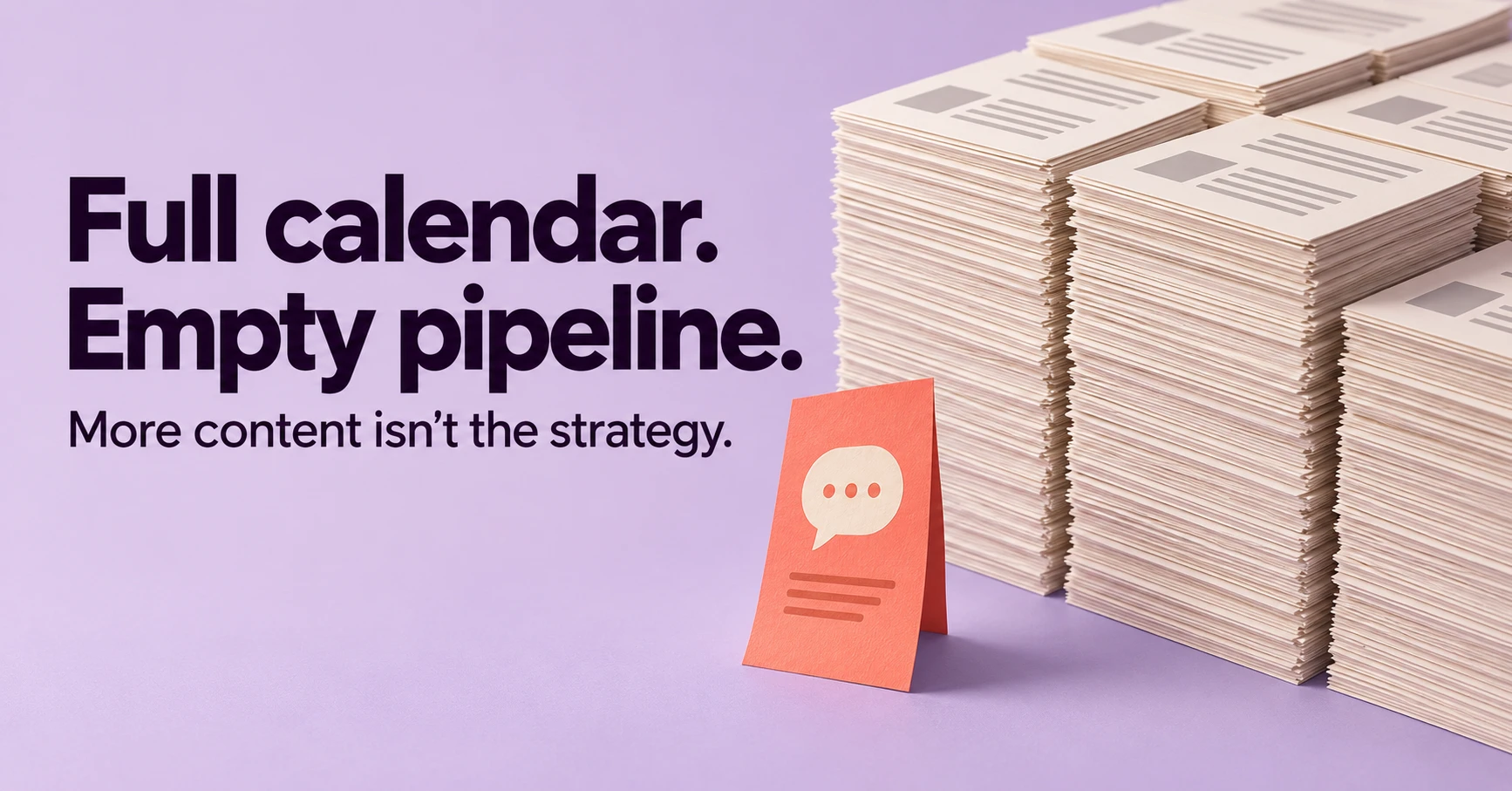
“AI makes content cheap, so make more of it.” If you work in marketing, you’ve probably heard some version of that pitch this year.
Twenty blog posts a month. A landing page for every city. A “Top 10 Tips” article that looks suspiciously like the one your competitor published last Tuesday.
It feels productive. The calendar is full, the dashboard is green, and the pipeline looks exactly the same as it did before.
At WTSFest Philadelphia, Wil Reynolds framed the buying journey in three steps: seen, believed, chosen. Most content strategies are built for step one and quietly hope steps two and three take care of themselves.
Wil had a line for that, too: “You’re not scaling content. You’re scaling disappointment.”
The magic key that doesn’t open anything
There’s no shortage of people selling the “more” answer right now. Agencies, tools, and freelancers are all pitching some version of the same promise: let us produce more content, and we’ll get you more visibility. Some show up with a magic key. A proprietary AI workflow. A secret prompt. A set number of pages per month that’s supposed to change everything.
I get the appeal. More content is easy to buy, easy to measure, and easy to put in a monthly report. But visibility doesn’t come from volume. If it did, every company with a content mill would already own the first page and every AI answer in its category.
What actually builds visibility is less exciting: knowing your customers, saying something worth repeating, and showing up in the places where buyers and AI go looking for proof. No magic key opens that door. It gets built one genuinely useful piece at a time.
Why more content backfires
Wil called it zombie content: pages that exist to be seen, not believed. They’re 100% formulaic, which also means they’re 0% memorable.
His examples stuck with me. Back in 1900, a tire company started publishing a restaurant guide, and the Michelin name became a mental shortcut for quality. People trusted it before they ever tasted the food. On the flip side, he pointed to Banana Republic showing up for “ethical jeans” without many people actually believing it. Plenty of visibility, not much belief.
Whether you’re selling software, insurance, or plumbing repairs, belief is what actually moves someone from browsing to buying.
AI is getting pickier, too. Several WTSFest speakers made the same point from different angles. AI models increasingly favor trusted brands, real expertise, and original information, and they’re filtering out the generic listicles that all start to sound the same. If AI could have written your article, it doesn’t really need to cite it.
Wil’s goal is what he calls hardwiring: becoming the default answer, both in people’s heads and in AI models. That doesn’t come from volume, and it definitely doesn’t happen in a quarter. Volume without quality just trains buyers and AI to scroll right past you.
Your buyers aren’t where your blog is
Here’s the part that gets lost in the “publish more” conversation. Your buyers aren’t sitting on your blog waiting for the next post. They’re asking questions in a lot of different places, and they expect answers wherever they ask.
They’re asking AI tools to compare options and explain how things work. They’re reading reviews, which one study shared at the conference found to be the second most important citation source in AI answers. They’re scrolling Reddit and social for real stories. And when they’re ready to compare, they still visit company websites to check the details.
One speaker summed it up well: people use platforms like Reddit during discovery, then go to individual websites for evaluation. Your content strategy has to meet them at both moments.
That means the question isn’t “how many posts did we publish this month?” It’s “are we showing up with a useful answer where our buyers are actually looking?”
What better, more strategic content looks like
Start with real customer questions, not keyword lists.
Your sales and support teams hear the same questions every single week. Call logs, sales notes, and support tickets are a goldmine. If a question comes up ten times a month, that’s a content topic. If it never comes up, maybe skip the 1,500-word post about it.
Address the fear, not just the product.
People aren’t only searching for features and specs. They’re worried about hidden costs, wasted money, picking the wrong vendor, and looking bad to their boss. The session on reviews and AI trust made a great point: searches carry emotional signals. Content that speaks to the worry tends to land harder than content that just lists features.
Get specific.
“Fast, easy, and hassle-free” is invisible to AI and forgettable to humans. Specific, verifiable details about your products, pricing, and process give both buyers and AI something real to work with (with legal or compliance in the loop if your industry needs it).
Build fewer, deeper pages.
One genuinely helpful page that answers the whole question beats five thin pages that each answer a sliver of it and compete with each other.
Do the unscalable thing.
Wil talked about handing out custom tiles at MozCon, a small gesture people still remember years later. For your brand, that might be a video your subject matter expert actually records themselves, an honest story about a project that almost went sideways, or original data nobody else has. Things a content mill can’t fake.
Echo your customers’ language.
Your customer feedback is full of the exact words people use to describe a great experience. Use them in your headlines, FAQs, and team bios.
A quick gut check before you hit publish
Wil offered one question I love: would it be good if every website did this? If every company in your space published the same AI-generated “5 Things to Know Before You Buy” post, would anyone be better off? If the answer is no, that’s your sign.
A few more worth asking:
- Does this answer a question a real customer has actually asked us?
- Would our sales team be proud to send this to a prospect?
- Does it say something our competitors can’t, or won’t?
- Will it show up where our buyers are looking, not just on our blog?
- Would it still be useful a year from now?
If a piece can’t pass at least a few of these, it’s probably adding to the pile instead of standing out from it.
Better, not more
AI made content cheap. It didn’t make trust cheap.
The brands that win the next few years probably won’t be the ones publishing the most. They’ll be the ones publishing the right things, in the right places, in a way that sounds like a real person who actually knows the business.
So before you add another 50 posts to the calendar, ask what your customers really need to hear, and where they’re looking when they need to hear it.
Let’s make your content work harder.
At RankWriters, we help brands build visibility by publishing less and making it count: content built around real customer questions and designed to show up where buyers and AI are looking. If your content calendar is full but your pipeline doesn’t show it, send me a message. We are always happy to take a look and talk it through.
